The Night the Valley Hummed
The fox woke to the sound that hummed like an old radio caught between stations. It was not the same bright song of summer; it was lower, a long, distant drum that rolled across the hills and made the grass lean as if listening. Fox had a coat the colour of warm sand and eyes that kept careful watch. He lived near a brook where moonlight made tiny bridges of silver and where sparrows practiced their morning chatter. That night the brook looked pale and thoughtful.
Fox padded outside because he could not imagine leaving a hum alone. On the path he met Old Crow, who had left his favourite branch and also his nest because the wind of worry had whispered too close. "There is thunder in the valley," Old Crow cawed softly. "Not the loud summer thunder, but human thunder. It scares my feathered friends." His voice was not sharp; it was the voice of someone who had seen many seasons and kept a pocket of calm for the days that needed it.
Fox listened. He could not understand the exact words in the drum, but he felt the meaning: people and families in the next valley were frightened. Fox knew this valley had bridges and markets and a school where the children drew suns and big, clumsy boats. He remembered how laughter looked when it moved freely between houses. He thought, as foxes often do, that if a sound could be heard, then something could be done.
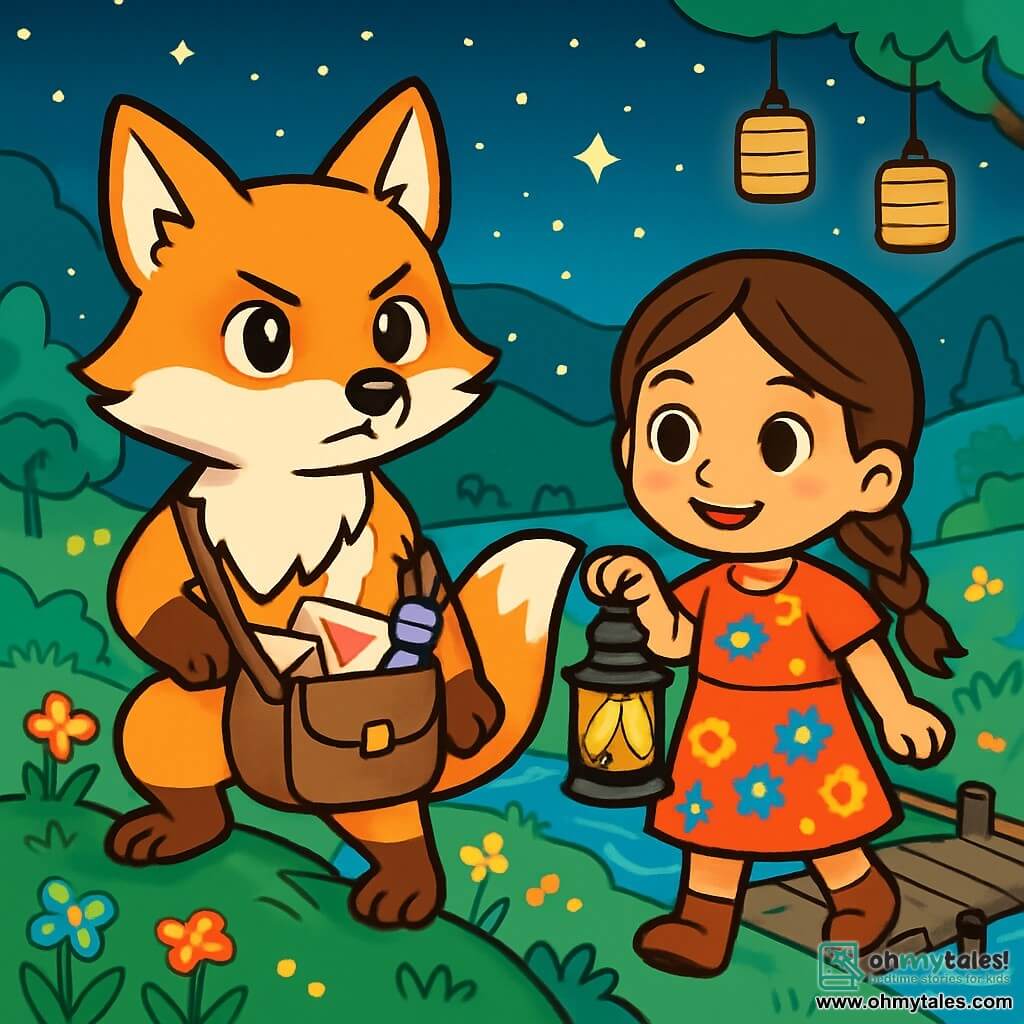
Fox fetched his satchel, an old woven thing lined with linen, and packed a soft scarf for himself, a small loaf of bread, a jar of honey, and a bright cloth to wave like a little flag. He put on a narrow lantern, because light is good for finding paths, and out he went with the low hum in his ears and a steady heart under his ribs.
He walked along the ridge, and below him the next valley had a breath that looked uneven. There were lights, yes, but they blinked uncertainly, like sailors unsure how to tie a knot. People moved with boxes and blankets. A boy carried a rabbit in a small basket. A woman balanced a pot and sang under her breath. Fox could see some things unraveling and others being tied again. There were no screams or flames in the places Fox watched; the hum was a heavy worry that pressed on everyone's shoulders. Fox thought of bridges.
Bridges were his kind of problem. Not the iron ones that grow strong from bolts and plans, but the small ones that bend with kindness: a cup of tea given at the right moment, a hand offered across a step, a warm voice in the dark. Fox believed these were enough to begin.
He slipped down into the valley like a little question, careful not to startle anyone. Children peered from behind curtains, and a dog with one ear up watched Fox like a polite guard. A woman with tired eyes noticed him and gave a tiny smile that Fox returned. She pointed to a field where a narrow wooden bridge had been broken into pieces, like a puzzle scattered by wind. People crossed a different path, clambering over stones, but their baskets were heavy and their faces heavy too.
Fox climbed onto a stump near the broken bridge and tapped his satchel twice, an old fox trick to say, I am here and I bring what I can. One of the children, a girl with a crooked braid and a stubborn chin, came forward. Her name was Lila. She had found a tiny tin soldier and a yellow pencil in the grass and kept them carefully in her pocket like a secret.
"You should go home," Lila said, more like advice than command. "Things are hard. Grown-ups say strange things."
Fox looked at her with his sand-coloured eyes and tilted his head. He did not speak like humans, except sometimes in the squeak of a sentence when it mattered, so instead he placed the bright cloth on the stump and pawed the ground gently. The cloth was a cheerful thing and felt like a promise.
Lila looked at the cloth and then at the broken planks, then at the people who were helping each other make a path. She thought about the tin soldier in her pocket and the pencil that made bold suns. A bridge can be more than wood, she decided, and took Fox's cloth.
The first important thing had happened: a stranger who looked like an animal had offered something small, and a child had accepted. It was not a dramatic rescue or a flashy spell. It was an exchange of trust.
The Letters of Light
Fox and Lila walked together toward the centre of the valley where a small group had gathered by the old schoolhouse. The school smelled of dust and crayons and stories. Its windows were marked with hands drawn in white paint, where once the children had painted suns and boats. Now some windows were covered and patched with cloth. A teacher named Mr. Ivo stood with his arms folded and his voice low but steady. He welcomed visitors with a line in his face that said, I will help find a way.
"People are scared of the ringing," Mr. Ivo told Fox and Lila. "They don't understand why things happen. We need to talk. We need to listen."
Fox watched the grown-ups use words like listen and talk as if they were tools. He remembered how rabbits listened to the wind for storms and how sparrows listened for the first barley. Listening could make a place softer.
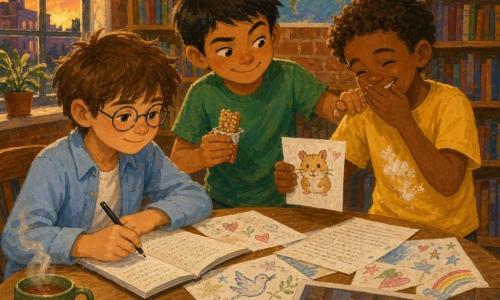
Mr. Ivo sat at a small table and placed a stack of paper in front of him. The paper was plain, but each piece had a small drawing of a dove in the corner. "Letters of Light," he said, and his smile was a slow sun. "We will write notes for anyone who is worried. We will put them where people can find them. A kind word can be a map back to calm."
Lila's eyes widened. She loved drawing. She took a paper and carefully drew a little house and a tree, a sun smudged with a thumb. Fox watched, and when Lila looked at him for inspiration, he tapped the jar of honey in his satchel and pointed to the warm yellow. Lila dipped her finger and spread a small smear of gold on the corner of her paper, like a lamp.
"I'll take these to the fields," Fox thought, and his lantern flickered as if nodding. He could not read, but he knew how to carry things. Mr. Ivo tied the notes in little bundles with string and asked for volunteers. People with blankets and grown-ups with quiet voices stepped forward. Fox sat very still with the satchel between his paws, and Lila slid a bundle into his bag with a look that said, Please.
"Remember," Mr. Ivo called gently, "if someone is crying or looks worried, invite them to speak with a grown-up they trust. Tell them it's okay to tell someone."
Fox felt that was an important instruction. He was not a grown-up, but he had friends who listened well. So he began his route.
He slipped through hedges and along the backs of houses where the moon painted everything silver. He left a note tucked under a stone by the well and another stuck into the pocket of a coat hanging on a fence post. He set a note on the windowsill of the bakery where the smell of bread still made people breathe deeper. Each note was small and simple: "There is a light near you. Speak to someone you trust. You are not alone." Fox imagined the notes like tiny lanterns, each one with a wick of kind language.
On his way he found a little boy sitting on a step with his chin in his hands, staring at the road as if it might fold up and leave. Fox placed a note beside him and nudged his coat with his nose. The boy looked surprised and then smiled, the way someone smiles when they remember a song. He stood and ran to the schoolhouse where Mr. Ivo was talking gently to a mother. Fox watched the two join hands, and the hum that had once felt like a drum softened a bit, like rain easing from a heavy sky.
Word began to move like a gentle stream. Families gathered in small groups. People spoke softly about plans and routes and what to do if worry arrived. The letters of light were not a solution to the whole valley's trouble, but they were the beginning of something sturdy: conversation. And conversation is often where bridges grow.
The Patchwork Bridge
In the next week, the valley learned to mend other things. A wooden bridge needed planks. A roof needed covering. A toy rabbit needed a stitch. Fox was good at mending in his own way. He fetched scarves and ropes and little tools people left out. Craftspeople and neighbours worked side by side, and laughter slipped in between tasks like bright thread.
The biggest problem remained the river. It cut the valley in two like a long, quiet line, and when people crossed they carried heavy loads and heavy worries. The old bridge could not be used; it had been hurt. No one wanted to cross alone.
One morning, as fog sat low like a shy cat, Fox found the children building a small raft from some planks and a few empty barrels. They pushed it into the water with a squeaky cheer. "We can float across!" someone shouted. It bobbed and drifted, carrying a pile of blankets. But it needed more. They needed to guide it, and they needed trust.
Fox decided to build a patchwork bridge — not a great stone construction, but a series of stepping places and ropes tied by hands that trusted each other. He could see the idea like stitches in a quilt. He ran from house to house gathering planks, ropes, a long ladder, even an old bicycle wheel that could be turned into a pulley. People watched a fox gather tools with careful paws and a serious look, and their smiles were curious, then determined.
An elderly woman named Grandma Mari found a roll of faded fabric and called neighbours. "We have to make a path that people feel safe to use," she said. "We will do it together."
They tied planks to stout trees on either bank and laid rope handrails. Children wove bright cloth around the ropes so the bridge would look friendly. Fox scampered along like a small engineer, nudging a board into place, holding a piece of rope with his teeth when no one else could fetch it quickly. He had no hands, but he had a steady body and a way of looking at things that made people move as if the plan were already done.
There was a moment, near noon, when the bridge seemed wobbly and the clouds formed a low ceiling of thought. A man carrying a box stopped halfway across and looked down. He was afraid of falling more than the boxes he held. Fox sat on the near bank and made a small sound, a soft question. The man met the fox's eyes and, with a slow breath, looked to where children and neighbours stood with outstretched hands.
"You can hold my hand," Lila offered, stepping forward. "I'll go with you."
The man smiled like a door slowly opening. He reached for Lila's hand and for the rope. If anyone needed help first, it was the one who felt unsure. Across the river, they found other hands waiting, and the crossing became a rhythm: step, hold, breathe. The patchwork bridge was not perfect, but it was woven with care.
By the time the sun leaned toward afternoon, the bridge had gathered a line of people carrying bread and blankets and photographs wrapped in tissue. They moved slowly, with conversations that were sometimes quiet and sometimes tinged with humour. People shared small jokes about who had the worst socks. Fox led the last crossing, his lantern now a sun-shaped coin stitched by Lila into his collar.
On the far bank, children had left paper doves hanging from branches. They fluttered like soft thoughts, and Fox watched them and felt his chest warm. Each dove had a wish tied to it: for safety, for reunions, for the bakery to smell clean again. The valley had been shaken by thunderlike sounds, but it was being pieced together by hands and small, steady lights.
The Night of the Lanterns
One night, when the moon was a thin silver smile, the valley organised a vigil. People left their windows open and set lanterns on doorsteps. The hum had not gone away entirely; sometimes it returned like a distant memory. But the valley had learned to place lights where they could see them. A little flame can be a brave thing.
Fox walked between houses, carrying a lantern that Mr. Ivo had fixed with a new glass. He thought about how lights lead the way and how shadows can be less frightening when a lamp is nearby. He came upon a small group gathered in the square: a woman rocking a baby, an elderly man who had fixed the police bell years ago, and Lila with her braid tucked into a wool hat. They formed a circle of people who smiled with tired kindness.
Mr. Ivo stood and spoke softly. "Tonight we remember," he said. "We also promise to speak and to listen. If you feel afraid, find a grown-up you trust. Tell them your worry, and they will help you carry it."
Fox watched as families joined the circle, and he felt something like a tide of relief. The people placed candles on the ground, and children released paper doves into the quiet air. The doves sailed like small white ships. Some hovered and dipped back down, as if the wind had questions, but many rose and found the stars.
There was a little boy who had been very quiet since the hum started. He had once loved counting the steps in his yard and lining up pebbles like a small army. He sat on the edge of the square holding a stone and looking at it as if it might whisper the secret of being brave. Fox sidled up and bumped the stone with his nose. The boy smiled and handed the stone to Fox, then stood up and joined the circle because he had been offered a small, safe place.
Halfway through the night a firefly landed on Fox's lantern and blinked in an odd, patient code. Fox thought of how light could be given and taken. He looked up at the sky where stars watched from very far away, and he imagined the stars as old friends who had seen the valley through many seasons. The vigil was not a cure-all, but it was a promise: when the nights were hard, there would be light. And there would be people to talk to.
Fox sat with the group and listened to stories of small kindnesses: a neighbour delivering soup, children drawing new games, a gardener who planted seeds in old pots to make a row of green where there had once been silence. The tales were like soft patches sewn onto the quilt of the valley. Each one made the hum seem less like an endless drum and more like a single sound that could be understood, talked about, and soothed.
When it was time to go, Fox curled beneath a low tree and watched the lanterns burn like small, friendly moons. He felt the valley breathe differently, as if its ribs had learned to let air in without trembling.
New Shoots, New Bridges
Spring came slowly, like a coverlet pulled up a few inches every morning. The valley regained its colours in shy streaks: a rowan with brave red berries, crocuses popping through the earth like tiny suns, and the river that now carried little boats of paper where once it had been only a divider.
People returned to their routines in the way people always do: carefully, with attention and new rules. Children went back to school and drew bigger suns than before. Fox watched them, proud. He had no book to sign his name in, but if there had been a page, it would have shown a fox-shaped pawprint of effort.
One clear morning, the community gathered at the riverbank with young trees and small shovels. They planted saplings in a row to make a living fence that would keep the soil close and the wind kind. Fox had helped carry a tiny tree stump with determined nibbling and careful pawing. He liked the idea that trees would grow while people told each other stories.
As they dug, Mr. Ivo read a short note aloud from a neighbour who had gone away for a while and sent a message: "We build bridges with our hands and with our words. We plant trees to remember. We will speak when we have worries, and we will listen when others do."
Lila tied a ribbon around the tallest sprout and whispered, "For our future," which was a phrase full of hope because it included both the unknown and the plan to keep on.
Fox sat in the grass, his tail curled like a sleeping question mark, and watched the children release more paper doves into the clear air. They went up and up, carried by a breeze that smelled faintly of bread and paint. Each dove carried a tiny wish: for calm, for a friend to return, for the bakery to be warm again. Fox thought the doves were like small messages to the stars, and the stars blinked in reply as if saying, We see you.
The moral of their work was soft but clear. Wars and conflicts, Fox thought, were like storms that could bruise a place and make it hard to breathe. But people who care for each other can mend what is broken by listening, by making safe places to speak, and by building bridges—both the ones you can walk on and the ones made of courage and kindness. Fox had no big speech to deliver. He had small, steady steps and the understanding that one fox, a child, a teacher, and a whole valley could keep working together.
That night, after the planting and the chorus of birds that seemed to enjoy a tidy field, Fox curled in his den with his satchel by his side. The lantern was dim on a nearby stone, and outside the window of the school, the paper doves still swung gently in the breeze like lullabies. Fox's heartbeat was calm. He listened to the valley breathe, which now sounded like a quilt being smoothed.
A soft sound came from the path — the boy who had once sat with the stone came to say good night. He placed a small pebble on Fox's satchel, the same pebble he had held when he was finding his courage. "Thank you," he whispered, as if thanking a friend who did what friends do: give light when it is dark, and a listening ear when it is needed.
Fox closed his eyes and thought of bridges, lanterns, letters, doves, and seedlings. He thought of how the hum had transformed into a humbler sound and how the valley had learned to gather and speak. He dreamed of the new trees, the steady hands, and the people who would keep their promises to listen.
If you ever find yourself hearing a drumlike worry, Fox would have said if he could speak in human words, go find a grown-up you trust. Tell them about the sound. Hold a hand, write a note, light a lantern. Build a small bridge with someone. Be patient. And remember that small things — a piece of bread, a bright cloth, a paper dove — can be seeds that make a field of light.
The valley slept under its new sky, and the fox dreamed of moonlight bridges and doves that carried little pieces of hope. Into the soft night the message whispered, like a comfortable blanket: in hard times, kindness and conversation are the best tools. When people listen, they begin to heal. When children and grown-ups speak together, bridges grow. The world can knit itself again with gentle stitches.
And so the fox slept, curled and content, while faint stars watched like old friends, and the valley hummed — not with fear, but with the slow, steady sound of folks doing what they could and talking about it together.