Chapter 1: The Quiet Shelf
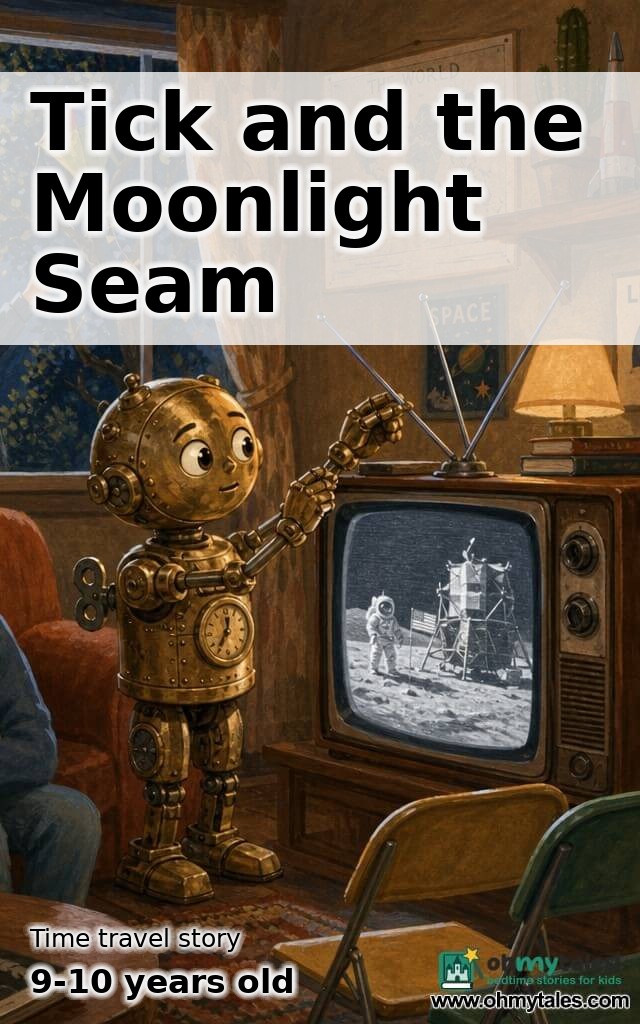
Tick had a glossy face and tiny brass hands that liked to tick in steady, thoughtful rhythms. Tick lived on a high wooden shelf in a small room full of maps, notebooks, and a cactus that always seemed a little surprised. Tick loved two things: careful thinking and the smell of old paper.
One afternoon, a light flicked through the curtains and landed on a thin seam in the wall. The seam was like a secret bead of silver. Tick had seen many seams. This one hummed like a quiet bell.
Tick inched forward and touched the seam with a cautious hand. It was warm. A soft voice pulsed, like a radio tuning itself. The seam opened like a pocket in time, and behind it was a doorway full of blue and grainy images—black-and-white faces, a rocket rising like a mountain, and a crowd of people clapping. Tick's tick slowed. Curiosity rose like steam.
“It might be odd,” said Tick aloud, voice a polite chime. “It might be safe, if I think carefully.”
Tick checked three small rules kept on the inside of its lid: observe, ask questions, do no harm. With a deep breath that sounded like a tiny spring uncoiling, Tick slid through the seam and stepped into a living room that smelled of coffee and new television.
Chapter 2: The Night of the Moon
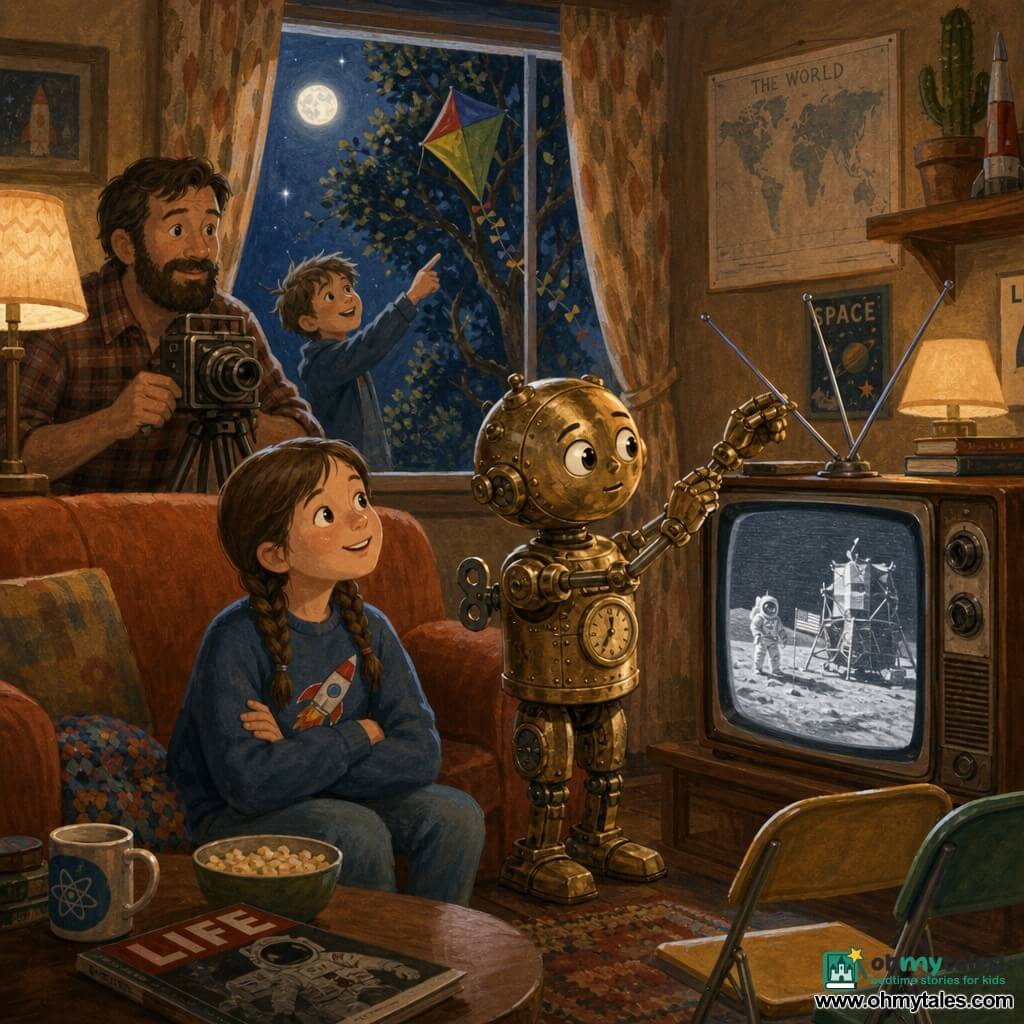
The room was loud in a gentle way. Folks in dresses and plaid shirts sat on fold-out chairs and cushions. A boxy television glowed with static, then cleared into the grainy white of a rocket on a launch pad. A man with a thin mustache spoke in a calm voice. People leaned forward. Children clapped when they weren't told to be quiet.
Tick kept to the edge of the room, peering over a newspaper. A girl nearest the window had hair in two braids and wore sneakers that looked shiny in the lamp light. She had a sticker of a tiny rocket on her sweater. Her name was June, and she was chewing gum with serious thoughtfulness.
“They say the moon will know a new kind of footprint tonight,” June said, more to herself than anyone. She noticed Tick's shiny face. “Well, hello. Are you from the future?”
Tick blinked, which for Tick felt like a small, polite reset. “I'm here to listen and learn,” Tick replied. “I mean no trouble.”
June grinned. “Good. We need witnesses. The world will watch. My dad is recording it.” She pointed at a bulky camera on a tripod. “You should watch. It's like a book you can't close.”
The television voice counted numbers. The room went quiet like a bowl holding water. Tick watched the screen. The rocket trembled, rose, and climbed. The hearts in the room climbed a little too.
Then, midway through the broadcast, the screen flickered. Lines crossed the picture. The camera sheepishly sputtered. The room held its breath. Someone said, “Not now,” as if the stars themselves might be embarrassed.
June's father rummaged behind the television. “It's a bad antenna,” he muttered. “If we lose this, folks won't see them step down.”
A small, sharp worry nibbed at Tick. A thought landed: If the broadcast failed, would people forget how brave the moment felt? Would doubts spread? Tick felt the rules in its lid hum louder. Observe. Ask questions. Do no harm.
“Maybe the antenna needs to be pointed,” Tick suggested. “Could I try looking at where the signal comes from?”
June blinked. “You can do that? You look... precise.”
Tick liked being called precise. It checked the tripod's cables with a tiny hand and listened to the hum of static. The signal made a pattern like waves in a pond. Tick shifted a piece of tin behind the antenna. The picture steadied.
The room sighed with relief. On the screen, two small dark shapes landed and a white dot became an even smaller dark boot print on a huge bright rock. The room erupted into applause that sounded like a storm of friendly pebbles.
Tick watched the faces glow. People were cheering for bravery and for a moment that showed how much careful planning and many small steps could add up to a giant leap. Tick's brass hands rocked with joy.
Chapter 3: A Paradox and a Promise
After the cheering, a man with a newspaper hat said something that twitched at Tick's gears. “If the broadcast had failed, would it have changed history?” he wondered aloud. “Would we have done things differently?”
Those were big questions. Tick felt a little squabble between excitement and caution. June asked, “Could we go back and... change it if something went wrong?”
Tick remembered the rule that fluttered like a bookmark: do no harm. Time was like a long river with stones that couldn't always be moved. Little hands might stir it up, but big waves could be dangerous.
“I think we should be careful,” Tick said. “We can learn by watching and asking. And we can help where things are small and safe—like fixing an antenna. Changing big events might make other things wobble.”
A man across the room frowned. He remembered a science fiction show where people zipped in and out of big events and made fireworks of possibilities. “But if we could save someone or stop something bad...”
June put her hand on the man's sleeve. “We can be brave here. Bravery can be small and honest.” She looked at Tick as if Tick were a tiny captain. “We can share what we saw. That's changing things by telling the truth, not by sneaking in and altering the past.”
Everyone hummed. The idea was soft and true. They agreed: witness, record, and be careful. That was a good plan. Tick felt pride like a warm battery.
Then a child in the corner cried because his kite had flown away outside. It had snagged on a nearby tree and was flapping like a white flag. June ran, Tick at her heels. The night air smelled of cold metal and the distant rocket smell that still lingered like a whispered secret.
At the tree, a small problem needed a small solution. The kite was stuck between two branches. June climbed with cautious steps. Tick offered a steadying touch. Together, they freed the kite and the boy grinned so wide his cheeks made two small hills.
No history shifted. No enormous paradox opened. Just a kite saved, a party kept cheerful, and some new friends who promised to remember what they saw.
Chapter 4: The Return and the Sticker
As the evening wound down, the people gathered around the television one last time. The moonwalkers waved from a dusty place far away. The room felt like a pocket of light in a long night. June's father rewound a spool and labeled it by hand with careful letters.
Tick felt its own hands slow. The seam in the wall had a soft glow again. Voices thanked one another. June pressed a small, round sticker into Tick's palm. It was shiny and said, in bright letters, "I SAW THE MOON."
“You should keep that,” June said. “So you don't forget what careful watching can do.”
Tick held the sticker and thought of rules, antennas, sticky kites, and the steady climb of rockets. It felt full, as if the little brass belly had swallowed a whole constellation.
Tick stepped back through the seam. The room on the shelf was the same, with the cactus looking politely surprised. The world smelled of the same old paper. Tick placed the sticker on the inside of its lid where the rules sat. The sticker stuck on top of the list like a promise.
Tick checked the three rules once more: observe, ask questions, do no harm. Then it snapped its lid closed. The tick inside sounded steady and content. Tick had seen the moon, had kept time, and had learned that curiosity is brave when mixed with careful thinking.
And when sometimes the wind shook the curtains and a tiny silver seam hummed, Tick would lift its lid, tap the sticker, and smile. The sticker wasn't just a keepsake. It was a little reminder that watching, asking, and helping were ways to be a small, good kind of brave.