Chapter 1: The Lunchbox That Tick-Tocked
Noah always packed his lunch like it was a treasure chest. He liked neat apple slices, a sandwich cut into triangles, and one “mystery item” that changed every day.
Maya, his best friend, liked mysteries too. She was the kind of kid who read signs out loud, just in case the signs had secrets.
That afternoon, they stayed after school to help Mr. Lyle clean the science room. Mr. Lyle was friendly and messy in the same way a puppy is friendly and messy.
“Be careful with the back cabinet,” Mr. Lyle said. “It's… old.”
Old was an interesting word. Old meant stories. Old meant secrets.
Maya leaned in. “What's in it?”
“Mostly dust,” Mr. Lyle said, smiling, “and a few things that should not be dropped.”
Noah promised not to drop anything. Maya promised too, but she crossed her fingers behind her back, not because she planned to drop things—only because she liked the feeling of making a promise extra dramatic.
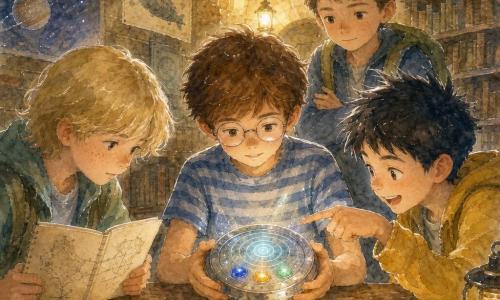
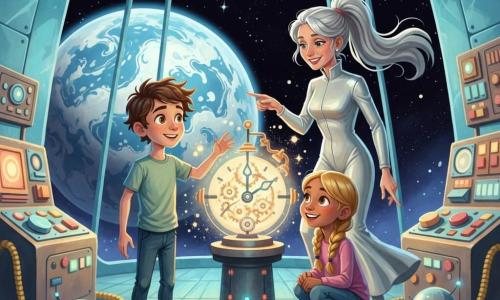
Inside the cabinet was a strange metal box about the size of a lunchbox. It had a handle, a round dial, and a small window where a thin line of light moved like a tiny comet.
A label was stuck to the top: DO NOT SET TO “TOMORROW” WITHOUT ADULT.
Maya read it aloud. “That sounds like a challenge.”
Noah looked at the dial. It had markings: YESTERDAY, TODAY, TOMORROW, and then, in tiny letters that looked like they were trying to hide, FAR.
Mr. Lyle turned away to wrestle a stack of papers. “You two dust the shelves,” he called, already losing his battle.
Maya and Noah stood very still. The box sat very still too, but it felt like it was listening.
Noah whispered, “We should not.”
Maya whispered back, “We should definitely not… but what if we only look?”
Noah's curiosity was like a puppy on a leash. It pulled. It pulled hard.
He picked up the box. It was warm, like it had been in the sun, even though it had been in a dark cabinet.
The tiny comet of light in the window sped up.
Maya pointed. “It's doing something.”
Noah's finger found the dial. It clicked gently, like a polite clock clearing its throat.
The dial slipped past TODAY.
It went to TOMORROW.
Then—because the click was so smooth and the label was so bossy—Noah nudged it one more tiny bit.
It landed on FAR.
The metal box hummed. Not a scary hum. A busy hum, like a bee that had found a job.
Maya grabbed Noah's sleeve. “Noah?”
The science room stretched, as if the air itself yawned. The shelves wobbled. The posters of planets rippled like pond water.
Noah tried to turn the dial back, but the box felt heavier, as if it had decided to stay put.
The humming became a bright whoosh.
And then the whole room blinked.
Chapter 2: The City That Breathed Cool Air
Noah and Maya landed on soft sand.
Not beach sand with salty wind. This sand was fine and pale, like sugar. Above them, the sky was blue, and the sun was hot, but the air around their faces was cool.
Maya sat up, patting her hair. “Are we… in a giant sandbox?”
Noah blinked. “Where's the school?”
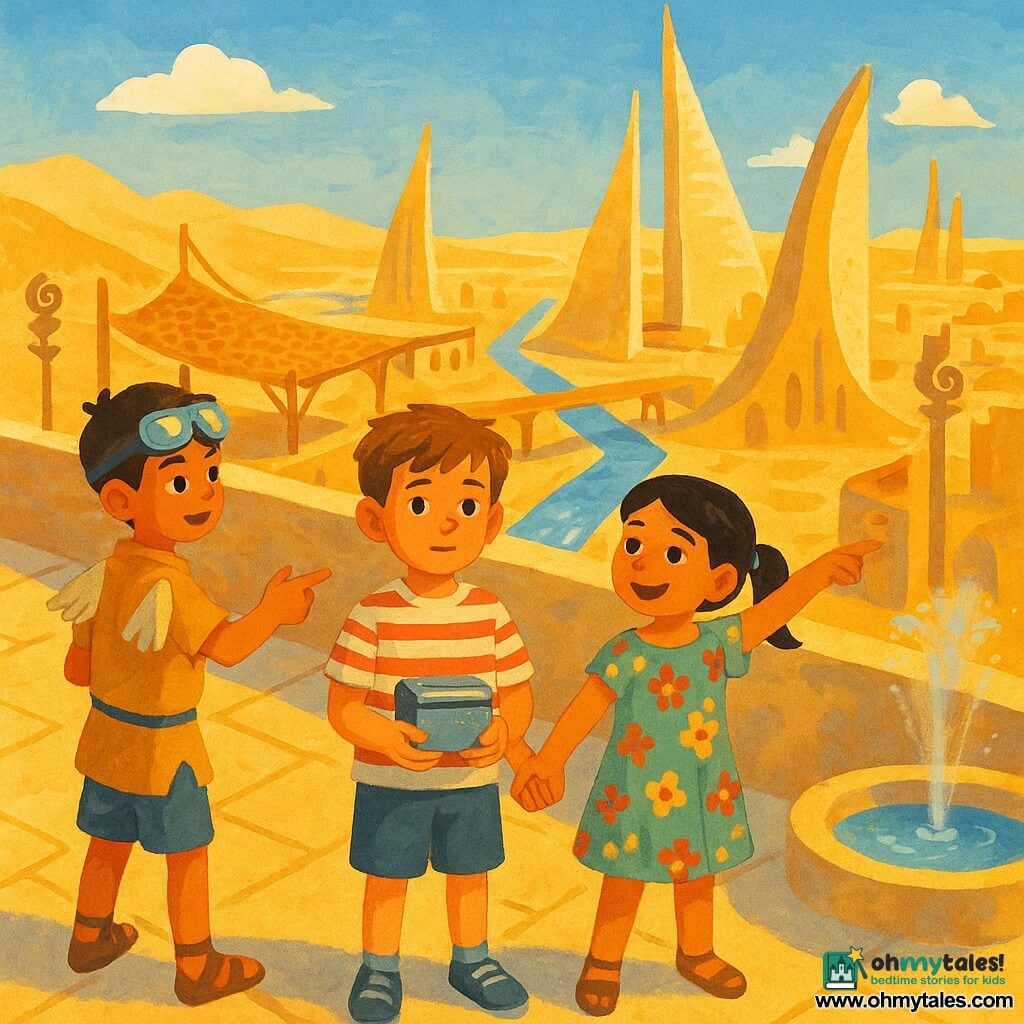
Behind them was a building made of smooth stone that curved like a shell. In front of them rose a city of tall towers shaped like sails. Between the towers ran long, shaded walkways.
And everywhere—everywhere—there were wind-catchers. They were like tall chimneys with open mouths, turned toward the breeze.
As the wind slid in, it flowed down into the streets. Noah could feel it: a natural air-conditioning made of clever shapes, shade, and moving air.
A kid about their age rolled up on something like a skateboard, but with a small fan underneath that whispered instead of roaring.
He wore light clothes and had goggles pushed up on his forehead. He stopped close enough to look curious but not close enough to be rude.
“You look freshly dropped,” he said.
Maya raised a hand like she was in class. “We didn't mean to drop.”
The boy grinned. “I'm Zed. Welcome to Dunehaven.”
Noah swallowed. “What year is it?”
Zed tilted his head. “That's a fun question. It's Year 312… of the Cool Wind Project.”
Maya whispered, “We're in the future.”
Zed watched their faces and nodded as if he had seen this before. “Time-slip kids. It happens sometimes near old science buildings. Your box looks like a jump-luncher.”
Noah held up the metal box. The comet-light in the window was calm now, like it had finished running.
“It's not ours,” Noah said quickly. “We were just—”
“Curious,” Maya finished, because it was the truth and also her favorite word.
Zed pointed down the nearest street. “Come on. The air is cooler in the shade. And you should see the Water Ribbons. They're the best thing we built after we stopped pretending we could drink sunlight.”
Maya's eyes widened. “You can't drink sunlight?”
Zed shrugged. “Not in a way that tastes good.”
They followed him along a walkway covered by woven panels. Above, the wind-catchers guided the breeze like giant hands. Every so often, a small fountain misted the air, and the wind carried it in gentle clouds.
Noah felt amazed and a little silly. The future wasn't full of flying cars and laser shoes. It was full of smart shade, wind, and water—things that made sense.
“It's like the city is breathing,” he said.
Zed smiled. “That's what my grandma says. Dunehaven inhales wind and exhales cool.”
They reached a long channel where water flowed in thin, shiny streams along the sides of the path. People dipped cloths in it to cool their necks. Plants grew in pockets of soil beside the water, green and stubborn.
Maya crouched and touched the stream. “It's cold!”
Zed nodded proudly. “Underground pipes. We keep the water shaded and moving. Sun on top, cool below. We learned that heat is a rule, not a villain.”
Noah turned the metal box over. On the bottom was a tiny engraving he hadn't seen before:
TIME IS A PATH. STAY ON IT.
He tried not to gulp. “Zed… how do we go back?”
Zed's grin faded into a thoughtful look. “Usually, you find the anchor. Time slips like to snap back to the moment that started them. But… don't mess with the path. You can look. You can learn. You should not try to fix things you don't understand.”
Maya nodded fast. “We're really good at not fixing.”
Noah coughed. “Sometimes.”
Zed chuckled. “Come on. The timekeeping tower might help. And also, it has the best view of the sand-sailing race.”
That sounded like two helpful reasons and one very tempting one.
They hurried along the cool, breathing city.
Chapter 3: The Mischievous Paradox
The timekeeping tower stood on a hill of packed sand, smooth as a bowl. Its sides were made of pale stone that sparkled. At the top, a ring of wind-catchers gathered breeze and sent it down through hollow walls.
Inside, the tower was quiet. Not empty-quiet—thinking-quiet. There were clocks, but not the kind Noah knew. These clocks showed shadows, water drops, and even a spiral of sand that turned steadily like a slow dance.
A woman in a light coat sat at a desk. Her hair was silver, and her eyes were sharp in a kind way.
Zed waved. “Archivist Suri! I found two time-slip kids.”
Suri looked up and took one look at the metal box. “Oh dear. A jump-luncher. I haven't seen one in years.”
Noah held it out carefully, like it might sneeze. “We didn't mean to go far.”
Suri's mouth twitched. “No one ever means to. Curiosity is a fine wind, but it can blow you off the path if you don't watch your feet.”
Maya leaned in. “Can you help us go back to today?”
“Yes,” Suri said, “but first we must make sure you haven't made a knot in time.”
Noah frowned. “A knot?”
Suri lifted a small bowl of sand from her desk. She tipped it gently. The sand flowed in a smooth stream.
“Time,” she said, “is like sand. It moves forward. You can step in it, but you can't grab it and shove it into yesterday without trouble.”
Maya nodded. “So we shouldn't change things.”
“Exactly,” Suri said. “Now, the paradox check.”
She opened a drawer and pulled out a thin tablet. On its screen was… Noah.
Noah froze. The Noah on the screen was standing in the science room cabinet area, holding the metal box.
But the Noah on the screen—screen-Noah—looked up and smiled as if he could see through time.
Then screen-Noah lifted his finger and very clearly pointed at the dial.
He mouthed something. The tablet had no sound, but the message was somehow obvious.
Go to FAR.
Maya's eyes went wide. “That's you telling you!”
Noah felt his stomach do a little flip. “But I didn't— I mean, I don't remember—”
Zed whistled softly. “That's a loop.”
Suri tapped the tablet. “A mischievous little loop. It means the push came from you, in a different moment.”
Noah's face grew hot. “So it was my fault?”
Suri shook her head. “Not fault. Cause. And now you must be careful not to become a bigger cause.”
Maya crossed her arms. “Time is bossy.”
“Time is fair,” Suri said. “It gives rules. You can learn the rules and still have fun.”
Noah stared at the metal box. “Why would I tell myself to do it?”
Suri's eyes softened. “Usually because you learned something you needed, and you wanted to make sure you did.”
Maya bounced on her toes. “So we're supposed to be here.”
Zed grinned again. “Or at least, you already were.”
Suri stood and walked to a tall cabinet. She opened it, and inside were objects sealed in clear cases: old books, cracked goggles, a tiny toy dinosaur, and—Noah squinted—a familiar metal box with a label.
DO NOT SET TO “TOMORROW” WITHOUT ADULT.
Suri held up the case with the box like Noah's. “This is our jump-luncher. It was found long ago. We keep it safe.”
Noah looked at the one in his hands. “So… there are two?”
Suri nodded. “For a moment, yes. That is allowed, as long as you don't let them meet.”
Maya whispered, “Like cats in a bag.”
“Like magnets,” Zed corrected. “They'd pull and snap and make a mess.”
Suri led them toward the tower's top platform. “You came at a good time. The city council is about to decide whether to expand the Cool Wind Project to the outer dunes. They need a small reminder from the past.”
Noah's heart thumped. “A reminder?”
Suri turned to them. “A simple one. Not a change. A memory.”
Maya's voice was quiet. “What memory?”
Suri smiled. “That cleverness begins with curiosity—and continues with kindness.”
Zed pushed his goggles up. “And with not wasting water.”
Maya looked at Noah. Noah looked at Maya.
Noah swallowed. “Okay. What do we do?”
Suri pointed to a long, shaded balcony where the whole city shimmered: sails of towers, ribbons of water, wind-catchers catching the invisible.
“Tell them,” she said, “what you see. Tell them what it feels like. The future listens best to fresh eyes.”
Chapter 4: The Sand-Sailing Race and the Lesson
The balcony filled with people. Some wore badges made of polished stone. Others carried small fans or water flasks. A few kids climbed onto the railings until an adult gave them The Look.
Below, on a wide stretch of dunes, sand-sailers lined up. Each was a light board with a curved sail. The sails were pale and strong, catching wind like giant leaves.
A bell rang. The racers shot forward, gliding over sand as if it were a frozen sea.
Maya gasped. “That is the coolest thing I have ever seen.”
Zed grinned. “You should see the advanced league. They argue with the wind like it owes them money.”
Noah tried to focus. Suri had said: a reminder, not a change.
A council member, tall and serious, stepped forward. “We will vote on expanding the wind-catchers. Some say it is too costly. Some say the old parts of the city are enough.”
Suri nodded to Noah and Maya. “Now.”
Noah stepped forward, hands sweaty around the metal box. He looked out at Dunehaven. He noticed small things: the shade panels woven carefully, the way fountains misted only in certain places, the way people shared water without fuss.
He spoke in short, steady bursts. “Where we come from, it's easy to forget what makes air feel good. Here, it feels like the city is helping everyone, all the time. The cool isn't magic. It's choices.”
Maya added, “And the choices are… kind. The shade is for everyone. The water ribbons are for everyone. It's like you built comfort without stealing it from someone else.”
The serious council member blinked, as if those words had landed gently but firmly.
A younger council member laughed softly. “They sound like tiny teachers.”
Maya whispered, “I prefer ‘time-traveling advisers.'”
Zed snorted.
Noah continued, “If you expand, maybe remember the rule we saw everywhere: move air, protect water, share shade. It works because you keep it simple.”
Suri watched the council carefully. She didn't look like she was trying to push them. She looked like she was holding a lantern so they could see their own path.
The serious council member nodded slowly. “A reminder from fresh eyes is welcome.”
The crowd murmured in approval. Above them, the wind-catchers hummed as they guided the breeze down. It sounded like a city breathing in and out.
The sand-sailing race ended with a spray of pale sand. The winner lifted both arms and nearly fell off the board. Everyone cheered anyway.
Maya clapped. “I would fall off immediately.”
Zed said, “That's the traditional first lesson.”
Suri took Noah aside. “You did well. You described, not demanded. That is how you respect time.”
Noah looked down at the metal box. “So now we can go back?”
Suri's eyes crinkled. “Nearly. First, we must close your loop.”
Maya leaned in. “The part where Noah tells Noah?”
Suri nodded. “A small message. The exact push. No more.”
Noah gulped. “How?”
Suri led them back down into the tower, to a room with a round window that showed swirling sand outside. In the center was a shallow circle of stone etched with marks: YESTERDAY, TODAY, TOMORROW, FAR.
“This is the anchor circle,” Suri said. “It helps the jump-luncher land on the right moment.”
She pointed to the tablet again. Screen-Noah was still there, waiting in the cabinet moment.
“You must do what you already did,” Suri said gently. “Just enough to keep the path smooth.”
Noah felt strange, like he was about to wave at himself across a mirror.
Maya squeezed his hand. “You can do it. Tiny push, not a shove.”
Noah nodded. He stepped into the stone circle with the box. The comet-light in the window began to move again.
Suri said, “Think of the science room. Think of the smell of markers. Think of the poster of the solar system.”
Noah did. He saw Mr. Lyle's messy desk. He heard the hum of the old lights.
Suri lifted a hand. “Now, set it.”
Noah touched the dial. It wanted to click, like a clock eager to be useful.
He set it to FAR for the briefest moment—just like screen-Noah had shown him.
In his mind, he saw himself in the cabinet moment look up.
Noah raised his finger.
He pointed.
Go to FAR.
He felt the loop close with a soft, tidy feeling, like finishing a sentence.
Then he turned the dial back toward TODAY as fast as he could without making it angry.
The box hummed, bright and busy.
Maya grabbed his other hand. “Ready!”
Zed called, “Come back sometime—when you're older and have an adult!”
Noah managed a laugh. “Deal!”
The air stretched again. The tower wobbled. The city shimmered.
Suri's voice came like a calm bell. “Remember what you saw. Use it kindly.”
The world blinked.
Chapter 5: Back to Now, and the Quiet Click
Noah and Maya tumbled onto the science room floor, right beside the cabinet.
A dusty spiderweb swayed, as if it had also traveled and was deciding how it felt about it.
Mr. Lyle was still at his desk, still wrestling papers. He looked up. “Did you two… move the cabinet?”
Maya stood quickly. “No, sir.”
Noah stood too quickly. “Absolutely not.”
Mr. Lyle narrowed his eyes like he was reading a difficult sentence. Then he sighed. “All right. Just don't touch anything labeled ‘Do Not.'”
Noah and Maya stared at each other. Their hair was sandy. Their cheeks were cool, as if the wind of Dunehaven had left a last friendly touch.
Noah looked at the metal box in his hands. The comet-light had stopped. It looked sleepy now.
Maya whispered, “Did that really happen?”
Noah opened his lunchbox. Inside, beside his apple slices, was the mystery item.
It was a small woven strip of shade-panel material, soft and strong, with a simple pattern that looked like wind.
Noah smiled. “Yes.”
Maya leaned close. “So… what do we do with what we learned?”
Noah thought of the water ribbons, the shared shade, the city that breathed cool.
He said, “We can start small. We can stop wasting water when we wash our paintbrushes. We can plant something by the fence. We can build a little shade for the class garden.”
Maya nodded, eyes bright. “Curiosity first. Kindness second.”
Noah corrected gently, “Curiosity and kindness together.”
They slid the metal box back into the cabinet. Noah made sure the dial pointed to TODAY.
Then, very carefully, he closed the cabinet door.
It shut with a soft, gentle click.
Like a door that knew how to end a story without slamming.