Chapter 1: The Clock That Winked
Milo was ten, and he liked things that made sense. He lined up his pencils by size. He folded his socks into neat squares. He even brushed his teeth for exactly two minutes, because his timer said so.
One rainy Saturday, Milo helped his grandma clean the attic. Dust floated like tiny ghosts in the sunbeam from the window.
“Found any treasure?” Grandma called from behind a stack of old quilts.
Milo opened a wooden box. Inside lay a pocket watch, heavy and smooth, with a star engraved on it.
When he pressed the button, the watch didn't tick. It hummed.
Then—very clearly—it winked. Milo was sure it winked.
“Grandma,” Milo said, holding it up, “did this watch just… look at me?”
Grandma peeked. “Oh! That old thing. It belonged to your great-uncle Orin. He was… a careful man. A very careful man.”
The watch face showed numbers, but also a tiny dial labeled: BEFORE / NOW / AFTER.
Milo swallowed. “That seems… important.”
Grandma's eyes twinkled. “If it does something odd, do it with a plan. That's what Orin always said.”
Milo nodded. He liked plans.
He took out his small notebook and wrote:
LOGBOOK
Rule 1: Stay calm.
Rule 2: Observe first.
Rule 3: Don't touch anything that looks like it might change history.
He turned the little dial to AFTER.
The attic air turned bright, like someone opened a door inside the light. Milo's stomach did a gentle flip, like the start of a roller coaster.
“Whoa,” he whispered.
The floor didn't feel like wood anymore.
It felt like warm stone.
Chapter 2: The Luminous Cloister
Milo blinked.
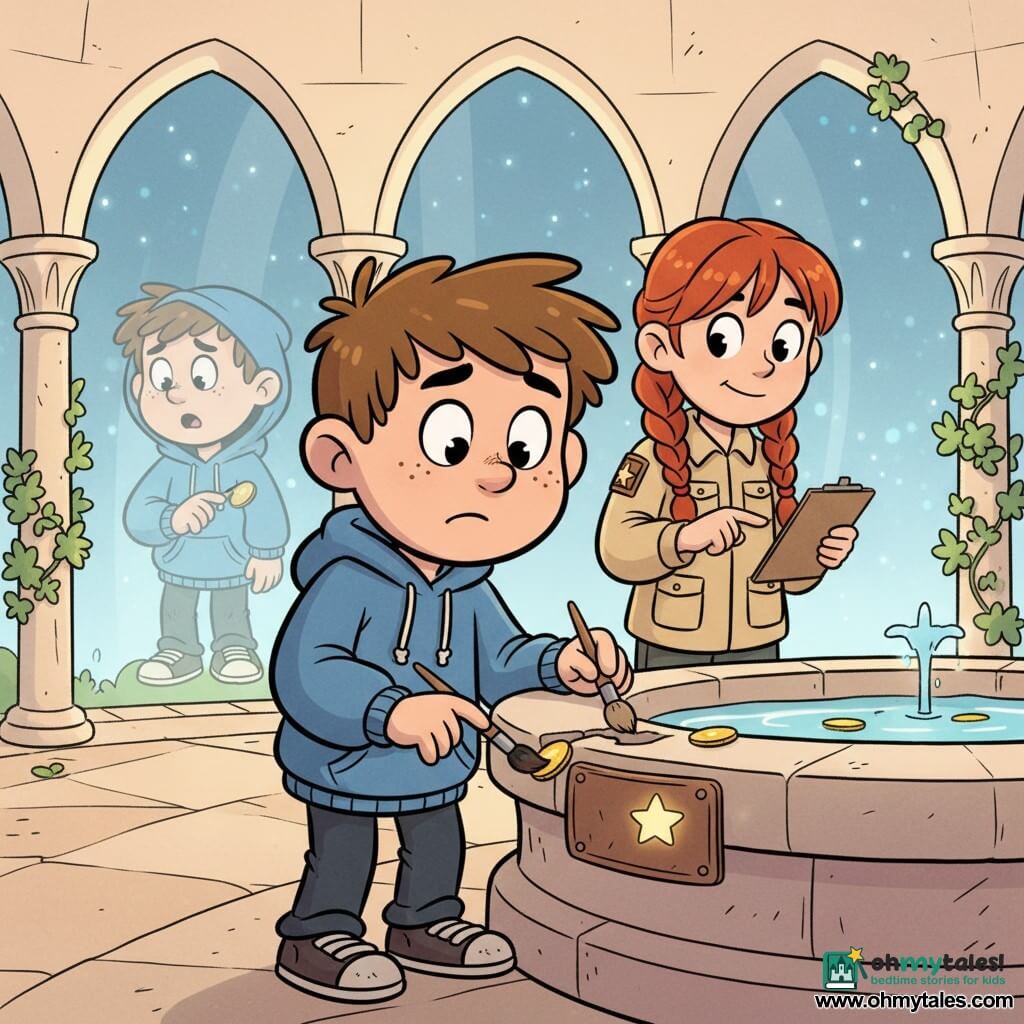
He was standing in a cloister—an open courtyard surrounded by covered walkways. The stone arches were pale and glowing, as if moonlight lived inside them. Ivy climbed the columns, and every leaf shimmered with tiny drops of light. A fountain sang in the center, and the water looked like liquid glass.
The air smelled clean and sharp, like rain and lemons.
Milo checked himself. Same sneakers. Same hoodie. Same notebook in his pocket.
He looked down at the watch. The dial pointed to AFTER, and the star engraving felt warm, like it had been sitting in sunlight.
Footsteps tapped nearby.
A girl about his age stepped out from behind a column. She wore a simple jacket with lots of pockets and carried a clipboard.
She stared at Milo. Milo stared back.
Then she said, “You're early.”
“I'm… what?” Milo said.
She sighed, not mean, just tired in a funny way. “Time travelers always say that. Okay. Name?”
“Milo.”
“I'm Saffron,” she said. “Welcome to the Bright Cloister. Please don't lean on the glowing stones. They are… moody.”
Milo leaned back immediately. “I wasn't going to.”
Saffron glanced at his watch. “Oh. A Starwatch. Those are rare. They don't like chaos.”
“I don't like chaos either,” Milo said honestly.
“That's a good start.” She pointed to a sign hanging from a column. It read:
TEMPORAL VISITORS
1) Observe.
2) Don't copy yourself.
3) Don't leave objects behind.
4) Don't take objects out.
5) If confused, breathe and ask.
Milo read it twice. Then a third time, quietly, because he liked being sure.
Saffron led him under the arches. The glowing stones cast soft light on the floor, like gentle puddles of sunshine.
“This place is in the future?” Milo asked.
“In one of them,” Saffron said. “Time has lots of pockets. Like my jacket.”
Milo smiled a little. “So… why is it glowing?”
Saffron tapped a column. “Special mineral in the stone. It stores light during the day and releases it at night. The builders wanted a place that felt safe.”
Milo wrote:
LOGBOOK
The cloister glows because the stone stores light.
It feels like a night-light for grown-ups.
Then he asked, “Am I allowed to explore?”
Saffron nodded. “Yes. But carefully. There's one big rule: you must not cause a loop.”
“A loop?” Milo echoed.
Saffron leaned closer. “A mischievous paradox. Like meeting yourself and trading hats until nobody knows whose head is whose.”
Milo pictured that and snorted. “That sounds… confusing.”
“It is,” Saffron said. “And the Starwatch hates confusion.”
As if to agree, Milo's watch gave a tiny, grumpy buzz.
Chapter 3: The Mischievous Paradox
Saffron brought Milo to the fountain. The water made a steady plink-plink sound, like a calm metronome.
“Here's your task,” she said. “We've got a problem. Something small but sneaky.”
Milo straightened. Tasks made him feel brave.
Saffron pointed to a little bronze plaque by the fountain. It said:
PLEASE DO NOT DROP COINS.
THANK YOU.
“But there are coins,” Milo said. He could see them glittering on the fountain's bottom.
“Exactly,” Saffron said. “And every morning, more appear. Not from visitors. From time.”
Milo frowned. “How can time drop coins?”
Saffron flipped her clipboard and showed him a drawing. It looked like the fountain, the plaque… and a small hand dropping a coin.
The hand was wearing a hoodie sleeve.
Milo's hoodie sleeve.
His stomach did that gentle flip again, but this time without any fun. “That's… me.”
Saffron nodded. “A loop is starting. You drop a coin because you see coins. Then the coins are there because you dropped a coin. It's a silly circle that can grow.”
Milo stared at the fountain as if it might suddenly explain itself.
“Do I… have to drop a coin?” he asked.
“Better question,” Saffron said, “what do the rules say?”
Milo pulled out his notebook and read his own words. “Observe first. Don't change history. Don't leave objects behind.”
He looked at the plaque again. “Also: don't drop coins.”
Saffron smiled. “You're good at this.”
Milo walked around the fountain slowly, hands in his pockets so they wouldn't do anything on their own. The coins on the bottom sparkled, tempting like tiny suns.
Then Milo noticed something else: a thin crack in the stone rim, right near the plaque. It wasn't big, but it looked like it could catch a coin if one slipped.
He leaned closer, careful not to touch the glowing stone.
There, stuck in the crack, was a coin halfway out—like it had been dropped and then changed its mind.
Milo said, “If I don't drop a coin, the coin in the crack might still fall later.”
Saffron tilted her head. “Good observation.”
Milo's mind clicked like his pencil case closing. “So I should prevent the fall without adding anything new.”
“How?” Saffron asked.
Milo looked around. Beside the walkway, there was a small brush and dustpan, like the kind used for sweeping leaves.
He picked up the brush. “I can nudge the coin back onto the rim, away from the crack. No new coin. No drop. Just… fixing what's already here.”
Saffron's eyes widened. “Method,” she said, as if the word tasted nice. “Go ahead.”
Milo held his breath and gently used the brush tip to slide the coin away from the crack. It scraped softly and settled on a flat spot.
For one second, nothing happened.
Then the coin wobbled.
Milo froze. “Please don't—”
The coin stopped wobbling.
Milo exhaled.
His watch hummed, warmer now, almost pleased.
Saffron checked her clipboard. “The loop weakens when you remove the ‘because-I-saw-it' part. You didn't add a coin. You didn't drop one. You broke the circle.”
Milo wrote, hands a little shaky:
LOGBOOK
Paradox tip: Don't do something just because you saw it happen.
Find the cause, then choose a better step.
Saffron pointed at the plaque. “Now there's one more piece. The picture of you dropping a coin. We need to make sure that never starts.”
Milo gulped. “How?”
Saffron reached into her pocket and pulled out a small sticker shaped like a star. “Put this on the plaque. It's a reminder. A bright one.”
Milo hesitated. “But the rules said don't leave objects behind.”
Saffron nodded. “Good catch. This sticker belongs to the cloister. It was made here. It's allowed.”
Milo carefully placed the star sticker next to the words PLEASE DO NOT DROP COINS.
The star seemed to glow softly, like it was proud to be useful.
Milo stepped back. “Okay. No coin-dropping Milo.”
From behind a column came a small giggle.
Milo turned fast.
A boy stood there—same height, same hoodie, same face.
Milo's face.
The other Milo held a coin between his fingers, poised over the fountain.
Both Milos stared.
The other Milo whispered, “I was going to drop it because… there are coins in there.”
Milo's heart thumped like a drum in a quiet room. “Don't,” he said quickly. “It's a loop.”
The other Milo squinted at the plaque. His eyes landed on the new star sticker.
He lowered the coin. “Oh,” he said. “Right. The star. That means… no.”
He looked embarrassed, like he'd almost stepped in a puddle.
Milo said, gently, “It's okay. Just… follow the rules.”
The other Milo nodded and put the coin in his pocket.
Then the air around him shimmered, like heat above a sidewalk, and he faded away—like a reflection leaving when the mirror turns.
Saffron let out a long breath. “Loop avoided. Nicely done.”
Milo finally laughed, a small shaky laugh. “I just talked myself out of doing something silly.”
Saffron grinned. “That might be the most powerful time-travel skill.”
Chapter 4: Notes for the Present
They walked along the cloister's edge. The glowing arches made soft shadows that moved like slow dancers.
Saffron stopped at a stone bench. “Before you go, you should write down what you learned. Time travel is exciting, but the lesson is for your everyday life.”
Milo sat and opened his notebook.
Saffron said, “Three things.”
Milo nodded, ready.
“First,” Saffron said, “method. You paused, you checked rules, you looked for the real problem.”
Milo wrote:
1) Pause. Check the rules. Look closely.
“Second,” Saffron continued, “small choices matter. A tiny coin can make a big mess.”
Milo wrote:
2) Small actions can start big trouble—or prevent it.
“Third,” Saffron said, “don't let ‘because everyone does it' decide for you.”
Milo smiled. “Like dropping coins in fountains.”
“Exactly,” Saffron said. “Make your own smart step.”
Milo wrote:
3) Don't do things just because you saw others do them.
The fountain's steady plink-plink sounded like it was clapping politely.
Milo looked at the bright stones, the shining leaves, the safe light everywhere. “This place is amazing,” he said. “I wish I could stay longer.”
Saffron's voice softened. “You can't stay in a pocket that isn't yours. But you can carry it back in your mind.”
Milo touched the warm watch. “How do I go back?”
Saffron pointed to the dial. “NOW. And think of your attic. Think of the dust in the sunbeam. Clear picture.”
Milo stood. He felt a small pinch of sadness, like the end of a great book chapter.
Saffron gave a quick salute with her clipboard. “Good traveling, Milo. And remember—if time offers you a coin, say no.”
Milo chuckled. “Deal.”
He turned the dial to NOW.
The bright air folded inward. The cloister's glow blurred into a single line of light, like a bookmark sliding shut.
Chapter 5: The Attic, Exactly Two Minutes Later
Milo's sneakers were on wood again.
Dust still floated in the sunbeam. The rain still tapped the roof.
Grandma stood by the quilts, holding a box of old photos. “Milo?” she called. “Where did you wander off to?”
Milo looked at the attic clock.
Two minutes had passed.
His heart was still full of arches and shining ivy.
He walked to Grandma, holding the watch carefully, as if it might sneeze time again.
“I didn't wander,” Milo said. “I… took a very short trip.”
Grandma raised an eyebrow. “And did you follow a plan?”
Milo patted his notebook. “Yes.”
He opened it and showed her the logbook notes.
Grandma read, smiling. “Method. Small actions. Think for yourself.” She nodded slowly. “Uncle Orin would approve.”
Milo looked at the pocket watch. It was quiet now, just a normal-looking watch with a star.
But when Milo closed the lid, he could have sworn he heard a tiny satisfied click.
Later that day, Milo cleaned his desk without being asked. He sorted his homework papers into neat piles. Then he paused before starting his math worksheet.
He wrote at the top of the page:
RULE 1: PAUSE.
RULE 2: CHECK.
RULE 3: CHOOSE.
Grandma walked by and peeked over his shoulder. “Time travel homework?”
Milo grinned. “No. Present travel. I'm trying to do it properly.”
Outside, the rain stopped. A thin strip of sunlight slid across the floor like a friendly path.
Milo felt steady, like a clock that knew its own rhythm.
And in the attic, inside the wooden box, the Starwatch rested—ready, but not rushing—because the best adventures always begin with a careful first step.