Chapter 1: The House That Spoke in Whispers
In Bramblewick Burrow, even the daylight seemed to tiptoe.
The village was made of tunnels and snug rooms carved into the roots of old trees. Lantern-moss glowed softly on the walls, and the air always smelled like tea leaves and damp earth. But the strangest thing about Bramblewick wasn't the moss or the roots or the way the wind played lullabies through hollow acorns.
It was the rule.
“Whisper after sundown,” the grown-ups always said. “Don't wake the night.”
The night, according to the elders, was not just a time. It was a creature—huge and listening—draping itself over the burrow like a dark velvet cloak. If you startled it, it might stir. If it stirred, it might notice you.
Milo, a young fox with clever paws and an open, curious mind, tried very hard to follow the rule. He really did. He whispered when he asked for jam. He whispered when he laughed. He even whispered when he sneezed, which made him look like a dramatic mouse performing in a tiny theater.
But there was a sound in Milo's home that did not whisper back.
It scratched.
Every evening, once the lantern-moss dimmed and everyone's voices sank into softness, the sound began under the stairs.
Scratch. Scratch-scritch. Scrape.
It wasn't loud. That was the worst part. It was a secret sound, the kind that crawled into your ears and built a nest.
Milo's little sister, Pip, would shove her pillow over her head.
“Don't listen,” she'd mutter, muffled. “It's the night's nails.”
Their mother would tuck the blankets up and say, very quietly, “Probably just the house settling.”
But the stairs didn't settle.
The stairs waited. And beneath them, something kept scraping as if it were trying to write a message on the bones of the burrow.
Milo lay awake, watching the shadows stretch long fingers across the ceiling. His heart beat like a trapped drum, but his curiosity beat louder.
He didn't just want the scratching to stop.
He wanted to understand it. To tame it. To turn the fear into something he could hold.
The next morning, when the night had rolled away and the village dared to speak at normal volume again, Milo announced, “I'm going to make friends with the sound under the stairs.”
Pip stared at him as if he'd suggested inviting a thunderstorm to tea.
“You can't make friends with a scratch,” she said.
Milo flicked an ear. “Maybe it's lonely.”
Their mother paused mid-pour, tea shimmering in the cup like a tiny amber pond. “Milo,” she said gently, “some mysteries are happier left alone.”
But Milo had already decided. When a question planted itself in him, it grew roots.
And roots, in Bramblewick, always found their way deeper.
Chapter 2: A Candle, a Map, and a Promise
Milo began like any sensible fox: by gathering supplies as if he were going on an expedition to the edge of the world.
He packed a stubby beeswax candle, a piece of chalk, and a jar of honey biscuits—because if you were going to face something frightening, you might as well face it with snacks.
He also found a friend.
Juniper the crow landed beside him on the burrow's front step, tilting her glossy head. Her eyes looked like two polished buttons sewn onto the morning.
“I heard you're planning to get yourself eaten by a staircase,” she said.
Milo snorted. “I'm planning to talk.”
Juniper ruffled her feathers, unimpressed. “To a scratch.”
“To whatever's making it,” Milo corrected. “And I'm not doing it to show off. I'm doing it because I'm tired of being scared of something I haven't even met.”
Juniper hopped closer. “That's almost noble,” she said. “Almost. Still stupid, though.”
“Will you help?” Milo asked.
Juniper pretended to think, which for a crow meant staring dramatically at a pebble.
“I do enjoy mysteries,” she admitted. “And I enjoy not being bored. Fine. I'll help. But we need a plan.”
So they made one.
They drew a map of Milo's home on a flattened leaf, marking the stairs with a jagged symbol that looked like teeth. Juniper insisted on adding warning lines.
“Just in case the stairs try to bite,” she said.
Milo rolled his eyes. “Stairs don't bite.”
“Anything can bite if it's angry enough,” Juniper replied. “Even a muffin.”
They decided to investigate at dusk—the moment when the village's voices began to soften, when the world's colors drained into gray-blue, and when the first stars appeared like pinpricks in a dark curtain.
That evening, Milo waited until Pip's breathing slowed and their mother's lamp was turned low.
Then he and Juniper crept into the hallway.
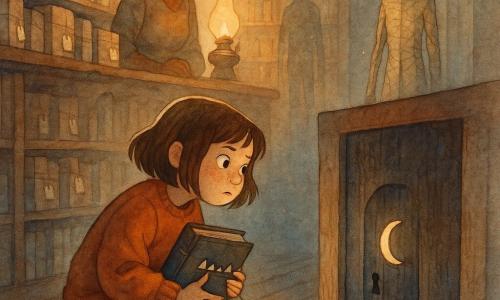
The staircase rose ahead of them, a wooden spine climbing into shadow. Underneath it was a small door, half-hidden by a hanging rug.
Milo had noticed it a hundred times. He had always told himself it was just a storage nook.
Now, in the hush of nearly-night, it looked like a mouth trying not to smile.
Scratch. Scratch-scritch. Scrape.
Juniper leaned in, her beak close to Milo's ear. “Do you hear that? It's like… like someone filing their teeth.”
Milo swallowed. His courage didn't feel like a sword. It felt like a candle in wind—small, trembling, but still lit.
He took the chalk and drew a circle on the floor.
“What's that for?” Juniper whispered.
“A boundary,” Milo whispered back. “A reminder. I'm allowed to be scared. But I'm not allowed to run without learning something first.”
Juniper blinked. “That is… surprisingly wise for a fox who keeps honey biscuits in his pocket.”
Milo set the candle down, shielding its flame with his paws. The light made the shadows jump, as if they'd been caught whispering.
He reached for the little door's latch.
The scratching stopped.
The silence that followed felt heavier than the sound, like a blanket soaked in cold water.
Milo froze. Juniper froze. Even the candle seemed to hold its breath.
Then, from the other side of the door, came a slow, delicate tap.
Tap. Tap.
As if something was listening back.
Chapter 3: The Door That Wouldn't Open
Milo tried the latch.
It didn't move.
He tried again, gentler, as if the door might be shy.
Still nothing.
Juniper peered at the edges. “It's swollen,” she whispered. “Wood does that when it's damp.”
Milo pressed an ear to the door. The wood felt cool, almost feverish with trapped air. He could hear something inside—small movements, like a broom brushing sand, like claws combing through dry leaves.
“You there?” Milo whispered, surprised by how steady his voice sounded.
Nothing answered.
Juniper leaned close and whispered, “Ask it what it wants.”
Milo hesitated. He hadn't thought that far. In his mind, the sound was just a sound. A nasty, nameless noise. But now it felt like a presence, like a guest behind a curtain.
“What do you want?” Milo asked softly.
A pause.
Then: scratch-scritch. Scratch.
Three quick scrapes, like a reply written in a language of splinters.
Juniper's feathers rose. “That's a yes, I think.”
“Yes to what?” Milo whispered.
Juniper snapped her beak quietly, as if chewing on a thought. “Maybe it wants… out.”
Milo imagined the door opening and something crawling out—a thing with too many joints, a shadow with teeth, a bundle of cold hunger.
His stomach turned.
But the scratching sounded… tired.
Not angry. Not hungry.
Impatient, maybe. Or lonely. Like someone tapping a foot in a waiting room that never calls their name.
Milo drew a long breath through his nose, letting the scent of wax and old wood settle him. “Okay,” he murmured. “If you want out, I need to open the door. And if I can't open the door, I need to figure out why.”
Juniper gave him a sideways look. “That's a lot of ‘need' for one evening.”
Milo's tail flicked. “Perseverance,” he whispered. “That's what Mother says when she's kneading dough and it won't behave.”
Juniper snorted. “Dough doesn't scratch back.”
Milo examined the latch again. There was a thin crack along the edge where the door met the frame, and the crack was clogged with grit. Dirt, old crumbs, maybe tiny bits of root.
“The door's stuck,” Milo whispered. “But not locked.”
Juniper hopped onto the first step and pointed with her beak. “Look—there's a nail bent into the hinge. Someone hammered it wrong.”
Milo's candlelight gleamed on the nail. It was crooked, half-buried, as if it had been forced in a hurry.
Milo felt a strange twist in his chest. This door wasn't meant to be used. Someone had decided, a long time ago, to shut it and keep it shut.
The scratching started again, faster now.
Scratch-scratch-scratch.
Juniper flapped her wings once, quietly. “It's getting worked up.”
Milo put his paw against the door. “I'm here,” he whispered. “I'm trying.”
The scratching slowed, as if it heard the promise.
Milo backed away and looked around the hallway. Tools. He needed a tool.
His eyes landed on a small iron poker by the hearth. Their mother used it to prod coals, always careful, always patient.
Milo lifted it. It was heavy, cold, and serious.
“Okay,” he whispered. “We do this gently.”
Juniper scooted closer. “Gently, yes. Like defusing a sleeping dragon.”
Milo slid the poker's tip under the bent nail and levered it, careful not to squeak the wood. The nail resisted with stubborn pride.
His paws began to ache. The candle's flame wobbled.
From behind the door came a soft, shaky sound—not scratching now, but something like a tiny whimper.
Milo's ears pricked. That wasn't a monster noise. That was a frightened noise.
He gritted his teeth and pressed again.
The nail shifted—just a little.
Then the hallway floor creaked.
Above them, Pip mumbled in her sleep.
Milo froze, heart leaping like a startled rabbit. If Pip woke, she'd scream. If she screamed, the whole burrow would panic. And in Bramblewick, panic was loud.
Juniper whispered, “Stop. We can't risk it.”
Milo's paws trembled with frustration. The nail was almost free. Almost.
But “almost” wasn't enough tonight.
Milo slowly slid the poker away and set it down. He leaned toward the door again, voice barely air.
“I'll come back,” he promised. “I won't quit.”
The scratching paused.
Then, very softly, came a single scrape, like an underlined word.
As if the thing inside believed him.
Chapter 4: Lessons in Quiet Courage
The next day, Milo couldn't stop thinking about the whimper.
It followed him like a shadow that didn't want to be alone. During chores, he replayed it in his mind: not fierce, not wicked—just scared.
So he asked questions, the way foxes do when they can't leave well enough alone.
He asked Old Hazel the badger, who knew the burrow's history the way some animals knew songs.
“There's a door under our stairs,” Milo said, trying to sound casual. “Do you know what's behind it?”
Old Hazel's whiskers twitched. “Storage,” he said too quickly.
Milo tilted his head. “Just storage?”
Hazel avoided his eyes. “The night likes its secrets,” he muttered. “And secrets like to stay shut.”
That wasn't an answer. That was a warning dressed up as wisdom.
Milo asked Mallow the rabbit carpenter, who repaired chairs and always smelled faintly of pine shavings.
“A bent nail in a hinge?” Mallow repeated. His nose wiggled. “That's sloppy work. Someone must've been in a hurry.”
“In a hurry to close the door,” Milo said.
Mallow's ears drooped. “Look,” he said quietly, “sometimes adults close things because they don't know how to fix them. So they hide them. That's not always right, but it's… common.”
Milo carried those words home like stones in his pocket.
That evening, he and Juniper met again in the hallway, armed with a softer plan.
“No pokers,” Juniper insisted. “We'll be quieter.”
Milo brought a small tin of oil, the kind used for squeaky hinges. Juniper brought a piece of cloth and—somehow—a tiny metal file.
“Don't ask,” she whispered, when Milo stared. “Crows have hobbies.”
They lit the candle.
Scratch. Scratch-scritch.
Milo crouched, heart knocking. “It's me,” he whispered. “Milo. I'm back.”
The scratching stopped.
Juniper leaned in close to the door and whispered, “Hello, terrifying mystery. We brought… lubricant.”
Milo shot her a look. Juniper's eyes glittered with mischief. “What? Humor is brave,” she whispered back.
Milo dabbed oil carefully along the hinge crack and the latch. The smell was sharp, like cold metal. Then Juniper used the file to shave away grit at the seam in tiny, patient strokes.
It took time. So much time.
Milo's legs went numb from crouching. His ears kept catching every tiny sound from the sleeping rooms. He wanted to rush—wanted to yank the door open and be done with it.
But he remembered the whimper.
And he remembered how the nail had shifted only when he stayed steady.
Perseverance wasn't a dramatic leap.
It was a thousand careful steps taken in the dark.
Finally, Juniper stopped filing. “Try now,” she breathed.
Milo touched the latch.
It moved.
Just a little. Like a reluctant thought.
Milo looked at Juniper. Juniper looked at Milo.
They both listened.
No footsteps. No waking. The house was still whispering.
Milo pulled.
The door opened a finger's width.
A thin line of air slipped out, cold and dusty, carrying a scent like old paper and wet stone. The candle flame bowed toward it, as if greeting something ancient.
From the crack came a pair of eyes.
Not glowing red. Not huge.
Small, dark, and shiny with tears.
A voice—raspy and tiny—whispered, “Please… don't slam it.”
Milo's throat tightened. He whispered back, “I won't.”
Juniper's feathers lifted. “Well,” she murmured, “that's new.”
Milo opened the door a bit more.
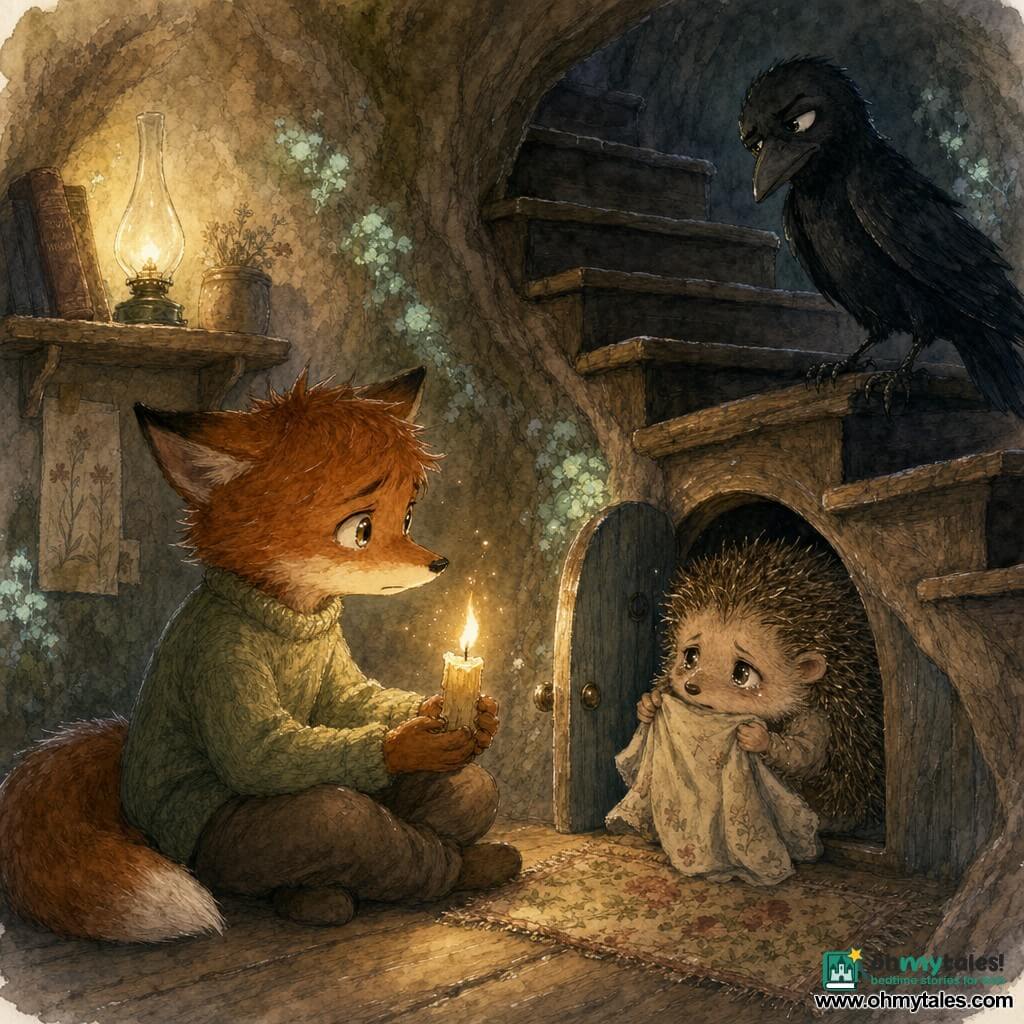
Curled inside the cramped space was a hedgehog, thin as a winter twig. Their spines were patchy, as if they'd been rubbing against wood for too long. Their paws were dirty, nails worn down to pale stubs.
And on the floor, scratched into the dust, were frantic little marks—lines and circles and arrows, like a map made by someone who had forgotten what freedom felt like.
Milo stared. “You've been… under our stairs?”
The hedgehog swallowed. “For a long time,” they whispered. “I didn't mean to scare anyone. I just… I couldn't stop moving. If I stop, I think about it too much.”
Juniper's voice softened. “Think about what?”
The hedgehog's eyes flicked toward the open hallway, as if the air itself might bite. “The night,” they breathed. “The night that listens.”
Milo felt his own fear stir, familiar and cold. But he kept his voice steady, gentle as a paw placed on a sleeping pup.
“What's your name?” he asked.
The hedgehog hesitated, then whispered, “Thimble.”
Milo nodded. “Okay, Thimble. I'm Milo. This is Juniper. And we're going to get you out.”
Thimble's breathing hitched. “It's not that simple.”
Milo's tail curled tighter around his feet. “Then we'll make it simple,” he said, and surprised himself by meaning it.
Chapter 5: The Thing Called Night
Milo opened the door wider, just enough for Thimble to peek out.
Thimble flinched at the hallway, eyes darting to the shadows under the staircase as if expecting them to grab.
Milo noticed something then: Thimble wasn't scratching to threaten.
They were scratching to cope—like a nervous habit turned into a prison song.
Juniper perched on a step, voice low. “Why were you locked in here?”
Thimble's spines trembled. “I wasn't locked at first,” they whispered. “I came here to hide. The village was loud one night. Someone laughed too hard. A pot fell. The night… woke up.”
Milo felt a chill slip down his back. Bramblewick's rule suddenly didn't seem like a silly superstition. It felt like a fence built around something real.
Thimble continued, words spilling like beads from a broken string. “I heard it. Not with ears—inside my head. Like a slow drum in the dark. I panicked. I ran. I found this space and curled up and told myself it would pass.”
Juniper's beak clicked softly. “And it didn't.”
Thimble shook their head. “Every time I tried to leave, I heard it again. The listening. The weight. I thought if I stayed small and quiet, it wouldn't notice me. Then… someone found me. An adult. A badger, I think. They said I was ‘too jumpy' and that I was ‘spreading worry.' They pushed the door closed and hammered it. Crooked. Fast.”
Milo's chest burned with anger, hot as coals. He imagined Thimble pressing tiny paws to the door, the bent nail sealing the world away.
“That wasn't fair,” Milo whispered.
Thimble's eyes shone. “Maybe they thought they were helping,” they said. “Maybe they thought they were protecting the village from my fear. But fear doesn't disappear when you shut a door. It just scratches.”
Milo stared at the faint marks on the floor. A map of panic. A diary written in dust.
He took a slow breath. “Thimble,” he said, “the night scares me too. The rule, the whispers… it gets in my head.”
Thimble blinked at him.
Milo continued, voice soft and sure. “But I'm here. I'm not going to leave you under the stairs. And I'm not going to pretend the night isn't scary. We'll be careful. We'll be quiet. But we'll move forward anyway.”
Juniper nodded, surprisingly serious. “Forward in tiny steps,” she said. “Like a worm with ambition.”
Thimble made a small sound that might have been a laugh, or maybe just a shaky breath. “Tiny steps,” they echoed.
Milo glanced toward the sleeping rooms. He couldn't wake his family. Not yet. Not with Thimble trembling and the night listening.
“We'll do it tonight,” Milo whispered. “We'll get you out. Quietly.”
Thimble's paws clenched. “The night will hear.”
Milo leaned closer, candlelight painting gold on his whiskers. “Then we'll teach the noise to be gentle,” he whispered. “We'll show the night we can move without shouting. We'll show you that the hallway isn't a mouth.”
Juniper muttered, “It's still kind of a mouth.”
Milo ignored her. He offered Thimble a honey biscuit, careful and slow.
Thimble sniffed it like it might be a trick. Then, with a tiny bite, they tasted sweetness, and their shoulders lowered a fraction.
In that small bite, Milo saw something hopeful: fear can be starved by kindness.
But it takes patience.
And patience, Milo was learning, was bravery that didn't need applause.
Chapter 6: The Quiet Escape
Later that night, the burrow became a sleeping sea. The lantern-moss dimmed until everything looked painted in soot and moonmilk.
Milo and Juniper returned to the staircase with the candle and a folded cloth. They'd decided Thimble would wrap the cloth around their paws to soften their steps. Juniper, ever dramatic, called it “stealth socks.”
Thimble stood in the doorway, trembling like a leaf that hadn't decided whether to fall.
Milo whispered, “One step. Then stop. Then breathe.”
Thimble nodded, eyes squeezed shut.
They took one step into the hallway.
The floor did not creak.
Nothing lunged from the shadows.
Thimble opened their eyes, startled.
Juniper whispered, “See? The house isn't hungry. It's just old.”
Thimble took another step. Then another.
Scratch—Milo's heart imagined it, hearing echoes that weren't there. His mind tried to turn every sound into a monster.
He forced himself to listen properly.
All he heard was the candle's soft hiss and the distant sigh of sleeping animals.
They reached the bottom of the stairs.
Above them, the staircase loomed like a ribcage. The dark beneath it felt less like a mouth now and more like an empty coat hung in a corner—still spooky, but not alive.
Thimble paused. Their breathing sped up.
Milo whispered, “I'm right here.”
Thimble's voice shook. “It's listening,” they whispered.
Milo felt it too, suddenly—a sense of being noticed. Not by eyes, but by silence itself. As if the darkness had turned its head.
The night, in Bramblewick, was not just absence of light. It was a presence. A wide, patient thing that liked everything tucked away and quiet.
Juniper swallowed. “Okay,” she whispered. “I admit it. I also feel… listened to.”
Milo's paws went cold. His candle flame bent sideways, though no wind blew. Shadows thickened, pooling at the corners like ink.
Thimble whimpered.
Milo closed his eyes for a heartbeat. He remembered his chalk circle from the first night—his boundary. He didn't have chalk now, but he had something better: a decision.
Perseverance, he thought, wasn't fighting the night.
It was walking through it without letting it steer you.
He opened his eyes and whispered, “Night,” as if speaking to a grumpy neighbor, “we're not here to wake you. We're just helping someone go home.”
The shadows seemed to press closer, curious.
Juniper hissed, “Are you… negotiating with darkness?”
Milo didn't answer. He kept his voice calm and low, like a lullaby. “We'll be quiet. We'll be careful. But we won't hide forever.”
For a moment, the air felt tight—like the second before thunder.
Then, from somewhere deep in the burrow, came a sound.
Not a scratch.
A slow, tired sigh, as if the night itself had exhaled.
The candle flame straightened.
The shadows loosened their grip, sliding back into ordinary corners.
Thimble stared. “It… let us,” they whispered.
Milo's ears twitched. “Maybe the night isn't evil,” he whispered. “Maybe it's just easily startled.”
Juniper muttered, “Like Pip.”
They moved again, step by soft step, down the hallway and toward the front room where the exit tunnel curved upward to the surface.
Thimble's courage flickered, then steadied.
At the doorway to the outside tunnel, Thimble stopped and looked back at the staircase.
“I thought the scratching was the only thing I had,” they whispered. “Like a rope in the dark.”
Milo nodded. “But it was also a chain,” he whispered.
Thimble's eyes filled again. “Thank you,” they said. “For not quitting when the door wouldn't open.”
Milo's throat tightened. “I almost did,” he admitted. “But then I heard you.”
Thimble took a deep breath, wrapped in the cloth, holding their own trembling like a small animal held carefully in two paws.
Then they stepped into the tunnel.
And for the first time in a long time, they didn't need to scratch.
Chapter 7: A New Sound Under the Stairs
The next morning, Milo told his mother everything.
He expected anger. Or fear. Or the kind of adult sigh that means, You have made my life complicated.
Instead, his mother sat very still, her tea cooling unnoticed.
When Milo finished, she pressed her paw to her mouth. “Oh, Thimble,” she whispered, voice thick with regret. “I remember a hedgehog who used to help in the herb garden. Then they disappeared. We told ourselves… stories.”
Pip, wide awake now, clutched Milo's tail. “The scratch was a person?” she asked, horrified.
“A hedgehog,” Milo said gently. “And they were scared.”
Pip's ears drooped. “I called it the night's nails,” she whispered. “I thought it was… gross.”
Milo nudged her shoulder. “You didn't know.”
Their mother stood. “We need to fix the door,” she said. “Properly. And we need to find Thimble and bring them food—and apologies.”
Juniper, who had come to listen from the windowsill like a feathery gossip, said, “Apologies are harder than nails.”
Milo's mother gave her a look. “Then we'll persevere,” she replied.
That afternoon, the village gathered—quietly, respectfully. Mallow the carpenter removed the bent nail with careful taps, then fitted a new hinge. Old Hazel the badger cleared his throat again and again before finally admitting, in a trembling voice, “I told myself shutting the door was protecting everyone. But it was only protecting my comfort.”
Thimble arrived with a basket of herbs, escorted by two rabbits. They looked cleaner, steadier. Still cautious, but no longer crumpled into themselves.
When Thimble saw the open space under the stairs, their spines lifted.
Milo stepped beside them. “We're not closing it on you,” he whispered. “It can be storage. Or nothing. Or a place to sit if you want. But it won't be a cage.”
Thimble nodded, eyes shining.
Pip approached, holding out a small ribbon. “For your paw,” she whispered. “To make it… less scratchy.”
Thimble laughed softly—this time, it was definitely a laugh. “Thank you,” they said, tying it around their wrist like a brave little flag.
As the sun sank, the village remembered its rule: whisper after sundown. But the whispering felt different now—not like fear, but like respect. Like the way you speak in a library, not because you're scared of books, but because you care about quiet.
That night, Milo lay in bed, listening.
The staircase was silent.
No scratch. No scrape.
Then, just as sleep began to tug him under, he heard a new sound beneath the stairs.
Tap. Tap. Tap-tap.
Milo's eyes opened.
He sat up, heart fluttering.
Juniper, perched on the window ledge because she refused to sleep “like a normal creature,” whispered, “Oh no. Not again.”
Milo listened carefully.
The taps were gentle, rhythmic, like someone drumming a calm pattern.
Milo crept to the hallway and peered down.
Thimble sat beneath the stairs with a small piece of chalk, tapping it on the floor in a slow beat. Around them were drawn shapes: stars, leaves, little spirals. Not frantic marks. Not desperate maps.
Art.
Thimble looked up, startled, then smiled shyly. “I couldn't sleep,” they whispered. “So I'm making a new sound. One that doesn't scare.”
Milo's chest warmed, as if someone had lit a lantern inside him. He sat beside Thimble, careful not to creak the stairs.
“Can you teach me?” Milo whispered.
Thimble nodded. “It takes practice.”
Milo took the chalk. His paw hesitated, then tapped.
Tap.
The night did not wake. The darkness did not bite. It simply listened, the way a tired creature listens to a lullaby.
Milo tapped again, matching Thimble's rhythm.
Tap. Tap.
Perseverance, Milo thought as sleep finally softened his eyes, wasn't loud. It wasn't quick.
It was a steady hand in the dark, turning a scratching fear into a gentle song.