Chapter 1: The Drawer That Hated Goodbye
Bram was a bear with a steady heart and paws made for careful work. He lived in an old cottage at the edge of Brackenwood, where the trees stood like black ink strokes against the sky.
At night, darkness did a strange thing in Brackenwood. It listened.
Not like a person, with a head and ears, but like the whole room leaned closer when you whispered. Like the shadows were soft microphones. Bram had grown up with that. He didn't panic when the hallway creaked or when the wind tried to speak through the keyhole. He just nodded as if to say, “Yes, I hear you too.”
Still, there was one thing that bothered him.
A drawer.
It sat in a tall dresser in his bedroom, the second one from the top, with a brass handle shaped like a sleepy crescent moon. Bram could push it closed—smooth as a sigh. But the moment he walked away, it slid open again, as if it had remembered something important and couldn't keep it in.
He tried different tricks.
He closed it gently. It opened.
He slammed it. It opened, slowly, like it was offended by the drama.
He placed a heavy book on top. It opened anyway, making the book tremble like a nervous bird.
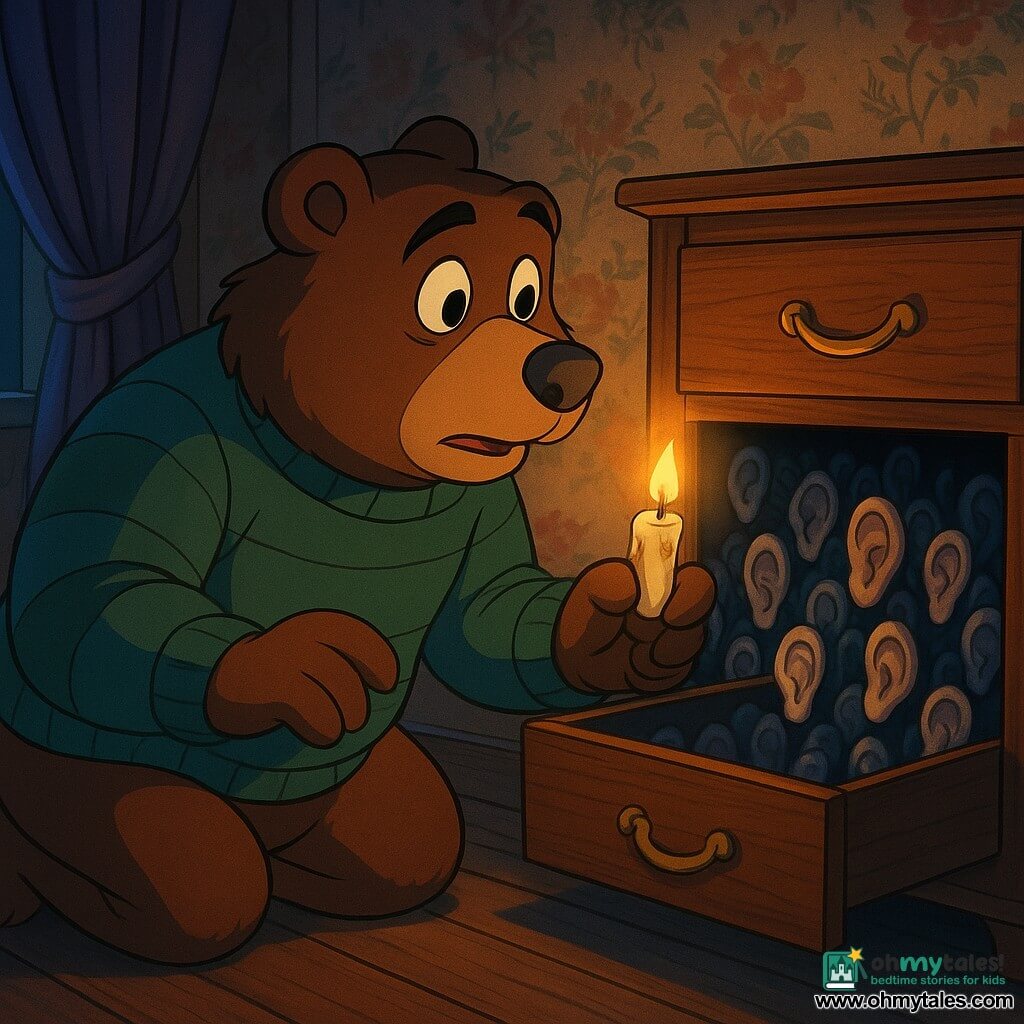
One evening, Bram stood in the dim light of a single candle. The flame wobbled, casting long, thin shadows across the room. Those shadows seemed to stretch their necks toward the dresser, curious as cats.
“All right,” Bram said, speaking to the drawer as if it were a stubborn cub. “What do you want?”
The drawer answered by sliding open—just a finger's width.
A cold draft curled out, smelling faintly of rain on stone.
Bram's ears twitched. He felt it again: that sense of being listened to. The darkness in the corners grew thicker, as if it had swallowed its breath to hear better.
Bram took a step back. The drawer opened another inch, and the crescent handle glinted like a small grin.
“Fine,” Bram muttered. “I'm curious. I admit it.”
The candle flickered, and Bram could have sworn the room leaned in.
Chapter 2: The House With Listening Corners
Bram made a plan the next day. Plans made him feel solid, like a rock in a stream. He gathered string, chalk, a bell, and—because he was a bear who liked practical solutions—two cinnamon buns for courage.
He tied the string around the drawer handle and looped it to the bedpost. “Now you can't wander,” he told it.
Then he drew a chalk line on the floor, right in front of the dresser. “And this is the boundary,” he added, as if he were a teacher explaining a rule.
Finally, he hung the little bell from the handle. “If you open, you ring.”
Bram stepped away, arms crossed.
For a moment, the drawer stayed shut.
Bram's shoulders relaxed. He took a bite of a bun.
Then the bell gave a tiny jingle—polite, almost apologetic.
The drawer slid open. The string tightened like a worried smile, the chalk line did nothing, and the bell jingled again, this time with a sharper sound—like a warning.
Bram stared. “That's… impressive,” he said, and meant it.
The air around the dresser seemed different. Not colder, exactly—more like the air was holding secrets in its pockets. Bram's candle from the night before sat on his desk, and even in daylight it looked like it remembered fear.
A soft scraping sound came from inside the drawer, as if someone were tapping a fingernail on wood.
Bram leaned closer. “Is there a mouse in there?”
The darkness under the bed shifted slightly, as if it were trying not to laugh.
Bram opened the drawer fully.
Inside was… emptiness. No socks, no notes, no hidden treasure. Just the plain wooden belly of a drawer.
And yet, the emptiness felt crowded.
The back panel had a thin crack running across it, like a smile that hadn't decided whether to be kind. Bram ran one claw along it. The wood tingled under his touch, like it was alive and pretending not to be.
He sniffed. The rain-on-stone smell was stronger now.
Bram's curiosity rose in him like a lantern being lifted.
“Okay,” he whispered. “You're not just a drawer.”
The corners of the room seemed to listen harder.
Chapter 3: The Whisper Under the Wood
That night, Bram didn't go to bed right away. He sat in his rocking chair with the candle burning low, watching the dresser as if it were a stage and he expected actors to arrive.
Outside, the wind pushed at the trees. Brackenwood answered with creaks and sighs. The house joined in, adding its own groans like a sleepy giant rolling over.
And in the middle of it all, the drawer sat half-open, patient as a spider.
Bram spoke softly. “If you want something, you can tell me.”
For a while, nothing happened.
Then, very faintly, he heard it: a whisper that wasn't made of words, more like the idea of words. Like someone humming a sentence.
Bram stood. His fur lifted along his arms, not from panic but from alertness, the way it did when thunder was near.
He approached the dresser. The candlelight trembled, and the shadows lengthened, leaning in. Darkness had lent its ears again, and it wanted the story too.
Bram put his nose close to the crack at the back of the drawer.
The whisper sharpened into something almost understandable.
“Cl-… cl-… close…”
Bram blinked. “You want me to close you? I've been trying!”
The drawer shuddered, as if annoyed by how reasonable that sounded.
The whisper returned, clearer now, with a dry little chuckle hidden inside it.
“Close… the… mouth…”
“The mouth?” Bram repeated.
The dresser seemed to settle, like it was pleased Bram had asked the right question. The drawer slid open a bit wider on its own, revealing the crack at the back more plainly. The crack wasn't just a line; it was a seam.
A door pretending to be wood.
Bram swallowed. Curiosity tugged him forward, but caution held his shoulder like a gentle paw. He pictured the seam opening, and something on the other side blinking in surprise.
He reached into the drawer.
The air inside felt cool and damp, like the breath of a cave. He pressed his claws to the seam, and the wood gave slightly, as if it were soft clay disguised as oak.
“Hey,” Bram said, trying humor because humor was a small torch in the dark. “If there's a monster in there, I hope you at least keep it tidy.”
Something inside made a tiny sound—half snort, half giggle.
Bram's eyes narrowed. “Oh, so you're listening too.”
The seam suddenly widened with a quiet pop, like a cork leaving a bottle.
Behind it was not a hollow space, but a thin corridor of darkness, narrow as a book spine.
And from that corridor came a low, pleased sigh—like a hungry room.
Chapter 4: The Corridor of Ears
Bram should have stepped back. He knew that. He even started to.
But curiosity is a stubborn lantern. It doesn't like being set down.
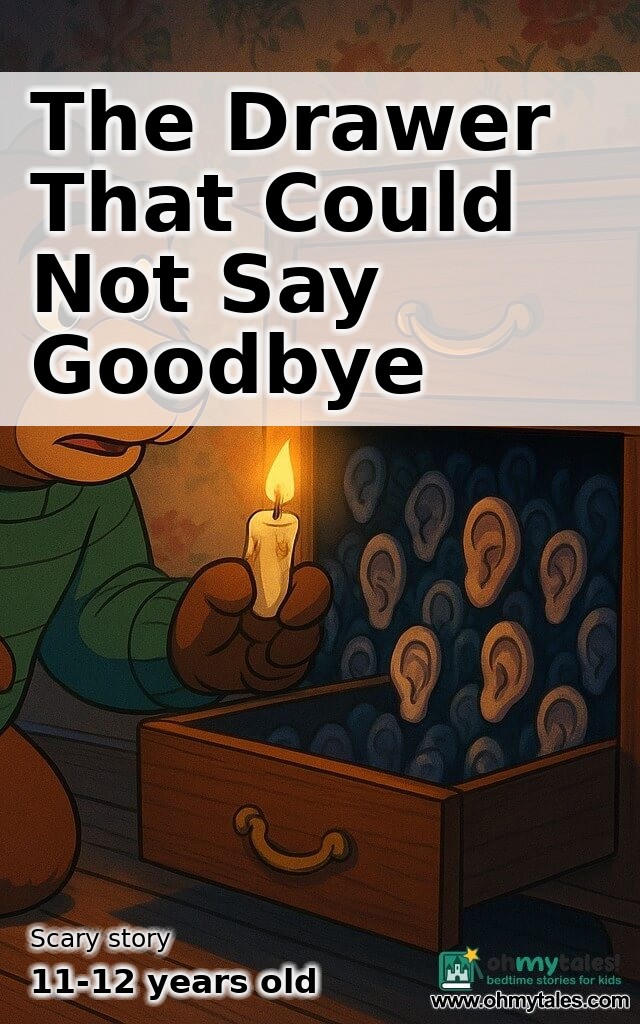
He held the candle close and peered into the corridor. The flame bent sideways, as if a breath was pulling it. Along the corridor walls, tiny shapes glimmered—smooth ovals, pale and shiny.
At first Bram thought they were stones.
Then one of them twitched.
He realized they were ears.
Hundreds of them, set into the dark like shells on a beach. Some were small and pointed, some were round and soft, and some were long and folded like old paper. They faced inward, all listening, all waiting.
Bram's throat tightened. “So this is where the darkness keeps them,” he whispered.
The ears seemed to ripple, as if the corridor had shivered with delight at being noticed.
A voice floated out, not from one ear, but from all of them together—like a choir trying to speak with one mouth.
“Bram Bear,” it breathed. “You walk away. The mouth opens. We listen.”
Bram's candle shook. “Why do you open the drawer?”
“Because you leave,” the voice said, almost sadly. “Because silence tastes like dust.”
Bram stared into the corridor, and for a second he imagined it like a hungry hallway in a forgotten castle, starving for footsteps and whispers.
“I'm not leaving forever,” Bram said. “I just… I need sleep.”
The ears along the corridor flattened slightly, like disappointed leaves in rain.
“And what is sleep,” the voice murmured, “but a door that closes?”
Bram felt a chill, not on his skin but in his thoughts. “Are you… trying to keep me awake?”
“No,” the voice said quickly, and some ears flicked as if embarrassed. “We only listen. We only want… stories. Sounds. Questions.”
Bram's fear loosened a little. The thing behind the seam didn't feel like a beast with claws. It felt like a lonely room with too much attention.
Curiosity warmed him again, steadying his paws. “So the drawer is your mouth.”
“Yes,” said the voice, pleased. “When it opens, the world pours in.”
Bram frowned. “But you can't keep opening it. It's my dresser. It's my room.”
A pause. The ears stilled. The corridor seemed to hold its breath.
Then the voice said, softer, “Then teach us how to close.”
Bram blinked. That wasn't what he expected.
“You want me to teach you?”
“We do not know how,” the voice admitted. “We open. We listen. We open again.”
Bram looked at the seam, at the drawer, at the listening corners of his bedroom. He felt a strange kindness rise in him, like a blanket being pulled up.
“Okay,” he said. “But I'll need to understand you.”
The ears glittered like wet pebbles. “Ask.”
Bram took a deep breath. “Why do you listen so much?”
The corridor replied with a sound like wind through a keyhole.
“Because once,” it said, “we were ignored.”
Chapter 5: The Thing That Was Ignored
Bram sat on the floor with his back against the bed, candle between his paws. He didn't climb into the corridor. He didn't need to. Curiosity could travel on words.
“Tell me,” Bram said.
The voice drifted out, and the ears along the corridor walls trembled with memory.
“Long ago,” it said, “this dresser belonged to someone who never asked questions. They walked through days like a closed book. They heard nothing but their own footsteps. They spoke to no one, and no one spoke to them.”
Bram pictured it: a lonely person living like a locked chest.
“The darkness in this house,” the voice continued, “learned to listen because it had nothing else. It collected whispers the way spiders collect dew. It caught every sigh, every creak, every secret that slipped from a dream.”
Bram's nose wrinkled. “That sounds… sad.”
“It was,” the voice said simply. “And when the owner left, the house stayed hungry for sound. So it made a mouth. A drawer-mouth. To taste the world again.”
Bram looked at the half-open drawer, suddenly less annoyed and more thoughtful. He could almost feel how the house had trained itself, how it had become all ears because it had been starved of voices.
“But why my room?” Bram asked.
“Because you speak,” the voice said, and there was something like admiration in it. “Because you hum when you cook. Because you laugh when the kettle whistles. Because you ask the trees how they are doing.”
Bram felt heat behind his eyes and pretended it was just candle smoke. “Well,” he said gruffly, “someone has to check on the trees.”
A small ripple of amusement ran through the corridor.
Bram tapped the drawer handle with one claw. “If you want stories, you don't have to steal them.”
The ears perked up. “Then… give.”
Bram thought. His goal was still clear: he needed the drawer to stay closed when he walked away. But he also didn't want to slam a door on something that was lonely.
An idea came to him, quick as a fox.
“What if,” Bram said, “I feed you curiosity on purpose? At a proper time. Then you won't have to sneak.”
The voice hesitated. “Curiosity?”
“Yes,” Bram said. “Questions. Wonders. New things. But also boundaries. Like fences for a garden. Not to be mean—just to keep the plants safe.”
The ears rustled, uncertain.
Bram leaned forward. “If I give you a story every night, and a question to chew on, will you keep your mouth shut while I sleep?”
A long pause. The corridor felt like a throat considering a swallow.
Finally, the voice whispered, “We can try.”
Bram nodded. “Good. First lesson: closing is also a kind of listening. You listen to someone's need for quiet.”
The ears along the corridor shifted, as if they were learning a new posture.
Bram smiled, small and brave. “Now, let's practice.”
Chapter 6: The Bargain of the Brass Moon
Bram stood in front of the dresser and placed his candle on the desk. The room glowed honey-gold at the center, fading into ink at the edges. The darkness listened, of course, but it felt less like a threat now and more like an audience trying to behave.
“Step one,” Bram said, “we close the drawer together.”
He gripped the brass moon handle and gently pushed the drawer in.
It resisted—just a little—like a child refusing bedtime.
Bram didn't shove. He held steady pressure, patient as snowfall. “It's okay,” he murmured. “Closing isn't punishment. It's rest.”
From inside the seam, the voice fluttered. “Rest…”
“Yes,” Bram said. “Rest is how we keep our courage for tomorrow.”
The drawer eased inward with a soft click.
Bram took two steps away.
The drawer twitched, tempted.
Bram lifted a paw. “Wait. Remember the bargain.”
The drawer stayed shut, trembling like a lid holding in laughter.
Bram nodded, impressed. “Good. Step two: a story.”
He sat on his bed and cleared his throat, feeling slightly silly and very serious at once.
“Once,” he began, “there was a river that wanted to know what the ocean tasted like. Every day, it hurried over stones, asking questions with its cold fingers. ‘Is this the way? Is that the way?' It bumped into logs, it tickled fish, it argued with reeds. It was curious—so curious it sparkled.”
The room grew quieter, but not empty. It was the quiet of attention.
Bram continued, weaving the river's journey into the night. He described moonlight like silver paint, cliffs like sleeping giants, and stars like pinholes in a velvet curtain. His words felt like warm bread. Even the shadows softened.
When he finished, he added the promised question, the one to chew on.
“Here's tonight's wonder,” Bram said. “If you could listen to one thing in the world without being noticed, what would you choose—and why?”
The drawer did not open. The seam did not widen. The corridor of ears did not hiss.
Instead, the voice sighed—content, thoughtful.
“We will think,” it whispered.
Bram smiled. “Good. Thinking is a kind of adventure.”
He blew out the candle.
In the dark, the room listened.
But it listened gently, like a friend trying not to wake you.
Chapter 7: The Night the Drawer Stayed Closed
Bram woke sometime before dawn. The world was washed in gray, as if morning was rubbing sleep from its eyes. A single bird tested its voice outside.
Bram's first thought was the drawer.
He sat up, heart thumping, and stared at the dresser.
The drawer was closed.
Bram slid out of bed and padded across the floor. He reached toward the handle, then stopped. He didn't want to break the spell of cooperation with suspicion.
He spoke softly into the dim room. “You did it.”
From the dresser, a faint whisper drifted out, like a page turning.
“We listened,” the voice said.
Bram let out a breath he hadn't realized he was holding. Relief warmed him, a sunrise inside his chest.
“Thank you,” he said. Then, because curiosity was his favorite tool, he added, “Did you answer my question?”
A pause. Then the corridor replied, shy as a moth.
“We would listen,” it confessed, “to your laughter when you are alone. Because it means you are not pretending for anyone. It is true.”
Bram's ears tilted back, surprised. “That's… a very good answer.”
The voice grew bolder. “And you, Bram Bear? What would you listen to?”
Bram looked toward the window where the first pale light was slipping through the curtains. He thought of the forest, the house, the listening corners, the drawer-mouth that had learned manners.
“I'd listen,” he said slowly, “to the moment right before someone asks a question. That little spark. Because that's where bravery begins.”
The room was quiet for a heartbeat.
Then the voice whispered, almost happy, “Curiosity.”
“Yes,” Bram said. “Curiosity. It's not just poking at scary things. It's caring enough to understand them.”
He placed a gentle paw on the dresser. “But remember—nighttime is for sleeping.”
“We remember,” the voice promised.
Bram nodded, satisfied. He walked away to make tea, and the drawer did not open behind him.
The darkness still had its ears.
But now, it also had a lesson: listening wasn't grabbing.
It was waiting.
And Bram, the bear with the steady heart, knew something new too—curiosity could be a lantern, but only if you carried it with kindness.