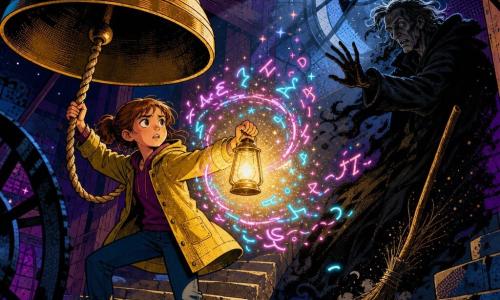
Chapter 1: The Cardboard Teeth
In Larkspur Town, stories didn't just get told—they got built.
They were folded from paper, stitched from whispers, and finished with a grin of cardboard teeth. If you listened closely at bedtime, you could hear them chattering softly on shelves like polite skeletons applauding in the dark.
Mina Graves was eleven, small enough to slip through crowded aisles at the Storyworks Shop, but old enough to notice the way adults pretended not to notice certain things. Like how the library's shadows didn't always match the lamps.
Mina's mother worked at Storyworks, where the air smelled of ink and cinnamon and old storms. Mina often helped after school, stacking finished tales in neat piles. Each one had a mouth—paper lips, cardboard teeth—because in Larkspur, a story was supposed to bite just a little, the way a good mystery nips your curiosity.
“Careful with that one,” her mother warned one evening as Mina lifted a thin, black-covered booklet whose teeth were unusually sharp. “It's a midnight tale.”
Mina tilted it, watching its grin click-click like tiny dominoes. “All the tales have teeth.”
“Yes,” her mother said, smoothing Mina's hair. “But some of them remember how to use them.”
Mina pretended to laugh, because laughter was a flashlight. Still, she felt her secret dream flutter inside her ribcage like a moth: she wanted to teach an shadow not to go too far.
Not any shadow. Hers.
Mina's shadow had been bold lately, stretching like a cat that owned the world. It slid ahead of her in hallways, leaned too close to other people's feet, and once—only once—had crept up the wall of the library when Mina wasn't looking, as if it wanted to climb out of her life and into its own.
She had tried scolding it, of course. “Stay,” she whispered one morning. “Behave.”
Her shadow only wriggled, long and smug, as if it were chewing a joke with invisible teeth.
That night, after closing, Mina swept the shop while her mother counted coins. The lamps hummed. The shelves loomed like friendly giants. And in the far corner, behind the newest stack of toothy tales, Mina noticed a door she had never seen before.
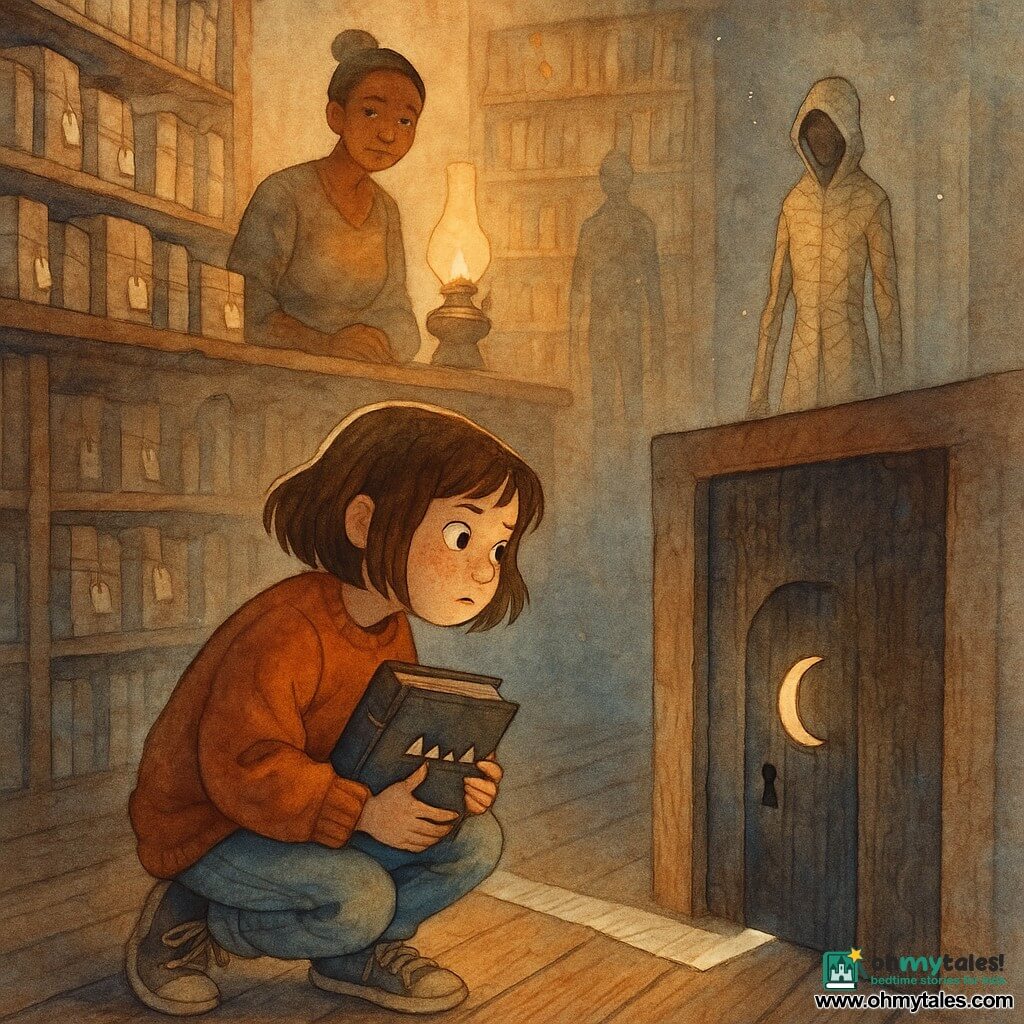
It was small—child-sized. The wood was the color of bruises. No handle. Just a keyhole shaped like a crescent moon.
On the floor in front of it, her shadow paused.
Then it pointed itself straight at the door, like an arrow made of darkness.
“Mina?” her mother called. “Time to go.”
Mina swallowed. The door seemed to breathe, faintly, like it was asleep and dreaming.
She stepped back quickly, and her shadow snapped back under her feet—too fast, like a dog yanked by a leash.
But as Mina turned off the last lamp, she could have sworn she heard a soft cardboard chomp from behind the shelves, as if some story had woken up hungry.
Chapter 2: The Door That Wasn't There
The next day, Mina tried to act normal, which was hard when your shadow felt like a rebellious twin.
At school, she sat by the window and watched clouds drift like slow ships. A boy named Ellis tapped his pencil and whispered, “You look like you stayed up reading ghost stuff.”
“I didn't,” Mina lied. The truth was worse: she'd stayed up watching the corner of her room where her shadow pooled, darker than it should be, as if it had been mixing itself a thicker ink.
At lunch, her friend Zara waved a hand in front of Mina's face. “Hello? Earth to Mina.”
Mina blinked. “Sorry. I'm… thinking.”
“About what?”
Mina pictured the little bruised door. The crescent keyhole. The way her shadow had aimed at it like it had been waiting its whole life for that moment.
“About boundaries,” Mina said.
Zara snorted. “That's the most adult word you've ever used.”
Mina smiled because she didn't want to scare Zara with the truth. Empathy, her mother always said, wasn't just feeling your own feelings—it was caring about what your feelings might do to other people.
After school, Mina walked back to Storyworks. The shop bell jingled like a tiny laugh. Warm light spilled across the floorboards. Everything looked ordinary enough: shelves, ladders, ink-stained tables.
But Mina headed straight for the far corner.
The new stack of midnight tales was still there, their cardboard teeth peeking out like crooked grins. Mina eased them aside.
No door.
Just a wall.
She blinked hard, as if her eyes were smudged. She ran her fingers along the wood paneling. Solid. Smooth. Unbroken.
Her shadow stretched forward, searching, wavering like smoke.
“Don't,” Mina whispered through her teeth. “You're not allowed to… to wander.”
The shadow quivered. It didn't listen.
When Mina looked down, she saw something that made her stomach shrink: her shadow was not attached to her shoes. It was a half-step ahead, as if the sun inside the shop had shifted without permission.
Mina stamped.
Her shadow didn't jump like it usually did. It stayed where it was—defiant, stubborn, a smudge that refused to be erased.
“Mina!” her mother called from the counter. “Can you bring me the ledger?”
Mina dragged her feet toward the front. The shadow followed, but slowly, like it didn't want to leave the corner.
All evening, Mina felt it tug, like a kite string pulling her toward a storm.
When closing time came, her mother locked the front door. “You're quiet today,” she said gently. “Is something bothering you?”
Mina wanted to say: My shadow is learning bad manners. There is a door that appears when it wants. I think stories are chewing in the dark.
Instead she said, “Can a shadow get… lost?”
Her mother paused, keys in hand. In the dim shop, her mother's face looked older, carved by lamplight and worry.
“A shadow,” her mother said carefully, “goes where the light tells it to. But sometimes… it goes where the heart tells it to.”
Mina's throat tightened. “And if the heart is confused?”
Her mother knelt so their eyes were level. “Then you don't fight the shadow with anger. You guide it with understanding. Shadows are scared things, Mina. They act brave, but they're made of what we hide.”
Mina nodded, but her shadow slid over her mother's shoes like a rude cat brushing past, and Mina felt a jolt of embarrassment on its behalf.
“I'm sorry,” Mina murmured—not sure if she meant her mother or her shadow or herself.
As they walked home, the streetlamps painted the pavement with long black ribbons. Mina's shadow stayed close for once, but Mina could feel its attention turned backward, like it was listening for the chomp-chomp of cardboard teeth behind them.
Chapter 3: The Midnight Tale's Whisper
That night, Mina couldn't sleep.
The house was quiet except for the radiator ticking like a tiny, patient clock. Moonlight spilled across Mina's bedroom floor. Her shadow lay there, wide and restless, like a blanket that wouldn't settle.
Mina sat up and whispered, “Okay. We need rules.”
Her shadow didn't move, but Mina felt it listening. Shadows, she had learned, listened with their whole bodies.
“Rule one,” Mina said. “You stay with me.”
The shadow rippled, as if laughing silently.
“Rule two,” Mina continued, trying not to feel silly. “You don't climb walls. You don't touch other people. You don't—”
Something tapped at her window.
Mina froze. Her heart thudded like a fist on a door.
Tap. Tap.
She slid out of bed and crept closer. Outside, the night was a black pond. The branches of the maple tree scratched the glass like fingernails.
Then a face appeared in the window—pale, round, and smiling.
Mina gasped, stumbling back.
The face blinked. It was not a person at all. It was a book cover.
A midnight tale had pressed itself against the outside of her window, its cardboard teeth chattering softly in the cold. Somehow, it had climbed up from the street like a spider made of paper.
Mina's mouth went dry. The tale's eyes were drawn in ink—simple circles with heavy lids—but they looked knowing.
The book's mouth opened, and the cardboard teeth clicked like castanets.
“Mina,” it whispered. The voice was like pages turning too fast.
Mina backed away until her calves hit the bed. “How do you know my name?”
The book's cover bent as if shrugging. “Stories know the people who carry them.”
“I didn't carry you,” Mina said. She glanced at the floor.
Her shadow had stretched toward the window, eager as a dog hearing its leash.
The midnight tale whispered again. “Your shadow is hungry.”
Mina's stomach clenched. “It's not hungry. It's… it's confused.”
The book's cardboard teeth chomped once, softly, like a warning. “Confusion is a cupboard. Hunger hides inside.”
Mina swallowed. “What do you want?”
“To be read,” the tale breathed. “To be finished. To be… returned.”
“Returned where?”
The book leaned closer, pressing its paper forehead against the glass. Its ink eyes seemed to darken.
“Behind the door that wasn't there.”
Mina's skin prickled. The bruised door. The crescent keyhole. She had thought it was a trick of tired eyes. But here was a book on her window, saying the same secret words.
“Why me?” Mina asked.
The book's voice softened, becoming almost kind. “Because you noticed. Because you care. Because your shadow is already half in the story.”
Mina looked down.
Her shadow had slipped farther than before—snaking across the floor, stretching thin, reaching for the window as if it wanted to climb out and join the midnight tale in the cold.
“Stop!” Mina hissed.
The shadow paused, trembling like a held breath.
Mina pressed her palm to the floor, right where the shadow began. “Listen,” she said quietly, feeling ridiculous and brave at the same time. “I know you're curious. I know you feel… pulled. But I'm scared too.”
Her shadow shivered, as if it hadn't expected her to admit that.
Mina spoke more gently. “If you go without me, you'll get lost. And if you scare people, they'll fear you. And if they fear you, you'll be alone.”
The shadow drew back a little, as if the word alone had weight.
The midnight tale clicked its teeth. “Empathy,” it murmured. “A lantern in a tunnel.”
Mina exhaled. “Okay. I'll return you. But my shadow stays with me.”
The book's cover smiled wider, all cardboard and moonlight. “Then come,” it whispered. “Tomorrow. After closing. Bring courage. Bring kindness.”
“And bring…” Mina added, watching her shadow, “boundaries.”
The midnight tale's teeth clicked in approval. Then it slid down the window and vanished into the night like a leaf carried by dark water.
Mina climbed back into bed. Her shadow curled close, smaller than usual, as if it had finally understood it could be frightened too.
For the first time in days, Mina almost slept.
Chapter 4: The Crescent Keyhole
The next evening, Mina stayed at Storyworks until the last customer left and the bell gave its final jingle.
Her mother was in the back room, wrapping deliveries. “You can head home, Mina,” she called. “I'll be a while.”
Mina's pulse fluttered. “I'll just… tidy the corner shelves.”
Her mother didn't question it. Adults, Mina thought, sometimes trusted children too much, and sometimes not enough.
Mina walked to the far corner where she'd seen the door. The air there felt cooler, like the shop had a secret draft. The midnight tales on the shelf seemed to grin at her, their teeth bright in the lamplight.
Her shadow stretched forward, eager.
Mina held up a finger. “Slowly.”
The shadow hesitated. Then it shortened, as if reluctantly agreeing.
Mina reached for the thin black-covered midnight tale—the one with the sharp teeth. The moment her fingers touched it, the cardboard teeth clicked hard.
“Easy,” Mina whispered. “I'm helping.”
She pulled the tale free and tucked it under her arm. It felt colder than paper should.
Then she stepped closer to the wall.
At first, there was nothing. Just wood panels and the faint smell of glue.
Mina took a breath and said, “I'm here to return a story.”
Her words hung in the air like a charm.
The wall shimmered.
A line appeared, thin as a pencil mark. Then it widened, and the bruised little door unfolded from the wood as if the wall had been hiding a folded secret. The crescent keyhole winked at Mina.
Her shadow surged forward.
Mina tightened her grip on the book and spoke firmly. “With me.”
Her shadow paused, then slid back under her feet, pressed close like a child holding a parent's hand.
Mina stared at the door. No handle. No knob. Only the crescent.
“I don't have a key,” she whispered.
The midnight tale under her arm gave a quiet chomp.
Mina looked down at her shadow and remembered her mother's words: Shadows are made of what we hide.
Mina knelt. “Maybe you're the key,” she told it softly. “But you don't get to unlock everything you want. You unlock what we agree to unlock.”
Her shadow flickered.
Mina placed the book on the floor in front of the door. Its teeth clicked, impatient.
Then Mina lifted her hand and held it over the crescent keyhole. Moon-shaped. Like a smile turned sideways.
She leaned closer and whispered, “I'm not here to fight. I'm here to understand.”
Her shadow rose up her legs like ink climbing a pen. It pooled under her palm, cool and velvety.
The crescent keyhole darkened, drinking the shadow like a sip of night.
Click.
The door swung inward without a sound.
Behind it was not a room, but a corridor made of paper and dim light, as if someone had built a hallway out of half-finished pages. Words crawled across the walls like sleepy ants. Far away, something sighed—long and slow.
Mina's mouth felt tight. She wanted to run to her mother and confess everything.
But then she imagined her shadow slipping away on its own, wandering into that paper corridor, bumping into strangers, causing trouble because it didn't know where to stop.
She imagined the shadow alone.
Empathy, she reminded herself, wasn't just kindness for others. It was kindness for the parts of yourself that didn't know how to behave yet.
Mina picked up the midnight tale. “Stay close,” she told her shadow.
The shadow pressed to her heel.
Mina stepped through the door.
It closed behind her with a soft cardboard chomp.
Chapter 5: The Library of Unfinished Frights
The corridor led Mina into a place that made her breath catch.
It was a library, but not like the one in town. This library was a hollowed-out hush. Shelves spiraled upward like the ribs of a giant whale. The books didn't sit still; they shifted and leaned and whispered, their cardboard teeth clicking like distant rain.
Above, a ceiling of dark glass reflected Mina and her shadow—except the reflection lagged, as if it was thinking before it copied.
“Mina,” a voice said.
Mina turned.
A figure stood at the end of the aisle, tall and thin as a bookmark. It wore a coat made of stitched pages, and its head was a hood of shadow. Where its face should be, there was only darkness—smooth, blank, and listening.
Mina's knees went watery. She held the midnight tale like a shield. “Who are you?”
The figure bowed slightly. When it moved, paper rustled.
“I am the Editor,” it said. The voice was dry, like parchment. “I keep what people begin and do not finish. I mend what they abandon. I shelve what they are too afraid to read.”
Mina's shadow twitched at her feet, stretching toward the Editor as if pulled by a magnet.
The Editor tilted its hood. “Ah. A lively one.”
“It's mine,” Mina said quickly. “And it stays with me.”
The Editor's darkness seemed to smile, though it had no mouth. “Does it?”
Mina swallowed. The library felt like a dream where you couldn't remember the rules. “I brought the midnight tale back,” she said, setting the book on a nearby table.
The tale's cardboard teeth clicked with relief, like a door locking safely.
The Editor drifted closer. “Good. This story escaped. It likes to feed on curiosity.”
“Feed?” Mina echoed.
The Editor's paper coat fluttered. “Not on flesh. On attention. On fear. On the little gasp people make when the room goes quiet.”
Mina shuddered. “So you lock scary stories in here?”
“I keep them where they belong,” the Editor said. “So they do not bite too hard.”
Mina looked around. Some books had enormous teeth, like goofy cartoon wolves. Others had tiny teeth, like nervous mice. A few had no teeth at all, only stitched mouths—stories that could not speak.
“My shadow,” Mina said, forcing herself to meet the Editor's blank darkness, “has been trying to run away. Has it… been called here?”
The Editor lifted a long finger, page-thin. It pointed at the ceiling of dark glass, where Mina's reflection wavered.
“Shadows are curious,” the Editor said. “They want to step beyond. They want to be first. They want to be seen.”
Mina's throat tightened, because that wasn't only about her shadow. That was about her, too—about the times she wanted to shout her answer in class, the times she wanted to storm away when she felt misunderstood.
“So what?” Mina demanded, voice shaking. “You want to take it?”
The Editor's coat sighed. “Not take. Teach.”
Mina hesitated. Teaching didn't sound like stealing. But the library's whispering shelves made her feel watched.
“How?” Mina asked.
The Editor moved its hand, and the air shimmered. A book floated off a shelf and opened by itself. Its pages were blank except for a single sentence written in looping ink:
A SHADOW THAT CROSSES EVERY LINE BECOMES A MONSTER TO EVERYONE ELSE.
Mina stared at the words until they felt like a pebble in her shoe.
“My shadow isn't a monster,” Mina said fiercely.
The Editor's hood dipped. “No. It is only untrained. Like a dog that has never been taught where the yard ends.”
Mina thought of her secret dream—teaching her shadow not to overstep. It had sounded silly before, like trying to teach the wind manners. Here, in this toothy, whispering library, it suddenly felt real.
“How do I train it?” Mina asked.
The Editor extended a palm. Resting on it was a strip of pale paper, folded into the shape of a small fence.
“A boundary,” the Editor said. “Not a prison. A promise.”
Mina reached for it. The fence felt warm, like it had been held in someone's hands for a long time.
“You will place this where your shadow likes to wander,” the Editor continued. “And you will explain why. Not with anger. With empathy.”
Mina frowned. “You want me to… talk to it.”
The Editor's blank face turned toward her shadow. “It has been listening all along.”
Mina looked down. Her shadow was still, oddly small, like it was trying to make itself less noticeable.
Mina crouched and whispered, “Do you know you've been scaring me?”
Her shadow trembled.
“And you've been embarrassing me,” Mina added, softer, “when you touch other people's feet or stretch ahead like you don't need me.”
The shadow quivered again, a nervous ripple.
Mina took a breath. “But I think… you're scared too. Maybe you think if you don't explore, you'll disappear.”
Her shadow stretched slightly, then shrank back, as if caught.
Mina's chest ached with a strange tenderness. “You don't have to prove you exist,” she said. “I know you're there. You're part of me. But we can't hurt others to feel real.”
The library seemed to quiet, as if it were listening.
The Editor placed the paper fence in Mina's hands. “One more thing,” it said. “A boundary only works if you keep it, too.”
Mina blinked. “Me?”
“Yes,” the Editor said. “If you ignore your own feelings, your shadow will act them out.”
Mina thought of all the times she swallowed words, stuffed fears into silence like clothes into an overfull drawer. No wonder her shadow was bursting out.
“I'll try,” Mina whispered.
The Editor stepped back, and the corridor behind it appeared again, like a page turning to the way out.
“Return,” the Editor said. “And be kind to what follows you.”
Mina clutched the paper fence and the midnight tale, and she walked back through the whispering shelves while stories chattered with cardboard teeth, not hungry now—just curious.
At the door, Mina glanced back once.
The Editor stood among the books like a bookmark holding the place.
Then Mina stepped through, and the bruised door folded away behind her.
Chapter 6: The Line on the Floor
Back in Storyworks, the lamps hummed as if nothing had happened. The shelves looked ordinary. The air smelled like ink and cinnamon again, not like dust and secrets.
Mina's hands shook. She stuffed the midnight tale back into its stack. Its cardboard teeth clicked once, satisfied, like a cat curling into sleep.
Her shadow stayed close, unusually quiet.
Mina hurried home, the paper fence tucked safely in her pocket like a fragile idea.
In her bedroom, she placed the fence on the floor near the wall where her shadow had tried to climb. It unfolded by itself into a neat little line—only an inch tall, but bright as moonlight against the boards.
Her shadow approached it cautiously, stretching forward.
Mina sat cross-legged and patted the floor beside her. “Come here.”
The shadow slid to her side, pooling like ink spilled carefully.
Mina swallowed. Talking to a shadow felt like talking to a feeling you'd named. But maybe that was the point.
“This is a boundary,” Mina said. “It's not because I hate you. It's because I care about us. About other people. About… not turning into something that scares everyone.”
Her shadow wavered.
Mina continued, voice softer. “When you go too far, I feel like I'm losing control. And when I feel that, I get angry at you. But really, I'm angry at myself for not saying what I need.”
She took a breath, tasting honesty like a new fruit.
“So here's the deal,” Mina said. “You can stretch. You can wiggle. You can be curious. But you don't cross this line unless I say it's okay. And if you want something—if you're scared, or lonely, or bored—you tell me. In your shadow way. And I'll listen.”
The shadow pulsed once, like a heartbeat.
Mina waited.
Slowly, her shadow extended toward the fence. Its edge touched the paper line—
And stopped.
It didn't cross.
Mina's eyes stung with relief she hadn't expected. “Good,” she whispered. “Thank you.”
The shadow curled back toward her, smaller, calmer, as if it had finally found a seatbelt.
Over the next few days, Mina practiced. When she felt nervous at school, she admitted it to herself instead of pretending she was fine. When she felt jealous of Zara's easy jokes, she named it quietly: jealousy, green as a frog, hopping around in her chest. When she felt left out, she didn't let the feeling hide in the cupboard of silence—she opened the door and looked at it.
And each time Mina did that, her shadow behaved better, like a dog that trusts it won't be abandoned.
One afternoon, Ellis waved at Mina across the classroom. “You okay today?”
Mina considered lying out of habit. Then she remembered the Editor's warning.
“I'm a little worried,” Mina admitted. “But I'm handling it.”
Ellis nodded, surprisingly gentle. “That's… brave.”
Mina smiled. Her shadow on the floor didn't stretch ahead. It stayed beside her desk, calm as a dark ribbon.
That night, Mina lay in bed listening to the house settle. The paper fence glowed faintly on the floor.
Her shadow rested within its safe space, no longer trying to climb the walls.
But just as Mina's eyelids grew heavy, she heard it: a faint click-click, like cardboard teeth tapping together from far away.
Mina sat up, heart thumping.
The sound came from her window.
She crept closer.
Outside, the midnight tale hovered on the sill like a dark moth. Its cardboard teeth chattered softly, not hungry—urgent.
“Mina,” it whispered through the glass. “The Editor is… slipping.”
Mina's stomach dropped. “What do you mean?”
The tale's ink eyes looked smudged with worry. “Something is chewing through the shelves. A story that doesn't want boundaries. A story that wants every shadow to run free.”
Mina's shadow stirred behind her, restless again, as if it had heard its name.
Mina swallowed fear like a bitter pill. “What do I do?”
The midnight tale pressed its cover to the glass. “You go back,” it breathed. “But this time, you don't go for your shadow. You go for theirs.”
Chapter 7: The Story Without a Fence
Mina waited until the next evening, when her mother was busy with deliveries again. Her hands were cold, but her mind was steady. Fear, she realized, was a drum—you could march to it or you could let it chase you.
She tucked the paper fence into her pocket and went to the far corner of Storyworks.
“Show yourself,” Mina whispered.
The bruised door unfolded from the wall like a sigh.
This time, the crescent keyhole drank a tiny bit of her shadow without a fight. The door opened.
Mina stepped through.
The paper corridor was darker than before. The words on the walls looked smeared, as if someone had rubbed them with a dirty thumb.
The library beyond seemed restless. Books trembled on shelves. Cardboard teeth clicked in nervous clusters, like a crowd whispering bad news.
And in the center aisle, something moved—tall, loping, wrong.
It was a story.
Not a book, not exactly. More like a bundle of pages torn loose and wrapped around itself into a shape that walked. Its mouth was huge, lined with cardboard teeth big as bottle caps. Its pages were blank, as if it had eaten its own words.
It prowled between shelves, biting at shadows. When it snapped, the air shuddered, and the shadows of nearby books jerked like they'd been yanked.
Mina's heart hammered.
The Editor stood near the back, its paper coat torn, its hooded face tilted as if exhausted.
“The Unfenced Tale,” the Editor rasped. “It was never finished. It hates limits. It thinks boundaries are cages.”
The prowling story turned toward Mina. Its toothy mouth opened, and the sound that came out was a laugh made of ripping paper.
Mina's shadow tried to surge forward.
Mina planted her feet. “No,” she said firmly.
Her shadow shook, but it stayed.
The Unfenced Tale lunged, snapping at Mina's shadow like it was prey.
Mina yanked her shadow closer with sheer will, like pulling a curtain shut. The story's teeth clacked inches from her shoes.
“Mina,” the Editor whispered, voice thin. “It wants your shadow. It wants every shadow. It wants the world messy and scared because then it feels powerful.”
Mina swallowed. She remembered the sentence in the floating book: A shadow that crosses every line becomes a monster to everyone else.
But she also remembered her mother's words: Shadows are scared things.
Mina looked at the Unfenced Tale, really looked—not at its teeth, not at its size, but at its blank pages.
No words.
No ending.
No comfort.
It was a story trapped in the middle of itself, forever running, forever biting, because it didn't know how to stop.
Empathy rose in Mina like a small, steady flame.
“You're scared,” Mina said, voice shaking but clear.
The Unfenced Tale froze. Its teeth clicked once.
“You think if you stop, you'll disappear,” Mina continued. “You think if you let anyone draw a line, you'll be trapped.”
The tale's pages fluttered, agitated.
Mina reached into her pocket and pulled out the paper fence. It looked tiny against the enormous mouth and hungry teeth.
“I'm not here to lock you up,” Mina said. “I'm here to help you feel safe.”
The Unfenced Tale lunged again, faster.
Mina didn't run.
She slid the fence onto the floor between them.
It unfolded into a glowing line, pale and calm.
The Unfenced Tale skidded, teeth clacking, and stopped right at the boundary—as if it had slammed into an invisible wall.
It shook, pages rustling wildly, furious and trembling.
Mina crouched, keeping her hands visible, her voice gentle. “This isn't punishment,” she said. “It's a promise. If you stay on your side, I won't hurt you. I won't tear you up. I won't throw you away.”
The Unfenced Tale's mouth opened and closed, its cardboard teeth clicking like nervous applause.
Mina continued, “But you can't bite everyone's shadows. You can't make people afraid just so you feel big.”
The tale's pages sagged slightly, as if tired.
The Editor stepped forward, paper coat fluttering. “It was written by a child who was never listened to,” the Editor said softly. “It grew teeth to be noticed.”
Mina's throat tightened. She imagined being so unheard that you became loud in the scariest way.
“I hear you,” Mina told the Unfenced Tale. “You don't have to chase shadows to exist.”
For a moment, nothing moved but the whispering shelves.
Then the Unfenced Tale did something unexpected: it lowered its head, and its huge mouth closed. The cardboard teeth tucked away like a wolf deciding not to bite.
A single word appeared on one of its blank pages, written in slow, careful ink:
STOP.
Mina exhaled, shaky. “Yes,” she whispered. “Stop is a word that saves.”
More words bloomed, one by one, like shy flowers:
BREATHE.
LISTEN.
ASK.
The Unfenced Tale's shape softened. The bundle of pages loosened and folded back into a book—not perfect, but whole. Its mouth shrank to a normal grin of small cardboard teeth. Not gone, just gentler.
The Editor's shoulders—if a hood of shadow could have shoulders—seemed to relax.
“You gave it an ending,” the Editor murmured. “Not with force. With empathy.”
Mina's shadow, beside her feet, settled like a cat finally home.
Mina picked up the newly formed book. It felt warm now, like it had found its heart.
“Where does it go?” Mina asked.
The Editor held out its hands. “On a shelf,” it said. “Not hidden. Not unleashed. Simply… placed.”
Mina set the book among the others. It clicked its teeth once, politely, then went still.
The library's whisper softened into something almost peaceful—a lullaby made of paper.
The Editor turned to Mina. “You have done what many cannot,” it said. “You drew a line, and you kept it kind.”
Mina's eyes stung. “I still get scared.”
The Editor's hood inclined. “Courage is not a wall,” it said. “It is a door you open while your hands are shaking.”
Mina nodded, and the corridor brightened, showing her the way back.
As she walked out, Mina glanced down at her shadow.
It stayed with her, not because it was trapped, but because it trusted her.
Chapter 8: A Shadow That Knows Its Name
The bruised door folded back into the wall at Storyworks, leaving only quiet wood panels and the smell of cinnamon.
Mina stood in the corner for a moment, listening. No hungry chomping. No urgent whispers. Just the soft hum of lamps and the distant sound of her mother humming in the back room.
Mina walked home under streetlamps that painted the sidewalks in gold and ink. Her shadow followed neatly, like a well-trained kite tail.
In her bedroom, she placed the paper fence on the floor again. It glowed faintly, a moonlit thread tying her to her own choices.
Mina lay down. Her shadow curled within the boundary line, calm as a settled pond.
“Mina?” her mother called softly from the hallway. “Are you awake?”
“Yes,” Mina said.
Her mother stepped in, hair loose, eyes gentle. She looked at Mina's face the way you look at a storm cloud to see if it's passing.
“You seem… lighter,” her mother said.
Mina hesitated. Some secrets were too strange to say out loud. But some truths deserved air.
“I've been trying to listen to myself,” Mina said. “And to… the parts of me that get scared.”
Her mother sat on the edge of the bed. “That's wise.”
Mina stared at the ceiling. “Do you think,” she asked quietly, “that being kind can be a boundary?”
Her mother brushed Mina's forehead with her fingertips. “Yes,” she said. “Kindness doesn't mean letting everything happen. It means caring enough to choose what should happen.”
Mina nodded slowly. Down on the floor, her shadow shifted, as if it agreed.
After her mother left, Mina whispered into the dim, “Goodnight.”
Her shadow lifted like a small wave, then settled again—obedient, not out of fear, but out of understanding.
And in the deep quiet of Larkspur Town, the stories on shelves clicked their cardboard teeth softly, not as a threat, but as a rhythm—like a bedtime song with just enough shiver to feel alive.
Mina closed her eyes.
Her secret dream had come true, not with shouting or wrestling, but with empathy: she had taught an overstepping shadow how to stop, how to listen, and how to stay.
In the darkness, the boundary line glowed once, like a gentle crescent moon.
Then everything, even the shadows, went peacefully still.