Chapter 1: The Backward Shoes
Mothfen was the kind of town that didn't try to be normal. It wore its oddness the way a crow wears shine—like it belonged.
Pip, a young stoat with a neat white stripe between his eyes, lived in a burrow under an old cobblestone path. He was straight-backed and careful, the sort of stoat who lined up his berries by size and always returned borrowed things with an extra thank-you.
And yet—every morning—his shoes betrayed him.
They were small leather shoes with brass buckles, made for quick feet and quiet steps. Pip placed them side by side each night, toes pointing toward the door, like two polite guests waiting to leave.
But when dawn crept in like a pale cat, Pip would wake to find them turned around.
Heel-to-heel. Toe-to-toe. Or worse—each shoe facing a different direction, as if they had argued in the dark.
Pip stared at them, whiskers twitching. “I'm not sleepy-walking,” he muttered. “I don't even like walking sleepy.”
His neighbor, Aunt Juniper the hedgehog, poked her head out of her garden tunnel when she saw Pip frowning at his feet.
“Shoes behaving again?” she asked, voice full of prickly kindness.
“They're… plotting,” Pip said.
Aunt Juniper chuckled. “In Mothfen, even teacups have moods. Don't let it boss you about. Tie your laces tight and mind your own path.”
But Pip couldn't.
Because he had a secret dream—bright as a lantern in his chest—to find out why shoes turned backward. Not just his. Lots of animals complained in whispers at the market: boots that swapped feet, slippers that shuffled under beds, sandals that faced the wall like they were sulking.
It felt like a riddle written in footprints.
That evening, Pip decided on a plan. He placed his shoes neatly. Then he sprinkled a thin line of flour around them, like a moonlit circle.
“If you move,” he told them, “you'll leave a message.”
The burrow grew quiet. The lamp flickered. Outside, wind combed the grass with cold fingers.
Pip lay awake, listening.
A soft scrape came from the corner.
Then another.
Pip held his breath so hard his ribs complained.
In the flour, something delicate stepped—tap, tap, tap—like a tiny dancer wearing invisible boots.
The shoes did not hop. They did not fly.
They were turned, slowly, carefully, by… something.
Pip sat up, heart thudding like a drum in a far-off parade. “Who's there?” he whispered.
The darkness didn't answer with words.
It answered with a long, thin sigh, as if the night itself had shifted in its sleep.
Chapter 2: The Alley of Lost Laces
In the morning, Pip followed the flour prints.
They were not paw prints. Not claw marks. Not even snail trails.
They were neat little dents, as if someone pressed the ground with the tips of knitting needles.
The trail led out of Pip's burrow, across the cobblestones, and into a narrow lane behind the market stalls. Animals avoided this place, mostly because it smelled of wet rope and old secrets. A crooked sign hung above it, creaking softly.
THE ALLEY OF LOST LACES.
Pip swallowed. His courage felt like a coat that was a size too big—heavy, but still warm.
A raven on a fencepost watched him with one bright, suspicious eye.
“Going lace-hunting, stoat?” the raven croaked.
“I'm going truth-hunting,” Pip said, trying to sound braver than his knees felt.
The raven fluffed its feathers. “Truth is slippery. Like a fish in a thunderstorm.”
“That's… a terrible place for a fish,” Pip replied.
The raven gave a sound that might have been laughter. “Name's Rook. If you're poking around strange corners, keep your ears open. Mothfen has corners that listen back.”
Pip stepped into the alley.
The light changed. It wasn't darker exactly—it was as if the air had been stained with ink. Strings dangled from above: shoelaces tied together, braided into thick ropes, knotted into dangling charms. Some laces were new and bright; others were frayed like tired smiles.
A wind sighed through the knots, and the laces whispered.
Pip could almost hear words in them, half-formed and hushed: left… right… turn… return…
At the end of the alley sat a door in a brick wall that should not have had a door at all. It was painted the color of midnight and had a handle shaped like a curled toe.
Pip reached out.
Before he touched it, a voice drifted down from somewhere above, like a spider thread brushing his ear.
“Shoes do not turn themselves.”
Pip jerked his head up. On a ledge sat a thin black cat with pale green eyes. Its fur looked like it had been dipped in shadow and sprinkled with starlight.
“You're a cat,” Pip blurted. “Cats don't usually—”
“—talk?” the cat finished, blinking slowly. “In Mothfen, even silence has a vocabulary. I am Nyx.”
Pip swallowed again. “Do you know why shoes turn backward?”
Nyx's tail flicked once, like a metronome keeping time for trouble. “I know where answers hide. Whether they want to be found is another matter.”
“I have to know,” Pip said. “It's like… like my feet are being argued with.”
Nyx slid down from the ledge without a sound. “Then you must meet the one who collects directions.”
“The one who—”
Nyx's eyes narrowed pleasantly, as if enjoying a scary story. “The Cobbler-in-the-Walls.”
Pip's ears flattened. “That sounds… very made up.”
Nyx leaned close. Her whiskers were cold as dew. “Most frightening things do.”
She touched the midnight door with one paw. It clicked open by itself.
From inside came the scent of old leather and candle smoke. And something else—something like rain on stone, the smell of underground places where echoes live.
Nyx nodded toward the opening. “If you walk in, stoat, walk in on your own. No one lends bravery. It's not the kind of thing that fits.”
Pip looked at the doorway. It looked back, a dark mouth waiting for a word.
Pip took a breath, straightened his little shoulders, and stepped through.
Chapter 3: The Cobbler-in-the-Walls
The door closed behind him with a soft, final sound—like a book shutting on a chapter you weren't ready to end.
A narrow passage stretched ahead, lit by candles stuck into cracks in the stone. Their flames leaned sideways, even though there was no wind. The air felt awake.
Pip walked, paws quiet. Nyx moved beside him, soundless as a thought.
The passage opened into a room that looked like someone had scooped it out of the earth with a careful spoon. Shelves climbed the walls, packed with shoes: tiny mouse slippers, sturdy badger boots, elegant fox loafers. Some were paired neatly. Others were stacked like sleeping bats.
In the center sat a workbench covered in tools: awls like sharp beaks, needles long as thorns, spools of thread that shimmered like spider silk.
And behind the bench, hunched like a bent question mark, was a figure.
It wasn't a human—there were no humans in Mothfen's stories anymore, only old echoes of them. This figure was a mole, but not like any mole Pip had seen. Its fur was ashy gray, its claws long and polished, its eyes covered by a strip of black cloth tied around its head.
It stitched without looking.
The needle flashed. The thread sang softly as it slid.
Pip's mouth went dry. “Are you… the Cobbler-in-the-Walls?”
The mole's snout lifted. “I am called that,” it said. Its voice sounded like gravel poured into a velvet bag. “Names are shoes, little stoat. Sometimes they fit. Sometimes they pinch.”
Nyx sat on a stool as if this was an ordinary errand. “He came for the turning,” she said.
The mole's claws paused mid-stitch. “Ah.”
Pip's heart banged. “So you're doing it. You're turning our shoes backward.”
“I do not turn,” the mole said. “I realign.”
“That's… the same,” Pip insisted.
The mole set the shoe down—an otter's boot with river mud still on it. “No. Turning is mischief. Realigning is mercy.”
“Mercy?” Pip echoed.
The mole tilted its head, listening to something Pip couldn't hear. “The paths have been confused lately. The town's compass is… tired. When animals walk too fast, when they chase noise instead of need, they wear grooves into the world. And the world begins to lean.”
Nyx's tail curled around her paws. “A leaning world makes crooked luck.”
Pip frowned. “So you make shoes face backward to… slow us down?”
The mole's claws tapped the table. Tap. Tap. Like punctuation. “To make you notice. To make you stop walking on habit.”
Pip's whiskers bristled. “But it's my choice how I walk.”
A pause. Candle flames bent toward Pip, as if curious.
The mole's voice softened, though it stayed rough. “Is it? Or do your feet follow the first thought that shouts?”
Pip wanted to argue, but he remembered how he had stomped out in a hurry yesterday, grumbling, not looking at the sky at all. He remembered bumping into a rabbit because he'd been thinking about breakfast instead of the path.
Still, annoyance flared in him like a match. “You can't mess with everyone's shoes. It's… it's controlling.”
Nyx watched Pip with bright, unreadable eyes.
The mole reached beneath the bench and pulled out Pip's shoes.
Pip gasped. “Hey! Those are mine!”
The mole held them gently, almost respectfully. “Your shoes are loud,” it murmured. “They dream of straight roads.”
“They're just shoes,” Pip said, but his voice wobbled.
“Everything that carries you has a memory,” the mole replied. “Leather remembers rain. Buckles remember pressure. Soles remember fear.”
Pip swallowed. “Then why do my shoes turn even when I'm careful?”
The mole's blindfolded face turned toward him, as if seeing without eyes. “Because you are close to the hinge of the problem. Because you ask when others only complain.”
Pip's stomach tightened. “What problem?”
The mole's claws slid across the workbench and picked up a spool of thread the color of twilight.
“The Direction-Thief,” it said.
Nyx's ears twitched. “So it has begun again.”
Pip's fur prickled. “Thief? Like… a criminal?”
“Not coins,” the mole said. “Not jewels. It steals ‘forward.' It nibbles at it. It chews it small. Then animals forget where they meant to go. They wander. They panic. They blame their shoes.”
Pip stared. The room suddenly felt narrower, as if the walls had inched closer to listen.
“How do we stop it?” Pip asked.
The mole's claws placed Pip's shoes on the bench, toes facing Pip. “With a choice made alone.”
Nyx's gaze sharpened. “Tell him.”
The mole's voice became a whisper with weight. “Tonight, the Direction-Thief will come for the Heart-Compass of Mothfen. If it takes it, the town will spin like a top until no one can stand. The only one small enough to follow it into the Hollow Seam is you.”
Pip's tail stiffened. “Me? Why me?”
“Because you dream of the why,” the mole said. “And dreams are doors.”
Pip looked down at his shoes. They seemed suddenly like two loyal dogs waiting for a command.
He breathed in. Fear tasted like metal. But underneath it, there was a calmer flavor—like warm bread.
“If I do this,” Pip said slowly, “I do it because I decide. Not because my shoes are shoved around.”
Nyx's mouth curved in a tiny, approving smile. “That's the first real step.”
Chapter 4: The Hollow Seam
That night, Mothfen's moon hung low, a pale coin caught in the branches.
Pip stood at the edge of the old cemetery grove—no humans slept here, only mossy stones that remembered names of animals long gone. The air was cool enough to make every breath visible, like ghost-thoughts.
Nyx walked beside Pip. The mole had not come; it had only given directions, scratched onto a strip of leather:
FOLLOW THE BACKWARD PRINTS. DO NOT FOLLOW THE VOICES.
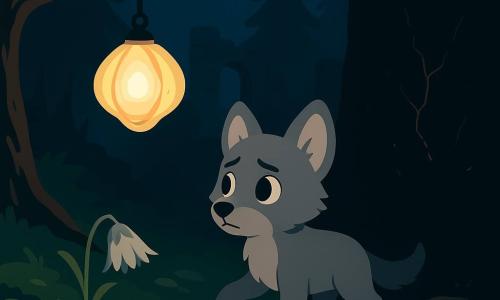
Pip held a small lantern in his mouth. Its light bobbed with each step, painting the trees in trembling gold.
“Are you scared?” Nyx asked, not teasing.
Pip huffed around the lantern. “My insides are doing cartwheels.”
“That's normal,” Nyx said. “Courage isn't the absence of fear. It's fear wearing a brave hat.”
Pip snorted. “A very wobbly hat.”
They reached a split in the path. One side led to the river, its murmur soft as a lullaby. The other side led into thicker trees where the shadows piled up like folded blankets.
On the ground, in damp soil, were prints—those neat needle-tip dents.
Backward prints.
Pip's paws tingled. “So it's real.”
Nyx's eyes gleamed. “Real enough to bite.”
They followed the backward prints into the thick trees. The lantern light caught on hanging threads between branches—silvery strands that hummed faintly. Pip ducked and shivered as a thread brushed his ear. It felt like a whispered warning.
Soon they found a crack in a large stone, half hidden under ivy.
It looked like a seam in the world, as if the earth had been stitched and the thread had snapped.
A cold draft breathed out. The lantern flame leaned away.
Nyx sat back on her haunches. “This is the Hollow Seam.”
Pip peered into the crack. Darkness pooled there, deep and glossy, like ink in a well.
From within came a faint sound: scuff… scuff… scuff…
Like feet dragging.
Pip's shoes, on his own feet, suddenly pulled tight, as if bracing.
“I go in,” Pip said, voice small but steady.
Nyx's tail flicked. “I'll wait here. The Seam doesn't like company. Besides, someone has to pull you out if you forget which way is you.”
Pip tried to laugh, but it came out thin. “How do I not forget?”
Nyx leaned forward and tapped Pip's chest with one paw. “Keep listening to that. Not to the dark. Not to me. To you.”
Pip nodded. He took one last breath of outside air—leafy, damp, alive.
Then he squeezed into the crack.
The world tightened around him. Stone pressed close like cold shoulders in a crowd. The lantern light became a narrow, trembling ribbon.
He crawled, claws scraping. The air smelled of dust and old leather. Then, suddenly, the passage widened, and Pip dropped onto soft ground.
He landed in a cavern made of shadow. The lantern light didn't spread properly here. It clung to Pip like a shy friend.
In the center of the cavern stood a thing like a spindle, tall and thin, wrapped in countless shoelaces. The laces twitched as if breathing.
And beside it, hunched and humming, was a creature.
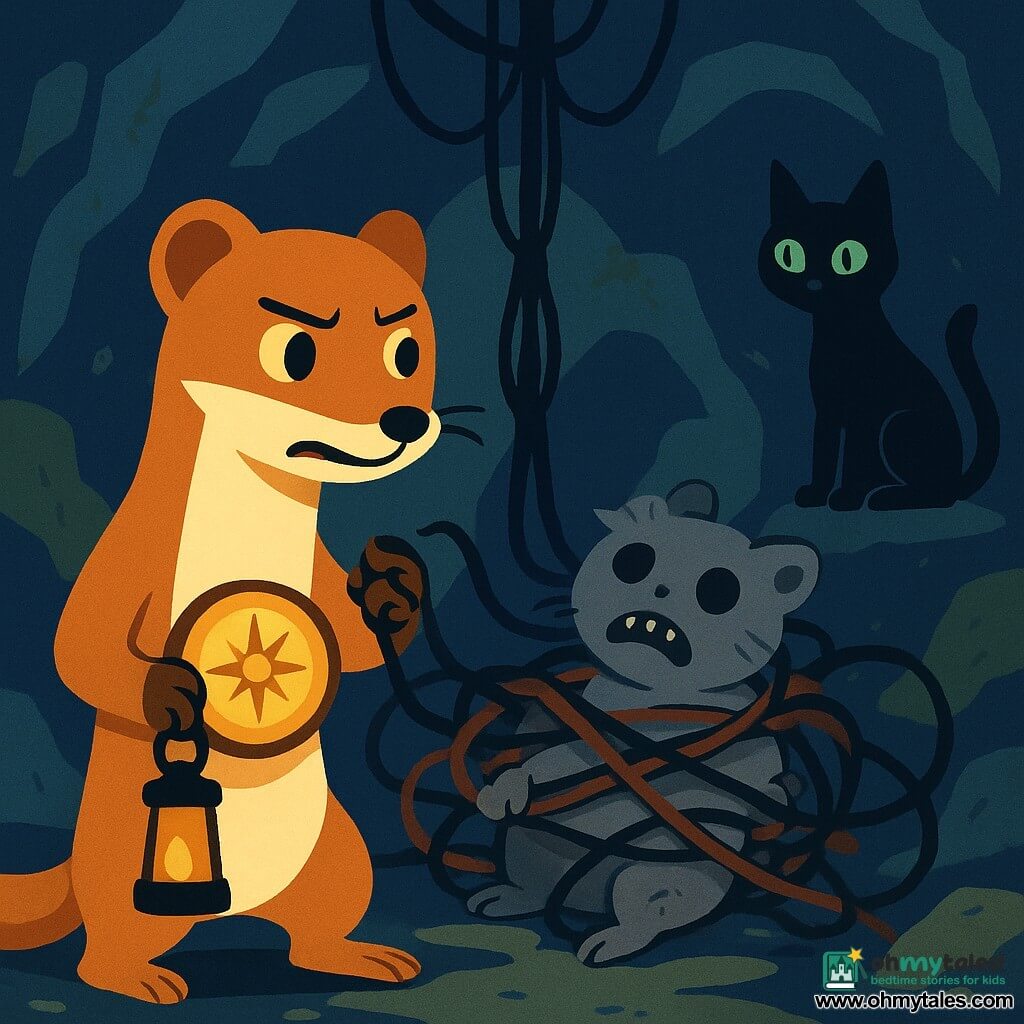
It was small—smaller than Pip expected—but wrong in a way that made Pip's teeth ache. It had the shape of a weasel, but its fur looked like smoke that couldn't decide where to go. Its eyes were two dull buttons, and its mouth—oh, its mouth was a zipper, half-open, showing darkness between its teeth.
It held something in its paws: a compass made of amber, glowing softly, pulsing like a heartbeat.
The Heart-Compass.
Pip's throat tightened. So this was the Direction-Thief.
The creature lifted its head as if smelling him.
Its zipper-mouth rasped. “Fooooorward…”
Pip's paws went cold. The lantern flickered.
The Direction-Thief took a step closer, and the laces around the spindle rustled like nervous snakes.
Pip backed up, then stopped himself.
No running on habit.
He planted his feet.
“My town needs that,” Pip said, voice trembling but clear.
The Direction-Thief tilted its head, almost curious. “Needs… is… a leash.”
Pip swallowed. “No. Needs is a map. And you're chewing holes in it.”
The creature's zipper-mouth widened. “Give… me… your forward.”
A whisper rose from the cavern walls—soft, tempting voices:
Go back. Hide. Let someone else do it. You're small. You're only a stoat.
Pip remembered the mole's warning: DO NOT FOLLOW THE VOICES.
He shut his eyes for one heartbeat. He listened inward, the way Nyx had said.
Inside, he found a quiet place. A small, steady drum.
His own decision.
Pip opened his eyes. “No.”
The Direction-Thief's fur rippled. It lunged.
Chapter 5: The Knot of Choice
Pip jumped sideways. The creature's claws scraped the ground, sparks of coldness skittering like beetles.
The Heart-Compass swung in its paws, glowing brighter, as if frightened.
Pip's mind raced. He was not the strongest. He was not the fiercest. But he was quick, and he was careful—and he had something the Direction-Thief didn't.
A sense of where he meant to go.
The creature circled him, silent except for that zipper rasp. “Forward… forward… delicious…”
Pip's shoes suddenly tugged again, trying to swivel on his feet. For a terrifying moment, Pip felt his own toes wanting to turn. Wanting to obey the pull of the cavern.
The Direction-Thief smiled with its zipper. “Even shoes… know… me.”
Pip gritted his teeth. “My shoes don't tell me who I am.”
He looked around. The spindle of laces in the center pulsed like a trapped storm. If the Direction-Thief stole forward, maybe it stored it there, knotted up and tangled.
Pip darted toward the spindle. The creature hissed and rushed after him.
Pip reached the laces and grabbed handfuls. They were cold and alive, squirming like a nest of worms. He fought the urge to fling them away. Instead, he pulled hard, yanking a thick knot loose.
The laces snapped taut, and the spindle shuddered.
A sound burst out—not a voice, but a feeling. The feeling of taking the right turn home. The feeling of remembering what you promised. The feeling of standing up straight when someone tries to bend you.
Pip's chest warmed.
The Direction-Thief screeched, zipper-mouth clattering. It stumbled back as if the warmth stung.
Pip realized, with a sudden, fierce clarity: the creature didn't like choice. It liked confusion. It liked animals moving like sleepwalkers.
So Pip made a choice, sharp as a needle.
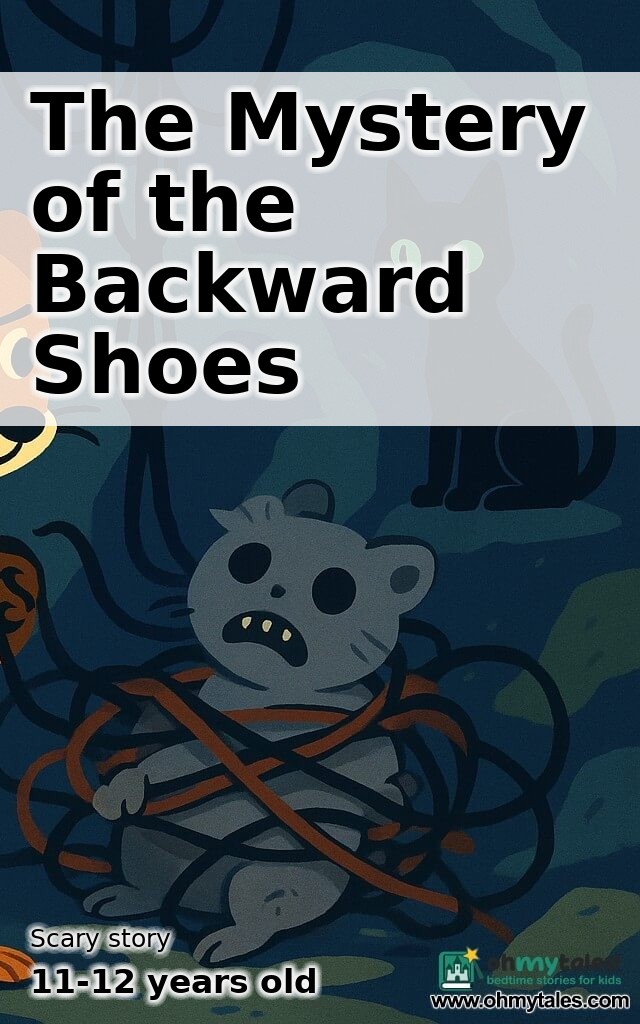
He pulled more laces free and began tying them—fast, clumsy, determined—around the Direction-Thief's ankles as it lunged again.
The creature fought, smoke-fur flaring, but Pip kept tying, knot after knot. His paws hurt. The laces wriggled, trying to escape his grip, but Pip's stoat fingers were nimble.
“Stop!” the creature rasped. “No knots! No… decisions!”
Pip's breathing came in short bursts. “Knots are just decisions you can't undo easily.”
He yanked the last lace tight. The knot cinched with a satisfying little tug.
The Direction-Thief toppled, tangled in its own stolen strings.
The Heart-Compass rolled from its paws and spun on the ground, light wobbling.
Pip dove for it.
The moment his paws touched the amber, warmth flooded up his arms like sunrise. The compass needle steadied, pointing—not north, not south—but toward something deeper.
Toward home.
The cavern shook. The spindle of laces shuddered violently, and the whispers on the walls rose into a storm.
Give it back. Drop it. You'll be lost. You'll be alone.
Pip clutched the Heart-Compass to his chest. “I'm already alone in here,” he said through clenched teeth. “And I'm still choosing.”
The Direction-Thief writhed, smoke-fur unraveling at the edges.
“You can't keep forward,” Pip said, voice louder now. “Forward belongs to the one walking.”
The creature's zipper-mouth buzzed like angry insects. “Then… I will… take… you.”
It strained against the knots. The laces creaked. One snapped.
Pip's stomach dipped. He had seconds.
He looked for the backward prints, for the seam, for anything.
Then he saw it: the lantern light, weak as it was, made a faint reflection on the ground—a trail of tiny shiny dents, like the needle-tip prints, but brighter.
A path out.
Pip sprinted.
Behind him, the Direction-Thief shrieked, a sound like fabric tearing. The cavern's darkness lunged too, reaching with long, cold fingers.
Pip ran on purpose, each step a sentence.
I choose. I choose. I choose.
The path narrowed. Stone pressed close again. Pip shoved himself into the tight passage, Heart-Compass tucked under his chin, lantern bouncing.
A cold hand of shadow brushed his tail.
Pip kicked hard, wriggling forward.
Then the crack widened, and he spilled out into the cemetery grove, gulping air like it was water.
Nyx was there instantly, eyes wide. “Pip!”
Pip panted, holding up the Heart-Compass. “Got it.”
Behind him, the crack in the stone trembled, as if something inside was furious.
Nyx grabbed Pip by the scruff—gentle but firm—and dragged him away from the seam as it snapped shut with a noise like a stitched wound closing.
Silence fell.
Only the river, far off, kept speaking.
Chapter 6: Facing Forward, On Purpose
By morning, the market in Mothfen buzzed with cautious relief. Animals stepped carefully, testing their feet like they were meeting their own shoes for the first time.
The Cobbler-in-the-Walls stood in the Alley of Lost Laces with Nyx and Pip. The mole held the Heart-Compass in its claws, as if it were a living thing.
“You returned it,” the mole said, voice softer than before.
“I didn't return it,” Pip corrected, surprising himself. “I brought it back. Returning sounds like I borrowed it. It was stolen.”
Nyx's whiskers quivered, amused. “Listen to him.”
The mole dipped its head. “Words matter. Steps matter.”
Pip glanced at the hanging laces, which seemed quieter now, less twitchy. “So… will the shoes stop turning backward?”
The mole paused. “Not entirely. Sometimes a shoe turns because a path is wrong. Sometimes it turns because a mind is rushing. But the town's forward will no longer be eaten.”
Pip looked down at his own shoes. They sat on his feet, buckles bright, toes pointed ahead.
“Did I… beat it?” Pip asked, still feeling the cold brush on his tail in memory.
Nyx's gaze turned serious. “You didn't destroy darkness. No one does. You tied it up long enough to choose your way out. That's what matters.”
Aunt Juniper waddled into the alley, carrying a basket of warm rolls. “There you are! I heard the town slept steadier,” she said. She peered at Pip. “And you look like you wrestled a storm.”
Pip tried to grin. “A small storm.”
Aunt Juniper sniffed. “Well, eat a roll. Storm-wrestling is hungry work.”
Pip took one. It was warm and sweet, and it reminded him that the world had soft parts too.
He turned to the mole. “Why me, though? Why was I ‘close to the hinge'?”
The mole placed the Heart-Compass into a small niche in the wall, where it glowed gently, like a firefly that had learned to be patient. “Because you wanted to know why,” it said. “And because when the fear came, you did not wait for someone else to choose for you.”
Nyx added, “Autonomy, stoat. It's a fancy word for steering your own paws.”
Pip chewed thoughtfully. “So the answer to the backward shoes is… a warning?”
“A question,” the mole corrected. “Are you walking because you decided, or because you were pushed?”
Pip looked out of the alley toward the morning streets of Mothfen. The cobblestones shone with dew. The shadows were shorter now, but they still existed, tucked under carts and fences, minding their own business.
Pip tightened his buckles. Not too tight. Just right.
He took one step forward, deliberately.
Then another.
Behind him, a shoelace charm swayed gently, whispering like a lullaby:
Left. Right. Choose. Walk.
And for the first time, Pip didn't feel bothered by the mystery.
He felt ready for the next one.