Chapter I — The Man Who Loved the Turning
Hiroto walked under a sky that changed like a slow breath. He lived by a river that kept secrets and by a hill that wore small stones like medals. Every morning he watched the same world shift. One moment the maples blushed like shy faces. The next moment frost traced fine silver on the reeds. He loved how the world turned. He loved the hush between one change and the next.
Hiroto wanted something gentle and strange. He wanted a marriage of seasons. Not a wedding for two people, but a joining of spring to summer, summer to autumn, autumn to winter, winter to spring — a ring of vows that would keep the earth moving in kindness. He had read old bamboo scrolls in the shrine and had heard the wind sing names of yokai and kami. He believed that seasons were like good friends and that friends could promise to care for one another.
He made small offerings on the riverside: a cup of tea for the river, a ribbon for the wind, a pebble for the mountain. He whispered to the old willow, "Will you help me?" The willow only shifted its leaves, as if thinking. Hiroto waited. He learned to wait like the moon learns patience.
Chapter II — The Four Messengers
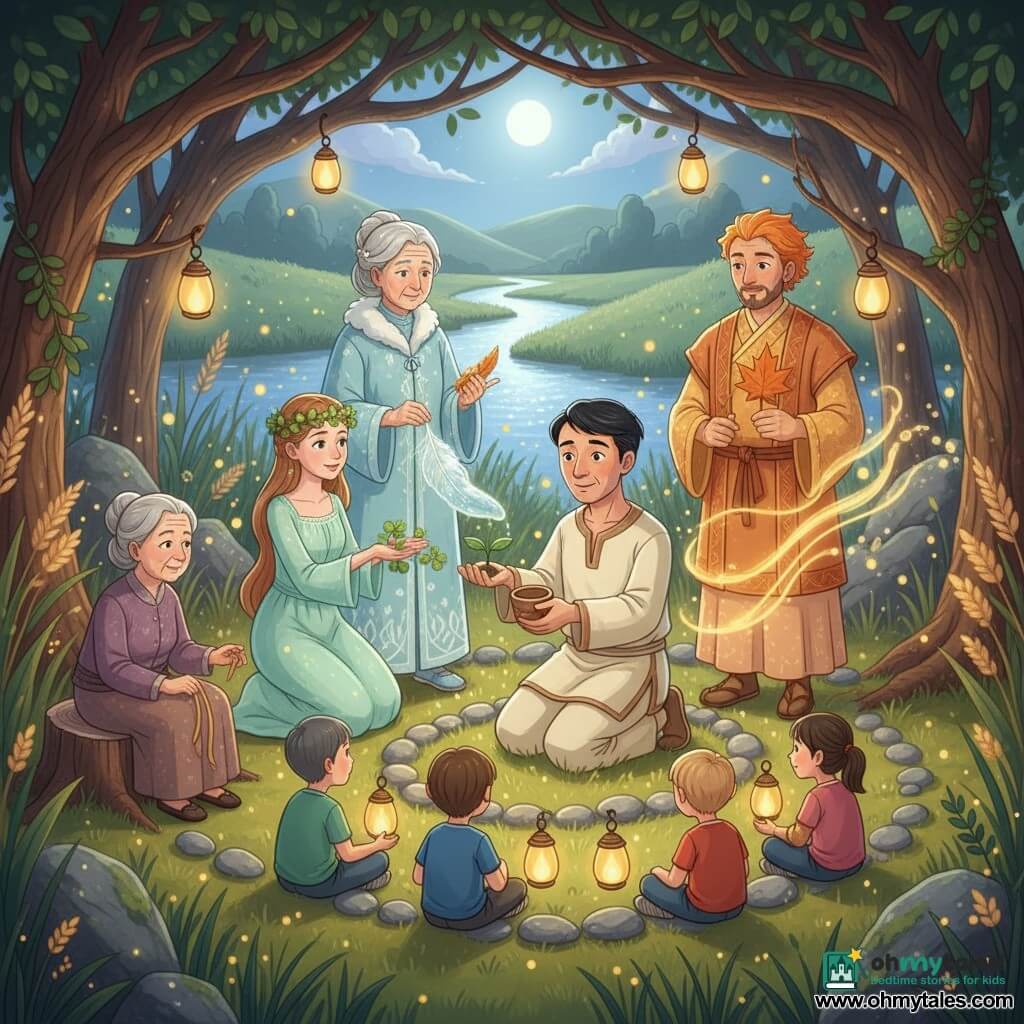
On a morning washed in pearly light, four figures came. They were not people like Hiroto, but not quite spirits. The first smelled of wet flowers and hummed with the sound of new things. She wore a crown of tiny green buds. The second was warm and full of laughter. He carried a small fan that smelled of ripe fruit. The third moved with the soft creak of dry leaves. He wore a robe stitched from amber and dusk. The fourth glowed faint and clear as frost; she left silver footprints on the grass.
They bowed to Hiroto without needing words. He bowed back until his forehead touched the dirt. The green-budded one, who was Spring in a voice like dripping rain, touched his shoulder with a hand full of clover. "You want them married?" she asked, and it sounded like rain telling a story.
"Yes," Hiroto answered. His voice was small and steady. "I want the seasons to promise to share the earth. I want the turn to be gentle. I want no one left cold or forgotten."
Autumn, who smelled of chestnuts, laughed softly. "We are old," he said. "We have our ways." Summer fanned herself and hummed. Winter brushed the grass with frost, and the frost turned into tiny silver bells that chimed when the wind passed.
They agreed to try. But the world would not listen to a single man without a witness. There had to be a place where all four could meet without crowding each other. There had to be a ring where their hands could touch without fear.
Hiroto thought of the hill of small stones. He thought of the river and the willow. He thought of a fallen log where beetles kept stories. He walked the land and found a circle of old trees whose branches tangled like playmates. The trees made a roof, a kind of canopy, and they seemed to nod when he stepped beneath them.
Chapter III — The Tests That Were Gifts
"Each season must give a gift," Spring said, "and each gift must show what the season promises." They agreed to tests that were more like songs.
Spring planted a seed in Hiroto's palm. It was tiny as a thought. "Keep it warm," she said. "Talk to it." He held the seed close and felt a small pulse, like hope's heartbeat.
Summer asked Hiroto to bring water from the river at noon. He waded barefoot, and the sun laughed on his shoulders. The water was bright and full of light. He offered it in a cup made from bark. "We promise warmth and plenty," Summer said.
Autumn gave him a strip of paper made from a dry maple leaf. "Write what you will care for," he said. Hiroto wrote the names of the small things: children who play by the stream, the fox that visits at dusk, the old woman who mends nets. His hand shook, but his words were true.
Winter laid a feather of frost on his sleeve and whispered, "Remember to rest." He learned to hold the cold without fear. He learned to breathe through quiet.
Each test felt like a small kindness. Each test felt like a promise not only between seasons but also between Hiroto and the creatures and people of the land. He found empathy in the shape of listening, in the shape of keeping, in the shape of tending.
At night, the four sat under the canopy and told stories that did not frighten. They spoke of rain that helped seeds, of wind that carried songs, of leaves that found their way home. Hiroto felt very small and very brave at once.
Chapter IV — The Wedding of Circles
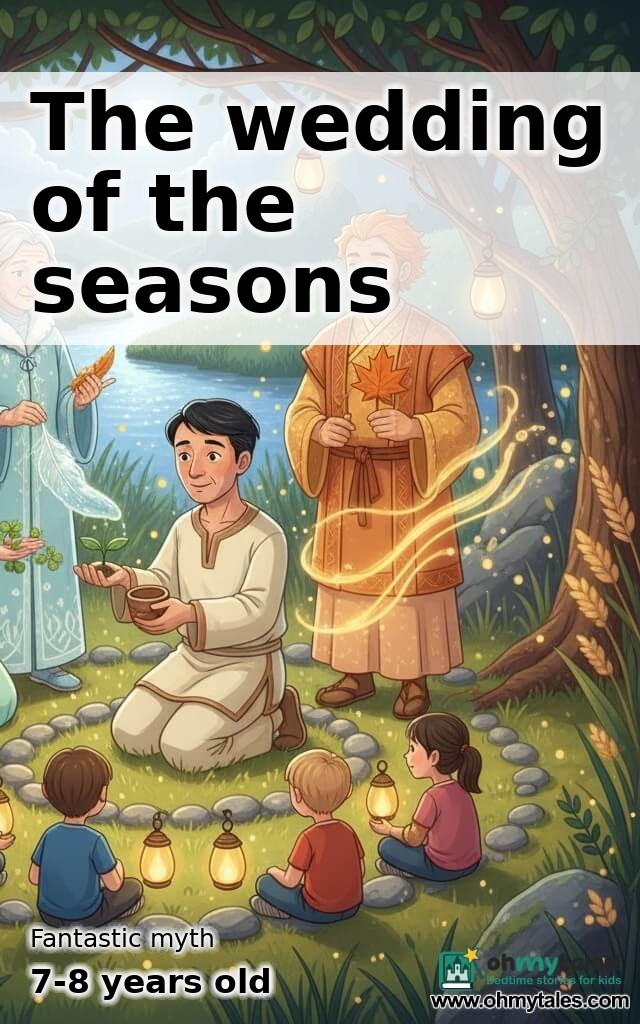
When the moon was a thin silver coin, the day came. Fireflies hung like lanterns. Children were there, blinking in wonder. Old hands put out bowls of rice. Animals peeked from bushes. The four seasons stood around the ring that the trees made, and Hiroto stood between them with the seed in his palm.
"Do you promise?" Spring asked of Summer, Summer of Autumn, Autumn of Winter, Winter of Spring. The promises were not long words but images. Summer promised to give time for fruit to grow. Autumn promised to gather and keep what was needed. Winter promised rest and the clear sky. Spring promised to wake the small things with song.
Hiroto repeated the promises he had learned, aloud and then again in his heart. He placed the seed on the earth within the ring and watered it with the river water. He wrapped the maple-paper names around the small sprout like a ribbon. He laid the frost feather over the ribbon like a cool hand.
The seasons let their hands touch there, in the way the wind can touch the sea. The branches above them stirred and made a hush like a thousand small bells. The canopy leaned in, listening. It was not a loud sound. It was a soft, deep music that felt like being tucked into a blanket.
"I will keep them," said Summer, and warmth spread through the ring.
"I will gather what is good," said Autumn, and the light changed to honey.
"I will hold their sleep," said Winter, and the air cleared like a promise.
"I will wake their hearts," said Spring, and the tiny sprout breathed.
Hiroto felt the seasons fold around him like pages of an old book. He felt the river smile. He felt the willow sigh in relief. He bowed his head and let the world marry itself, and his chest was full with a joy that did not rush but stayed.
Chapter V — The Canopy That Murmurs
They left the new ring to the care of the trees. Time moved in the gentle way of a heartbeat. The seed grew into a small sapling, and the sapling learned the voices of wind and rain. Children who played there learned to speak kindly to birds. The foxes napped without worry. The old woman kept one of Hiroto's ribbons in her pocket, and when she walked, she hummed the promise.
Years later, when Hiroto was older, he walked beneath that same canopy. The branches were thicker, and leaves had learned new songs. He sat where he had stood and listened.
The canopy murmured in the language of leaves. It did not shout. It did not make anyone afraid. It told him that the promises had been kept because small hands and kind hearts had kept them. It told him that seasons could be married by a man who only knew how to be gentle, by children who learned to care, by neighbors who traded bread and stories.
Hiroto smiled. He touched the bark where children had carved tiny moons and felt a warmth that was not from the sun but from many small kindnesses. The canopy kept murmuring, and in its voice was a lesson: when people listen, when people give small gifts, when people name the things they love, the world turns in a kinder way.
He rose slowly and walked home under a sky that looked as if someone had painted it softly. The seasons kept their promises. The ring kept its hush. The canopy murmured on, and the sound was like a good night said by the whole world.