Chapter One: The Path of Lantern Leaves
Somchai walked where the river sang like silver coins. He was small for a young man, with bright eyes that asked a hundred soft questions. In his village the elders told stories of the stones that remembered the sky. Somchai liked stories the way a bird likes wind—he wanted to try them for himself.
He packed a simple satchel: a piece of sticky rice wrapped in banana leaf, a string of jasmine for luck, and a small bell that had once belonged to his grandmother. "Be brave and be kind," she had said, tying the bell on his wrist. "Ask your question gently, and listen with both your ears and your heart."
The path left the village and went under trees with leaves like lanterns. Each step felt like a drumbeat. At the path's edge stood carved wooden figures—ram-headed guardians and small elephant masks—smiling as if they knew the way. Somchai smiled back. He walked until the lantern leaves turned to moss and the moss turned to stone.
"I am ready," he whispered. The bell chimed softly. The world seemed to lean closer, waiting.
Chapter Two: Where Stones Keep Secrets
The stones began as small pebbles, then large river rocks, then monoliths taller than houses. They were smooth and warm, marked with curving lines like willow branches and tiny sun dots. Some had faces carved long ago, some held hollow places where rain had sung. Monks had taught Somchai that stones keep memories. Mothers had hummed that stones guard promises. Now, Somchai stood before a ring of stones glowing faintly like moon-fruits.
"Hello," he said, because a question needs a hello. "I have come to ask."
A gentle wind moved through the circle, and the bell on Somchai's wrist answered like a tiny cloud of light. A voice that was both many voices and only one came from the stones. It sounded like rain on a tiled roof and like the hush of bamboo. "Ask, small one," it said. "Ask, and plant your question like a seed."
Somchai felt a flutter in his chest. He had practiced his question all the way from the village. Yet when he opened his mouth, the words changed, softer and truer. "How can I make a place where stories grow for everyone?" he asked. "How can I help my village remember joy and wonder without losing what is real?"
The stones hummed. "Why do you ask?" they said, not to test him, but to hold his question like a bright bird.
"My grandmother told me to be brave and kind," Somchai said. "My friends get busy. The river forgets to laugh sometimes. I want to plant stories that bloom every evening, so people can taste them like sweet mango after work."
An old stone, the tallest, shifted a little. It had a crack shaped like a smile. "First listen," it said. "Then gather. Then give. Begin with a single small light."
"It sounds small," Somchai whispered, and then laughed. "It sounds easy and hard at the same time."
Chapter Three: The Answer in Patterns
The stones asked Somchai to sit. So he sat, cross-legged, by their cool faces. He closed his eyes and breathed like the tide. The stones told him of patterns: how rivers carve steps, how seed leaves open the same way each spring, how stories repeat in new faces. They taught him an old game—anaphores of the earth, they called it—where one phrase returns like a friendly bird.
"Listen to three echoes," the stones said. "Repeat and change. Sing and then hand the tune to others."
Somchai listened. He heard the river laugh, then the laugh made a small poem. He heard the rice field breathe, then the breath became a riddle about the moon. He heard a child's foot, then the foot left a question painted in the dust.
Somchai practiced. He spoke a line and the stones turned it into a light pattern on their faces: a ripple, a leaf, a small boat. "Tell a little story tonight," they suggested. "Tell of the cat who stole a moonbeam. Tell of the frog who played a tiny drum. Start with one, and let it grow."
He decided to make a story-sitting on the riverbank, close to home. He would hang the jasmine and ring his bell and invite one neighbor, then two, then more. "I will plant my question like a seed," he promised the stones, "and I will share the watering."
"Remember to be creative," the stones said. "Use your hands, your voice, your silly songs. Make room for whispers and loud laughs. Open doors with a gentle nudge."
Somchai felt the pattern settle into him like a map. He thanked the stones, and the stones answered with a shiver of moonlight across their faces. "Go," they said, "and bring back what grows."
Chapter Four: Home with a Garden of Stories
Somchai returned by the path of lantern leaves, carrying a small pouch of river-sand and a notebook woven from banana bark. He hummed the stone's pattern—"listen, gather, give"—and the bell on his wrist chimed like a promise.
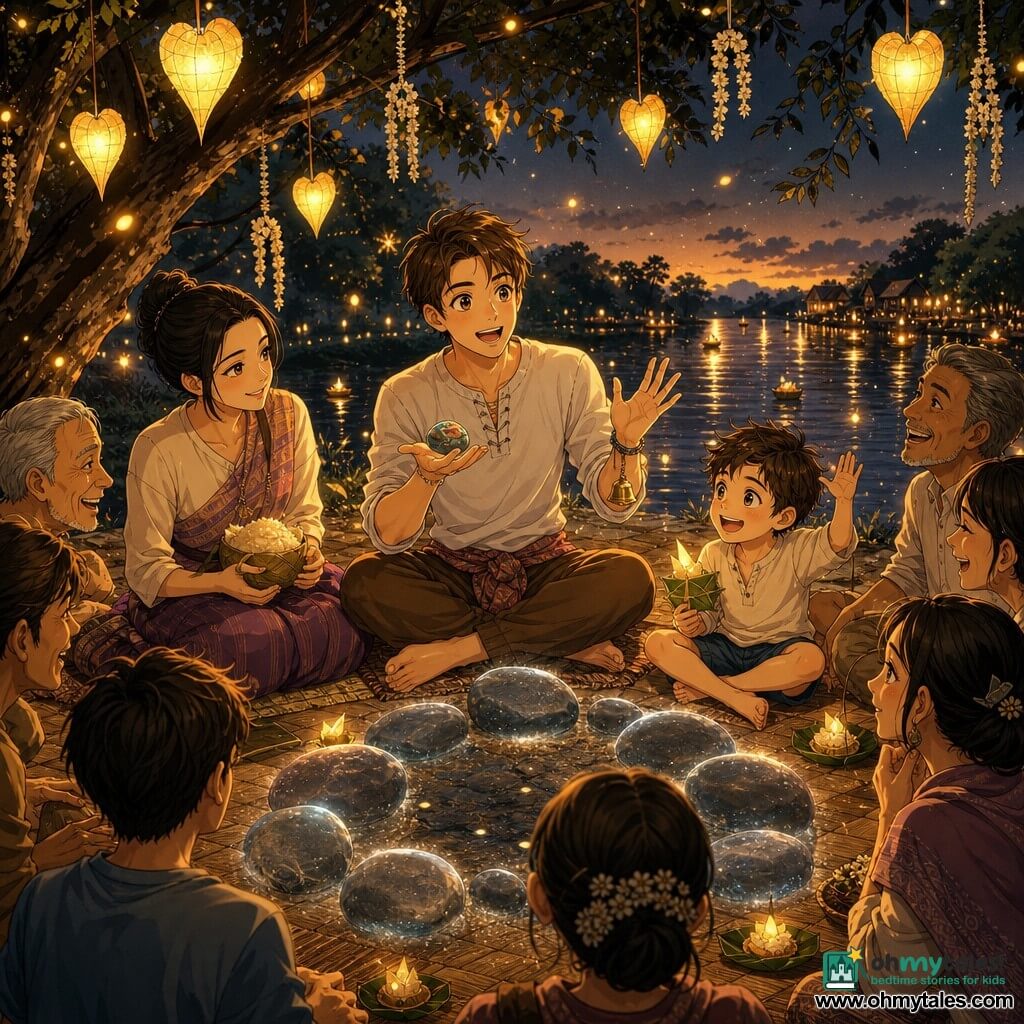
That evening he set out his jasmine. He called to his neighbor Mae and her little brother Noi. "Will you come and hear a short story?" he asked. Mae smiled and brought sticky rice. Word spread like spice in the breeze. Soon there were mats and small lamps, and the village sat close together like seeds in a palm.
Somchai told the first story: a tale of a fish that learned to paint the moon, and a small frog that taught an old tree to dance. He used his hands to make waves, he hummed the river's laugh, and he left a space for everyone to add a line. Mae added a laugh that sounded like a bell. Noi made the frog tap a tiny drum. The story grew, new leaves unfurling with each voice.
"Tell it again tomorrow," someone said.
"Yes," Somchai said, and he meant it. The next night two more people came. The night after that, children brought lanterns made of folded leaves. The stories bloomed into a little festival, gentle and bright. People painted stones with small suns and placed them near the river, so other wanderers could sit and listen.
Weeks later Somchai returned to the ring of stones. He carried with him a small jar of moonwater and a wooden whistle. He placed the jar where the tallest stone caught the moon, and he blew the whistle once. The stones shone, not with answers but with approval.
"You kept your promise," they said. "You asked, you planted, you gave. The songs you made are seeds that will sprout again and again."
Somchai felt warmth like a small sun in his chest. He heard laughter from the village and the river singing along. "Thank you," he said simply.
The stones hummed a farewell like wind through bamboo. "Return when the stories need water," they said, "or when your heart needs a map."
Somchai walked home at a slow, happy pace. He kept the jasmine and the little bell close, and he held in his hand a tiny painted stone that said only two words: keep going.
At his doorway he paused and looked at the sky. The moon was a coin in a gentle palm. "I will," he whispered. Inside, the house smelled of rice and quiet. He lay down and let the day's stories roll over him like soft waves, sure that tomorrow he would plant another seed.