Chapter 1: The Flame That Would Not Quit
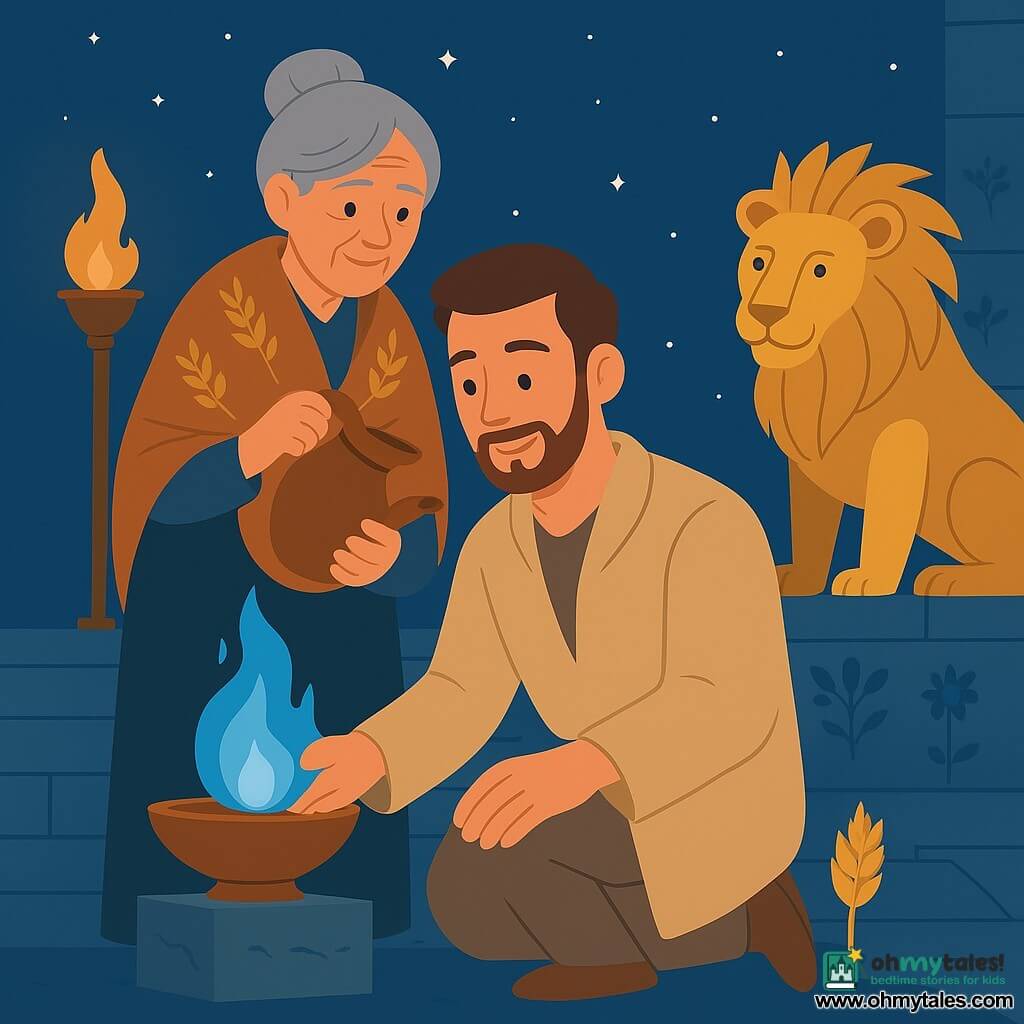
The night over Nineveh was soft and warm, like a blanket that had been left in the sun. Above the city, the stars looked like tiny lamps hung by careful hands. At the very top of a stepped temple, a small flame shivered inside a bronze bowl.
It was not a normal flame.
It was the Temple Flame, the one the old songs spoke about. The flame was said to remember every brave promise ever made. It was said to listen. It was said to glow brighter when someone chose what was right.
Tonight, it did not glow much at all.
Sargon the traveler climbed the last steps with steady boots. He was a grown man, tall and broad-shouldered, with a satchel at his side and sand in the folds of his cloak. His beard was neatly trimmed, and his eyes were kind, even when they were tired.
He knelt beside the bowl and held his hands around the flame, not to grab it—no one grabbed a sacred flame—but to shelter it, like you shelter a small bird.
“Hush,” he whispered. “I'm here.”
The flame fluttered. It made a tiny sound, like a sigh.
Behind him, the temple keeper, an old woman named Nana-Sheri, came up with a slow but sure step. Her silver hair was tied in a knot, and her shawl was stitched with little wheat shapes.
“You came fast,” she said.
“I ran the last street,” Sargon answered. “A goat tried to race me. The goat won.”
Nana-Sheri gave a small laugh that sounded like a bell. “Goats always win.”
She looked at the bowl. The flame was so small now it barely lit the bronze rim.
“The wind has been strange,” Sargon said. “But the air feels calm.”
“It is not the air that troubles it,” Nana-Sheri said softly. “It is the story.”
Sargon blinked. “The story?”
“The Temple Flame is fed by more than oil,” she said. “It is fed by courage. By truth. By keeping your word. This week, many people have been afraid. They have been snapping at each other like hungry dogs. They have been hiding their best parts. The flame has felt it.”
Sargon's hand stayed steady. “So what do I do?”
Nana-Sheri lifted a clay jar and a small cloth bundle. “You will watch it. You will keep it awake. You will keep it company. But you will also bring it what it needs.”
She opened the bundle. Inside was a little piece of lapis-blue stone shaped like a star.
“This is a Star-Shard from the river shrine,” she said. “And this—” She tapped the jar. “—is oil pressed from dates and sesame. Good oil. Honest oil.”
Sargon nodded. “And if that isn't enough?”
Nana-Sheri's eyes turned toward the dark horizon, where the fields lay beyond the city walls. “Then you must go where old courage sleeps and ask it to rise.”
Sargon swallowed. A quest, then. He was an adventurer, yes, but he still felt the tickle of nervousness before a new path. Nervousness was not a monster. It was a knock at the door, asking, “Are you ready?”
He smiled. “I can answer a knock.”
The flame trembled again, as if it had heard him.
Nana-Sheri placed her hand on his shoulder. “Remember,” she said. “You do not go to fight. You go to tend. A flame is not won by shouting. It is won by staying.”
Sargon leaned closer to the bowl and spoke as if to a friend.
“Little flame,” he murmured, “I will keep you. I will keep you.”
And the flame, still small, leaned toward his voice.
Chapter 2: The Gate of Winged Bulls
At dawn, the city woke with clattering carts and calling merchants. Sargon moved through the streets with his satchel and Nana-Sheri's jar tucked safely inside. He passed walls painted with bright lions and blue flowers. He passed a baker who waved a hot flatbread like a flag.
“Where are you going, Sargon?” the baker called.
“To visit an old story,” Sargon replied.
“Bring it back a bit warmer!” the baker joked. “My stories are always cold by lunchtime.”
Sargon laughed and kept walking until he reached the great gate. Two giant winged bulls stood carved in stone, their faces calm, their wings curled as if they could take off at any moment. People said these bulls had guarded the city since the first brick was set. People also said they listened, and if you spoke kindly, they would remember your voice.
Sargon stopped before them and set his palm on the cool stone.
“Hello,” he said politely. “It's me again.”
A guard leaned on his spear and grinned. “Talking to statues?”
“They're good listeners,” Sargon said. “Better than some humans. No offense.”
“None taken,” the guard replied. “My cousin never listens. Go on, traveler. May your feet be light.”
Sargon bowed and stepped through the gate, out into the wide land of fields and canals. The air smelled of water and green reeds. Far away, the sun rose like a golden coin.
He followed a path that ran beside a canal. Birds skimmed the water, and frogs made tiny drum sounds from the shadows. It felt peaceful, and yet the thought of the flickering flame tugged at his mind like a small hand.
He remembered Nana-Sheri's words: The flame is fed by courage. By truth. By keeping your word.
“Courage,” Sargon said to himself as he walked. “Not loud courage. Not sword-swinging courage. The other kind.”
After a while, he reached a low hill topped with a lonely shrine built from pale stone. A single tamarisk tree leaned over it like a careful parent. This shrine was old—older than many songs. It was said that a sacred mystery was kept here, simple but strong.
Sargon approached and called, “Is anyone here?”
A voice answered from behind the shrine, surprised and cheerful. “Yes! And I was just about to ask the same thing!”
A small spirit stepped out, no taller than Sargon's knee. It looked like a little person made of sunlight and dust, with bright eyes and hair like thin wheat strands. It wore a sash of blue thread and carried a tiny jug.
“I am Pazu,” the spirit announced proudly. “Guardian of the Honest Drip.”
Sargon raised an eyebrow. “The Honest Drip?”
Pazu nodded seriously. “I guard the last drop of water that never lied. It always tells the truth about thirst.”
Sargon's mouth twitched. “That is a very important job.”
“It is,” Pazu agreed. Then it peered at Sargon's satchel. “You have temple oil. Sacred errands. You smell like responsibilities.”
“I do,” Sargon admitted. “I must help a flame that is fading.”
Pazu's face turned gentle. “Ah. A brave tending.”
Sargon sat on a flat stone near the shrine. “Nana-Sheri said I should find old courage and ask it to rise.”
Pazu hopped closer. “Courage sleeps in strange places,” it said. “Sometimes in drums. Sometimes in lullabies. Sometimes in wheat fields, where people stand up straight even when the wind pushes.”
Sargon looked toward the distant fields. The wheat was not yet tall, but it was growing in soft green waves.
Pazu tapped its tiny jug. “The shrine has a small gift. A drop of Honest Water. It doesn't make you stronger like a magic potion. It makes you clearer. You remember what matters.”
“That sounds useful,” Sargon said.
Pazu held up one finger. “But you must trade.”
Sargon nodded. “Fair.”
“A promise,” Pazu said. “A real one. Say you will not leave the flame alone. Not even when you feel tired. Not even when you feel silly.”
Sargon chuckled. “Silly?”
Pazu's eyes widened. “Some heroes fear dragons. Some heroes fear looking foolish. Both are very serious.”
Sargon placed his hand over his heart. “I promise. I will not leave it alone.”
The air seemed to brighten, as if the morning approved.
Pazu poured a single shining drop into Sargon's palm. It was cool as river shade. Sargon touched it to his tongue.
At once, he remembered a hundred small brave moments: Nana-Sheri keeping the temple clean even when her knees ached; a child sharing a fig with a stranger; the guard smiling at a tired traveler. Courage, he realized, was often quiet and close.
“Thank you,” Sargon said.
Pazu saluted him with two fingers. “Go, then. And if you meet a wind that tries to be rude, tell it I said ‘please stop.'”
“I will,” Sargon promised, and set off back toward the city with lighter steps.
Chapter 3: The Wind's Riddle and the Lion's Smile
By late afternoon, clouds rolled in like soft gray sheep. A wind rose over the canal path, teasing Sargon's cloak and trying to peek into his satchel.
“Not for you,” Sargon told the wind.
The wind answered by blowing harder, whooshing around his ears as if it wanted to speak.
Then, just ahead, the path shimmered. Not like heat, but like a veil of glass. Sargon slowed. He had seen strange things before—singing stones, sleeping rivers, doors that opened for jokes—but he always respected a shimmer.
From the shimmer stepped a lion.
It was not a hunting lion. It looked like it had walked out of a carved wall: golden, bright-eyed, with a mane like painted fire. Around its neck hung a small disk that glowed with a gentle light.
Sargon stopped, but he did not reach for any weapon. He lifted his empty hands.
“Good evening,” he said politely. “You are very… shiny.”
The lion's mouth curved, almost like a smile. “That is the nicest greeting I have had all day,” it said in a deep, smooth voice.
Sargon blinked. “You can talk.”
“I can,” the lion replied. “And you can listen. That is why you can help your flame.”
“The wind is bothering us,” Sargon said.
“The wind is always bothering someone,” the lion said calmly. “It is a busy creature. It blows away hats and brings new smells and tries to feel important.”
The wind swirled around them, grumpy and impatient.
“What do you want?” Sargon asked the wind aloud.
The wind blew a spiral of dust that looked almost like a question mark.
The lion tilted its head. “It wants a riddle answered,” it said. “The wind loves riddles because riddles do not sit still.”
Sargon sighed. “All right. Give me the riddle.”
The wind rushed past his face and then softened, as if it were whispering into his ear:
“When I am shared, I grow.
When I am hidden, I fade.
I am not gold, but I can make a heart brave.
What am I?”
Sargon thought of the Honest Water drop on his tongue. He thought of the flame, fed by courage. He thought of small brave moments that grew when people spoke them out loud.
He smiled. “I know,” he said. “You are hope.”
The wind paused. For a moment, it felt like the whole world held its breath.
Then the wind softened into a warm breeze, gentle as a hand patting your back. It carried the smell of dates and clean water. It did not tug at Sargon's satchel anymore. It simply moved along, satisfied, as if saying, “Well answered.”
The lion nodded. “Hope shared is hope doubled,” it said. “Now, traveler, you must hurry. Your flame waits.”
“Will you come?” Sargon asked.
The lion's eyes glowed kindly. “I cannot cross the city gate. I belong to the in-between places. But I can give you this.”
It lifted the glowing disk from its neck and set it into Sargon's palm. The disk was warm, like sunlight caught in stone.
“This is a Bright Seal,” the lion said. “Not to command, but to comfort. Place it near the flame. It will remind the flame of all the good hearts nearby.”
Sargon bowed. “Thank you, noble lion.”
The lion chuckled. “Noble is a big word. I prefer ‘helpful.' Go.”
Sargon ran the rest of the way. The clouds broke, and the sky turned pink and gold. Behind him, the wind hummed, almost like a lullaby.
Chapter 4: Wheat-Light in the Temple
Night returned, and with it the hush that makes every sound feel important. Sargon climbed the temple steps two at a time. At the top, Nana-Sheri waited beside the bronze bowl.
The flame was still there, but it was thin, like a candle trying very hard.
“You came back,” Nana-Sheri said, relief in her voice.
“I did,” Sargon replied. “And I brought friends, in a way.”
He set down the oil jar, the Star-Shard, and the Bright Seal. Nana-Sheri's eyes widened, just a little, because even temple keepers can be surprised.
“A lion gave you that,” she said, not as a question.
Sargon nodded. “A helpful one.”
He poured a careful line of date-and-sesame oil into the bowl. Nana-Sheri placed the lapis Star-Shard beside the flame. Sargon set the Bright Seal near the rim, where its warm glow could touch the trembling light.
Still, the flame wavered.
Sargon leaned in, cupping his hands around it again. He remembered his promise. Not even when you feel tired. Not even when you feel silly.
He spoke softly, rhythm in his words, like walking steps.
“I will keep you when the streets are loud.
I will keep you when the night is quiet.
I will keep you when I am tired.
I will keep you when I am afraid.”
Nana-Sheri joined in, her voice low and steady.
“We will keep you with clean hands.
We will keep you with kind words.
We will keep you with brave hearts.”
The flame quivered. Then it rose a little, like a child sitting up in bed.
Sargon smiled and continued, because courage often needs repeating, the way a song needs a chorus.
“Hope shared is hope doubled,” he whispered, remembering the riddle. “You are not alone.”
From below, the sounds of the city drifted up—laughing, a distant flute, someone calling goodnight. Sargon imagined all those people, each with a small light inside them. He imagined those lights leaning toward the temple, as if they wanted to help.
Nana-Sheri reached into her shawl and pulled out a small bundle tied with twine. She opened it to reveal a fresh sheaf of wheat, golden and soft, its heads full and bright.
“I saved this from the first harvest,” she said. “Wheat is the promise that the earth keeps. Wheat is the courage of fields that stand up again and again.”
She laid the wheat near the bowl, not inside, but beside it, like an offering and a reminder.
The scent of it rose—warm, sweet, alive.
The Temple Flame responded as if it recognized an old friend. It steadied. It brightened. It grew from a shiver into a sure, calm glow. Light spilled across the bronze and kissed Sargon's hands.
“There,” Nana-Sheri breathed. “There you are.”
Sargon let out a slow breath he hadn't realized he was holding. His shoulders lowered, as if they had been carrying a heavy pack.
The flame did not roar. It did not explode into fireworks. It simply burned well, like a heart that had decided to keep beating.
Nana-Sheri looked at Sargon with proud, tired eyes. “You watched. You waited. You returned. That is the courage that feeds it.”
Sargon glanced at the wheat sheaf, and then at the steady light. “So the sacred mystery is not only hidden in far places,” he said. “It's also in staying.”
Nana-Sheri nodded. “In staying. In sharing. In tending.”
Sargon sat beside the bowl, and the two of them kept watch as the night moved gently on. The flame held its light. The Star-Shard gleamed like a tiny sky. The Bright Seal glowed like a friendly moon. And the sheaf of wheat lay golden beside them, a small sun made of earth.
Below, Nineveh slept, safe and warm, while above, the Temple Flame burned bright enough to tell the stars, “We are still here.”