Chapter One — The Quiet River
Lumenford had the look of a city that kept small secrets. Its houses leaned like old friends, and the cobbled streets remembered every footstep. But lately the city felt like a soft bell that had stopped ringing. The river that crossed Lumenford, the Silverlilt, used to hum and sparkle, singing to the people as it passed by. Boats bobbed and children chased its music. Now the river moved slow and silver, and its song had faded until it was barely a whisper.
Orin lived in a narrow house near the riverside, where morning light painted his window with pale gold. He was young—tall enough to reach the highest shelf in his kitchen and small enough to still tremble with wonder. He loved to fix things: a loose tile, a tired toy, a broken promise. He worked at the market by day, mending nets and listening to neighbors, and by night he walked the riverbank, pressing his palm to the stones, hoping to find what had been lost.
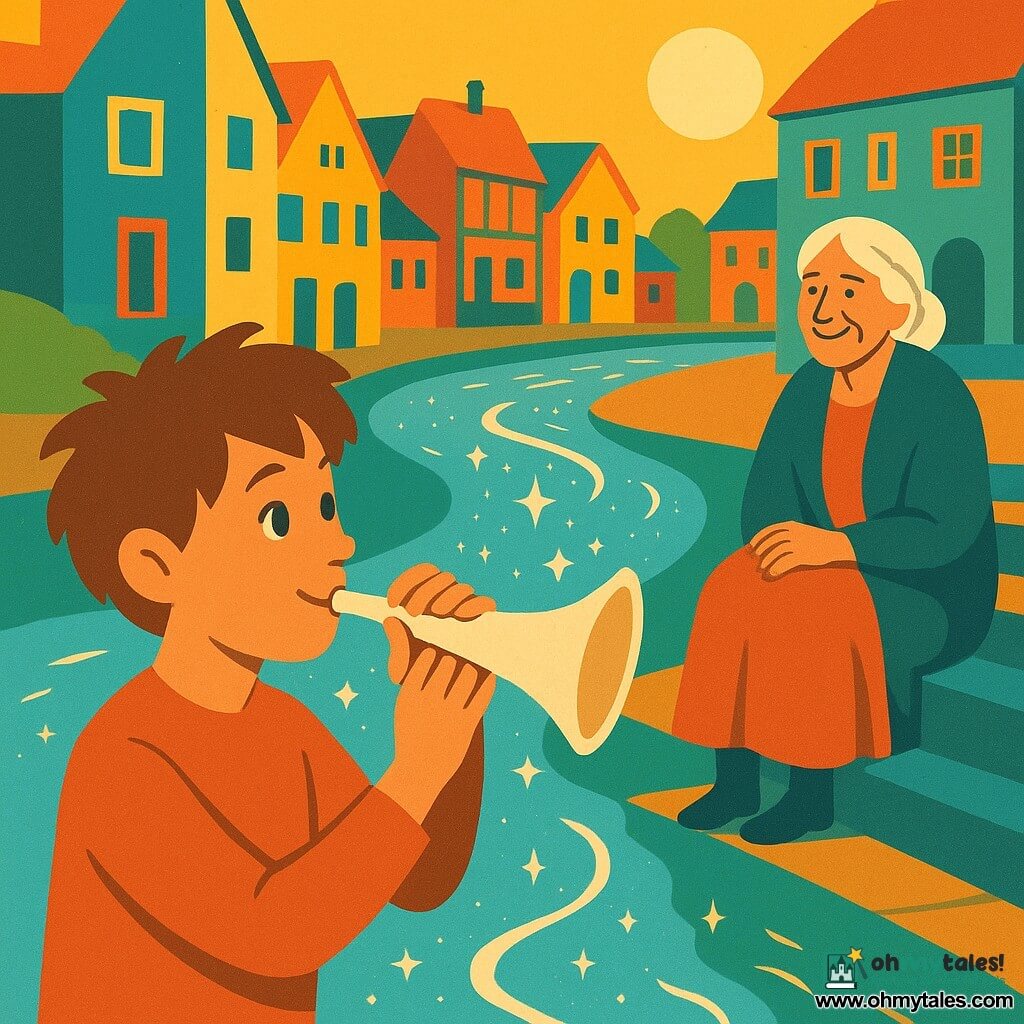
One evening, when the clouds were soft as wool, Orin heard a sound—a tiny, bright sound like a bell hidden in a pocket. It was not the river, but it came from the old square where the statue of the city's founder stood, worn by centuries of hands laid upon his granite shoulder. Orin followed the sound and found an old woman sitting on the steps, threading blue thread through a small horn made of pearly bone.
“You hear it too?” the woman asked, looking up at him with a smile that practiced kindness.
Orin nodded. “The river is quiet. I thought maybe the city was tired.”
The old woman laughed like wind through reeds. “Cities cannot rest alone. Sometimes they need a thank you. Long ago, the gentle gods listened to our gratitude and kept the river singing. Now their whispers sleep. This horn will call them when it hears thanks true enough for their ears.”
Orin's heart bumped. “A horn that calls the gods?”
“Gentle gods,” she corrected. “Not the thunder and the break-your-door gods. These are small and kind—river-tenders, night-bringers, bread-bakers of dawn. They sleep because we forgot to say thank you. If someone wakes them with the horn, Lumenford might find its song again.”
“Where did the horn come from?” Orin asked.
The old woman tapped the horn with a fingernail. “It came from a place where gratitude grows as tall as trees. But the horn needs a voice that remembers how to thank. You listen to people, Orin. Maybe you remember.”
He took the horn in both hands. It was cool and smooth, and when he touched it, a little flutter of light raced along his arm like a tiny current. His mind filled with images of the river—of children stacking stones and elders tossing crumbs to bluebirds. He understood, simply and at once, that gratitude could be something as big as a bridge and as soft as a sigh.
“I'll try,” he said. “But I can't wake all the gods alone.”
The old woman's smile deepened. “You never need to be alone when you have thanks to share.”
Chapter Two — The Journey of Small Thanks
Orin began by walking through the market, horn tucked under his coat. His first stop was Marla's stall, where jars of honey glowed like melted sunlight.
“Marla,” Orin said, and remembered to look up with a grin. “Thank you for keeping jars of summer here even when winter is near.”
Marla blinked. “Oh—thank you! That's kind.” She handed him a small pot of honey on the house. Orin put it in his coat and felt a tiny hum from the horn. A thread of warm light rose and touched his cheek like a friendly moth.
He went from stall to shop to lane. He thanked the baker for bread that rose like small white hills, the cobbler for shoes that could take a child to the top of a tree, the lamplighter for mornings that never quite forgot twilight. Each time he thanked someone, the horn answered with a thin, singing note. The notes were small, but together they made a pattern, like stones placed to form a path.
People began to notice. They smiled at Orin in a way they hadn't for some weeks—an old habit, warm and immediate. The mayor peeked from his office and called out, “Orin! Why the good cheer?”
“Because,” Orin said simply, “I started saying thank you. Try it.”
They tried. “Thank you for keeping the square clean,” a baker said. “Thank you for the water,” a child blurted to the town well. The horn chimed each time, and Orin felt the city breathe a little deeper.
But the horn hummed faintly, as if listening for something else. The old woman had said it needed a voice that remembered how to thank. Orin felt in his bones that the deeper thanks were not gifts or goods, but things people rarely spoke aloud: thank you for being brave when alone, thank you for staying when leaving would be so easy, thank you for tending the garden even in gray weather.
So Orin walked to places where hidden thanks lived. He visited the watchman who kept the bridge upright through cold nights. “Thank you,” Orin said, “for standing guard even when no one notices.”
The watchman's eyes softened with surprise. “No one's thanked me for years,” he breathed, and a small note rose from the horn, clear as a waterdrop.
At the orphanage, he thanked the woman who mended sleeves at the edge of her sleep. “Thank you for being a steady shelf when little hands climb,” he whispered.
The woman laughed and wiped tears quickly away. “Little hands make me feel full,” she said. The horn sang, and Orin felt hope grow like a seed pushed by gentle soil.
Word spread that Orin was walking with a grateful heart. A few people followed him, whispering thanks behind him like a trail of lanterns. It began to feel less like Orin alone and more like the city learning a new habit: saying what was often left inside.
Chapter Three — The Gentle Gods Stir
One morning, Orin climbed the hill outside town where the old stone circle stood—an ancient place where Lumenford once gathered to celebrate small mercies. The circle had been quiet for years. Orin stood in the center, lifted the horn to his lips, and thought about everything he and the city had thanked for: warm bread, steady hands, open doors, people who listened. He blew.
The sound was not loud like a trumpet; it was a clear breath that warmed the air. For a moment, nothing seemed to happen. Then the stones under his feet vibrated with a slow, friendly pulse. A breeze came that smelled like a chorus of lavender and toasted grain. Shadows in the circle stretched and turned into shapes that were almost people—soft and kind, made of river-mist and moonlight and the feel of a hand on your shoulder.
A small figure draped in reeds stepped forward. It bowed its head to Orin. “We are the gentle ones,” it said in voices that sounded like wind chimes and warm bread. “We were sleeping because the songs of thanks had grown thin. You have found the horn and gathered many small thanks into one voice.”
Orin lowered the horn. “Will you help Lumenford? The river has forgotten its song.”
A ripple of laughter like pebbles in a puddle answered. “We can not wake a city alone. We are small. But we can teach the people to remember again. The river remembers when everyone remembers.”
The figures spread along the river path like soft light. They touched the water with their fingertips, and the Silverlilt shivered as if from a pleasant dream. Under their breath, the river tried a single bright note. It was thin at first, like a baby bird trying a new sound, but it ran through the stones and over the mill wheel and into the hearts of people who chanced to stand near the banks.
Orin watched the ripples ripple into wider ripples: a fisherman heard the note and hummed; a child clapped in delight; the baker paused mid-knead and hummed back. The horn at Orin's side chimed every time someone made a small, true thanks of their own. The gentle gods taught these simple songs—how to say thank you that was not hurried, how to look someone in the eye when saying it, how to mean the words so they could be carried like a bright lantern.
“You remember too,” said one gentle god to Orin, touching his forehead like a soft coin. “You remember that thanks is a thing that grows when shared.”
Orin felt a warm thread tie itself to his chest. He thought of the old woman who had given him the horn, of Marla's honey, of the watchman, and of all the small things that make a city kind. He realized that waking the city was not just the gods' work, nor only his; it belonged to everyone who lived and listened there.
Chapter Four — The City Raised Its Voice
The next days in Lumenford were bright with small noises. People began to say thank you as a habit. A child who received a borrowed toy ran back to say, “Thank you for lending me your star-car.” An old baker put a small loaf into Orin's hands and said, “Thank you for reminding us.”
The river's song returned slowly, like a tune learning itself after a long nap. It did not roar back all at once. Instead, it offered short clear notes along its banks—a laugh under the bridge, a lullaby near the mill. The gentle gods taught children to make music with pebbles and wind; they taught gardeners to hum in time with seeds they buried. Lumenford's people discovered that gratitude changed the taste of bread and the brightness of morning light.
Not everyone found it easy. Some were shy or forgot or thought their thanks too small to matter. Orin found them gently. He would listen, nod, and remind them of one small thing to be grateful for. “Thank you for keeping the lights,” he told the lamplighter again and again, and the lamplighter learned to smile when he saw the long road glow with tiny flames.
When market day came round, the people gathered in the square and, by habit and by hope, began to speak their thanks aloud. The mayor, who had been busy with lists and numbers for a long time, stood on the steps and said, “Thank you for bringing children to the square; they make plans softer.” The crowd clapped, not because someone asked them to, but because the words were true. The horn chimed, and a taste of joy blossomed like an apple in spring across the faces of everyone there.
One evening, the old woman who had given Orin the horn appeared again. She sat where the statue's shoulder caught the sunset and watched the river sparkle. “You taught them to find small thanks,” she said simply.
Orin handed her the horn. “It almost feels like the horn needed us as much as we needed it.”
The woman tucked it into her bag and winked. “Horns like this belong where thanks is kept alive. Hold it close when you need to remind yourself.” She rose and stepped into the crowd, and no one questioned her sudden vanishing. In Lumenford, small wonders were accepted as part of the streets.
Chapter Five — A City That Woke with a Thank You
The Silverlilt's song grew stronger each day. Its music braided into children's games and the baker's whistle and the net-mender's soft humming. The gentle gods did not stay forever. Their work was to kindle the habit and make space for gratitude to live in people's voices. When they left, they left a light in the stones, a hint in the wind, and the knowledge that thanks could wake other softly sleeping things.
Orin stood by the river on a morning sharper than most and threw a pebble that sounded like a small bell. A child beside him laughed and said, “Thank you for showing me.”
Orin laughed back. “Thank you for laughing.”
They both watched as the river ran on, filled with many small songs stitched together like a bright quilt. Across the bridge, the watchman waved; the baker waved with flour on his cheek; the lamplighter stood at his post like a proud little tree. The city moved with a gentle rhythm—less solemn and more open.
People had learned that gratitude was not only for the big miracles. It was for mending sleeves and staying late, for sharing honey and listening to old stories, for the quiet men and women who kept the city's tiny engines running. When those thanks were given, the city answered with music and with more than music: with neighbors who came to help when gutters overflowed, with children who helped elders cross the square, with the odd stranger welcomed to supper.
At sunset, as lights blinked to life like a soft constellation over the roofs, Orin walked the river once more. He pressed his hand to the cool stone bridge and felt the echo of the horn there, a faint and steady hum. He did not need to wake the gods now; the city had learned how to wake itself.
A small voice called from the other side of the bank. “Orin!”
He turned to see the old woman smiling, her bag lighter than before. “You did more than wake them,” she said. “You helped them remember who they were.”
Orin smiled back, feeling that warm thread in his chest pull a little tighter, not from pride but from quiet joy. “We remembered together,” he said.
They stood in silence, watching the river catch the last of the sun and throw it back in glittering thanks. The city hummed around them—people making tea, closing shutters, telling stories—and Orin understood that every small thank you was like a pebble dropped into a wide stream. One by one, the ripples met and became a song again, and the city that woke with a thank you would live brighter for it.