Chapter 1: The Island That Whispered
On an island shaped like a sleeping dolphin, the wind had a voice and the waves had stories. They never stopped talking—unless they were listening.
Mira lived there in a cottage with salt on its windows and moonlight in its roof thatch. She was a young woman with quiet eyes, the kind that noticed small things: the way a crab bowed before sliding into a hole, or how a cloud could look like a torn piece of wool.
Each morning, the wind visited her doorstep like an old friend.
“Good day, Mira,” it hummed through the palm leaves. “Have you kept your heart gentle?”
“I'm trying,” she would answer, tying back her hair. “I have a lot to keep safe.”
Beneath her cottage, hidden under a floorboard worn smooth by years of careful feet, rested an ancient bundle wrapped in sea-silk. Inside were three things: a smooth stone that held warmth even at night, a tiny shell that rang like a bell when held to the ear, and a book no bigger than her hand. Its pages were blank to everyone else, but to Mira they glimmered with pale writing, as if the ink were made of starlight.
It was called the Tide-Book, and it carried old knowledge: lullabies that calmed storms, names of stars used as guides, and words that could mend a frightened mind like a stitch in cloth.
The waves had given it to her grandmother long ago, and her grandmother had pressed it into Mira's palms when Mira was still learning how to braid. “Protect it,” she had whispered. “Not with swords. With steadiness.”
Mira did not think of herself as brave. She thought of herself as watchful. Yet watchfulness can be a kind of courage, like a lantern that stays lit in a long hallway.
That afternoon, the sea looked uneasy. The water frowned in little wrinkles, and the gulls flew in circles as if they had misplaced something.
The wind darted low and urgent around Mira's ankles. “A shadow sails near,” it warned. “Not a cloud-shadow, not a passing mood. A hungry one.”
Mira felt her stomach tighten, but she placed her palm on the warm stone inside her pocket. It was like holding a small sunrise.
“Then I will keep the old knowledge closer,” she said.
The waves answered from the shore, their voices tumbling like pebbles: “Legends say the hungry shadow seeks the Quiet Words. It wants to swallow them so hearts cannot heal.”
Mira looked out over the water. Far away, where the horizon met the sky, a dark shape moved—too still to be a bird, too sharp to be a rock.
She swallowed her fear the way you swallow a bitter medicine: quickly, with purpose.
“Wind,” she asked softly, “will you guide me?”
The wind sighed, and for a moment it sounded almost tender. “I will guide you to what you need. But you must carry calm, not panic. Panic is a noisy drum that calls trouble.”
Mira nodded. “Then I will be quiet as a candle flame.”
Chapter 2: The Lantern Shell
That night, Mira went down to the beach. The sand was cold and pale, like flour spilled under the moon. The waves rolled in and out, speaking in their ancient way.
“Tell us,” Mira said, kneeling so close she could smell the sea's wild breath. “How do I guard the Tide-Book from a shadow?”
The nearest wave lifted itself, then fell with a gentle slap, like a hand on a shoulder. “We cannot fight the shadow for you,” it murmured. “But we can remind you of the Light that lives in listening.”
The foam gathered at Mira's feet. From it, something small gleamed—an ordinary-looking shell, except it held a faint glow, as if a firefly had made a home inside.
The wind whistled. “A Lantern Shell. Rare. It shines brightest when the holder speaks truth without shouting.”
Mira picked it up carefully. It warmed her fingertips.
“How will this help?” she asked.
The waves replied, “The shadow feeds on tangled feelings—fear knotted into anger, sorrow tightened into shame. But when a heart grows calm, the shadow finds no handle to grab.”
Mira thought of the Tide-Book under her floorboard. She imagined darkness creeping in like ink spilled on a map. Her throat tightened.
The Lantern Shell pulsed, and a gentle light spilled over her hands. It did not blind. It soothed, like a soft blanket.
“Try,” the wind said. “Speak what you feel, plainly.”
Mira looked out at the moonlit water. “I am afraid,” she said. “I don't want to fail my grandmother. I don't want hearts to lose their healing words.”
The light grew steadier, not brighter—steadier, like a friend who doesn't leave.
The waves chuckled, and the sound was like silver coins poured into a bowl. “Good. Fear named becomes smaller. It is a mouse once you turn on the lamp.”
Mira let out a breath she didn't know she'd been holding. Her shoulders dropped, and even the night air felt less heavy.
A splash sounded nearby. A sleek shape rose from the shallows: a seal with whiskers like wet ink lines. Around its neck hung a ribbon of seaweed tied in a neat bow.
“I heard talking,” the seal said, blinking. “The island always talks, but you—your voice has a careful taste. Like tea cooled to the right warmth.”
Mira laughed despite herself. “Do seals know about shadows?”
“I know about hungry things,” the seal replied. “And about sharing. I'm called Brin. If a shadow is sailing near, it will look for entrances: cracks in doors, cracks in courage.”
Mira held up the Lantern Shell. “Then I will keep my courage uncracked.”
Brin's whiskers twitched. “Courage isn't a rock. It's more like bread dough. You knead it, you rest it, you keep it from drying out.”
Mira smiled. “Will you help me, Brin?”
The seal made a grand bow, nearly tipping over. “I am excellent at helping. Sometimes I help too much and bump into things, but my heart is in the right ocean.”
Together they walked—Mira on sand, Brin flopping alongside with dramatic sighs—back toward the cottage under its roof of moonlight.
Chapter 3: The Visitor Made of Mist
The next day the island felt muted, as if someone had wrapped it in gray cloth. Even the wind spoke in whispers.
Mira stayed close to home. She checked the floorboard twice. She tucked the Tide-Book into a satchel and slung it across her shoulder. The warm stone sat in her pocket, and the Lantern Shell rested in her palm like a tiny, patient star.
Brin waited by the door, pretending to be a rug. “I am blending in,” he announced.
“You look like a very suspicious rug,” Mira said.
“I am a rare rug,” Brin insisted. “From the far-off kingdom of Wet.”
A knock came at the door—soft, polite, almost shy.
Mira's fingers tightened on the Lantern Shell. The wind slid through a crack in the window and warned, “Careful.”
Mira opened the door a sliver.
A traveler stood outside, cloaked in mist. Their face kept shifting, as if it could not decide what shape to be. Their voice sounded like two people speaking at once.
“Good day,” said the traveler. “I have sailed long for the Book of Quiet Words. The legends say it calms hearts. I need it.”
Mira's pulse jumped. She remembered: Panic is a noisy drum. She held still, like a tree that has weathered many storms.
“What do you need it for?” she asked.
The traveler leaned closer. The air smelled suddenly cold, like stone in a cave. “To stop feelings,” it said. “To lock them away. Feelings make people weak. If I swallow the words, no one will soothe sorrow, and sorrow will harden into something useful.”
Brin made a gagging noise. “That's the worst recipe I've ever heard.”
The traveler's shifting face tightened. “Hand it over, young woman.”
Mira raised the Lantern Shell, and it shone—not fierce, but clear. In its light, the mist-cloak looked thinner, as if it were only smoke pretending to be cloth.
Mira spoke, steady and plain. “I will not give you what was meant to heal. But I will not fight you with hate, either.”
The traveler hissed. The sound scraped the air like a thorn. “Then I will take it.”
Mist poured forward, sliding under the door like a sneaky tide. It reached for Mira's satchel.
Mira felt fear rise again, but she named it in her mind: fear, fear, fear—like placing stones in a row instead of letting them roll around her feet. She pressed the warm stone in her pocket, and a little courage-bread began to rise.
“Wind!” she called. “Help me remember the way!”
The wind answered with a sudden gust that pushed the mist back, not by force alone, but by carrying a scent: lavender from the cliff gardens, and rosemary from old kitchens—smells that felt like home.
The traveler wavered. “Home…” it muttered, as if the word burned.
Mira understood then: the shadow did not like what was gentle. Gentleness was sunlight to it.
She backed away from the door. “Brin,” she whispered, “to the sea cave. Now.”
Brin stopped pretending to be a rug and became a seal again in one dramatic flop. “Adventure time,” he said, though his eyes were worried.
Mira ran, the satchel bouncing against her side. The wind swirled around her like a scarf, and the waves called from the shore, “This way! This way!”
Behind her, the traveler—no, the shadow—followed, stretching long fingers of mist across the path.
Chapter 4: The Cave of Listening
A narrow trail led to a cave hidden behind a curtain of hanging vines. Inside, the air was cool and smelled of salt and secrets. The cave walls glittered with tiny crystals, like frozen tears.
“This is where the island keeps its oldest echoes,” the wind whispered. “Speak softly. The cave listens.”
Mira and Brin hurried deeper until they reached a pool so still it looked like a piece of night trapped underground. The waves' voice came even here, faint but present, like a lullaby heard through a door.
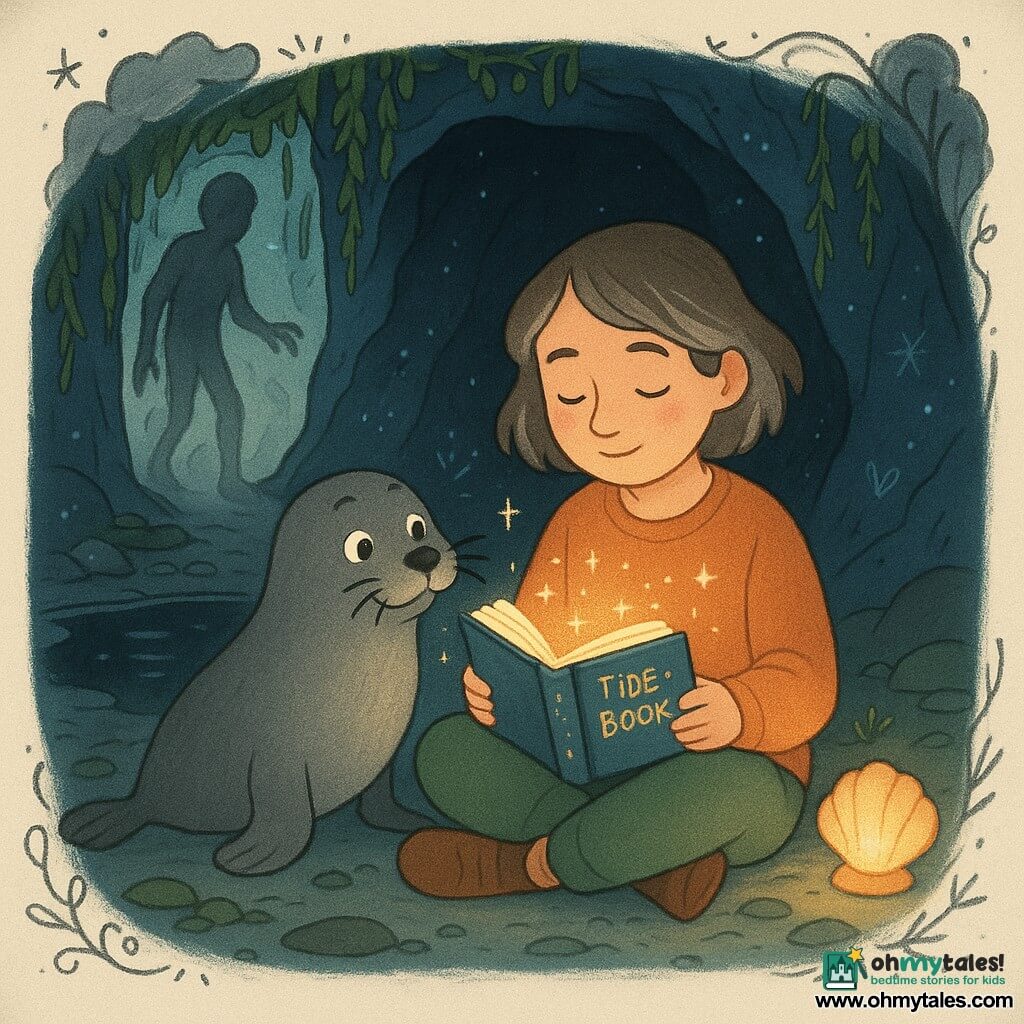
Mira set the satchel down and took out the Tide-Book. Its cover shimmered, as if relieved to be held.
Brin stared at the pool. “It's so quiet I can hear my thoughts,” he said, then frowned. “I do not always enjoy that.”
Mist seeped into the cave entrance, creeping along the ground like spilled ink. The shadow's voice echoed off the walls. “Give me the Book.”
Mira's throat went dry. She wanted to shout, to throw something, to do anything loud enough to feel powerful.
Instead, she remembered the waves: Light lives in listening.
She sat by the still pool and opened the Tide-Book. The pages glowed, and words rose like gentle birds from the paper.
“What are you doing?” Brin squeaked.
“Listening,” Mira whispered.
The shadow slid closer, drawn by the glow. “Yes,” it crooned. “Those words. I will swallow them.”
Mira held up the Lantern Shell. Its light met the Book's starlight, and together they made a soft circle around her—like a hearth made of brightness.
Mira began to read aloud. The words were simple, but they felt old as the sea:
“Let the heart be a harbor,
not a battlefield.
Let the breath be a lantern,
not a siren…”
As she read, the cave seemed to breathe with her. The crystals on the walls shimmered. The still pool quivered and then began to show pictures: Mira's grandmother smiling, a child being comforted, two friends forgiving each other. The images were not sharp, but they were warm—like memories wrapped in wool.
The shadow trembled. “Stop,” it hissed. “Those words make things…soft.”
Mira kept reading. Her voice did not rise; it settled, like dust after a storm.
Brin, who had been bouncing nervously, grew quiet. He rested his chin on his flippers and sighed. “I feel…less wiggly inside,” he admitted.
The shadow pressed against the circle of light, but it could not enter. Not because of a wall, but because the calm in Mira's voice gave it nothing to grip. It was like trying to climb a smooth pearl.
Finally, the shadow's misty shape began to thin.
“I don't understand,” it whispered, sounding suddenly smaller, almost childlike. “If people feel, they will hurt.”
Mira paused. She looked at the shifting face and spoke gently. “Yes. Feelings can hurt. But they also heal. Love is a light, and light can sting eyes that have lived too long in dark. That doesn't mean the light is wrong.”
The Lantern Shell glowed a little brighter, as if agreeing.
The shadow shuddered, then broke apart—not into nothing, but into harmless fog that drifted upward and out through cracks in the ceiling. It left behind a single drop of water that fell into the pool with a quiet plink.
The cave became still again, but it was a peaceful stillness now, like a cat dozing in sun.
Brin blinked. “Did we just…read a villain to sleep?”
Mira smiled, tired but relieved. “We reminded it what it forgot.”
Chapter 5: The Eternal Tide
At dawn, Mira returned to the shore with Brin at her side. The island looked bright again, as if someone had pulled away the gray cloth and let colors breathe.
The wind danced around Mira's shoulders. “You protected the old knowledge,” it said proudly. “Not by locking it away, but by using it.”
Mira held the Tide-Book to her chest. “It was never meant to be hidden forever,” she said. “Only kept safe until it was needed.”
The waves rolled in, sparkling like scattered glass beads. “Legends grow when shared,” they sang. “And calm hearts make strong islands.”
Mira knelt and dipped her fingers into the sea. The water was cool, and it felt like a promise.
Brin cleared his throat importantly. “I, Brin of the Kingdom of Wet, declare that Mira is officially wise. Also, she owes me one fish for emotional support.”
Mira laughed. “You can have two.”
The wind sighed happily. “Hear that? Laughter. The brightest magic.”
Mira took the warm stone from her pocket and placed it on a rock at the water's edge. The sun touched it, and for a moment it looked like the stone held a tiny dawn inside.
Then she tucked the Lantern Shell into her satchel beside the Tide-Book. “Will the shadow return?” she asked, not in panic, but in honest curiosity.
The waves answered, “Shadows wander. Some return. Some change. But the sea keeps moving, and so does the heart. When you listen, you will always find the next right step.”
Mira looked out at the horizon. It seemed wider now, as if the world had taken a deeper breath. She felt something steady inside her—not a hard shield, but a quiet glow.
She understood the moral her grandmother had left like breadcrumbs: protecting wisdom is not about fearfully guarding it; it is about carrying it with kindness and sharing it with care. And when the heart is soothed, even darkness grows less frightening.
The wind spoke softly, like a lullaby: “As long as the island has ears for stories and a heart for peace, the old knowledge will live.”
The waves added, “As long as love is spoken, it will echo.”
Mira stood between wind and water, between whisper and legend. Above her, the sky stretched on and on, a blue page without end.
And she felt it then—a sense of eternity, gentle as tide rhythm: stories flowing through time, returning again and again, always new, always home.