Chapter 1: The Valley That Listened
In a land where mornings tasted like mint and sunlight slipped through leaves like golden thread, there lay a gentle region called Larkwhisper Valley. People said the valley could listen. If you sighed, the grasses leaned closer. If you laughed, the river chuckled back.
There lived a young woman named Elowen. She was not grand in the way of queens in tall towers, nor fierce like heroes with shining swords. She was wise in small ways—she knew when bread needed more time, when a friend needed fewer words, and when a worried horse needed a softer hand. Yet one wish kept tapping at her heart like a tiny bird: she wanted to learn wisdom that could guide her even when she did not know the path.
Elowen often walked alone beneath the alder trees, where the air smelled of rain even on clear days. She would speak to the valley as if it were an old aunt.
“Teach me,” she whispered one evening, when the sky was turning the color of a peach. “Not cleverness. Not tricks. Real wisdom.”
The wind, which had been dozing in the reeds, stirred and slipped through her hair. The leaves clicked together, like teeth beginning a sentence.
At her feet, something glimmered—an acorn, but not brown. It shone faintly, as if it had swallowed a star and was trying to keep it safe. When Elowen picked it up, it felt warm, like a friendly hand.
A soft voice came from the nearest oak. Not from its branches, exactly, but from the space between its roots and the earth—where secrets like to hide.
“Plant it,” the oak murmured. “And walk where it points. Nature will be your guide and your guardian.”
Elowen looked at the strange acorn. It pulsed once, like a slow heartbeat.
“Where will it point?” she asked.
The oak creaked, as if smiling. “Toward what you must understand.”
Elowen did not argue. Some truths arrive wearing no explanation. She found a patch of rich soil beside a path of pale stones, planted the starry acorn, and covered it with her palms. For a moment, the ground hummed—a low, steady song like a lullaby sung by the world itself.
When she stood, a thin sprout had already risen, bright as a blade of moonlight. It leaned to the east, steady and sure.
Elowen took a breath, tightened the straps of her satchel, and followed where the sprout pointed. The valley listened behind her, and the path ahead seemed to lift its chin, as if it knew her name.
Chapter 2: The River of Mirrors
The east path led Elowen to a river that did not rush. It drifted, slow and silver, as though it were thinking. Its surface was smooth as a polished spoon, and when Elowen looked down, she did not see her face.
She saw her feelings.
In the water, her worries floated like dark fish. Her hopes hovered like bright minnows. Even her kindness appeared—soft and round, like a pebble warmed by sun. The river was a mirror, but not for skin and hair. It reflected what lived behind the ribs.
On the far bank sat an old heron, tall as a question. Its feathers were the color of dawn fog, and one eye watched Elowen with calm, clever patience.
“You seek wisdom,” the heron said, without opening its beak. The words landed in Elowen's mind like gentle stones.
“I do,” Elowen answered, feeling a little silly speaking to a bird, though this was a land where silly things were often true.
The heron nodded. “Then cross.”
Elowen glanced left and right. There was no bridge. Only the shining river and the quiet pull of the far side, where the trees seemed to stand a little straighter.
“How?” she asked.
The heron tilted its head. “The river will carry what you offer it.”
Elowen knelt. The water showed her a moment from yesterday: a neighbor had asked for help, and Elowen, tired and busy, had answered too sharply. In the reflection, her words looked like tiny thorns drifting downstream.
Her cheeks warmed. “I didn't mean to be unkind,” she whispered.
The river shimmered, as if it had heard.
Elowen took a small ribbon from her satchel—a ribbon she used to tie her hair. She held it over the water, thinking. It was useful. She liked it. But she also remembered her neighbor's face, the way it had drooped like a flower without sun.
“I offer an apology,” she said, and she let the ribbon fall.
The ribbon did not sink. It stretched across the river, becoming a narrow, shining path—like a strand of moon pulled long. Elowen blinked. The ribbon-bridge trembled but held.
As she stepped onto it, the water's reflection changed. The thorny words softened into leaves that drifted away. Her worries thinned. Her hope brightened.
Halfway across, the ribbon wobbled. Elowen's heart jumped.
The heron's voice came again, quiet as a feather landing. “Do not cross by pretending you never stumble. Cross by making room to mend.”
Elowen swallowed and nodded, even though the heron was far away. She reached the other side and stepped onto grass that felt cool and welcoming.
Behind her, the ribbon turned into a real ribbon again and floated back to her hand, damp but intact, as if the river had borrowed it only to teach her.
Elowen bowed to the heron. “Thank you.”
The heron closed its eyes, satisfied. “Go on. Wisdom is a lantern. It brightens when you carry it for others, too.”
Elowen walked forward. The air smelled of wet stone and new beginnings.
Chapter 3: The Lantern Under the Ferns
Beyond the river, the forest grew thicker and older. Ferns spilled over rocks like green waterfalls. Mushrooms stood in tidy circles, like little tables set for invisible guests.
As Elowen walked, she noticed something strange: patches of shadow clung to the forest floor, darker than any normal shade. They lay like spilled ink, swallowing the shine of the leaves.
From one of these inky puddles came a small sound—thin and trembling.
Elowen knelt. “Who's there?”
A creature the size of a kitten crawled out. It looked like a squirrel made of soot, with eyes like tiny drops of night. Its tail dragged, heavy with gloom.
“I lost my light,” it squeaked. “I used to glow. I used to guide travelers to berries and safe burrows. Now I'm just… a smudge.”
Elowen's chest tightened. She could almost feel the creature's sadness, cold as winter under the skin.
“What happened?” she asked.
The creature sniffed. “I tried to hold all the darkness so no one else would have to see it. I thought I was being brave. But the darkness grew, and my light ran away.”
Elowen sat back on her heels. The creature's words felt like a story she half-knew. How many times had she tried to fix everything alone, biting down her worries so no one else noticed?
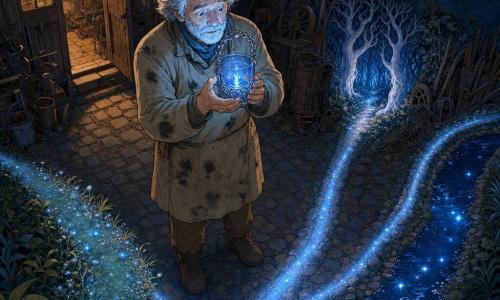
She looked around. Beneath the ferns, something glinted—a lantern, half-buried in leaf litter. Its glass was cloudy, and inside, a faint spark hopped like a nervous firefly.
Elowen reached for it, but the shadows slithered closer, as if they wanted to swallow the last glow.
She remembered the heron's lesson: make room to mend. And she remembered the oak's promise: nature would guide and guard.
Elowen placed her palm on the ground. “Forest,” she whispered, “if you are listening, help me share this load.”
The earth answered with a quiet thrum. The ferns lifted slightly, like skirts making space. A line of pale mushrooms began to glow, one after another, forming a gentle ring around Elowen, the creature, and the lantern. The ring was not a wall; it was a circle of welcome.
Elowen lifted the lantern. “This light belongs to you,” she told the soot-squirrel. “But you don't have to carry every shadow alone.”
The creature's ears drooped. “But if I don't, who will?”
Elowen held the lantern between them. “We will. Little by little. Together.”
She opened the lantern's latch. The spark inside fluttered out, not away, but toward the creature—like a homecoming. It touched the soot-squirrel's chest and spread in soft lines through its smoky fur. The creature brightened, not into blazing brightness, but into a steady, warm glow—like embers that know how to last.
The shadows on the ground did not disappear. Instead, they softened around the edges, becoming ordinary shade again, the kind that rests beneath trees without fear.
The creature blinked, surprised. “I can see my paws!”
Elowen laughed, relieved. “They were always there.”
The soot-squirrel—no, the ember-squirrel now—bounded in a small circle. Its tail lifted, lighter. “What is the wisdom here?” it asked, eyes shining.
Elowen thought of the darkness the creature had tried to swallow, and of her own sharp words drifting like thorns.
“Courage isn't pretending you're made of stone,” she said slowly. “It's knowing when to ask for hands, and when to offer yours.”
The ember-squirrel pressed its warm forehead to Elowen's thumb. “Then take a bit of my light,” it said, “so you remember.”
A tiny ember leaped from its fur and settled into Elowen's satchel, where it glowed through the cloth like a friendly secret.
Elowen stood, feeling lighter herself. Somewhere ahead, the trees thinned, and a pale path rose toward a hill where the air looked softer, as if the sky had melted into the land.
Chapter 4: The Crown of Thorns and the Crown of Bloom
At the top of the hill stood a ruined gate made of white stone. Vines crawled over it, and roses grew where the mortar had crumbled, stubborn and sweet. Beyond the gate lay a small courtyard, quiet as a held breath.
In the center, upon a pedestal, sat two crowns.
One was made of thorns—sharp, dark, and proud. It seemed to whisper, even without words: Be right. Be above. Stand alone.
The other was made of wildflowers—daisies, cornflowers, and tiny bells that chimed when the wind touched them. It seemed to hum: Be kind. Be with. Grow together.
Elowen's heart tugged in two directions. She had come for wisdom, and the crowns looked like answers shaped into circles.
A voice rose from the roses, soft and sad. A woman stepped from behind the vines. Her gown was gray as mist, and her hair was braided with dried leaves. Her eyes were beautiful, but tired, like lamps that had burned too long without being refilled.
“I am the Lady of the Courtyard,” she said. “Long ago, I guarded this place. Travelers came for counsel. But I chose the thorn crown, thinking it would make me strong. It did make me sharp. So sharp that I cut those who came close. At last, no one came at all. Loneliness grew like ivy in my chest.”
Elowen listened, feeling the melancholy in the air—the way even the sunlight seemed to step quietly, not wanting to disturb a sorrow.
“Now,” the Lady continued, “wisdom waits here, but it must be chosen again and again. One crown leads to cold power. The other leads to harmony, which is a different kind of strength. Take one, and the other will fade.”
Elowen stared at the thorn crown. It gleamed like a challenge. She imagined herself wearing it, walking with her chin high, never needing anyone. The thought tasted bitter, like chewing bark.
Then she looked at the flower crown. It was fragile, surely. But it was alive. It smelled like summer fields and shared laughter.
Elowen remembered the river that carried an apology. She remembered the ember-squirrel whose light returned when the darkness was shared. She remembered all the times she had been helped without being made small.
“I do not want wisdom that stands alone,” she said, and her voice did not shake. “I want wisdom that makes room for others.”
She reached for the flower crown.
The moment her fingers touched it, the courtyard sighed—an exhale that seemed to come from the stones, the roses, even the sky. The flowers brightened, and their small bells rang, clear and happy. The thorn crown dulled, as if it were only an old twig after all.
Elowen placed the flower crown on her head. It was cool and light, and yet it made her feel steadier than armor.
The Lady of the Courtyard closed her eyes. Color crept into her cheeks like dawn returning. The dried leaves in her hair turned green again. “You have chosen harmony,” she whispered. “And harmony chooses you back.”
Elowen stepped forward and took the Lady's hands. They were cold.
“You don't have to guard this place alone anymore,” Elowen said.
The Lady's eyes filled, and a single tear rolled down—bright as a pearl. When it touched the ground, a small sprout rose between the stones.
“Then go,” the Lady said, smiling for the first time. “Bring what you have learned home. Let nature celebrate with you.”
As Elowen walked back through the gate, the roses lifted their heads. Petals loosened and drifted after her like a blessing.
Chapter 5: The Feast of Leaves and Light
Elowen returned to Larkwhisper Valley as evening poured honey-colored light across the fields. The valley felt different, though perhaps it was Elowen who had changed. The grasses seemed to bow as she passed. The river's laughter sounded closer. Even the stones on the path looked warmer, as if they remembered her footsteps.
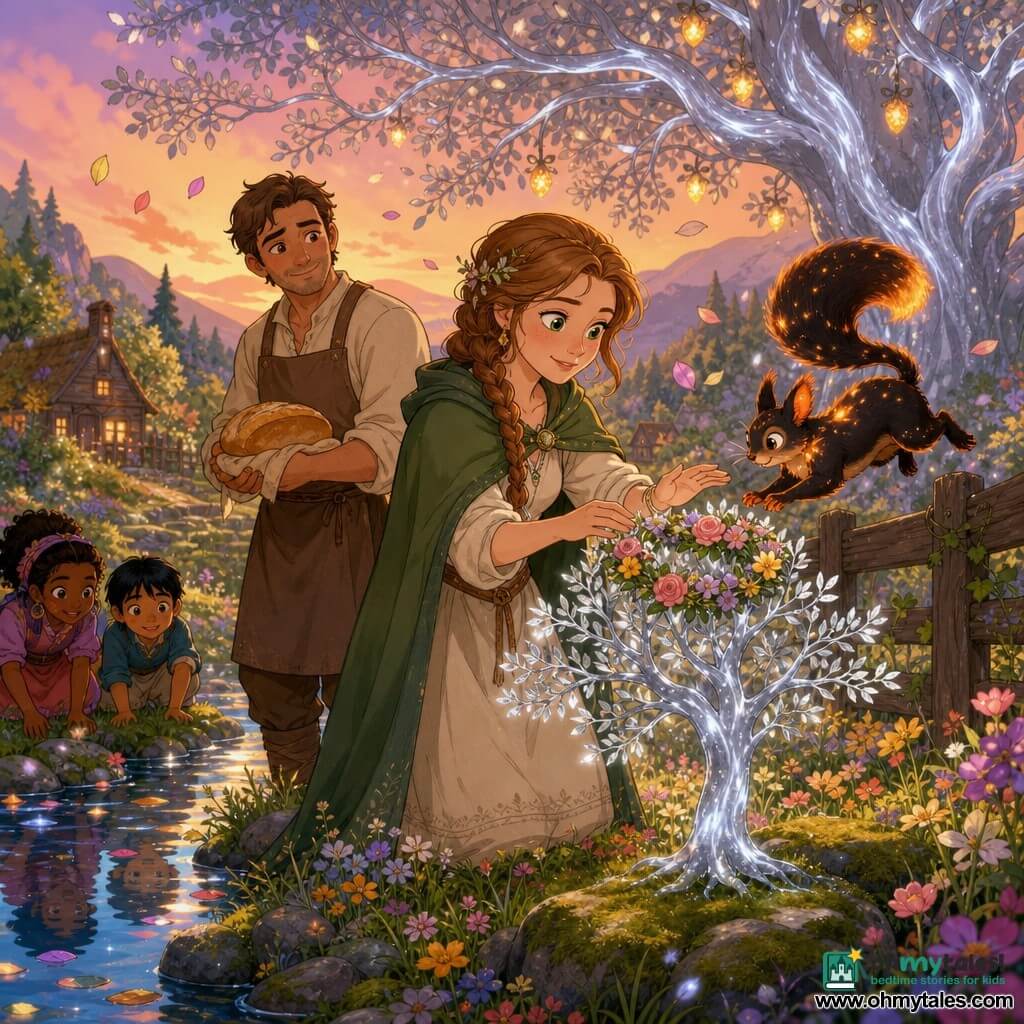
She hurried to the spot where she had planted the starry acorn. There, instead of a sprout, stood a young tree—taller than Elowen, its bark silvered, its leaves shaped like little open hands. Between its branches hung tiny lights, like fireflies that had decided to become fruit.
Neighbors gathered, drawn by the glow. Children came first, curious as sparrows. Adults followed, carrying baskets and questions. The air filled with murmurs.
Elowen lifted her hands. “Friends,” she said, “I asked the valley to teach me wisdom. And it did, but not as a riddle to be solved alone. It taught me with a river, a lantern, and a choice.”
She told them about the river of mirrors and the ribbon-bridge of apology. She told them about the ember-squirrel and the darkness that grows when someone tries to swallow it all. She told them about the two crowns—thorns and bloom—and how one kind of strength cuts while the other kind holds.
As she spoke, the young tree's lights brightened. They drifted down from the branches, floating like slow snow, and touched the people listening. Wherever a light landed, a person's face softened. Shoulders unknotted. Hands reached for other hands.
Her neighbor—the one she had answered sharply—stood at the edge of the crowd, holding a loaf of bread. Elowen walked to them.
“I'm sorry,” she said simply, and she meant it all the way down to her bones.
Her neighbor blinked, then smiled. “I'm glad you're here,” they said, and offered the bread.
The valley seemed to clap without hands. Leaves rustled like applause. The river chimed against its stones.
Then the nature-festival began as if it had been waiting behind a curtain.
The trees shook down petals like confetti. The mushrooms along the forest's edge glowed in friendly colors. A chorus of crickets tuned their tiny fiddles. Even the wind, that old traveler, twirled through the valley carrying the scent of berries and warm earth.
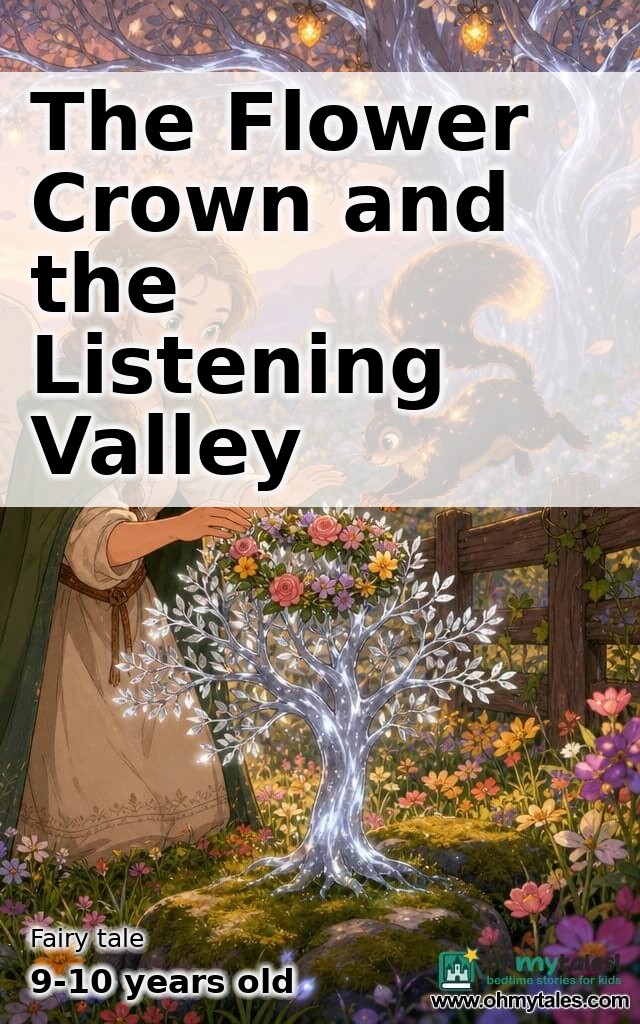
Elowen placed the flower crown upon the young tree's lowest branch, and it did not wilt. Instead, it rooted itself there, blooming brighter, as if the tree had always been meant to wear it.
The ember-squirrel appeared on a fencepost, shining like a brave coal. The heron flew overhead, wings wide and slow, and its shadow on the ground looked like a protective hand.
Elowen sat among her neighbors as they shared food and stories. Laughter rose like lanterns into the twilight. When a child stumbled and nearly cried, another child helped them up, and the hurt became a joke instead of a wound. When an older farmer looked sad for a moment, someone squeezed his shoulder, and his eyes brightened again.
Elowen looked around and understood, at last, the kind of wisdom she had been chasing.
Wisdom was not a crown you wore to be above others. It was a circle you formed so no one stood outside in the cold.
And harmony was not silence. It was many different voices choosing to make one song.
Above them, the first stars blinked awake. Below them, the young tree glowed steady and kind, a lighthouse made of leaves. The valley listened, pleased, and in its listening, it felt like love—quiet, strong, and bright enough to guide anyone home.