Chapter One: The Hill of Quiet Bells
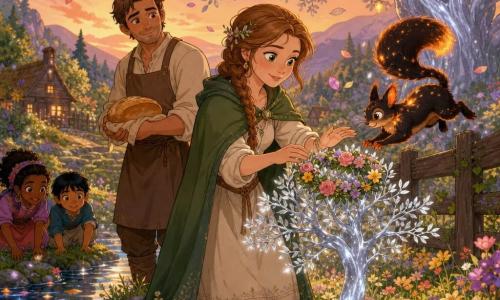
In the valley where the morning breathed like a linen sheet and the hills wore golden hair, there lived a young woman named Elara. She moved with the careful steps of someone who tended gardens of soft truths; her hands smelled faintly of thyme and stardust, and she wore a cloak the colour of sunrise. Elara was a protector—of little birds that forgot the ways of the wind, of lost lanterns that had dimmed their own flames, and of children's small hopes that had fallen between the stones. The people called her gentle as a rain cloud, and the world around her listened.
The hills were not ordinary hills. They hummed with quiet bells, a music born when dew touched the grass at dawn. Each bell chimed a note that told of something needed: a lost toy, a promise, a forgotten song. Far beyond the golden curls of the hills crouched the forest of silver leaves. In that forest the trees whispered like old librarians who had read every secret. Magic in this land did not thunder; it danced like dust motes in a sunbeam, delicate and patient, ready to be believed.
Yet Elara had a secret sadness that she folded into the hem of her cloak. Once—when she was very small—she had been able to call upon a power that sparkled inside her chest like a lighthouse: the power of believing. With it she mended broken things and made joy grow in hush places. But years of sheltering other people's fears had dimmed this light into a faint candle. She could still hear the bells and the wind, but the song that had once answered her voice had grown distant. To protect was not the same as to believe, and she felt her own heart like a lantern half-buried in the earth.
On a morning that smelled of warm bread and rain, Elara climbed the highest of the golden hills. There she sat and listened to the bells. One bell sang with a clarity she had not heard in a long while—a single, crystal tone that trembled with both sorrow and hope. It was the bell that rang when someone needed to find their belief again. Elara closed her eyes and let its music fill her.
A small silver bird alighted on her shoulder. It had feathers like moonbeam and eyes that held maps. "The forest remembers," the bird whispered in a voice soft as moss. "The Moonstone at the heart of the silver wood keeps the mirror of true belief. You must find it, Protector, and look upon what you have kept hidden."
Elara's hands tightened around the staff she carried—a simple branch wrapped with twine, a place where her promises slept. She rose, and the bells sang as if to sweep her onward. She did not set out for glory. She set out to find the light that would let her believe again, for to protect others she needed to trust the very thing she had lost: that light could be given, and that some truths were gentle and unbreakable.
Chapter Two: Across the River of Glass
Between the golden hills and the silver forest flowed the River of Glass. Its surface was not water but a mirror of moving sky, and all who looked into it saw themselves as they might become. Many had crossed it by stepping on stones that rose like exhalations, but the stones moved in riddles—some days they led home, other days to places where dreams went to sleep.
Elara reached the river by noon. Her reflection in the glass was a woman with wind-tangled hair and small, brave hands. The river's voice was a liquid hymn. "To cross," it said, "you must trade something precious and take something truer."
Elara thought of the many things she had protected: a child's missing laughter, the promise sewn into an old coat, the light of a lantern that had forgotten its fire. She set down one of these little treasures—a feather from a bird she had once helped. It was not grand, but it was honest, and the river understood honesty like a friend. The stepping stones rose and formed a path that shimmered like a poem.
About halfway across a sudden fog curled over the river. From it emerged a figure draped in grey, like a cloud that had learned to walk. He called himself The Broker of Maybe and he had pockets full of could-have-been. "Give me your certainty," he said, with a smile that showed both tooth and twilight. "In return I will give you the safest route, the path that never surprises."
Elara peered into his eyes and saw old winters and quiet absences. She felt the ache of an offered trade: safety for warmth, sameness for song. Her faith in other people's safety had sometimes made her too careful; she had folded friendships into neat squares to keep them from tearing. But she remembered a child's laugh that had burst like popcorn when she let a little risk remain, a laugh she had almost traded away for silence.
"I will not give up my belief in warmth and surprise," she said. "I will not trade the risk of loving for a road that never bends."
The Broker of Maybe frowned—the way a raincloud frowns—and the fog trembled. He could not take what she would not surrender. The stepping stones brightened as if to applaud. Elara crossed the last gleaming slab and stepped into the shadow of the silver leaves, where the forest waited like a patient heart.
Chapter Three: The Silverwood's Test
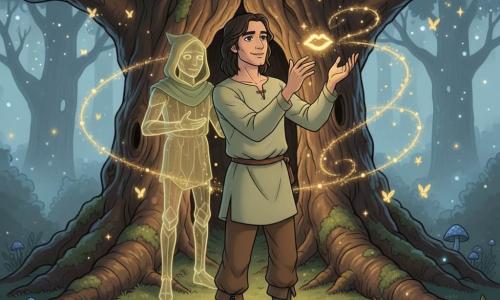
The silver forest was a place where moonlight had learned to speak. Leaves chimed softly as Elara walked beneath them, and tiny lights—lantern-moths—floated like questions. The path wound like a thought that had gotten lost and then found a reason to continue. At the center of the wood the trees opened into a clearing where the Moonstone sat upon a plinth of root and lichen. It was not a jewel as people often thought jewels to be; it was a smooth, pale stone that seemed to breathe. When Elara approached, the Moonstone felt like an old friend who remembered every story she'd been part of.
Beside the stone stood three guardians: an old fox with fur silver as frost, a woman-shaped shadow with eyes that held midnight, and a child whose hair was woven with stars. The fox bowed, the shadow narrowed its face, and the star-child smiled with the wide trust of someone who had never yet learned fear.
"You have come to see the mirror of true belief," said the shadow. "But first you must answer what weighs most: what will you protect when you have your belief again?"
Elara thought of her village and of strangers whose sorrows she had gathered like pebbles. She thought of herself, almost forgotten like a candle in the cellar. She answered slowly: "I will protect the small lights—trust, laughter, and the quiet courage that sits inside people like seeds. I will also protect myself, so I may keep protecting others."
The fox stepped forward and touched her hand with a paw warmer than moonlight. "Pure answers," he said. "The world needs protectors who remember to care for their own lamps. But there is a last test. To reclaim true believing, you must look into the Moonstone and speak what you fear to lose."
Elara knelt. The Moonstone showed not her face but a garden with a gate undone. Beyond the gate were people she loved blurred by fog. She feared that if she believed again, she might risk losing them—by loving too much, by asking too much, or by promising and failing. She feared that her light might attract shadows that would take them away.
She pressed her palm to the stone and whispered, "I fear losing those I love."
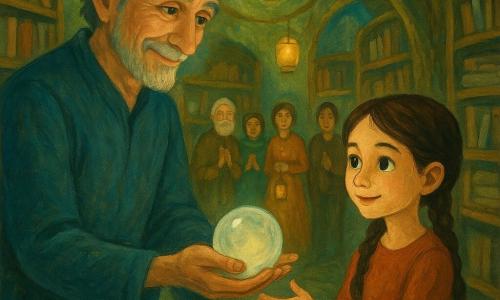
The Moonstone warmed. Its surface cleared like a pond when a stone is removed from its center. A reflection emerged, not of things that would be taken, but of what her believing could become: a chain of lanterns floated between people, each light feeding the next. The image told her that belief was not a greedy fire that burned and consumed; it was a net of small flames that could keep one another safe.
The star-child sang a note that smelled of chamomile. "Belief is not a risk against the ones you love; it is the bridge you build for them." The shadow nodded, and the fox curled at her feet like a soft question answered.
Elara realized her fear had been a thin wall of mist. It was made of good intentions, but it kept out not only harm but warmth. She stayed awhile with the Moonstone, and it showed her faces she had sheltered: a little boy who laughed too rarely, an old woman whose garden had forgotten how to grow, and a sister who'd stopped drawing. In every face, a small light flickered. She saw how her belief could help each flicker find air.
When she rose, the guardians gave her a silver thread. "Tie it around your staff," said the fox. "When the thread glows, follow what it guides you to. It will not lead you away from duty, but toward the heart that needs you to believe."
Elara tied the thread. It fit her hand like a promise.
Chapter Four: The Night of Borrowed Stars
Elara walked out of the silverwood as the sky poured itself into evening. The golden hills were a darker gold now, the bells humming like distant wishes. The silver thread on her staff pulsed once, then twice, like a heartbeat, and the thread guided her toward a cottage whose chimney curled like a sleepy question.
Inside the cottage lived a widow named Mara and her little girl, Lio, who kept a jar of firefly-glow beneath her bed. Their lantern had dimmed after winter took some heat from the hearth and their courage from the small girl's mouth. The thread shimmered brighter when Elara stood at the threshold. She entered and found the air heavy with silences that had not yet learned laughter.
Lio looked up with eyes like unfinished stories. "Are you a witch?" she asked, half hopeful, half cautious.
Elara smiled. "I'm a protector who got lost and found her believing again," she said simply. "May I sit by your hearth?"
Mara nodded, and Elara set down her staff. She did not pull from her pocket a grand spell nor a box of miracles. Instead she told a story—one small, true tale about a fox that traded its silver tail for a moonbeam and then learned to find itself again. The story wound around them like bread dough, softening the rigid shapes of worry. Lio's jar trembled and a few fireflies stirred. Mara's eyes, which had been glassy from a winter of worrying, grew warm like bread fresh from the oven.
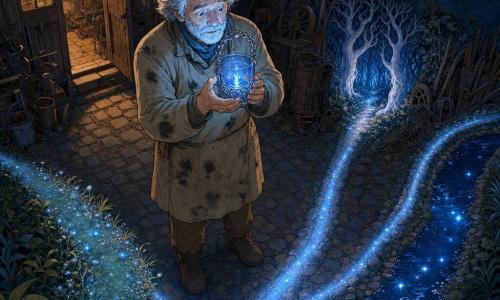
The silver thread glowed like understanding. Lio asked Elara for a little thing—a place to plant a seed. Elara took a scrap of cloth and wrapped around the seed a promise: to water it with hopeful words and give it time. She showed them how to whisper to seeds and to wishes: kindly, persistently, believingly. That night, they kept a vigil of small lights, passing lanterns like stories from hand to hand. The fireflies came out, as if summoned by trust, and the lantern that had dimmed sat up and became stubbornly bright.
Before she left, Elara helped Mara mend the old coat with a stitch called Honesty. "When you tell each other the truth with a soft heart," she said, "you feed the lamps inside you." The coat carried that new stitch like a secret that would warm its wearer.
As she stepped outside, the silver thread tugged her onward. The stars above seemed to listen when people kept soft promises. Elara thought of the moonstone's image—a necklace of lanterns—and she smiled. Each place she fixed, each light she coaxed awake, made the chain brighter.
Chapter Five: The Return of the Lighthouse
Weeks passed and Elara wandered the hills and forest, following the thread. She helped an old baker believe in his sourdough again; she taught a schoolboy how to draw a map of his dreams; she guided a lost caravan by humming the bell-notes until they remembered which way home sounded.
With each small rescue her heart grew lighter and more sure. The silver thread wound around her staff and sometimes spoke like a gentle bell, directing her where the need was greatest. Yet there was still a hollow room inside her that longed to be filled by one thing: the knowledge that her believing could hold, that it would not crack like a pond in late winter.
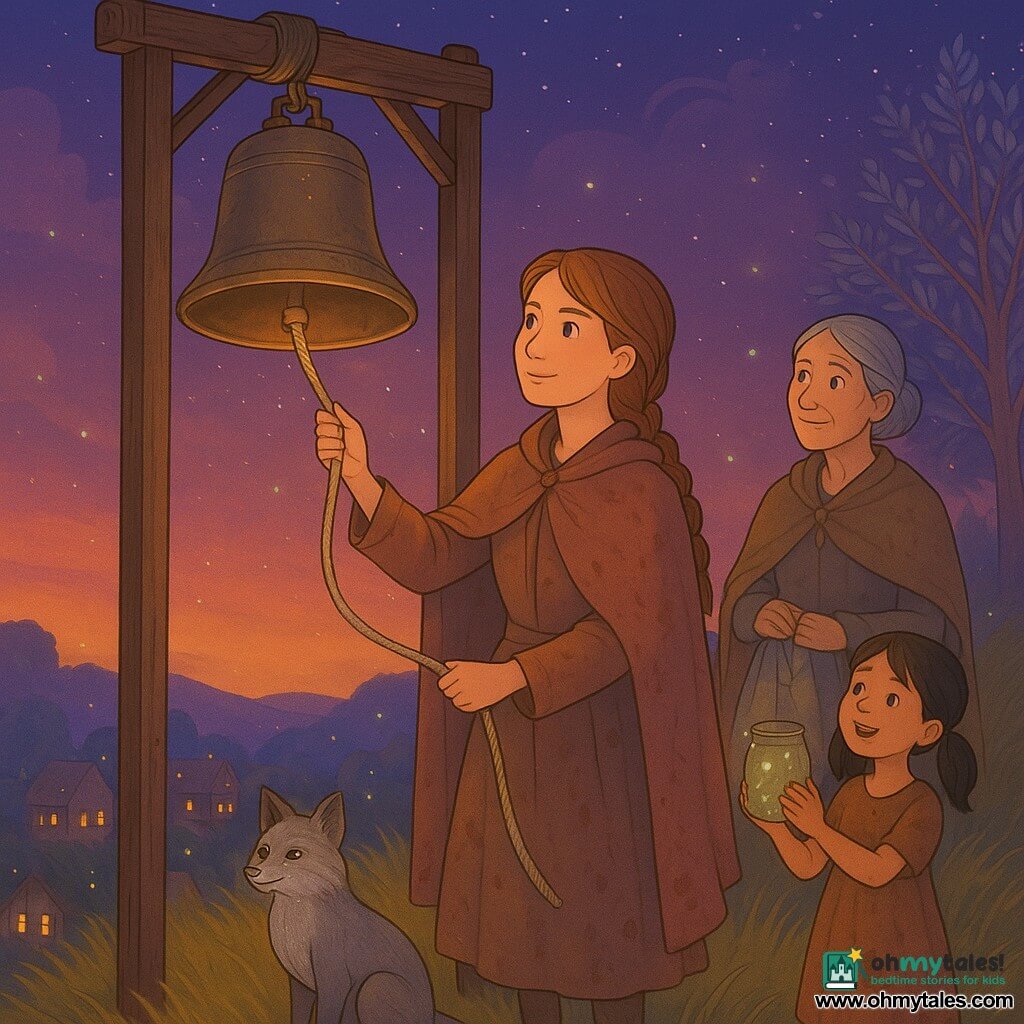
On a night when the moon leaned forward like a listener, the thread glowed brighter than ever. It led Elara up the highest hill, where the bell of the valley hung—a bell older than the oldest tree, made of a metal that remembered sunrises. The bell had rarely rung in years; when it had been muffled, people forgot how to call to their own hearts. The thread pulled her to its rope.
As she climbed, the scape below unfurled—a quilt of lights from the houses she had helped, each one now a small lamp with its own pulse. The people had come out to watch. Voices rose like chorus—some thanking, some simply humming the notes that the hills liked best. They did not know they were making a chain of light, but they were, as naturally as breath.
Elara took hold of the rope and thought of all she had feared would be taken: the faces that mattered, the fragile lights. She remembered the moonstone's mirror that had shown lanterns feeding each other. She thought of the Broker of Maybe and the choice she had made to keep surprise. With a breath full of both fear and fierce faith she pulled.
The bell pealed, and the sound sewed itself across the valley like a bright seam. It was not a cry of triumph but of pure invitation—an open palm. The little lamps flared and the silver leaves in the forest rang the echo as if they were clapping. The people below lifted their hands and each small hand found the next, making a circle wide as a meadow.
For a moment, the bell's note held the whole world like a cup of rain. Inside it Elara felt a warmth rise from her chest: the power of believing had returned. It was not a single star dropped into her; it was a weather that came when many tiny lights joined their wills. She had rekindled something not only in herself but in others. She had learned that belief grows when it is shared, and that protecting others meant sometimes letting their light be near enough to touch.
Love folded around Elara like a soft shawl. The people came up the hill, bringing pies and quilts and songs that smelled of thyme and newly-baked bread. Children pressed sticky-cheeked kisses to her hand; an old friend laughed until tears made silver tracks down his face. Mara and Lio stood near the bell, their lantern blazing proud. The fox from the moonstone waited at the edge of the crowd, tail curled like a question now answered.
Elara looked at the faces around her—their imperfections, their brilliant small goodness—and felt a peace like warm milk. The power to believe had returned because she had given room for it: in her deeds, in her honesty, and in the humble stories she told. The light inside her no longer flickered alone; it was part of a thousand lamps, each holding a tiny truth.
When the night settled and the stars embroidered the sky, Elara sat on a stone with the silver thread wrapped around her staff. She thought of the day she had first climbed the hill and how her heart had felt like a lantern with too little oil. Now it brimmed with oil made of community and courage. She understood, at last, that to be a protector was to keep other lamps safe and close—not to hide them away, but to help them burn brighter.
The valley slept with a soft glow, as if it had been kissed by a kindly sun. Elara closed her eyes and felt the bell's song curl into her dreams. The Moonstone's promise had been fulfilled: faith had returned, not as a sharp sword, but as a ribbon of light that bound them together.
And in the morning, children found their toys and old songs returned to their places, and the light in the lanterns shone a little truer. Elara walked among her people, a quiet lighthouse who no longer feared the waves, for she had learned that belief is strongest when it is shared. The world around her, the golden hills and the silver woods, continued to hum their bell-notes, and love—pure, steady, and bright—danced in the air like a little triumph of sunlight.
They say that when someone learns to believe again, the whole valley remembers how to hope. In Elara's valley the remembering went on for years, like a melody passed from mouth to mouth, keeping the lamps alive. And whenever a child doubted whether magic could be true, an elder would smile and point to the hill where a protector had rung the bell, and the child would see, between the stars, a thousand small lights holding one another, and know that believing was a thing that could be lent, borrowed, and most of all, shared.