Chapter One: The Forest of Whispered Leaves
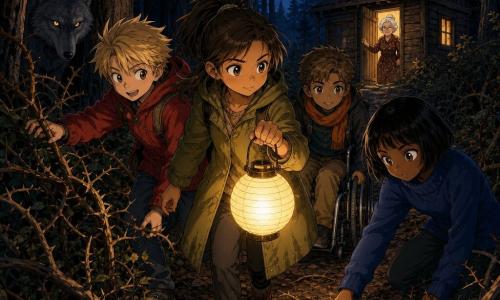
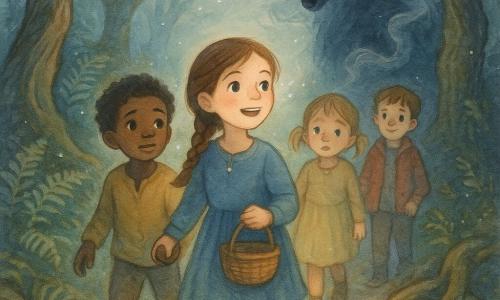
The forest around the little village was an old thing, full of sighs. Trees leaned together like conspirators and the wind spoke in low, secret words. Three girls lived at the edge of that wood in houses with warm chimneys and windows like bright eyes. Elsie, Mara, and June were friends the way river stones are friends—rounded by time, held close, and smoothed by the same water. They were nine or ten years old, small against the tall trunks, but their hearts were as wide as the meadow.
One autumn evening, when the sky wore a shawl of blue dusk, the three girls made a promise. They sat in a circle on the kitchen floor, their knees touching, hands warm against each other. Elsie, who loved to braid, said with a solemn look, “We will never open the door to someone we do not know.” Mara, who kept a notebook of curious things, nodded as if she were writing the vow into the air. June, who always carried a small tin of peppermint, pressed her thumb to the table and said, “Even if they say they are in need, we will ask for help together.”
They repeated the words like a lullaby, until the promise sounded like a small bell. The promise was not just for themselves; it was for their mothers, for the little cat that slept on the windowsill, and for the houses across the lane that had doors that shivered in wind and rain. At the edge of the circle a wooden soldier stood watch, silent and not unkind. The girls sealed the promise with a secret knot in a braid and tucked it under June's ribbon where it could be felt but not seen.
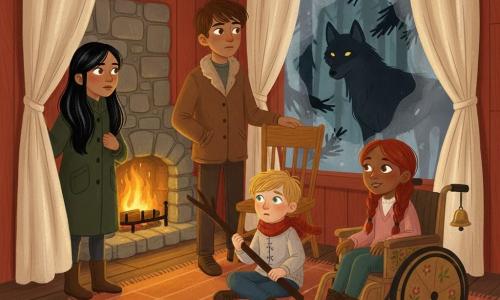
At that moment, a shadow moved beyond the glass. A voice, soft as moss and slippery as a creek, said through the pane, “Little ones, I have a gift.” The girls held their breath. A shadow with too many teeth brushed past the path and into the night. It was the wolf, who lived when he pleased and smiled with promises he never meant to keep.
Chapter Two: The Wolf's Hollow Tongue
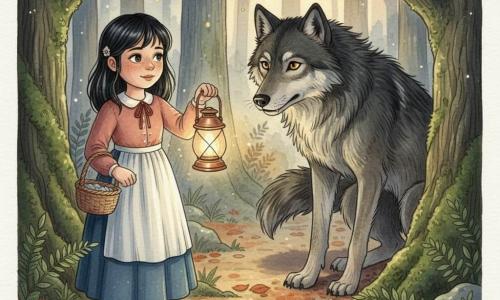
The wolf had a voice like sugar that melted into a trap. He wore the moonlight like a cloak and carried with him the smell of strange promises—honey, warm cookies, a bag of bright apples. He came to doors with words that glowed and vanished like soap bubbles.
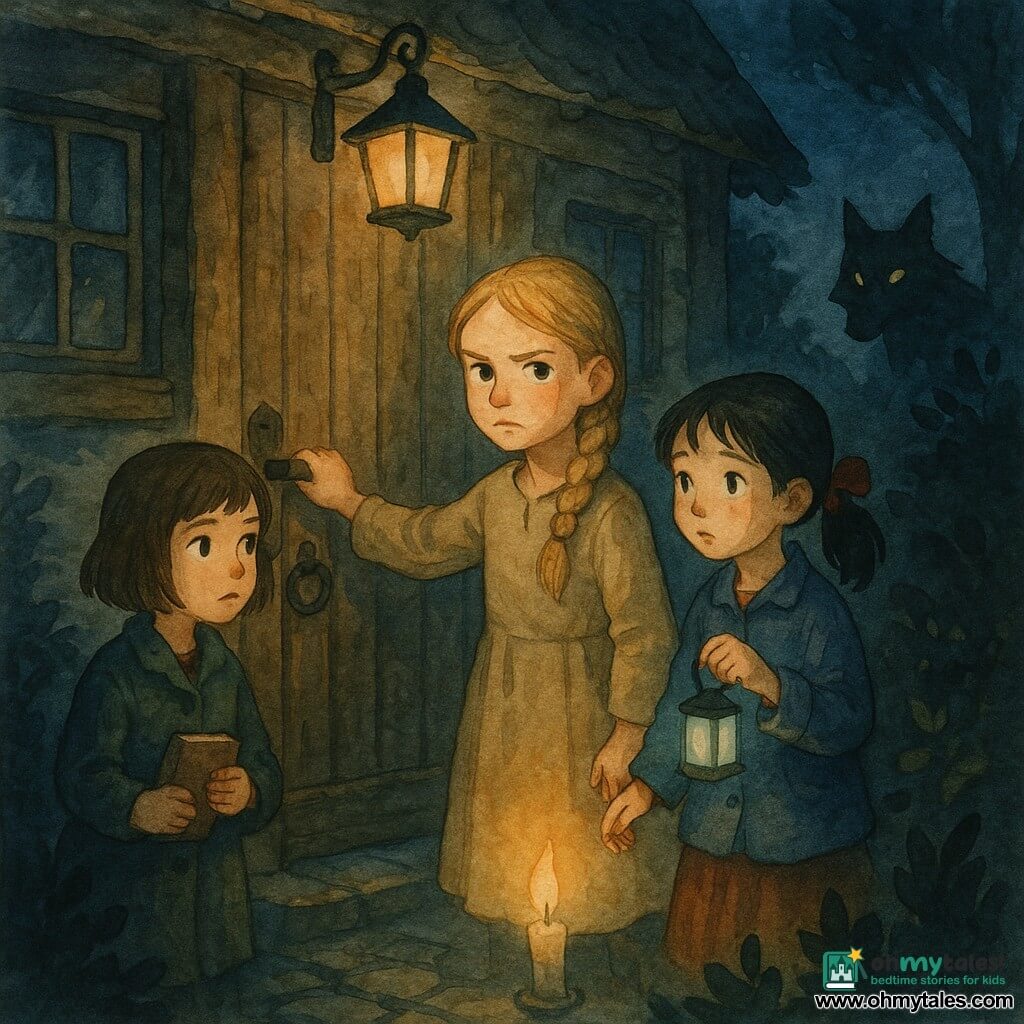
First he stopped at Elsie's cottage. He tapped, and through the keyhole his voice curled, “I am a weary traveler. I have a letter from your aunt.” Elsie remembered the promise and pressed her hand to the wood. “We do not open to strangers,” she said, and her voice was steady as a post. The wolf held up a jar of honey, sticky and golden. “Only a taste,” he called. Elsie looked to the window, and in the reflection she saw Mara and June, tiny lanterns of courage. She told him, “We must ring the bell and ask our mothers.” The wolf's smile thinned to a line and he moved on.
At Mara's house he sang of lost puppies and maps, and at June's he promised the moon's silver if she would lift the latch. Each time the girls remembered the knot in the braid and the little bell of their vow. They spoke to each other through the panes with short sentences: “Stay steady,” “Trust the knot,” “Call at once.” The wolf retreated into the night with his hollow tongue clicking like bones, but he did not go far. Hunger lives in wolves, but so does cunning; when one thing fails, another path appears.
Late that night he wore the voice of a neighbour. He came in rain, soaked and sorry, with a basket of bread and a story in his mouth. He said, “I was once your friend,” and that is how he learned to sound like something safe. At the cottage doors, each girl felt a thud of doubt. The wolf's promises were warm like a borrowed coat. Mara's hand hovered over the latch. She almost believed that a stranger could be small and needed, that promises could be given like bread.
But the girls had tied a knot that hummed in their palms and it hummed louder when they were afraid. They met at the corner where the lanterns set a pool of light. “We must be together,” Elsie whispered, and so they were—three small figures standing like stacked stones against a tide of words.
Chapter Three: The Wolf in the Straw Hat
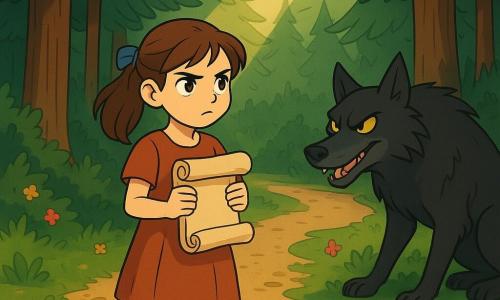
The wolf grew cleverer. He learned to change his voice, to wear new names like hats. One day he came in a straw hat and a coat patched with many patterns. He dropped a trail of crumbs that smelled of biscuits and of other people's kindness. He said, “My grandmother is ill; the road is long. Will you help me just once?”
This time he stood at the girls' meeting place, where the lane split like a forked tongue. He held two lanterns, one bright and one dim, and his eyes gleamed like coins. He promised that if they opened a single door, he would give them a secret—a map to a place where the trees whispered answers and the stars bent low.
The girls looked at one another. The forest behind them deepened like a sleeping dragon. The promise of a secret tugged at their curiosity, that gentle itch which sometimes leads children to climb too high. June remembered the peppermint tin and the ribbon knot, and she thought of the cat on the sill. Mara thought of her notebook, how many questions it held. Elsie thought of her braid and the slumbering bell.
“Together,” said Elsie, and it was not merely a word but a shield. They touched the secret knot in the braid, and the promise made in the kitchen warmed like bread. They agreed to trick the trick, to answer the wolf with a plan of their own. If the wolf would wear a hat and speak sweetly, they would give him no single way inside.
So Elsie, with courage as plain as a loaf, said aloud, “If your grandmother is ill, we will bring a message. But you must wait while we fetch a grown hand.” The wolf, surprised by the firmness, tried to slip a honeyed phrase through the crack. Mara stepped forward and placed a small note on the path. It read: WE DO NOT OPEN TO STRANGERS. June, quick as a fox, set the peppermint tin upon the doorstep and tapped it with a spoon. The sound rang like a bell of warning.
The wolf's straw hat shook. He circled, sniffed, and promised more—grander gifts, sweeter lies. The girls did not waver. Their voices joined, and where one voice flickered, another kept the flame. At last the wolf let out a howl that was less a sound than a surrender and slunk into hedges like a shadow folding itself away.
Chapter Four: The Moon, the River, and the Reward
The next morning, the village woke to a sky washed pale as an old bone. News traveled on the wind: a far cottage had been opened by someone who believed a wolf's promise, and the family had been frightened but not harmed because neighbours had come together. The story was a lantern that cast light and taught a new pattern—how towns hold together when each person keeps watch.
The three girls walked to the brook and sat on the stones where the river told riddles. A woman from the village, who stitched quilts of many colours, found them there and put a hand on each of their heads. “You kept a promise,” she said, and her voice trembled like thread. She braided ribbons into their hair and made a small charm of wood and copper—two tiny moons cut in half, so that when they were joined they made a whole. The charm was a token of trust and of shared keeping.
“You kept the door shut,” the woman said, “and you opened your eyes.” The charm slipped into Elsie's pocket like a secret seed. The girls learned that promises are not locks but bridges: they can be closed to protect, and they must be opened together to help when help is true.
That night the wolf came one last time, softer than a snowflake and meaner than a thorn. He sat under the birch and sang a sorrowful song about the road he had walked and the hunger at its end. His voice tried to curl into their dreams. But the girls had the token; they had the knot and the ribbon and the quilt-woman's blessing. They sat in a row outside Elsie's door, small candles set before them like stars in little cups. They watched the path and they hummed the promise softly, like a lullaby that holds back nightmares. The wolf's song met their hum and grew quiet; his hunger found no purchase where three lights glowed steady.
Chapter Five: The Quiet Promise
The forest did not change into something tame, but it learned a new measure of respect. Shadows still moved between trunks, but now the village had a rule that children would meet together at twilight, that every door would have a bell and every bell a friend who would answer.
For their bravery the girls received no gold except for one small reward that mattered more: a new promise, mutual and shared. The ribbon knot was braided into the curtain rope of the little lane hall where neighbors left messages and helped one another. The charm of the joined moons hung on the hall's nail, and when anyone entered, they touched it and remembered the four hands that made a promise and kept it.
The wolf, who had learned that false promises reach only empty bowls, passed by less often. Sometimes, when moonlight came thin and the wind told its old tales, he would sit on the far side of the wood and glance toward the houses. He would hear, from time to time, the three girls' laughter or the low murmur of many voices answering a door together. He would taste the memory of a candle's steady light and know that some doors are closed for safety and opened with care.
At night, when the girls lay in bed and the world felt like a blanket pulled up to the chin, they thought of promises as pieces of bread—shared, saved, and sometimes given away together. They slept with the gentle rhythm of their vow in their ears, a song that begins soft and ends softer: we will keep each other, we will ask together, we will not open to strangers alone.
And so the little village learned that courage is often quiet and that cunning can be met with companionship. The forest kept its mysteries, but the houses kept their doors. The wolf kept his hunger, but the children kept their promise. In the hush that followed, the world felt safer, like a chest that closes and locks not out of fear, but because inside it sits something worth protecting.