Chapter 1
Once, at the edge of a dark wood where the trees kept their secrets close, a small house stood with its back to the road. Smoke curled from the crooked chimney like a slow question. Inside, a boy of ten named Tomas learned to listen to small things: the tick of the clock, the creak of the stair, the soft scuff of his own feet. He had eyes that noticed patterns—how the moss grew thicker on the north stones, how the moon sat like a silver coin on the pond—and a heart that took kindly care of neighbors and beetles alike.
Tomas's village told stories at dusk, and the oldest tale was of the big wolf. The wolf of that story was not merely hungry; he was a shadow that could speak sweetly and turn words into snares. People said the wolf liked promises; he wore them like a coat. The old women tapped their spoons on the table and warned, "Never trust a promise that sounds softer than velvet." Tomas listened and tried to store that warning like a lantern in his chest—ready for a dark path.
One autumn evening, when the maples burned like small fires, Tomas found a scrap of paper under his door. On it was written in a curling hand: Come out. I will show you the secret of the wood. The ink smelled faintly of smoke. It was the sort of line that could guide you into wonder or lead you into a trap. Tomas folded the paper three times and tucked it into his pocket. He felt the pull of curiosity—the same pull that makes stone skip along water—but he also felt the steady weight of the old women's spoon and the lantern in his chest.
He lit a lantern and placed it at his threshold. The glass caught the flame and held it like a small stubborn sun. The villagers said the wolf feared lanterns at the threshold, for light makes shadows honest. Tomas stood in the doorway and listened. The wind answered with a low voice. He made a promise to himself, soft as a moth's wing: I will go, but I will not be fooled.
Chapter 2
Tomas walked along the lane where the houses hunched like sleepy animals. The lantern swung in his hand and painted his shadow long and thin. Each tree they passed bowed as if to hear him better. The path led into the wood, and the wood filled the world like a closed book. There were nights when the forest breathed mostly in black, but tonight the trees hummed with a low green light from deep inside—the kind of light that looks like the inside of a beetle's shell. It made Tomas's heart both bright and watchful.
Halfway beneath the trees, he met a man who wore a coat the color of wet fog. The man's voice was smooth honey. "You carry a lantern, child," he said. "That will make your way easier. Leave it here; I can guide you. Follow me, and you will see things no one in the village has seen."
Tomas felt the words like a hand on his shoulder. They were warm, and they slid their fingers into his ear. He remembered how his grandmother had told him, "A promise that wants your lantern may also want your feet." Tomas kept his grip on the glass. "No," he said. "I must keep my light at my door, and my promise to myself." The man's smile frayed like old velvet. He stepped back into the trees, and his shadow sighed away.
At the same place, a hare crossed the path and raised its nose. "Why are you taking lanterns to the woods?" the hare asked in a voice like a bell. Tomas thought for a moment and answered plainly, "To see what is real, and to make sure I am not led into a lie." The hare twitched and bounded onward, and Tomas walked on, his lantern like a small honest moon.
In the deeper grove, he found tracks. Not the prints of deer or fox, but a set of huge paw marks that left the soil trembling. Each print was a black question, pressed deep by something heavy. Tomas followed them with both care and curiosity. The wood felt older when one listened. It whispered of bargains and of old deals, of words wrapped in thread. He kept his lantern high so the shadows at the edge of the trees could not take his feet without asking.
Chapter 3
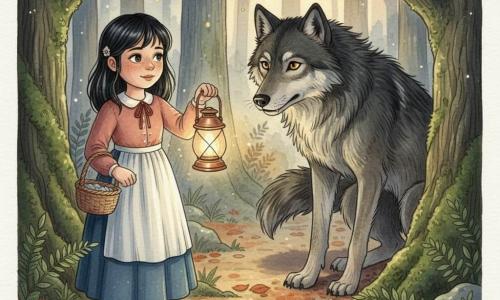
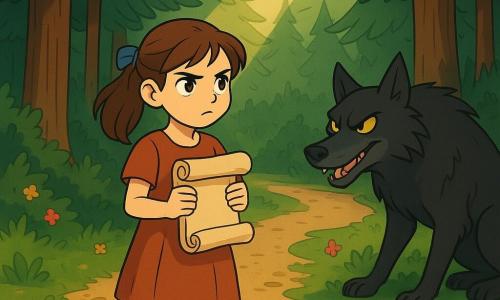
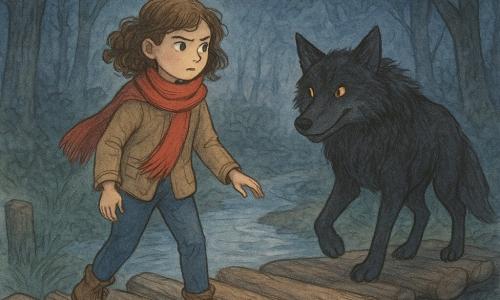
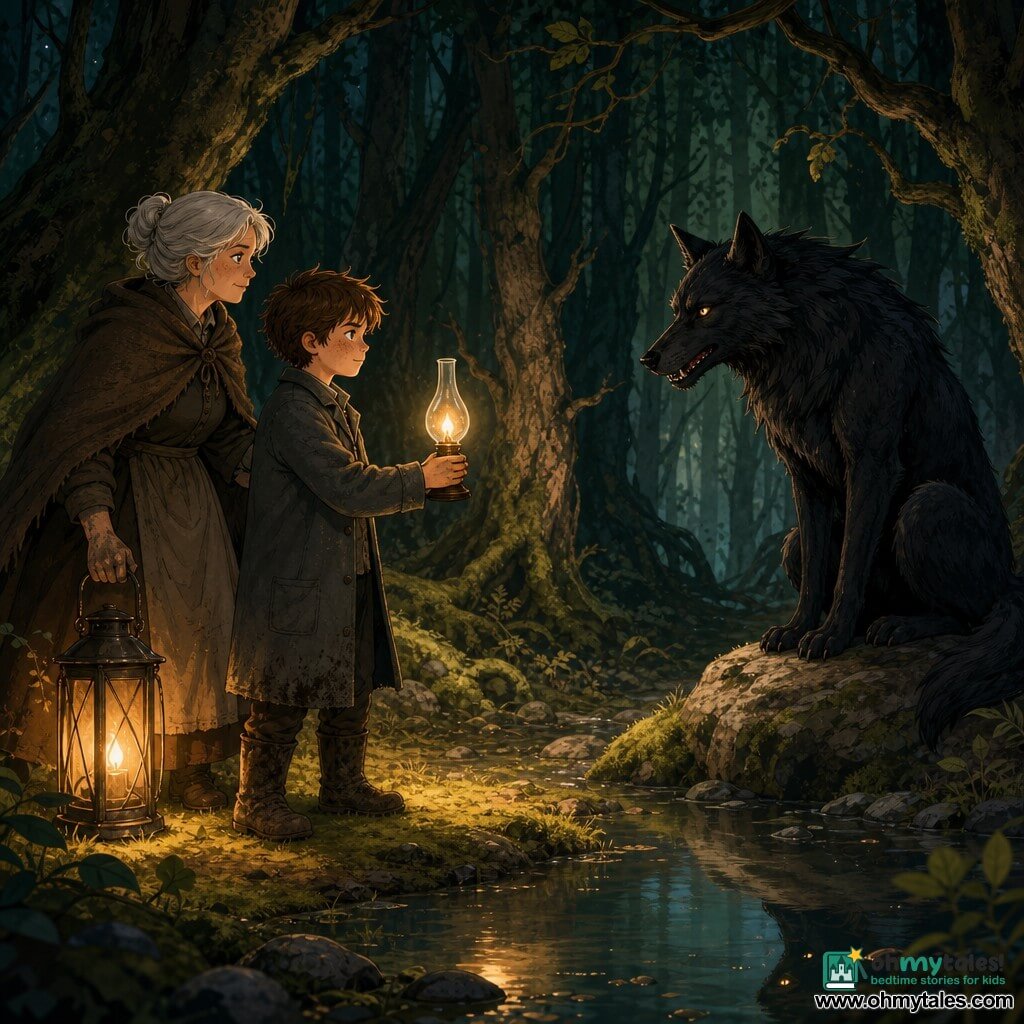
Near a pool that mirrored the thin sky, Tomas saw a figure sitting on a stone. It had fur the color of ink and eyes like two dull coins. This figure had the shape of a wolf, but it spoke with a human's cunning. "Ah," it said, "you are the boy with the lantern. I have waited for you. I could promise you anything—a sack of bread that never empties, gold that will make you lords of the village, the secret of why leaves fall."
Tomas watched the wolf. The lantern painted lines across the creature's face. The wolf's voice was smooth as the river stones, but the boy could see the small, sharp teeth behind the words. Words that glitter often hide hooks. "Why promise what you cannot give?" Tomas asked.
The wolf's tail flicked, and in that movement Tomas sensed a lie moving like a snake. "Because promises are sweet," the wolf said. "People swallow them like candy." It rose and padded closer, stopping a polite distance away. The lantern's glow cut a white circle around them, and beyond that, the wood held its breath.
Tomas remembered something else his mother had said—Respect others, but respect also the quiet rules that keep people safe. He bowed his head slightly, not in fear, but in the place where manners and caution meet. "A promise is not the same as truth," he said. "A promise can be soft as a pillow and sharp as a nail." The wolf laughed, a sound that rustled the leaves. "You are young, boy. You will learn." The wolf stepped to the threshold of the pool where the stone was slick, and the water around it shivered like a frightened thing.
"Tell me one true thing," Tomas asked. "That is how I will know if your promise is honest."
The wolf opened its mouth and, for a moment, the world quieted to hear. It said, "My hunger is older than your houses." That was true. The wolf's hunger had existed before the village began. But truth can come wrapped around a lie. Tomas knew the trick: find the bedrock of truth inside many soft, untrue promises.
Chapter 4
As the night deepened, a cold wind moved the branches into whispering hands. The wolf circled, trying to find where the lantern's light might falter. "I could make you brave," it said now, cunning turning soft like velvet. "Come with me, and I will teach you to be feared." It showed a false kindness, the kind that offers power instead of wisdom. Tomas's bones tightened like wood bent by frost.
Tomas thought of all the small promises he had made—to help his neighbor carry wood, to listen when someone cried, to be careful on the river stones. Those promises were like the lantern: useful and true. He thought of how the wolf wanted to trade that steady truth for a quick shine—power that would harden his heart and forget the value of others.
A sound came then from the edge of the pool. Little frogs, who had been silent, began to call like tiny bells. A woman stepped out of the trees; she was the village lantern keeper, her hands stained with soot and kindness. Her hair was silver like dawn. She carried a lantern larger than Tomas's and set it down at the very edge of the pool so that its light drew the lines of the world clearly.
The wolf recoiled. It wrinkled its nose at the double glow. The wolf had feared lanterns at the threshold—light made its shadows honest and its teeth ordinary. The lantern keeper's voice was small but firm. "Wolf," she said, "no more tricks. Leave these woods and keep your hunger to yourself."
The wolf's ears flattened. It stepped back, then turned, all smooth muscle and old cunning, and slipped into the deeper dark where the trees knit tightly. From where it went, the wood seemed to breathe again, less like a trap and more like a sleeping thing. Tomas felt the night's weight ease.
The lantern keeper smiled at Tomas. "You carried your promise well," she said. "You did not hand your light to someone who would hollow it out." Tomas set his lantern down beside the keeper's and felt the two lights steady each other like two hands.
Chapter 5
In the days that followed, the village spoke of the boy who had gone into the wood and kept his lantern. The tale was told slower now, like bread being eaten with care. Tomas learned to name the soft and dangerous promises. He kept his own vows: to be respectful, to help where he could, to listen to the small truths a person shows over time. He learned that respect is not only a quiet bow but a clear light on the path where others walk.
Sometimes the wolf returned to the edge of the wood, hungry and watchful, and always it skirted the lanterns at the threshold. The villagers placed lamps by their doors and by the wells, not to humiliate the dark but to make honest the space between one person and another. They learned that light at a threshold does not chase away mystery; it simply makes promises visible, so kindness can be given safely and lies can be seen for what they are.
Tomas grew, as all boys do, and the lantern he once carried became part of who he was: a careful light that shone without blinding. He learned to smile like the sun on a pond—gentle, not harsh. When children asked him about that night, he would say, "Listen to the voice that comes with proof. Keep your lights where you can see them. Respect others enough to speak plainly, and respect yourself enough not to hand over your whole heart for a glittering word."
On clear nights, he would walk to the threshold with a lantern and remember the wolf's silver teeth and the lantern keeper's steady hand. The wood would breathe around him, full of old stories that were neither cruel nor kind but simply true. Tomas knew now how to measure a promise: by the weight of its meaning and by whether it let others keep their own light.
And so the village slept with lanterns at their doors, and promises were not swallowed in the dark. The wolf learned to keep a careful distance, for the lanterns at the threshold made his offers visible, and people learned to see the hooks beneath velvet words. Tomas lay in his bed each night and dreamed of small, clear things: a lantern's flame, a neighbor's laugh, the moon like a patient coin. He slept with a courage that was neither loud nor empty, but the soft steady sort that keeps watch at the door.