Chapter 1: The Lantern That Would Not Blink
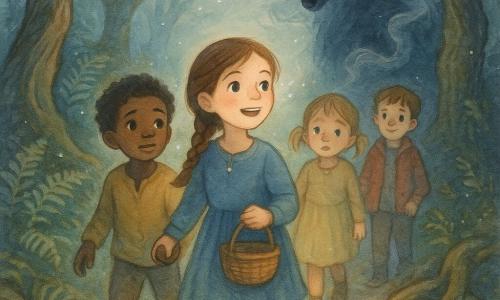
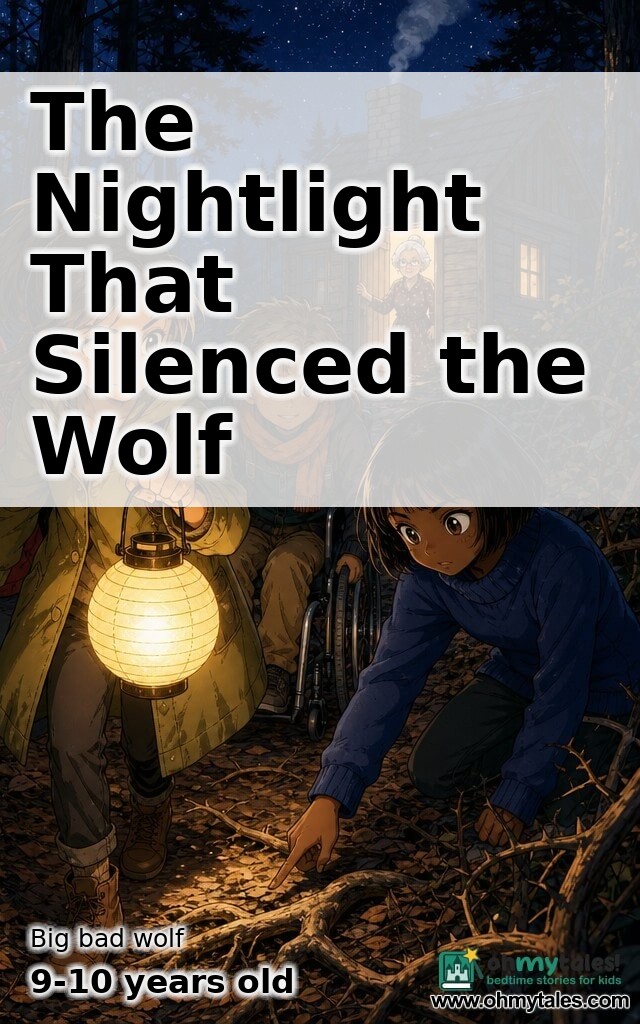
In the village of Pine-Needle Hollow, where roofs wore moss like old hats and the wind whispered bedtime stories through chimneys, four children met after supper.
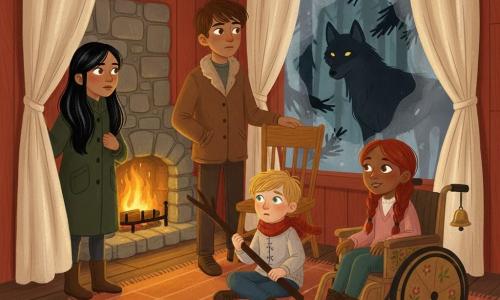
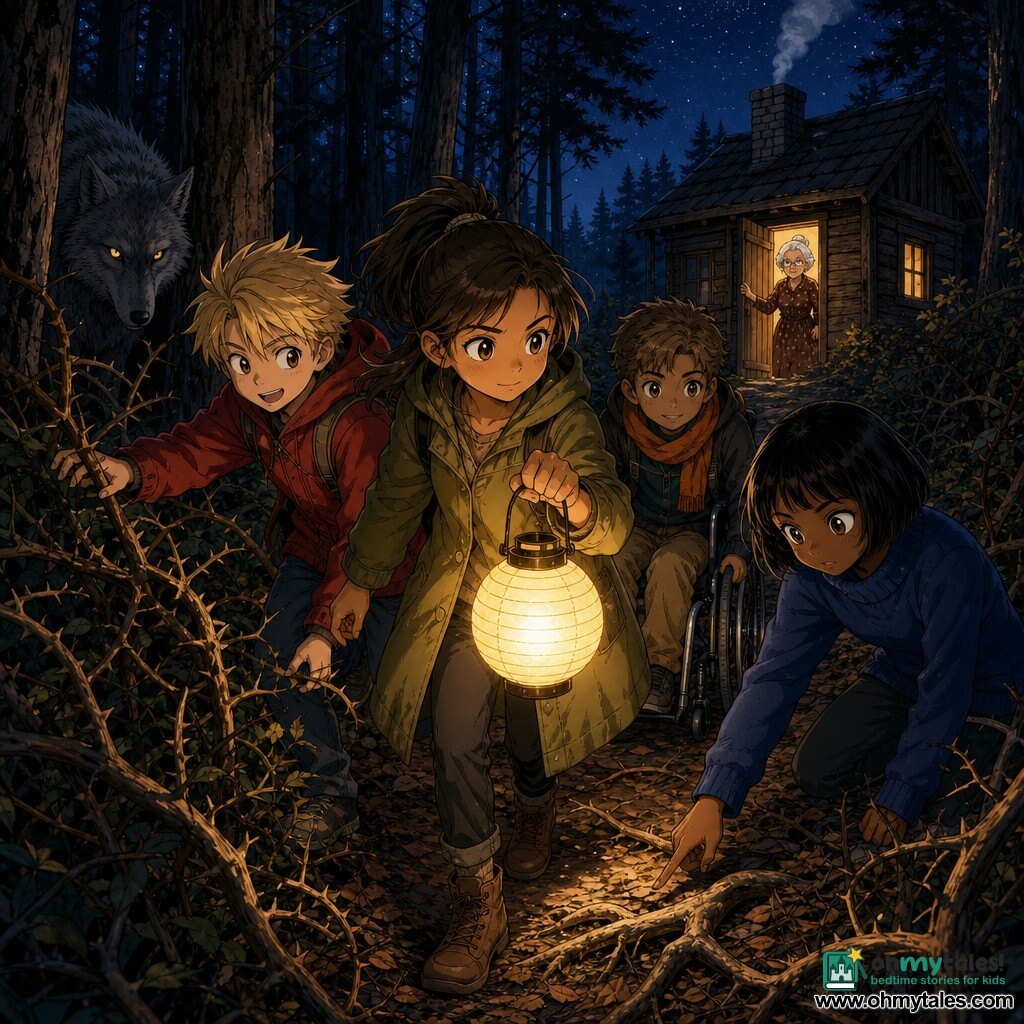
Mara was quick-eyed and curious, like a sparrow that wanted to peek into every crack. Jory laughed easily and could make even a stone seem friendly. Lin was quiet but brave, storing courage the way squirrels store nuts—small bits, saved for winter moments. And Oren, who used a wheelchair, rolled as smoothly as a little riverboat on the lane, steering with calm hands and a patient grin.
They were not supposed to wander far after dusk, not when the forest turned dark as spilled ink.
But Grandmother Hazel had sent a message: Come, little ones. Bring the new nightlight. The woods have been listening.
So they went together, four shadows and one warm glow—a small lantern that fit in Mara's hands. It was a nightlight, really, with a soft yellow belly like a sleepy firefly. It had one strange rule.
“When it shines,” Grandmother Hazel had told Mara earlier, tapping the glass gently, “the big bad wolf does not dare to speak.”
Mara had blinked at that. “Wolves can talk?”
“Some can,” Grandmother had said, and her eyes had looked far away, as if remembering teeth in moonlight. “And some talk best when they want you to answer.”
The path to Grandmother's cottage curled into the forest like a question mark. Pine trees stood tall and still, like watchmen holding their breath. Leaves skittered across the ground as if they were little feet running away.
Jory tried to lighten the air. “If we see the wolf, I'll ask him for manners lessons.”
Lin said, “Don't. He might actually teach you.”
Oren rolled over a root, steady as a drumbeat. “If the lantern works, he'll be quiet.”
Mara held the nightlight close. Its glow made a small circle of safety, like a blanket you could carry.
And all around them, the forest listened.
Chapter 2: The Question with Hooks
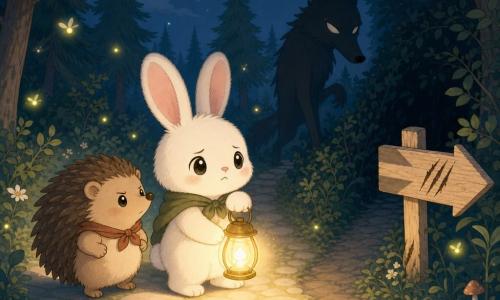
They reached the fork where the path split in two: one way smooth and pale, the other narrow and crowded with brambles. A wooden sign leaned there, scratched and old.
On the smooth path, someone had carved: Quick Way.
On the brambly path, someone had carved: Kind Way.
Jory snorted. “Kind way? That sounds like a trick.”
As if the forest had heard him, a shape slid between the trunks ahead—gray, tall, and careful. Two eyes glimmered like cold coins found at the bottom of a well.
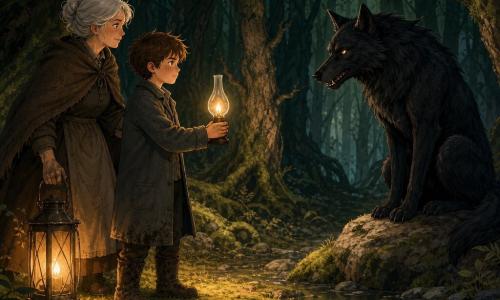
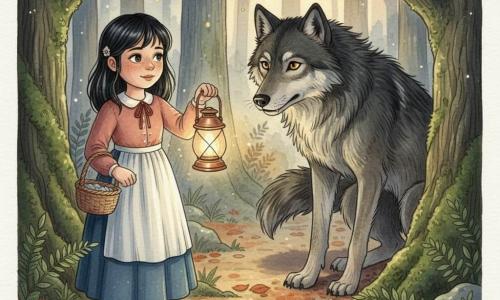
The big bad wolf stepped into the edge of the lantern's light. His fur looked like storm clouds. His smile looked like a door left slightly open.
Mara tightened her grip. The nightlight glowed steadily, warm and firm.
The wolf opened his mouth.
Nothing came out.
He tried again, and his lips moved like someone chewing words. Still, no sound. The lantern's glow sat on his tongue like a gentle lock.
The wolf's eyes narrowed. He stepped backward, just beyond the circle of light, and then—like a match catching—his voice returned.
“Children,” he said softly, as if talking might wake the trees. “Where are you going so late?”
“To Grandmother Hazel's,” Mara replied, because lying in the dark felt like dropping crumbs for trouble.
The wolf's ears tilted forward. “Ah. Grandmother Hazel. And tell me—” He leaned in, careful to stay outside the light. “Which path will you take? The quick way… or the kind way?”
His question sounded friendly, but it tugged at Mara like a hook in cloth. The words were smooth, too smooth. The forest felt suddenly colder, as if it disliked the question.
Mara remembered something Grandmother Hazel had said while stirring soup: A trap can be hidden inside a question, the way a thorn hides inside a rose. If you rush to answer, you prick yourself.
So Mara didn't answer right away.
She asked, “Why do you want to know?”
The wolf's smile widened. “So I can wish you safe travels.”
Lin's voice was small but steady. “You can wish it without knowing.”
Jory added, “You can shout it to the air. The air is free.”
Oren tilted his head. “And why is one path called ‘kind'?”
The wolf's tail flicked once. “Because it is… kinder to your feet.”
Mara watched his eyes. They slid toward the smooth path like hungry shadows. And Mara understood: the question had hooks because it was not really a question. It was a net.
She lifted the lantern higher. Its glow painted the wolf's nose gold.
The wolf tried to speak again, but the light stole his voice. He made a sound like a cough that forgot how to be a cough.
Mara said, slowly, “We will choose our path ourselves.”
She turned to the others. “We stay together. We keep the lantern between us and the dark.”
They chose the brambly path—the one that looked less easy, and therefore more honest.
Behind them, the wolf watched. His silent mouth shaped angry words the lantern would not allow.
Chapter 3: Brambles, Bread, and Brave Small Things
The kind path was narrow, but it felt true. Brambles reached out like bony fingers, trying to steal sleeves. The children moved carefully, helping one another without fuss.
Jory held branches aside. Lin pointed out roots that could trip a foot. Oren rolled where the ground allowed and, when it didn't, the others steadied his chair with gentle hands, as if they were all one creature with four hearts.
Mara kept the lantern low and bright.
Soon, the trees opened to a tiny clearing where a crooked little shrine stood—just a stone with a carved sun and a bowl for offerings. Someone had left a crust of bread there.
“Why?” Jory whispered.
“For travelers,” Lin said. “Or for luck.”
Mara felt the forest watching, not like the wolf watched, but like a grandmother watches from a doorway—worried and hopeful.
She broke the bread into four pieces. “We take only a little,” she said, and left most of it. “Being kind is also being fair.”
They ate quietly. The bread tasted like patience.
Then they heard it: a soft pad-pad-pad, like a secret following them.
The wolf came again, keeping to the darkness. He walked along the edge of the lantern's circle as if it burned.
“Children,” he called, voice smooth as oil. “You seem tired. Would you like me to carry your lantern? It must be heavy.”
Mara almost laughed. The lantern weighed about as much as an apple.
She answered with another question. “Why would you help us?”
“Because I am… changing,” the wolf said, and his voice tried to sound sad. “Because I am lonely.”
Jory's smile faded. “Lonely wolves can still bite.”
Lin said, “And changing takes time.”
Oren spoke gently, not mean at all. “If you want to change, you can start by leaving us alone.”
The wolf's eyes narrowed. “Is that your answer?”
Mara noticed how he pushed for an answer, the way a fisherman tugs a line. Yes or no. Quick or kind. Give me something I can pull.
She remembered the hook again.
So she did not give him what he wanted.
She said, “We don't have to answer every question.”
The wolf stopped. The forest seemed to stop with him. Even the wind waited.
Mara raised the lantern. Its glow touched the wolf's face, and his voice fell silent mid-breath. His mouth moved—no sound, only frustration. The nightlight, small as a firefly, held the power of a quiet “No.”
The wolf backed away into the dark.
Pad-pad-pad faded.
But the children did not run. They walked on, steady and together, like a lullaby that keeps its rhythm.
Chapter 4: Grandmother Hazel's Door and the Dark Test
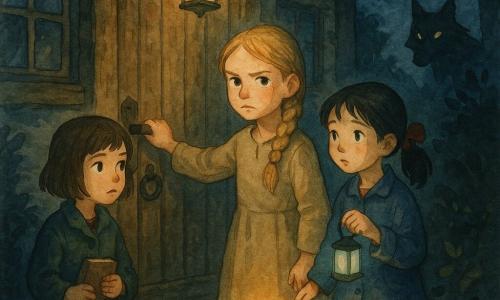
At last the cottage appeared between the trees—low and sturdy, with a roof like a sleeping bear's back. One window glowed orange. Smoke rose gently from the chimney, as if the house were sighing.
Grandmother Hazel opened the door before they could knock. Her hair was white as dandelion fluff, and her eyes were sharp as sewing needles.
“You brought the nightlight,” she said, and her voice was warm as tea.
Mara held it out. “It works. He couldn't talk when it shone.”
Grandmother Hazel nodded. “Good. Come in quickly.”
Inside, the cottage smelled of bread and pine resin. A kettle murmured on the stove. On the table sat four cups, already waiting, as if the house had counted the children before they arrived.
They sat close together. The lantern sat in the middle like a tiny sun.
Grandmother Hazel leaned in. “Now tell me: what did the wolf ask?”
Mara repeated his questions: Which path? May I carry the lantern? Are you tired? Each one sounded harmless when spoken aloud, like a ribbon. But Mara could still feel the hooks underneath.
Grandmother Hazel listened, her hands folded. Then she said, “The wolf uses questions like keys. He tries them in locks to see which doors open.”
Jory gulped. “What doors?”
“The doors inside you,” Grandmother said softly. “The door of fear. The door of pride. The door of rushing. If you answer too quickly, you might open the wrong one.”
Lin frowned. “So what should we do?”
Grandmother Hazel pointed to the lantern. “First, keep your light. A light is not only for seeing. It is also for remembering.”
Oren asked, “Remembering what?”
Grandmother smiled. “That you are allowed to think. That you are allowed to ask back. That you are allowed to say, ‘I'm not sure,' and wait.”
A scratching sound came from the window.
All four children froze.
Then came the wolf's voice from outside, sweet as honey and just as sticky. “Grandmother Hazel,” he called. “May I come in?”
Grandmother Hazel did not answer. She lifted the lantern and carried it to the window. The warm glow spilled through the glass like sunshine through water.
Outside, the wolf's shadow loomed. His muzzle pressed close.
“Grandmother Hazel,” he tried again.
But the light touched him, and his words vanished. His mouth opened and closed like a fish in air. His eyes flashed, angry and startled.
Mara's chest tightened. The wolf was real. The danger was real. Yet the lantern was also real—small and brave.
Grandmother Hazel spoke calmly, her voice steady as a rocking chair. “Go back to the deep forest. Tonight you will not practice your tricks here.”
The wolf's throat worked, but no sound came.
Then, because he could not use his voice, he did something else. He raised a claw and tapped the window—tap, tap, tap—like a question written in knocks.
Lin whispered, “He's asking without words.”
Grandmother Hazel nodded. “Clever. But not clever enough.”
Mara looked at the tapping claw and understood: even silent, the wolf was trying to pull them into answering, into reacting, into opening something.
Mara lifted her chin. “We won't open the door.”
Oren added quietly, “And we won't open the door in our minds, either.”
Jory said, trying to sound brave and only sounding a little shaky, “Tap all you like. We're busy drinking cocoa.”
Grandmother Hazel hid a smile. The taps stopped.
Outside, the wolf's shadow slid away, swallowed by the trees.
Chapter 5: The Lesson the Forest Keeps
The kettle sang. Grandmother poured cocoa dark as dusk and topped it with a little swirl of cream like a moon.
The children drank, and warmth spread through them, chasing the last cold corners from their fingers.
Grandmother Hazel set the nightlight on the shelf beside the bed. It glowed softly, steady as a promise.
Mara looked at it. “So… if someone asks a question that feels like a trap, what do I do?”
Grandmother Hazel tucked a blanket around Lin's shoulders. “You do what you did. You pause. You listen to your inside voice. You ask, ‘Why do you ask?' You don't rush to fill silence just because it is there.”
Jory yawned. “Silence is hard. It feels like being stared at.”
Grandmother nodded. “That is why tricksters love it. They push, and push, and hope you tumble into answering.”
Oren sipped his cocoa and said, “But the lantern made him quiet.”
“Yes,” Grandmother said. “And you made yourselves steady.”
Mara thought of the brambly path, the bread left for travelers, the way they had moved as one group. She realized something: courage was not always a roar. Sometimes it was a small lamp refusing to blink.
Lin's eyelids grew heavy. “Will he come back?”
Grandmother Hazel spoke in a voice like soft footsteps. “Wolves wander. Fear wanders. Questions wander too. But you have learned a skill the wolf dislikes: you can recognize the hook.”
Mara whispered, “And we can be kind without being careless.”
Grandmother Hazel smiled. “That is a strong kind.”
Outside, the forest sighed. The trees stood guard. Somewhere far off, a wolf padded through darkness, silent under the reach of a warm little light.
The children settled onto quilts and pillows. The nightlight painted gentle gold on the walls, turning shadows into harmless shapes—coats, chairs, the curve of a teapot.
As sleep came, Mara held one thought like a pebble in her pocket:
Not every question deserves an answer. Some deserve kindness. Some deserve caution. And some deserve a bright, steady light.