Chapter 1: The Lantern Path
In the Forest of Moth-Soft Pines, dusk did not simply arrive. It poured in like ink, slow and steady, filling every hollow between roots and rocks. The trees stood close together, their needles whispering like old paper, and the air smelled of damp earth and faraway rain.
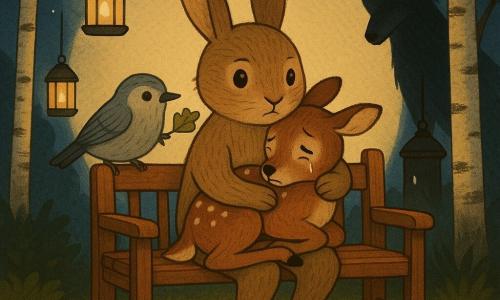
Pip the rabbit lived at the edge of the forest in a snug burrow tucked under a blackberry hedge. He was the kind of rabbit who said sorry when a leaf bumped his ear. Gentle, careful, and always thinking one step ahead—except when he forgot to.
Pip had a habit of hurrying when he should have watched, and that evening he needed to cross the forest to bring chamomile and honey cakes to Aunt Bramble, who had a cough that sounded like a rusty hinge.
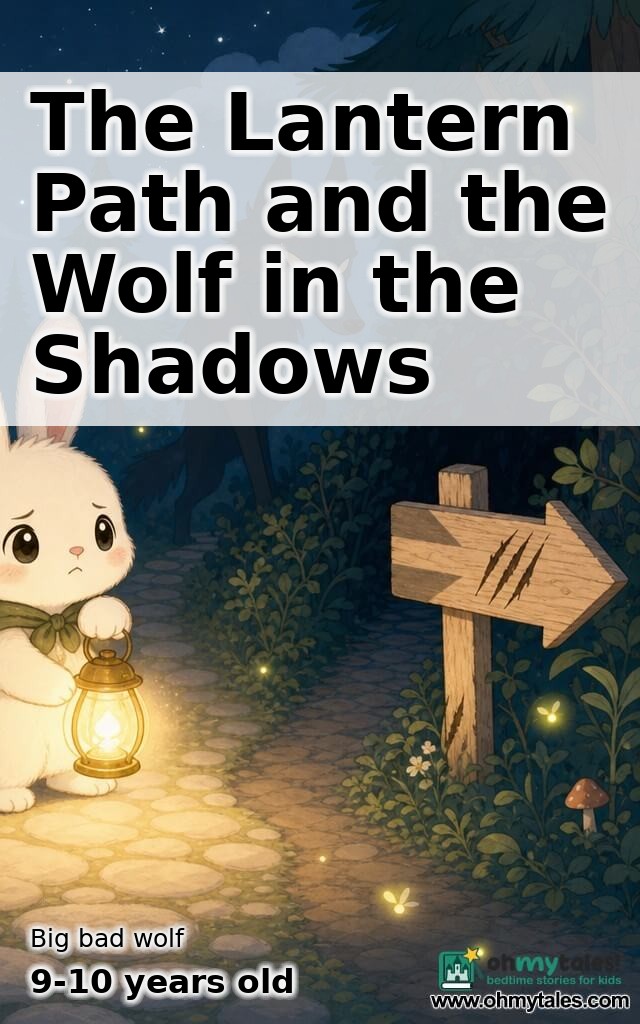
Before he left, Mama Rabbit set a small lantern in his paws. Its glass was warm, and the flame inside bobbed like a tiny golden fish.
“Light is a friend,” Mama said. “It tells you what is real. And if you must walk through shadow, walk the way that keeps you seen.”
Pip nodded, though his whiskers trembled. Everyone knew the tale of the Big Bad Wolf—how he loved darkness like a cloak, how his teeth were white as peeled bones, and how he avoided lit places as if light were nettles.
“The wolf does not like the lantern path,” Mama added, tying a scarf around Pip's neck. “He slips around the bright clearings. Remember that.”
Pip promised. He stepped into the forest, and the lantern threw a puddle of light onto the path ahead. Moths circled it like curious thoughts. The darkness waited at the edges, quiet and patient.
And somewhere, where the lantern could not reach, something else waited too.
Chapter 2: The Places the Light Cannot Sit
The lantern path was a simple thing: a trail marked by pale stones that seemed to glow faintly, as if they had borrowed moonlight long ago and never paid it back. Every so often, the trees opened into a clearing where fireflies hung in the air like living stars.
Pip walked with small, even steps. He tried to breathe slowly, the way Mama taught him. In…and out…like waves on a sleepy shore.
But the forest is full of choices, and choices are doors.
At a fork in the path, two ways led onward. The left path was bright, lined with white stones, and the trees leaned back as if making room. The right path was narrow and bent, with brambles that reached like hooked fingers. It looked quicker. It looked quiet.
A voice floated from the darker path, smooth as oil on water.
“Little rabbit,” it said, “why carry that heavy lantern? The night is kind. The short way is kinder.”
Pip's ears snapped upright. At first he saw only shadow. Then he saw the shape: tall, long, and still, like a broken fence post that had learned to breathe.
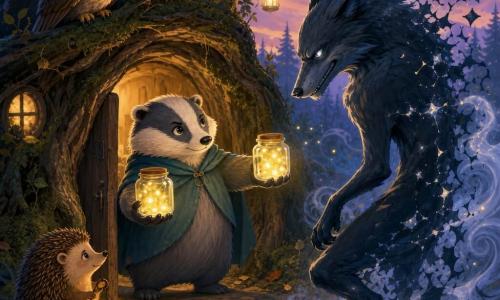
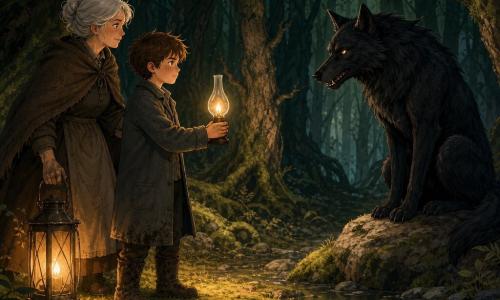
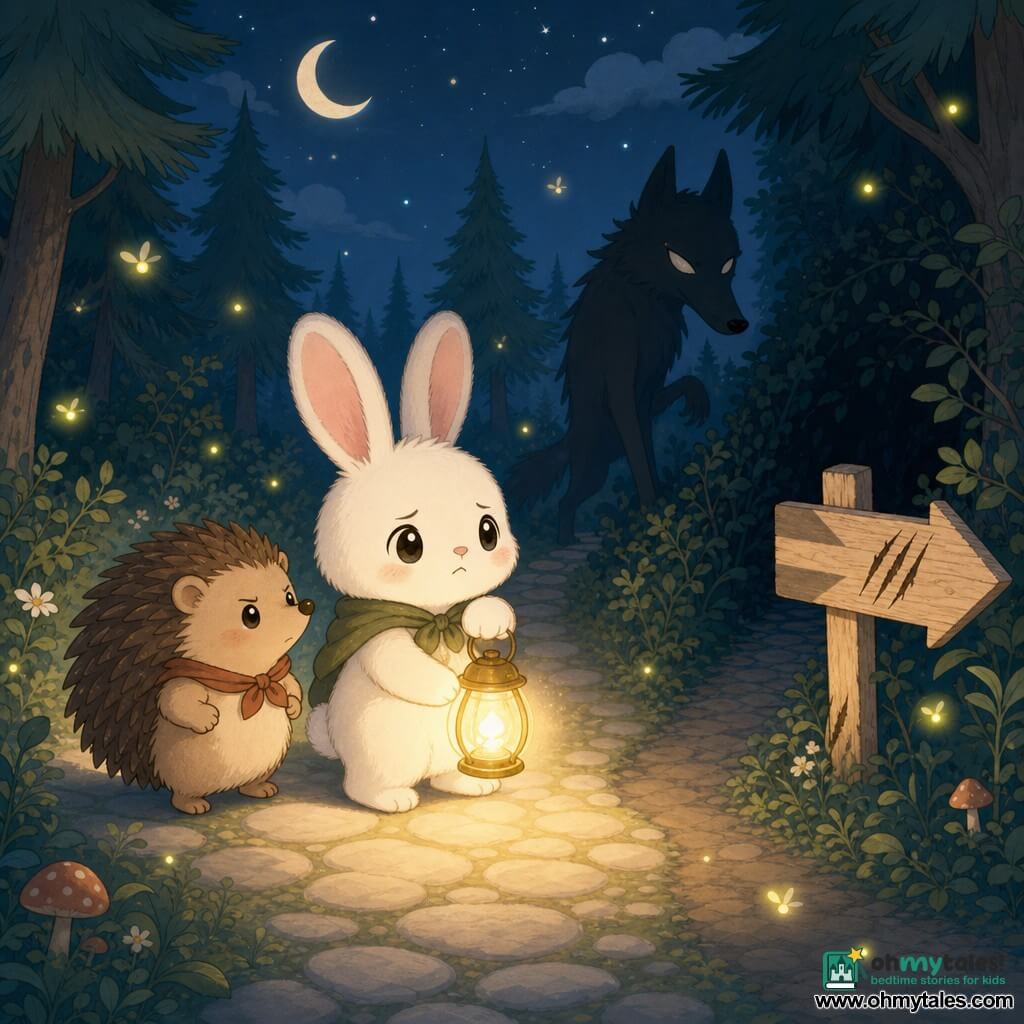
The Big Bad Wolf stepped forward just enough for the lantern light to touch his muzzle. His fur was the color of old smoke. His eyes shone pale and watchful, like coins at the bottom of a well. Yet he did not step into the light. He hovered at its border, as if the brightness stung.
Pip's heart began to drum. Fear, he realized, was not a scream. It was a whisper that said, Look. Listen.
“I—I'm bringing cakes to my aunt,” Pip said, keeping his voice small and polite, because that was how he had been raised.
“Cakes,” the wolf repeated, tasting the word with his tongue. “What a sweet duty. And what a shame to take the long way. That bright path is full of eyes. Owls. Foxes. Even badgers who ask too many questions.”
Pip glanced toward the bright trail. It did look open. It did look obvious. He felt suddenly silly for being seen.
The wolf's voice softened. “The dark path is private. Safer. Only you and me and the honest trees.”
The lantern flame flickered. Pip noticed something—small, but sharp as a thorn.
The wolf's paws stayed behind the line of light. He did not like the places where the light could sit.
Mama's words returned like a hand on Pip's shoulder: Light is a friend.
Pip swallowed. He thought of Aunt Bramble coughing. He thought of being brave. Then he thought of being clever.
“I…thank you,” Pip said. “But my mama told me to follow the lantern stones.”
The wolf's smile widened, too many teeth for such a gentle evening. “Mamas tell many things.”
Pip lifted the lantern higher. The light spilled wider, and the wolf's shadow shrank back like a guilty thought.
The wolf's eyes narrowed. “Go on, then,” he murmured. “Walk your shining road. I can be patient.”
Pip hurried onto the bright path. Behind him, in the bramble-dark, he heard the softest sound—like velvet sliding over bone.
Not footsteps. Not quite.
Following.
Chapter 3: Signs Written in Pine Needles
The bright path carried Pip through a clearing where fireflies stitched glowing dots into the air. The trees stood like tall guards, and the lantern made their trunks look striped, as if the forest wore pajamas.
Pip tried to calm himself by counting the stones: one, two, three… But fear kept tugging at his thoughts like a mischievous kitten.
He remembered a story Aunt Bramble once told him: “The wolf is not only teeth,” she had said. “He is also tricks. And tricks are shadows that pretend to be shapes.”
So Pip began to look for signs. Not just the scary kind, but the honest kind. Signs were the forest's way of speaking.
First, he listened. When the world is safe, it has small sounds: a beetle tapping, a leaf turning over, a bird settling into sleep. When danger is near, those small sounds hide, the way children hide when a grown-up calls their full name.
Now the forest felt…held.
Second, he watched the edges of the light. The lantern made a circle, and beyond it was the thick dark, like a pond without a bottom. Pip noticed the bushes were still. Too still. Even the brambles seemed to be holding their breath.
Third, he smelled. The forest had its own smell—green and wet and alive. But under it, he caught something else: a dry, wild scent, like old fur warmed by a secret sun.
Pip stopped.
A little wooden sign leaned beside the path. It pointed to Aunt Bramble's house: BRAMBLE HOLLOW — THIS WAY. Someone had scratched fresh marks across the arrow, making it point toward a side trail that slipped into darker trees.
Pip's stomach tightened. The scratch marks were new. The wood shavings still lay at the base like pale crumbs.
A clever trick. A shadow pretending to be a sign.
Pip crouched and looked close. The fresh scratches were deep, made by something hard and sharp. Not a squirrel's teeth. Not a badger's claws.
He pictured the wolf's long nails.
Pip's gentle heart beat faster, but his mind grew clearer. A danger sign is not only growling and glowing eyes. Sometimes it is a path that looks helpful.
He lifted the lantern and aimed it into the side trail. The darkness there did not brighten much. It swallowed the light like a hungry mouth. And in that darkness, two pale dots blinked—then vanished.
Pip's paws went cold. He backed away, staying on the lantern stones.
Just then, a rustle came from the bushes, and a hedgehog tumbled out, round as a pinecone, snuffling loudly.
“Oh! Sorry!” Pip squeaked.
The hedgehog blinked. “Why are you standing like a statue? You look like you've seen a ghost wearing a fur coat.”
Pip almost laughed, and the laugh loosened the knot in his chest. “I think…someone changed the sign.”
The hedgehog waddled over and sniffed the scratches. “Hmm. That's not right. That's not forest manners.”
Pip hesitated. He was used to keeping worries tucked inside, like carrots in a pantry. But Mama had also said: “When you are unsure, ask. When you are scared, share.”
So Pip told the hedgehog, in a low voice, about the wolf at the fork and how he would not step into the light.
The hedgehog's nose twitched. “A wolf avoiding light? That is as strange as a fish avoiding water. No, wait—fish love water. You understand.”
Pip nodded.
The hedgehog puffed himself up, trying to look fierce, which only made him look like a bristly teapot. “Come on. I'll walk with you to the next clearing. Two sets of eyes are better than one.”
Pip felt warmth spread through him, the kind that comes when someone believes you.
They walked together, lantern held high. Behind them, the forest stayed quiet, but now the quiet felt less like a trap and more like a blanket.
Still, Pip could not forget the pale dots in the side trail.
Chapter 4: The Wolf at the Edge of the Fireflies
At the next clearing, fireflies floated in thick clusters, making the air look sprinkled with tiny lanterns. In the center stood a fallen log like a bench. The bright stones curved around the clearing and continued onward.
The hedgehog stopped to catch his breath. “My name's Nib,” he said. “By the way.”
“Pip,” Pip replied.
Nib nodded solemnly. “All right, Pip. Here's what we do. We stay where it's bright. We don't follow new scratches. We don't listen to smooth voices.”
As if the forest had been waiting for those words, a shadow moved beyond the ring of fireflies. A shape unfolded from the trees.
The Big Bad Wolf appeared at the very edge of the clearing, where firefly light thinned. He did not step into the brightest part. He circled it, keeping the glow just out of reach, like a cat skirting a puddle.
“Well, well,” he said. “The rabbit brought a prickly friend.”
Nib bristled. “Go bother a stump.”
The wolf chuckled, low and rumbling, like distant thunder under a hill. “I bother no one. I only offer help. I only offer…shortcuts.”
Pip held the lantern closer to his chest. The flame made his fur shine like wheat. “Why don't you come into the clearing?” he asked before he could stop himself.
For a moment, the wolf's smile flickered. Not vanished—just cracked, like ice under a boot.
“The light is too honest,” the wolf said softly. “It shows what I am.”
Pip's ears dipped. He did not expect that answer. It sounded almost…sad.
But danger can wear sadness as a mask, the way a thief might wear a borrowed coat.
Nib whispered, “Don't feel sorry for teeth.”
The wolf's eyes slid to the lantern. “Little rabbit,” he purred, “your light makes you brave. But it also makes you visible. Put it down, and you can disappear. Wouldn't you like that? No eyes on you. No worries.”
Pip imagined the darkness closing around him like a curtain. For a heartbeat, it sounded tempting—like hiding under a blanket when the world feels too big.
Then Pip remembered Aunt Bramble's cough. He remembered Mama's hand on his head. He remembered the scratched sign.
He lifted his chin. “I don't want to disappear,” he said. “I want to arrive.”
The wolf's tail swished, slicing the air. “Arrive where? To an old rabbit with a wheeze? Your cakes will be stale by the time you reach her.”
Pip's voice shook, but he spoke anyway. “You don't want me safe. You want me quiet and alone.”
The wolf's eyes gleamed, and his patience thinned like a worn rope. He stepped forward—just one pace—and the fireflies drifted aside as if pushed by an unseen breath.
But still, he did not step fully into the brightest light.
Pip noticed it again: the wolf avoided the lit places. Avoided them the way a liar avoids a clear question.
Pip's mind clicked like a lock opening. The light was not only for seeing the path. It was a fence.
Nib cleared his throat loudly. “Listen, Wolf. We're not walking into your dark pockets. The bright stones go to Bramble Hollow, and that's that.”
The wolf's lips curled. “Two little creatures,” he murmured. “A rabbit and a hedgehog. So soft. So slow.”
Pip felt fear rise, hot and fast.
And yet—he also felt something else. A small seed of courage, warmed by the lantern flame and by Nib standing beside him.
Pip took a breath and called out, loud enough for the clearing to hear: “Fireflies! If you can hear me, shine closer!”
Fireflies do not understand every word, but they understand urgency. They swarmed nearer, thickening the glow like milk in tea. The clearing brightened. The shadows shrank.
The wolf flinched, his paws scraping backward.
And in that moment, Pip understood: the wolf's boldness lived in dim places. In bright places, it grew thin.
Nib leaned toward Pip. “Smart,” he whispered. “Now—move.”
They hurried along the bright stones, leaving the clearing behind. The wolf's low growl followed them, tangled in the trees, but it did not become footsteps on the path.
Not yet.
Chapter 5: Bramble Hollow and the Kind Trap
At last, the trees opened into a little yard. Aunt Bramble's house sat there, a small cottage made of woven branches and mud, with a roof of dried grass. The windows glowed warmly, as if the house held a pocket of sunrise.
Pip's chest loosened. Safe. Light. Home-smell.
Nib trotted up to the door, and Pip knocked.
Aunt Bramble opened it, wrapped in a shawl, her eyes soft and sleepy. “Pip! Oh, you sweet sprout,” she said. “And who is this spiky pudding?”
“Nib,” Nib said proudly.
Inside, the cottage was cozy. The air smelled of herbs and woodsmoke. Pip set the cakes on the table, and Aunt Bramble smiled so wide her whiskers quivered.
But then Pip noticed something that made his ears tilt.
The back window—usually shut tight at night—was cracked open. Just a little. Enough for a cold finger of air to slip in.
Aunt Bramble followed Pip's gaze and coughed. “Oh, dear. I must have forgotten. My head is full of fog when I'm ill.”
Pip walked to the window, lantern in hand. On the sill were faint scratches—fresh, like the ones on the sign.
Nib's spines lifted. “He's here.”
Pip's fear returned, but this time it did not push him into panic. It pushed him into paying attention.
Aunt Bramble looked between them. “What is it?”
Pip spoke gently, because empathy is also a kind of courage. “Auntie, the wolf has been trying to trick me. He changed a sign. He keeps to the dark. He may be nearby. But we can be careful.”
Aunt Bramble's face paled under her fur. Then she nodded, slow and steady. “All right. Tell me what you need.”
Pip felt proud of her, and surprised too. Even sick, she was listening. Even afraid, she was ready.
They did three simple things.
First, they shut and latched every window, and Pip placed the lanterns—Aunt Bramble had two more—on the windowsills so light spilled outward like warning paint.
Second, they made noise. Not screaming—steady noise. Nib drummed his paws on a pot. Aunt Bramble stirred a kettle so it hissed and sang. Pip tapped a spoon against a mug in a calm rhythm, like a heartbeat the house could follow.
Third, Pip did not forget empathy, even for those who frightened him. He remembered the wolf's words: The light shows what I am.
Pip did not want the wolf close. He did not want him inside. But he also did not want to become a creature made only of fear and hate.
So Pip opened the front window just a crack—on purpose, where the light was brightest—and called out into the night, “Wolf! Go back to your deep woods. There's no meal here. Only eyes, only light, only neighbors who will wake.”
His voice was firm, but not cruel.
Outside, beyond the lamp-glow, a shadow shifted. The wolf's eyes flashed once, like two cold moons.
Then the shadow retreated, melting into the trees.
Nib exhaled. “Did…did you just warn him politely?”
Pip's whiskers twitched. “Yes. But I also warned him truthfully.”
Aunt Bramble laughed, a small laugh that turned into a cough and back again. “That is my Pip,” she said. “Soft as a blanket, sharp as a needle when it matters.”
They waited. Minutes passed like slow raindrops. No scratching came. No voice slid through the cracks.
At last, the forest sounds returned—the gentle ones. A cricket started its quiet violin song. A branch creaked, not as a threat, but as a tree settling down to sleep.
The danger had moved away from the light.
Pip ate a cake with Aunt Bramble and Nib. The sweetness tasted like safety.
When it was time for Pip to leave, Aunt Bramble insisted he stay the night. “The forest is darker now,” she said. “And bravery is not about going alone. It is about going wisely.”
Pip agreed. The lanterns stayed lit, small suns against the dark.
Later, tucked under a quilt, Pip listened to the steady sounds of the cottage. He thought about the signs he had learned to read: the too-quiet bushes, the fresh scratches, the voice that asked for secrecy, the wolf's careful distance from bright places.
He thought about Nib walking beside him, and Aunt Bramble trusting him.
And he understood the moral as clearly as the lantern stones:
Danger often asks you to hurry, to hide, to be alone.
Safety asks you to notice, to share, to stay in the light.
And empathy—true empathy—does not mean stepping into a wolf's shadow. It means keeping your own heart gentle while keeping your paws on the bright path.
Outside, far away, the Big Bad Wolf slipped through the darkest parts of the forest, avoiding every lit place, avoiding every honest glow.
Inside, Pip's eyes grew heavy. The fire in the lantern swayed like a sleepy golden fish.
And the Forest of Moth-Soft Pines, for this night at least, held its darkness at a respectful distance.