Chapter 1: The Star That Stuttered
The galaxy of Lumenwake usually hummed like a well-tuned engine—comets whistling, moons turning like quiet gears, and spell-satellites blinking runes in neat patterns. But tonight, one star in the western spiral kept… stuttering.
It flared bright, then dimmed, then blinked twice as if trying to remember its own name.
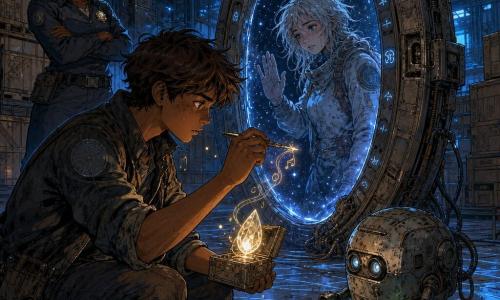
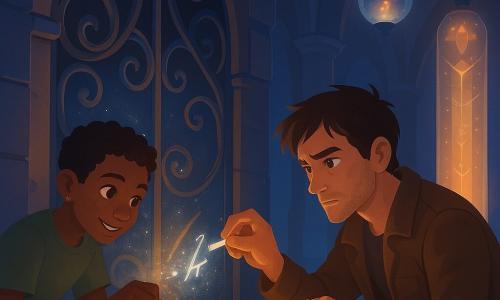
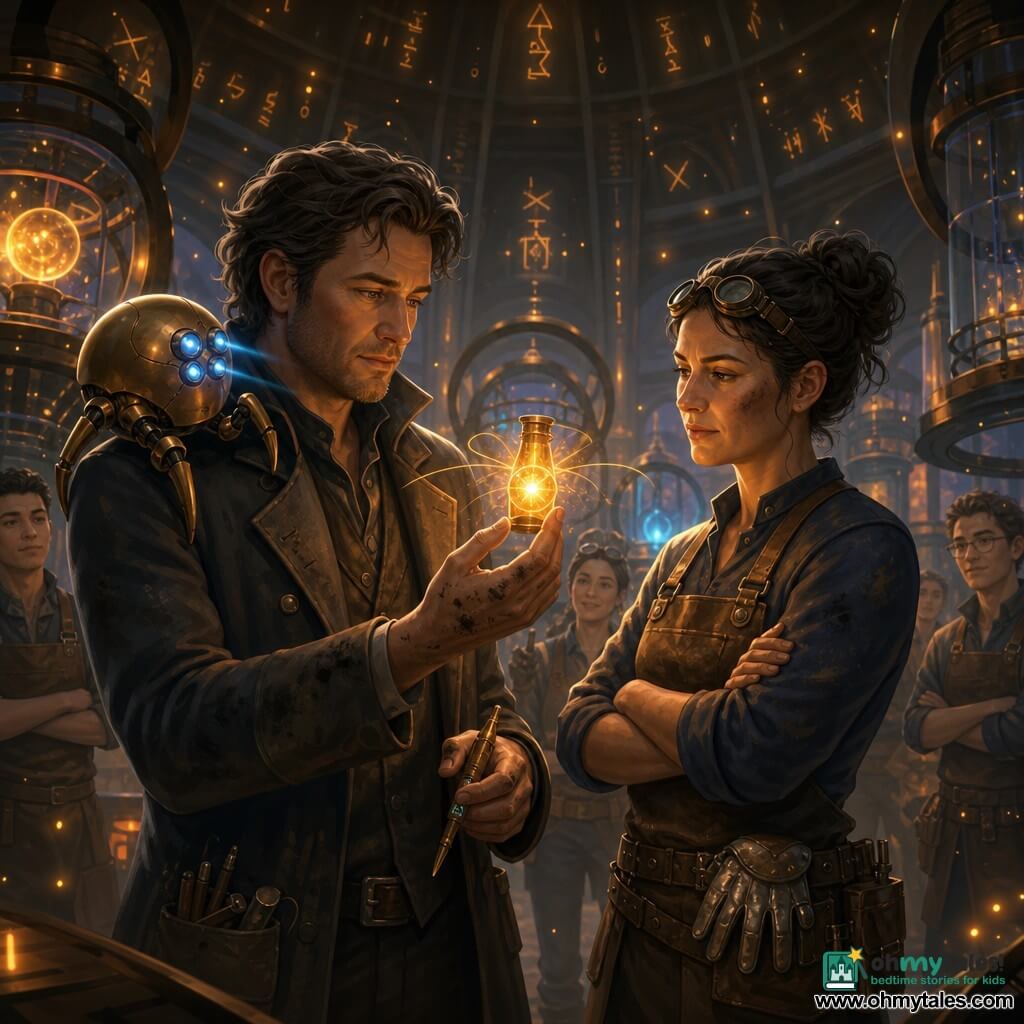
Orin Vale watched it through the cracked dome window of his workshop-ship, the Peregrine Kite. The ship smelled of ozone, ink, and hot metal. Wires curled across the floor like sleeping snakes. Spell-candles burned in glass jars, their flames shaped like tiny blue leaves.
Orin wasn't a captain in a shiny uniform. He wore a patched coat with too many pockets and a belt full of tools: a screwdriver, a coil of copper thread, and a rune-stylus that looked like a fountain pen but wrote magic.
He was an incantation coder—someone who wrote spells the way other people wrote programs. He loved the logic of it: if you placed the right rune in the right order, the universe answered politely.
Usually.
He tapped his stylus against his palm. “That isn't normal.”
On the table beside him sat a little brass orb with three legs. It clicked and rotated, projecting a thin hologram of the stuttering star. The orb was his companion device, a scout-drone named Pixo. Pixo didn't speak in full sentences—mostly whistles and beeps—but it had a talent for sounding judgmental.
Pixo beeped sharply: Beep-beep-BEET.
“I know,” Orin said. “It looks like a hiccup.”
Another beep, lower and longer: Bweeeep.
Orin squinted at the hologram. Something was wrapped around the star's light, like a net made of darkness. It tightened whenever the star brightened.
He set his stylus on the desk and pulled a thin slate toward him. Its surface was black glass, scratched with faint silver lines—an enchanted coding board. As he touched it, runes lit up like fireflies.
Orin began to write.
—SIGHTTHREAD: LINK(Orin_Eyes, Star_SevenWest)
—FILTER: REVEAL(Hidden_Layers)
—SAFETY: DO_NOT_POKE_ANYTHING_THAT_POKES_BACK
Pixo emitted a pleased chirp at the last line.
The runes sank into the slate. The dome window shimmered, and suddenly Orin could see deeper than normal sight. Between the star's flares, there was a pattern: a repeating symbol, ancient and sharp as broken glass.
Orin swallowed. He recognized it from a dusty archive he'd once visited on Moon-Library Sereph: the Mark of the Nullweave. A legend about magic that ate other magic. A myth most people dismissed because it sounded too dramatic to be real.
Orin wasn't most people.
He leaned closer to the window, heart thumping. “If the Nullweave is back,” he murmured, “then something is chewing holes in the galaxy's rules.”
Pixo beeped: …beep?
Orin nodded, as if the drone had asked the right question. “Yes. If it's spreading, it won't stop at one star.”
He rubbed his face, feeling the scratch of ink on his fingertips. This wasn't the kind of mystery you solved for fun. This was the kind that demanded responsibility, like spotting smoke and deciding whether to shout or to hide.
He looked at the stuttering star one more time. Then he turned to his ship's console—half control panel, half altar—and placed both hands on it.
“Pixo,” he said, voice steady even if his stomach wasn't, “plot a course. We're going to the nearest world with a star-forge.”
Pixo whirred, projecting a map: a spray of worlds like spilled glitter. One pulsed closest, a planet with rings of pale stone.
Name: VIRELIA.
Note: STARSMITHS + SPELL-ENGINEERS.
Warning: PROUD.
Orin grinned despite himself. “Perfect. Proud people always know something.”
The Peregrine Kite shuddered as engines woke, and the ship slid into the dark like a thought slipping between dreams. Behind them, the stuttering star blinked again—twice, quickly, as if it had tried to wave.
Orin's fingers tightened on the console. “Hang on,” he whispered to the galaxy. “I'm coming.”
Chapter 2: The Ringed City of Virelia
Virelia floated beneath its rings like a jewel in a giant's hand. The rings weren't ice or dust; they were stone—flat pale slabs etched with giant runes that glowed faintly when the sun hit them. From orbit, they looked like a halo built by careful, stubborn artists.
Orin guided the Peregrine Kite down toward the main city, Aurellion, where towers rose in spirals of metal and crystal. Bridges arched between them like frozen lightning. Airships drifted in neat lanes, their sails stitched with sigils.
As he docked, a harbor attendant in a gold helmet strutted over. His uniform was so pressed it could have cut paper.
“Name and craft?” the attendant demanded.
“Orin Vale,” Orin said. “Incantation coder. Research vessel.”
The attendant sniffed. “Research. How… quaint.”
Pixo beeped indignantly from Orin's shoulder.
Orin kept his smile friendly. “I'm looking for a starsmith. Someone who understands star-light regulation and… unusual dimming.”
At the word unusual, the attendant's eyes flicked away. Too fast. Like he'd been told not to hear it.
“You want the Forge Hall,” he said at last. “But starsmiths are busy. Our rings require constant tuning.”
Orin nodded. “Then I'll be quick.”
The Forge Hall was an enormous dome built from dark glass and reinforced bone-metal. Inside, heat rippled through the air. Hammering echoed like thunder trapped under a roof. Along the walls, stars were being made—not full suns, of course, but star-seeds: bright cores swirling inside containment cages, each one singing softly in a different key.
Orin's skin prickled. Magic and science braided together here so tightly you couldn't tell where one ended and the other began.
A woman with soot on her cheek and goggles on her forehead marched up. “No tourists,” she snapped, then paused as she saw Orin's rune-stylus. “You're not a tourist.”
“Orin Vale,” he said. “I code incantations. I saw the stutter in Star SevenWest.”
Her expression tightened. “That's off-world business.”
“It's everybody's business,” Orin said gently. “If a star is being strangled, it won't stay local.”
She studied him, then gestured sharply. “Come. Don't touch anything. If you touch something, it might touch back.”
“Fair warning,” Orin said. “I write that in my code.”
She led him to a workbench where a ring-shaped device lay open like a metal flower. Runes crawled along its petals.
“I'm Master Rell,” she said. “Starsmith, spell-engineer, and unwilling babysitter of panicking officials.”
Pixo beeped, approving of her honesty.
Orin leaned in. “Have you seen the Nullweave mark?”
Rell froze. For a moment, even the hammering in the hall sounded farther away.
“Who told you that word?” she asked.
“No one,” Orin said. “The star told me. The pattern was carved into its light.”
Rell's jaw tightened. “Then it's worse than we hoped.”
She pulled a drawer open and slid out a thin crystal panel. It displayed a map of nearby systems. Several stars flickered with faint warning icons.
“These started three days ago,” she said. “Small glitches. Light hiccups. Ring-tuning errors. We patched them—tightened wards, rerouted power. But the glitches keep returning, and the marks… they're appearing inside our ring runes.”
Orin felt his stomach sink. “So it's already in your infrastructure.”
Rell looked at him sharply. “You're calm.”
“I'm scared,” Orin admitted. “But I'm trying not to be useless.”
That earned him the tiniest upward twitch at the corner of her mouth. “Responsibility. Good. Too many people treat magic like fireworks.”
Orin nodded. “What do you know about the source?”
Rell tapped the panel. A region of space glowed faintly—a dark patch where sensors reported nothing, as if the universe had decided to hold its breath.
“The Quiet Rift,” she said. “A blank on every map. Old stories claim it's where abandoned spells go to sulk.”
“Or to grow teeth,” Orin muttered.
Rell pointed to a thin line leading toward the Rift. “We traced the disturbances. They're moving like a tide. If it reaches Virelia's rings fully, they'll fail. Our halo will fall, and the city…”
She didn't finish, but Orin could picture it: slabs of rune-stone crashing down like angry moons.
He inhaled slowly. “I need something from you.”
Rell crossed her arms. “We don't hand out forge tech to strangers.”
“Not tech,” Orin said. “A piece of star-seed light. A controlled sample. If I can read how the Nullweave bites it, I can write an incantation patch—something that doesn't just cover the wound, but stops the teeth.”
Rell's eyes narrowed. “And if you're wrong? If your patch spreads it faster?”
Orin didn't dodge. “Then I'm responsible for that. I won't pretend otherwise. I'll test it safely and I won't rush.”
For a long moment, Rell stared, weighing him like a metal bar on a scale.
Finally, she sighed. “Follow me. And keep your drone from judging my forge.”
Pixo beeped in a tone that absolutely sounded like, No promises.
They walked to a containment cage where a star-seed swirled like a tiny storm of gold. Rell adjusted dials and whispered a calibration charm. The cage opened a slit, and a thread of light slipped out—thin as hair, bright as sunrise.
Rell caught it in a vial made of crystal and spellsteel. The light coiled inside, restless.
“Handle it like a baby dragon,” she warned. “Gentle. No sudden noises. And don't feed it nonsense.”
Orin accepted the vial with both hands. It was warm, almost alive.
“Thank you,” he said.
Rell's gaze flicked toward the dark patch on the map. “If you go to the Quiet Rift,” she said quietly, “you might not come back the same.”
Orin tucked the vial into a padded pocket. “Then I'll make sure what comes back is still… me. And still trying to do the right thing.”
Pixo chirped, and for once it sounded a little worried.
Outside the Forge Hall, Virelia's rings glowed overhead, steady for now. Orin looked up at them—at the careful runes holding a whole world safe.
He didn't want to be the person who watched them fall.
“Come on,” he told Pixo. “Let's chase a quiet problem before it becomes a loud disaster.”
Chapter 3: A Map Written in Moonlight
The Peregrine Kite slipped away from Virelia and into the star-laned dark. Out here, the galaxy felt both enormous and close, like a giant library where every book was burning.
Orin spread his tools on the table and set the vial of star-seed light in the center. It pulsed softly, casting warm reflections on his hands.
Pixo skittered around the edges, projecting tiny warning icons: triangles, exclamation points, one rude-looking skull.
“Relax,” Orin told it. “We're being careful.”
He opened his enchanted slate and began writing a diagnostic charm—half code, half lullaby.
—THREAD: SAMPLE(StarSeed_Light)
—SCAN: FOR(Pattern_Bites)
—IF_FOUND: ISOLATE + DESCRIBE
—OUTPUT: NOT_IN_DRAMATIC_POETRY
Pixo beeped as if to say, Too late.
Orin smiled and touched the vial. The star-seed light rose like a curious serpent, tapping the air. Then, just at the edge of its glow, darkness appeared—thin threads, almost invisible.
They weren't simply shadows. They had texture, like spider silk made of absence.
The Nullweave.
Orin's breath caught. The threads tugged at the light, and the light trembled, trying to stay whole.
“Okay,” Orin whispered. “I see you.”
He didn't attack it. That was the first rule of dealing with unknown magic: don't slap it and hope it behaves. Instead, he observed—how it tightened, when it loosened, what made it react.
He wrote tiny lines of code-runes, adjusting variables as if the universe were a puzzle box.
—NOTE: Nullweave reacts to sudden brightness.
—NOTE: It ignores slow warmth.
—HYPOTHESIS: It feeds on panic-surges of energy.
Pixo emitted a thoughtful trill.
Orin leaned back. “So if we stop feeding it sharp bursts… we might starve it.”
He needed a map to the Quiet Rift, but not a normal one. The Rift didn't like being found. It blurred sensors, swallowed coordinates, and turned careful math into nonsense.
Orin opened a compartment beneath the console and pulled out something wrapped in cloth: a disk of dark stone etched with faint lunar runes.
A Moon-Scribe Map.
He'd gotten it years ago, traded for three jars of comet-jam and a promise to stop asking questions in the wrong taverns. Moon-Scribe Maps didn't show you where things were. They showed you where things wanted to be seen—if you treated them with respect.
Orin set the disk on the table and placed the vial beside it. The star-seed light bathed the stone in gold.
“Pixo,” he said, “dim the cabin lights. Let's give the moon a chance.”
Pixo whirred. The workshop-ship darkened until only the vial glowed.
Orin pressed his palms to the disk. “I'm not here to steal secrets,” he murmured. “I'm here to fix a tear.”
The disk stayed blank.
Orin sighed. “All right. I'm also here because I'm nosy and the universe is acting suspicious.”
The disk shimmered, as if amused. A line of silver light crawled across it—slow, reluctant, but real. It drew a path through a cluster of stars and then stopped at the edge of a dark smear.
The Quiet Rift.
But the line didn't end there. It continued, faintly, into the darkness, forming a shape like an eye half-open.
Orin's throat went dry. “An eye,” he whispered. “So the Rift isn't just empty. It's watching.”
Pixo beeped a soft question.
“I don't know,” Orin admitted. “But we're going to approach carefully.”
He tapped the console, setting the course along the Moon-Scribe line. The Peregrine Kite's engines answered with a low, determined rumble.
As the ship sped toward the Rift, Orin prepared a containment incantation—something meant to cushion any wild magic they met. He layered safeguards, triple-checked every rune, and added one extra line at the end:
—REMINDER: POWER_WITHOUT_CARE = BREAKAGE
It wasn't a spell. It was for him.
Hours later, the stars ahead began to look… wrong. They didn't twinkle; they hesitated. Their light seemed uncertain, like it didn't want to enter the space they were nearing.
The Quiet Rift arrived without a border. One moment there was starlight; the next moment there was a region where starlight thinned, stretched, and vanished.
The Peregrine Kite slowed automatically, as if the ship itself had developed common sense.
Orin swallowed. “All right,” he told Pixo, trying for brave and landing somewhere near polite. “Let's not do anything reckless.”
Pixo beeped: Good.
They drifted forward.
The darkness didn't feel like night. It felt like a pause in a song, held too long. Orin's ears popped. His skin prickled. Even the ship's spell-candles burned smaller, as if saving themselves.
Then the console flashed.
A message appeared in runes Orin didn't write.
NOT A PLACE.
A QUESTION.
Orin stared. “What does that even—”
The ship lurched. Not physically, but somehow in meaning. The world tilted sideways in his head, and suddenly the cockpit window wasn't showing space.
It was showing a corridor.
A corridor made of floating stone steps and shattered mirrors, stretching into a violet haze. Stars glimmered in the mirrors like trapped insects. Runes drifted through the air like falling leaves.
Pixo squealed a frightened beep.
Orin's hands tightened on the chair arms. “We're not dead,” he said quickly, more to himself than to Pixo. “We're… invited.”
At the far end of the corridor, something moved—tall, robed in darkness stitched with faint constellations.
The figure raised a hand.
And the corridor door—if you could call it a door—opened like a blink.
Orin took a shaky breath. “Responsibility,” he whispered. “Remember why you're here.”
Then he guided the Peregrine Kite forward into the corridor of mirrors, toward the heart of the question.
Chapter 4: The Weaver in the Rift
The ship glided without engines, as if the corridor itself carried it. The mirrors along the sides reflected Orin's face in dozens of versions—braver, older, tired, laughing, crying. One reflection stuck its tongue out at him.
“That one's accurate,” Orin muttered.
Pixo gave a weak chirp, clinging to his shoulder bracket.
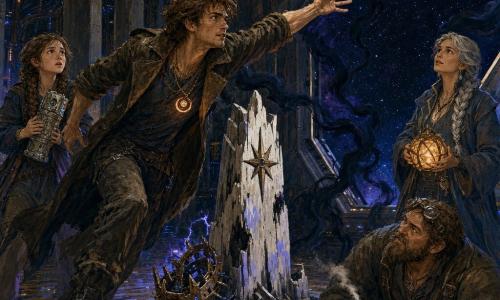
At last the corridor widened into a chamber shaped like a broken planet. Pieces of floor drifted in the air, connected by ribbons of pale light. In the center stood the robed figure, tall and thin, its shadow pooling like ink.
When it spoke, the voice sounded like many whispers braided together.
“Orin Vale,” it said. “Coder of incantations. Mender of little rules.”
Orin swallowed. “Who are you?”
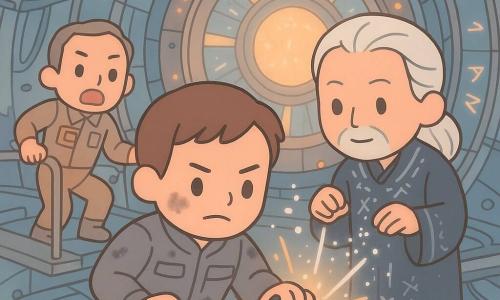
The figure lifted its hands. Between its fingers, darkness stretched into threads—the same spider-silk absence Orin had seen biting the star-seed light.
“I am called the Weaver,” it said. “Not because I create. Because I unmake.”
Pixo let out a furious beep.
Orin raised his rune-stylus like a small sword, though it felt more like holding up a pencil against a hurricane. “Why are you strangling stars?”
The Weaver's hood tilted. “Strangling. Such a dramatic word. I am quieting noise.”
Orin frowned. “Noise?”
“Magic,” the Weaver said. “Spells flung carelessly. Engines overfed. Wards built without thought. Your galaxy burns bright and blind, and it tears itself. I am… reducing.”
Orin felt anger flare—then he forced it down before it became the sharp burst of energy the Nullweave loved.
“So you fix damage,” he said carefully, “by causing more damage.”
The Weaver's threads twitched. “Damage is inevitable.”
“Not like this,” Orin insisted. “Stars aren't toys. Worlds depend on them. Kids depend on them. People—real people—live under those lights.”
The Weaver's voice softened, almost curious. “Do they live responsibly?”
Orin hesitated. Because the uncomfortable truth was: not always. He'd seen reckless spell-duels that cracked city shields. He'd seen miners drain mana-wells until the ground went gray. He'd seen coders like himself brag about “hacking reality” as if reality were a game.
But he'd also seen people repair, apologize, rebuild.
“Yes,” Orin said at last. “Some don't. But that's why we teach. We learn. We take responsibility instead of punishing everyone.”
The Weaver's threads tightened around a floating mirror. The mirror's surface dimmed.
“Responsibility,” the Weaver repeated, tasting the word. “A fragile concept.”
Orin took a slow step forward onto a ribbon of light that served as a bridge. It held, warm beneath his boots.
“I came here because your Nullweave is spreading,” Orin said. “It will collapse systems. It will make the galaxy afraid of its own magic and machines. And fear makes people do stupid things.”
The Weaver's hood tilted again. “Then they will stop.”
“Or they'll lash out,” Orin countered. “They'll build bigger weapons. Stronger wards. More noise. Your quiet will cause a storm.”
For the first time, the Weaver paused long enough that the chamber's faint runes could be heard, drifting like moths.
Orin reached into his pocket and pulled out the vial of star-seed light. It glowed softly, brave in the dim chamber.
“This,” Orin said, “is controlled light. Not a burst. Not a scream. A steady warmth.”
He uncorked the vial just a little.
The star-seed light rose, forming a small sun above his palm. The Nullweave threads in the chamber stirred, drawn to it—then hesitated. They approached slowly, like cautious animals.
Orin spoke in a low voice, coding with his stylus in the air. Runes formed around the little sun: a circle of gentle constraints.
—MODE: STEADY
—OUTPUT: WARMTH_NOT_FLARE
—BARRIER: KINDNESS_IS_A_FUNCTION
Pixo beeped, surprised.
The Nullweave touched the steady light. It didn't bite. It didn't tighten.
It simply… slid off, as if the light were too calm to grip.
Orin's heart hammered. “See? You feed on panic-energy. On sharp, irresponsible surges. But if we change how we use power—”
The Weaver's voice cut in, suddenly harsh. “Change is slow.”
“Then we start now,” Orin said, voice firm. “I can write a patch incantation. Not to destroy you—because you're part of what the galaxy made—but to limit the harm. To keep you from choking stars while we teach the galaxy to stop screaming with its power.”
The Weaver raised a hand. Threads of Nullweave lifted like a stormfront. The chamber's mirrors trembled.
Orin didn't step back, though every muscle wanted to. He forced himself to breathe slowly, to keep his own magic from spiking.
“This is the part where you decide,” Orin said, quieter. “Do you want to be a warning… or a disaster?”
The Weaver's threads hovered over Orin like cold rain that hadn't fallen yet.
Then, unexpectedly, the Weaver lowered its hand.
“You would bind the unbinder,” it murmured.
“Not bind,” Orin corrected. “Balance. A guardrail. Responsibility isn't a cage—it's a promise.”
For a long moment, the chamber held its breath.
Finally the Weaver extended one thread, thin as a hair, and touched Orin's rune-stylus. A chill ran up Orin's arm, not painful but startling, like plunging a hand into snow.
A symbol appeared in the air between them: the Mark of the Nullweave, now incomplete—one sharp corner softened, one line broken.
“A key,” the Weaver said. “If you can code it. If you can carry it without pride.”
Orin nodded slowly. “I can try.”
Pixo beeped, as if reminding him: Trying means you double-check.
Orin managed a shaky laugh. “Yes, yes.”
The chamber's ribbons of light brightened, forming a path back toward the corridor.
“One more thing,” Orin said, before leaving. “If you truly want less harm… help me stop the worst surges. Not by choking stars, but by guiding us.”
The Weaver's voice faded like a curtain falling. “Teach them to be gentle with power. Or I will return to quiet them.”
Orin swallowed. “That's fair,” he said, though he didn't like it.
He guided the Peregrine Kite back through the mirror-corridor. Reflections flashed by—some looked relieved, some looked tired, one looked like it wanted a sandwich.
As the ship slipped out of the Quiet Rift, normal space snapped back into place. Stars twinkled again, as if exhaling.
Orin slumped in his chair, sweat cooling on his neck. In the air above his slate, the softened Mark hovered like a problem waiting to be solved.
Pixo beeped softly.
“I know,” Orin whispered. “Now I have to write the patch… and make sure it doesn't become another kind of mistake.”
Chapter 5: The Patch That Had to Be Kind
Orin didn't sleep. He tried once—closed his eyes, told himself he'd rest for “just ten minutes”—and then his mind replayed the Weaver's words like a stubborn song.
Teach them to be gentle with power.
He sat at his slate, hands steadying, and began to code. The softened Mark hovered as a reference pattern, shifting slightly whenever he thought too hard, like it disliked being stared at.
“Okay,” Orin told it. “No pressure.”
Pixo projected a checklist:
—TEST
—TEST AGAIN
—DON'T BE A HERO
—SNACKS
Orin glanced at the last line. “Fine.” He grabbed a packet of dried nebula-pears and crunched thoughtfully.
He built the incantation patch as a layered spell-program, designed to be installed into star-forges and ring-tuners—any system that handled large flows of magical energy.
The goal wasn't to fight the Nullweave head-on. It was to change the shape of energy: smoothing spikes into steady streams, like turning wild rapids into a calm river.
He wrote:
—INPUT: MAGIC_FLOW
—DETECT: SURGE(Panic_Spike)
—TRANSFORM: SURGE -> STEADY_WARMTH
—EMIT: HARMLESS_LIGHT
—LOG: USER_ACTIONS
—PROMPT: “ARE YOU BEING CAREFUL?”
He paused at the prompt and snorted. “Imagine a star-forge asking for manners.”
Pixo beeped: It would help.
Orin added another line, reluctantly admiring its sense.
—IF_USER_IGNORES_PROMPT x3: THROTTLE_POWER
“Responsibility,” Orin said. “Not optional.”
Before testing anything near a real star-seed, Orin built a sandbox: a small spell-cage on his worktable, lined with copper thread and calming runes. He fed it a tiny spark of the star-seed light—a safe, measured amount.
Then he introduced a controlled Nullweave thread, copied from the pattern the Weaver had given him. It flickered in the air like a strand of cold.
Orin initiated a surge on purpose—a quick spike of brightness.
The Nullweave lunged, tightening.
Orin's patch engaged. The brightness softened instantly, turning into a warm glow that filled the cage like lantern light.
The Nullweave hesitated, confused, then loosened and drifted away from the glow as if it had lost interest.
Orin exhaled, realizing he'd been holding his breath. “It worked.”
Pixo beeped triumphantly, then immediately beeped again: More tests.
“Yes,” Orin agreed. “More tests.”
He ran it again with different spike shapes, different frequencies. He checked for side effects: overheating, feedback loops, accidental mood-changes (because some spells, when written poorly, could make an entire room feel grumpy).
At one point, the patch caused the spell-candles to smell faintly like onions.
Orin pinched his nose. “Okay. Not perfect.”
He adjusted.
Hours later, the patch stabilized: it smoothed surges without stealing power entirely. It didn't silence magic. It taught it to speak without shouting.
Now he had to deliver it.
He set course back to Virelia. As the planet's ringed halo came into view, Orin felt both relief and dread. Installing a patch into a star-forge network wasn't like updating a toy. It was like adjusting the heartbeat of a city.
Rell met him at the dock, goggles pushed up, arms crossed.
“You look terrible,” she said. “Good sign. Means you worked.”
Orin offered a tired grin. “I brought something. Not a weapon. A lesson.”
In the Forge Hall, Rell gathered a small group of engineers. They stared at Orin's slate with the skepticism of people who had watched too many “geniuses” break expensive things.
Orin spoke clearly. “This patch won't destroy the Nullweave. It can't. The Weaver is… a response. But this will stop it from biting hard when power surges. It encourages steady output and forces users to slow down.”
One engineer scoffed. “So it nags us.”
“Yes,” Orin said. “Like a responsible friend.”
Rell held up a hand. “We test it first,” she said. “On a spare ring segment. If it fails, it fails away from the city.”
Orin nodded, grateful. “Exactly.”
They installed the patch into a detached section of rune-stone, floating in a containment cradle. Rell initiated a power pulse—sharp, bright.
The rune-stone flashed.
A faint dark thread appeared, reaching—
Then the patch smoothed the pulse into a warm glow. The dark thread slackened, slid away, and dissolved like mist.
Silence filled the hall for a heartbeat. Then someone exhaled.
Rell's expression didn't turn joyful—she was too practical for that—but her shoulders loosened. “All right,” she said. “We install it. Carefully.”
The word carefully hung in the air like a blessing.
Orin stayed for the installation, checking every connection, re-running diagnostics, making sure nobody skipped steps just to be fast. When an engineer tried to rush a calibration, Orin gently stopped him.
“If we hurry,” Orin said, “we might win time and lose the city.”
The engineer grumbled, then slowed down.
Rell glanced at Orin. “You're annoyingly responsible.”
Orin chuckled. “I've been called worse.”
As the patch spread through Virelia's ring system, the halo above the city glowed with a steadier light, like a calm thought replacing a panic.
Orin watched the readings on the console. The warning icons faded one by one.
Pixo beeped softly, the sound almost like a sigh.
But Orin knew this wasn't the end. Virelia was only one world. The disturbance tide had already touched others.
Rell stepped beside him. “What now?”
Orin looked up at the rings. “Now we share it,” he said. “Across the lanes. Across the worlds. We don't hide the fix.”
Rell nodded slowly. “Some will resist. Pride, politics, profit.”
“Then we keep showing them,” Orin said. “Because the galaxy doesn't belong to the loudest users. It belongs to everyone who has to live under its stars.”
Outside, the stuttering star in the far spiral—Star SevenWest—no longer blinked in panic. Its light steadied, not perfectly, but enough to breathe again.
Orin felt a weight shift inside his chest. Not gone, but carried.
Responsibility, he thought, wasn't a chain. It was a way of holding the universe without dropping it.
Chapter 6: A Quiet, Bright Horizon
News traveled fast through Lumenwake—faster than ships sometimes—because stories rode on spellwaves and gossip-drones. Within days, Orin's patch incantation reached other star-forges: the frost-mills of Halcyon Drift, the lava reactors of Karth Emberbelt, the floating gardens of Mirabel Station where botanists used light-spells to coax fruit from vacuum-grown trees.
Some worlds accepted it immediately. Others argued.
One official sent Orin a message: THIS PATCH LIMITS PRODUCTIVITY.
Orin replied: IT LIMITS DISASTERS.
Another world asked, suspiciously, WHO ARE YOU TO TELL US HOW TO USE POWER?
Orin wrote back: SOMEONE WHO HAS MADE MISTAKES AND DOESN'T WANT TO MAKE BIGGER ONES.
And because Orin didn't believe in scolding from a distance, he traveled. He stood in forge halls and engine rooms, explaining, listening, and sometimes admitting, “I don't know yet.” He helped local coders adapt the patch to their systems, because responsibility wasn't just about rules—it was about respecting people's realities.
Pixo became famous in a small way. Children on Mirabel Station painted tiny brass orbs on their notebooks and tried to imitate its beeps.
Pixo responded by beeping in a way that sounded like it wanted royalties.
Late one evening, after a long day of teaching a group of young spell-engineers how to smooth energy flow without smothering it, Orin returned to the Peregrine Kite. He stood in the doorway of his workshop-ship, watching a line of stars rise over the curve of a nearby moon.
Rell had sent him one last message from Virelia:
RINGS STEADY.
CITY SAFE.
DON'T GET YOURSELF UNMADE.
Orin smiled and tucked the message away.
He still thought about the Weaver. Sometimes, when the ship passed through quiet regions, Orin imagined threads of darkness watching from between the constellations.
But the stuttering had slowed across the lanes. The tide of disturbances didn't vanish entirely—problems rarely did—but it no longer surged like a flood. It became something manageable. Something people could face without panicking.
One night, Orin set the Peregrine Kite drifting with engines off. The ship floated in open space where a soft nebula glowed green and gold, like a forest made of light.
Pixo settled on the console, projecting a gentle star map. No warning icons blinked. Just calm points of light, steady and patient.
Orin leaned back, hands behind his head. “We did okay,” he said.
Pixo beeped once: Okay.
Orin laughed under his breath. “That's the nicest thing you've ever said.”
A faint shimmer crossed the cockpit window—so subtle Orin wondered if it was only his tired eyes. For a moment, a symbol appeared in the nebula's glow: the softened Mark, incomplete and less sharp.
Not a threat.
More like a reminder.
Orin spoke softly, as if the galaxy were listening. “We'll keep learning,” he promised. “We'll keep teaching. We'll keep our power steady.”
The symbol faded, and the nebula continued to glow, peaceful and vast.
Orin watched the horizon of starlight where darkness and brilliance met, not as enemies, but as parts of the same wide sky. The universe felt less like a machine to hack and more like a shared home—one that needed careful hands.
He reached for his slate and wrote a final line, not as code, but as a note to himself:
Use wonder. Use wisdom. Use care.
Then he closed the slate, and the Peregrine Kite drifted on, carrying a quiet kind of epic across the stars—toward whatever mystery waited next, and toward a horizon that, for now, held steady.