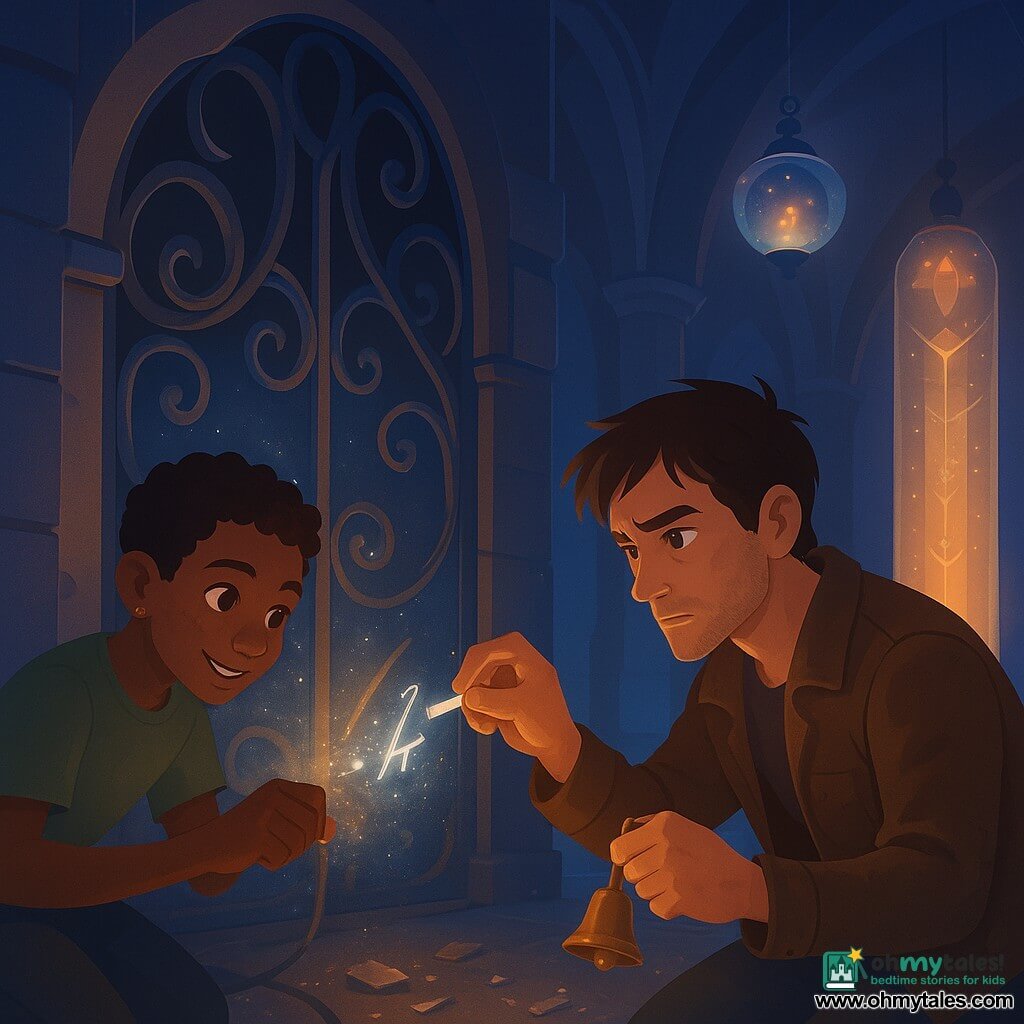
Chapter 1: The Silo That Hummed Like a Choir
The energy silo stood on the edge of the asteroid-city of Lumenbarge like a giant lantern planted in rock. From far away it looked simple—just a tall cylinder of dark alloy with rings of glowing runes—but up close it was alive with sound: a steady hum, layered with faint chimes, as if invisible singers were warming up.
Cassian Vail lived inside that hum.
He was a cosmic portal warden, which sounded like a job for someone with a cape and a dramatic jawline. Cassian did have a jawline, but his cape was mostly used as a rag when crystal dust got into the gears.
He walked along a narrow catwalk between towers of crystal batteries. Each battery was a column of clear mineral packed with starlight and spellwork. Their cores pulsed—blue, violet, gold—like slow heartbeats.
“Easy,” Cassian murmured, holding a palm-sized device made of brass and meteor-glass. It looked like a compass that couldn't decide where north was. “Let's see what you're upset about.”
The device, his proof-chime, was his favorite tool. When someone accused a portal of being dangerous, or a storm of being cursed, Cassian offered something simple: a proof. He could show, with a clear tone and a clean reading, whether the magic was stable or twisted. No speeches. No shouting. Just evidence you could hear and see.
The proof-chime twinkled, then gave a soft, honest ping.
Cassian frowned. “That's… new.”
Across the silo, one of the oldest crystal columns—an heirloom battery called Grandmother Quartz—flickered in an uneven rhythm. Not failing, exactly. More like… tapping.
Tap. Tap-tap. Pause. Tap.
A message.
Cassian leaned against the rail, eyes narrowed. “You've got a lot of nerve, Grandmother.”
The crystal's light brightened, as if it had been waiting for him to notice.
Cassian's comm-bead crackled in his ear. “Warden Vail,” came the voice of Inspector Rook from the Dock Council. “Your silo's power output just dipped. Again. Please tell me your crystals aren't composing poetry on the job.”
“They're only humming,” Cassian said. “The poetry is optional.”
“That hum is keeping the city's shields on,” Rook replied. “If the shields blink, our neighbors from the Rust Nebula will notice. They love noticing.”
Cassian pictured a swarm of scavenger ships circling like hungry flies. “I'm on it.”
He crossed the catwalk and climbed down a ladder, boots clanging. The air smelled like cold metal and sweet ozone. He reached the base of Grandmother Quartz and pressed his fingers to the crystal. It was warm, like a hand holding yours during a scary movie.
“Show me,” he whispered.
The runes along the crystal's surface rearranged themselves, sliding like glowing fish. A pattern formed—an old warding sigil used by portal keepers. A gate-mark.
His stomach tightened. Portals weren't supposed to wake up without permission.
Cassian lifted the proof-chime and struck it lightly with a fingernail. The note rang out: pure, bright, and then—halfway through—shivered, as if something invisible had tugged the sound.
A ripple spread through the air.
Above the crystal, space itself wrinkled. Not tearing violently, but folding neatly, like fabric being pinched.
A portal was forming.
Cassian swallowed. “Oh, that's just fantastic.”
The portal widened to the size of a doorway. Inside it swirled a view of somewhere else: a corridor of black stone lit by floating lights, and beyond that, stars that looked too close, as if you could reach out and poke them.
A voice came through, thin as thread. “Warden…?”
Cassian's hand hovered near the emergency seal switch. But the voice didn't sound like an invader. It sounded… tired.
“Who's there?” he called.
The portal flickered. The voice returned. “The hinge is stuck. The song is wrong. Please—”
Then the view snapped away. The portal collapsed with a pop like a bubble, leaving only the crystal's steady glow and Cassian's racing heart.
He stood very still, listening to the silo's hum. Under it, he heard something else now, faint but clear: a melody with an unfinished ending.
Cassian exhaled slowly. “All right,” he said to the crystals. “You want attention? You've got it.”
Grandmother Quartz pulsed once, like a wink.
Chapter 2: The Proof That Didn't Add Up
Cassian spent the next hour running tests. He checked the crystal charge levels, the rune integrity, the mechanical stabilizers. Everything looked normal.
Which was the problem.
Normal systems didn't open secret portals and whisper for help.
He sat at his workbench, surrounded by tools: wire wands, rune chalk, spools of silver thread, and a tiny screwdriver enchanted to never roll off tables. He flipped open his logbook and drew the gate-mark he'd seen.
The mark's curves were familiar, but the angles were wrong—like someone had copied it from memory while bouncing in a speeder.
Inspector Rook arrived with the kind of speed that suggested he'd practiced being annoyed.
Rook was tall, sharp-faced, and wore a uniform that looked like it had been ironed with pure disappointment. He stood at the lab doorway, arms crossed.
“Well?” he demanded. “Are we exploding?”
“Not today,” Cassian said. “Maybe next Tuesday.”
Rook didn't laugh. He stepped inside and lowered his voice. “The council is spooked. Portals opening on their own? That's… ancient trouble.”
Cassian tapped his proof-chime on the bench. “I have a reading.”
“Good. A simple proof. That's your whole thing.” Rook leaned in. “Show me.”
Cassian held up the chime and let it ring again. The note glowed as a thin line of light in the air—a visible soundwave, bright and clean. Halfway through, it wobbled, then steadied.
“There,” Cassian said. “See the wobble? Something is tugging at the resonance. Like an echo from a gate that shouldn't be active.”
Rook stared, unimpressed in the way only professionals could manage. “Can you fix it?”
“I can find it,” Cassian replied. “Fixing depends on whether the universe decides to cooperate.”
Rook's gaze flicked to the towering crystal columns outside the lab. “Those batteries are the heart of the city. Don't go wandering through strange portals and leaving us in the dark.”
Cassian leaned back, folding his arms. “If the tug is from a gate-link, it's already connected. Ignoring it won't unconnect it.”
Rook's mouth tightened. “If you go, you take a beacon. And you report.”
Cassian picked up a small cube of light-metal with runes carved into it. “Already packed.”
Rook stepped closer, voice dropping. “Cassian… you're sensitive to gates. That's why you're a warden. It also means you're the first one to feel the wrongness.”
Cassian looked down at his hands. Sometimes, when a portal opened, he felt it in his bones like a change in weather. He could tell if a gate was sick the way some people could smell rain.
“Yeah,” he said quietly. “I know.”
Rook exhaled through his nose, like he was trying not to sigh too loudly. “Then be careful. If this is a relic gate, it might lead anywhere. Or anywhen.”
Cassian raised an eyebrow. “Anywhen? That's cheerful.”
Rook turned to leave, pausing at the door. “And Cassian?”
“What?”
“If you find out your crystals really are composing poetry…” Rook's eyes narrowed. “Make sure it rhymes.”
When Rook was gone, the silo's hum seemed louder, as if it had been holding its breath.
Cassian walked back to Grandmother Quartz. He placed his palm on its warm surface.
“I'm going to need you to do that portal thing again,” he said. “But preferably without the dramatic disappearing act.”
The crystal pulsed. Tap. Tap-tap. Pause. Tap.
A request, stubborn and insistent.
Cassian pulled a strip of rune-thread from his pocket and tied it around his wrist. The thread shimmered, ready to tighten if the magic around him went wild.
“Okay,” he whispered. “Show me the hinge.”
He struck the proof-chime once more. The note rolled out like a silver ribbon, and the air in front of the crystal folded obediently. The portal blossomed open, steadier this time, revealing the same dark corridor of stone and floating lights.
Cassian swallowed, then stepped forward.
The moment he crossed the threshold, the silo's hum vanished.
Silence wrapped around him—thick, deep, and ancient—until, somewhere ahead, he heard that unfinished melody again, waiting like a question.
Chapter 3: The Corridor of Star-Lanterns
The corridor was colder than the silo, and the air tasted like dust and old lightning. The walls were carved from obsidian-black stone, polished so smooth Cassian could see his own reflection—slightly warped, like the stone was laughing at him.
Above, star-lanterns floated: glass spheres holding tiny storms of glittering light. They drifted in slow circles, as if guarding the hallway.
Cassian lifted his beacon cube and pressed it. It glowed a steady green, promising to guide him back.
“Hello?” Cassian called. His voice echoed, then returned softer, as if it had traveled a long way.
No answer. Just the faint melody again—three notes rising, one note missing.
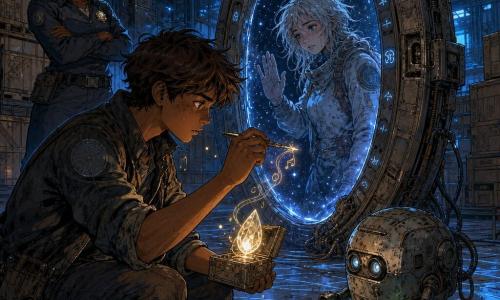
He walked forward, boots quiet on the stone. The corridor opened into a wide chamber with a domed ceiling. In the center stood a structure like a doorframe made of braided metal and bone-white crystal. Runes crawled along it like living ink.
A cosmic gate.
It didn't look like the sleek portals Cassian knew—those were engineered rings with tidy spell matrices. This one felt handmade, stitched together by someone who believed the universe could be persuaded with art.
Cassian approached cautiously. The gate's surface shimmered with a thin film of darkness, like a pond reflecting night.
At its base lay a cluster of shattered crystal shards. Some were the same kind used in his silo—Lumen crystals. Others were stranger, with veins of red and silver that pulsed like embers.
Cassian crouched and touched a shard. It was cold, but it tingled under his fingertip.
“A battery,” he murmured. “But… mixed.”
Behind him, a voice whispered, “Warden?”
Cassian spun, almost dropping the beacon. A figure stood near the wall—thin, hooded, and almost blended into the shadows. Only their eyes caught the lantern light: bright, sharp, and worried.
Cassian's heart hammered. “Who are you?”
The figure stepped forward, and Cassian saw they weren't an adult. They were about his height, maybe a little shorter, with a patched cloak and a belt full of tiny tools. Their face was smudged with soot, like they'd been fixing engines in a hurry.
“I'm Nix,” they said. “I didn't mean to pull you through. The gate grabbed your song.”
“My song?” Cassian repeated.
Nix pointed at the proof-chime in Cassian's hand. “That. Your clean note. The gate likes clean notes. It's starving.”
Cassian stared at the broken shards. “You broke the batteries.”
Nix winced. “It was already breaking. The hinge is jammed between places. If it snaps—” They made a quick gesture like something cracking apart. “—it could spill its path into space. Random doors. Random leaks. People stepping into closets and falling into comets.”
Cassian blinked. “That's… a terrible way to remodel.”
Nix's mouth twitched, almost a smile. “Exactly.”
Cassian stood slowly, keeping his tone calm. “Why are you here?”
Nix hesitated, then pulled back their hood. Their hair was cropped short, their ears pierced with tiny copper rings that sparked faintly with enchantment.
“I'm a stitcher,” Nix said. “I mend old magic-tech. Relics. Things nobody wants until they start screaming.”
Cassian looked at the gate again. He could feel it—an ache in the air, a tension like a rope pulled too tight.
“And you called me,” Cassian said, “through my crystal batteries.”
Nix nodded. “Your silo has Lumen crystals. They resonate across long distances. I tried to send a signal to any warden who'd listen. I didn't know it would latch onto your power system.”
Cassian frowned. “So my crystals started… tapping.”
“They're smart,” Nix said. “Crystals remember songs. They hate wrong notes.”
Cassian could relate. He lifted the proof-chime, then held it near the gate's braided frame. The chime rang softly on its own, like it was being plucked by invisible fingers.
The gate answered with a shiver.
“Show me the problem,” Cassian said.
Nix stepped to the side and pointed at the gate's left pillar. A metal joint there was twisted, as if it had been wrenched by force. Around it, runes had smeared, bleeding into each other.
“The hinge,” Nix said. “It should pivot smoothly between coordinates. But someone tried to force it open without the right pattern.”
Cassian ran a hand through his hair. “Someone as in… a person?”
Nix's eyes darted to the shadows beyond the chamber. “Or something. The Rust Nebula scavengers have been sniffing around old gates. They think relic magic is just free fuel.”
Cassian's stomach sank. If scavengers got their hands on a relic gate, they could pop into Lumenbarge's core like thieves through a skylight.
He straightened, voice firm. “Then we fix it. Now.”
Nix's shoulders loosened with relief. “Good. Because I've been improvising, and I'm out of safe ideas.”
Cassian raised an eyebrow. “You had safe ideas?”
Nix shrugged. “Two. Maybe two and a half.”
Cassian couldn't help a small laugh. “All right, Stitcher Nix. Let's add creativity to the menu.”
He pulled tools from his belt—rune chalk, a small crystal file, and a coil of silver thread.
Nix watched him closely. “You're not scared?”
“I am,” Cassian admitted. “But I'm also annoyed. Which is sometimes more useful.”
Together they knelt by the hinge, lantern light sliding over their hands like water.
Chapter 4: A Patch Made of Light and Nonsense
Cassian studied the hinge as if it were a puzzle box. The mechanical part was obvious: a joint of star-steel, bent slightly out of alignment. The magical part was trickier: runes smeared into a blur, the gate's “instructions” scrambled.
“First,” Cassian said, “we need a proof of what's wrong, not just what looks wrong.”
He lifted the proof-chime and struck it with a careful flick. The note emerged, visible again as a line of light. This time the line bent toward the hinge, like a curious cat leaning into a smell.
The line trembled at the smeared runes and dimmed.
“Corrupted script,” Cassian concluded. “The gate's reading the wrong map.”
Nix nodded, pulling out a tiny screwdriver with a handle wrapped in cloth. “Mechanical alignment is my part. But the script—”
“I can rewrite it,” Cassian said. “If I can find the original pattern.”
Nix bit their lip. “Do you have it memorized?”
Cassian looked at the braided frame. “No.”
Nix's eyes widened. “Then—”
Cassian tapped his temple. “But my crystals might. Lumen crystals record stable resonance patterns. If this gate ever connected to my silo's network, Grandmother Quartz may have a memory of the correct hinge-song.”
Nix stared. “You can… ask a battery for advice?”
Cassian shrugged. “It's not as weird as it sounds.”
Nix looked unconvinced. “It's exactly as weird as it sounds.”
Cassian set his beacon cube on the floor and adjusted its runes. “I'll send a question through the link. A simple call-and-response.”
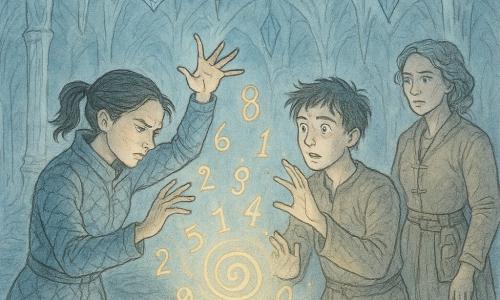
He drew a circle on the stone with rune chalk, then placed a small Lumen shard in the center. He tapped the proof-chime: three notes rising.
The shard glowed, and the air quivered. For a moment Cassian felt the energy silo again—the warm hum, the stacked crystal columns, the smell of ozone and dust.
Then the shard chimed back, not with sound but with light: a pattern of pulses, bright and clear.
Nix leaned in. “That's… code.”
“Music,” Cassian corrected. “A remembered melody.”
Cassian watched the pulses, counting. The pattern repeated with a missing note—then, the missing note appeared, shy and faint, like someone finally raising their hand in class.
Cassian's breath caught. “There. That's the hinge-song. The gate is missing its fourth note.”
Nix pointed at the broken shards. “Because the mixed batteries can't hold the full chord.”
Cassian nodded. “We need a patch—temporary, but stable. Something that can carry that missing note long enough to reset the runes.”
Nix rummaged in their belt pouch and produced a spool of copper wire and a small vial of glittering dust. “I have storm-sand. It conducts both current and charm.”
Cassian looked at the gate's braided frame, then at his proof-chime. “And I have an honest tone.”
Nix blinked. “That's your plan? Honesty and sand?”
“Plus creativity,” Cassian said. “The universe loves a good combination.”
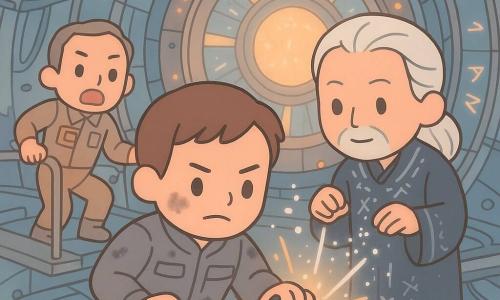
They worked fast. Nix bent the star-steel hinge back into alignment with a small lever, muttering, “Please don't snap, please don't snap,” like it was a prayer and a joke at the same time.
Cassian wiped the smeared runes with a cloth dipped in solvent-oil, then redrew them using the hinge-song as a guide. He didn't copy perfectly—he couldn't. Instead, he shaped the runes like the melody felt: smooth where the notes rose, sharp where the missing note clicked into place.
Nix sprinkled storm-sand into the engraved lines. It flashed, settling into the rune grooves like starlight filling cracks in a sidewalk.
Cassian wrapped copper wire around the hinge joint, not tight like a cage, but in a spiral like a vine. He tied the end with silver thread and whispered a binding charm.
Nix watched his spiral. “That's not standard.”
Cassian grinned. “Standard is what you do when you're not being chased by cosmic disaster.”
Nix snorted. “Fair.”
Cassian lifted the proof-chime for the final step. “When I ring this, the missing note should catch in the storm-sand and carry into the runes. That should re-teach the gate its own instructions.”
“And if it doesn't?” Nix asked.
Cassian considered. “Then we learn something exciting the hard way.”
Nix's eyes narrowed. “I hate exciting.”
Cassian rang the chime.
The note unfurled into light and slid along the copper spiral. The storm-sand ignited, glittering like a tiny galaxy. The rune lines drank the brightness, and the gate shuddered—once, twice—then exhaled a soft, steady glow.
For a heartbeat, the unfinished melody completed itself.
The chamber's air changed. The tension eased, like a fist unclenching.
Nix's shoulders sagged. “I think… it worked.”
Cassian smiled, but it didn't last long.
From somewhere beyond the chamber, metal scraped stone. A low laugh echoed, unpleasant and wet, like someone gargling engine oil.
A voice called out, “Pretty lights! Open doors!”
Nix went pale. “They followed the resonance.”
Cassian's grin vanished. “Rust Nebula.”
The star-lanterns dimmed slightly, as if afraid.
Cassian grabbed his beacon cube. “How many?”
Nix peered into the corridor. “Enough.”
Cassian's mind raced. The gate was stable now—but stability meant it could open.
And if the scavengers forced it, it could open to his silo.
He looked at the gate's dark surface and made a decision.
“We're not just fixing the hinge,” he said. “We're moving the door.”
Nix stared. “You can move a relic gate?”
Cassian tightened the rune-thread on his wrist. “Not with strength. With a better idea.”
Chapter 5: The Door That Wanted to Dance
The scavengers poured into the chamber in clanking armor patched from ship hulls. Their helmets had visors like insect eyes, and their weapons looked like tools that had stopped being polite.
“Warden!” one of them called, voice buzzing through a speaker. “Nice gate. We'll take it.”
Cassian stepped between them and the gate, holding up the proof-chime like it was a badge. “You can't ‘take' a gate. It's not a sandwich.”
A scavenger laughed. “Everything's a sandwich if you're hungry enough!”
Nix muttered, “That is the worst philosophy I've ever heard.”
The lead scavenger raised a device shaped like a drill with runes taped onto it. “Open it, warden. Or we open you.”
Cassian glanced at Nix. “Remember that unfinished melody?”
Nix nodded, eyes sharp despite the fear. “The hinge-song.”
“Gates respond to songs,” Cassian said quietly. “But relic gates respond to intention, too. They're like… stubborn pets.”
Nix whispered back, “So we distract it with a treat?”
“More like,” Cassian said, “we teach it a dance.”
He turned to the gate and placed his palm on the braided frame. He didn't force it. He listened. Beneath the glow, he felt a yearning—like the gate wanted to connect, to fulfill its purpose, but it didn't want to be used like a crowbar.
“Hey,” Cassian murmured to it. “You don't want them. I don't want them. Let's be creative.”
The scavenger shouted, “Enough whispering! Open!”
Cassian rang the proof-chime—softly, not as a command, but as an invitation. He played the hinge-song again: three rising notes, the missing note sliding in at the end like a wink.
The gate's surface rippled.
The scavengers surged forward.
Cassian took a breath and did something he'd never written in a manual: he changed the fourth note.
Just a little.
He bent it upward, making it brighter, lighter—less like a lock clicking shut, more like a door swinging open into laughter.
The gate responded immediately. Its runes flared, and the chamber filled with a wind that smelled like snow and cinnamon.
Nix's eyes went wide. “Cassian—what did you do?”
“I improvised,” Cassian said, and grinned despite himself. “Creative value, remember?”
The lead scavenger lunged, drill-device raised.
The gate opened.
Not to Lumenbarge.
Not to anywhere the scavengers expected.
A burst of shimmering whiteness poured out—sparkling flakes, a tumbling blizzard of enchanted frost. It swallowed the scavengers in seconds, coating their armor, clogging their visors, turning their loud threats into muffled yelps.
“What is this—? I can't—my boots are—!”
“Why does it smell like pastries?!”
Nix stared at the storm. “You opened it to a… dessert snowstorm dimension?”
Cassian shrugged, coughing as cinnamon tickled his nose. “A place I visited once during training. The Frost Bakeries of Mirabell. Very dangerous to anyone with a serious attitude.”
The scavengers stumbled, slipping, waving their arms. Their drill-device sputtered, runes shorting out under frosting-like ice.
Cassian grabbed Nix's sleeve. “Now. While they're busy being powdered.”
They ran past the gate's frame, avoiding the spill of snowy magic, and down a side corridor Nix had mentioned earlier—an access passage used for repairs.
Behind them the scavengers shouted, angry and confused, as the snowstorm continued to pour.
Nix panted. “That won't hold forever.”
“It doesn't need to,” Cassian said. “We just need time to do the real thing.”
They emerged into a smaller room filled with old machinery: crystal sockets, rusted conduits, and a pedestal holding a star-map disk.
Nix ran to the pedestal. “This is the coordinate core. If we can shift it, we can change what the gate considers ‘home'.”
Cassian's heart thudded. “So we can stop it from reaching my silo.”
Nix nodded. “But the core is locked. It needs a key-pattern.”
Cassian looked down at his proof-chime. The simplest proof he had—an honest note.
He lifted it and listened to the room. Under the distant chaos of scavengers, under the gate's wind, he heard something else.
A tiny, steady pulse.
Tap. Tap-tap. Pause. Tap.
Grandmother Quartz, still linked, still trying to talk.
Cassian placed the proof-chime against the star-map disk. “If the lock wants a pattern,” he whispered, “we'll give it one it trusts.”
He played the remembered hinge-song—this time perfectly, including the missing note Grandmother had offered.
The disk warmed. Its etched stars lit up, connecting into lines like a constellation drawing itself.
Click.
The lock released.
Nix let out a breath that sounded like relief and disbelief mixed together. “You did it.”
Cassian turned the disk carefully. The constellation lines shifted, rearranging like a new story being written.
The gate above them groaned—responding.
Nix swallowed. “Where are we sending it?”
Cassian hesitated. If he chose wrong, he could send a relic gate into someone else's home. Or into empty space, where it might drift and tear open randomly.
He closed his eyes, listening to that yearning in the magic-tech. The gate didn't want to be a weapon. It wanted to be a bridge.
“Somewhere safe,” he said. “Somewhere it can rest and be understood.”
He turned the disk until the constellation formed a symbol he'd only seen in old warden archives: a sanctuary mark.
Nix's voice was soft. “The Archive Moon.”
Cassian opened his eyes. “You know it?”
Nix nodded. “A place where relics are kept and repaired. Where stitchers learn without scavengers breathing down their necks.”
Cassian smiled faintly. “Then that's where the door wants to dance next.”
They heard a crash above, followed by furious shouting.
Nix grabbed Cassian's arm. “We have to go—now.”
Cassian lifted the beacon cube and whispered, “Home.”
Green light flared, and the world folded.
Chapter 6: The Secret Under the Hum
Cassian stumbled back into his energy silo, boots hitting the familiar metal floor. The warm hum wrapped around him instantly, comforting as a blanket.
Behind him, the portal snapped shut with a gentle sigh—not a pop this time. More like a door being closed carefully so it wouldn't wake anyone.
Nix appeared beside him a heartbeat later, blinking at the towering crystal batteries. “So this is your famous choir.”
Cassian steadied himself against the rail. “Welcome to my very glamorous life.”
Alarms were flashing on a panel across the room. Inspector Rook's voice crackled through the comm-bead, sharp with panic. “Vail! The readings just spiked and then—vanished. Report!”
Cassian pressed the bead. “Crisis contained. Mostly. Please tell me you still have shields.”
A pause. Then Rook: “Shields stable. Explain ‘mostly.'”
Cassian glanced at Grandmother Quartz. Its glow was calm now, satisfied. The tapping had stopped.
“The relic gate is relocated,” Cassian said. “To the Archive Moon.”
Rook's voice went very quiet. “That's classified.”
Cassian blinked. “It is?”
“Yes,” Rook snapped. “Which means you shouldn't know it exists.”
Cassian looked at Nix, who raised both hands innocently. “I didn't tell him everything,” Nix said. “Just enough to not die.”
Cassian cleared his throat. “Anyway. Scavengers attempted to seize the gate. We distracted them with… environmental conditions.”
Rook's sigh came through the bead like a storm cloud. “Environmental conditions.”
“Cinnamon snow,” Nix offered helpfully.
There was a long silence.
Rook finally said, “I'm coming over. Don't touch anything that can open another dimension.”
Cassian ended the call and leaned on the rail, suddenly exhausted. Nix wandered closer to Grandmother Quartz, staring at the crystal's steady pulse.
Nix whispered, “It really did remember the hinge-song.”
Cassian nodded. “Lumen crystals store resonance. That's why they're good batteries.”
Nix tilted their head. “But… the way it tapped. The way it answered you. That wasn't just stored energy. That was… choice.”
Cassian felt a chill, even in the warm silo. He stepped closer to the old crystal column, placing his hand on it again.
The hum of the silo deepened, as if listening back.
Cassian spoke softly, feeling a little silly. “Grandmother… why did you help?”
For a moment nothing happened.
Then, faintly, a shimmer rose inside the crystal like a thought forming. Images flickered behind the clear mineral: not pictures exactly, but impressions—hands setting crystals into sockets, voices chanting calibration songs, a young Cassian watching from a corner with wide eyes.
And then something else.
A memory Cassian didn't recognize as his.
A chamber like the relic gate's room. A warden long ago, placing a hand on a crystal pillar and whispering, “Guard the doors. Remember the songs. If a hinge breaks, call the one who listens.”
Cassian's breath caught. He pulled his hand back, staring at the crystal as if it had suddenly grown a face.
Nix's eyes were huge. “Cassian… your battery isn't just a battery.”
Cassian swallowed hard. “It's a warden.”
Not a person. Not exactly. But a keeper of patterns, a guardian built from crystal memory and slow awareness.
Grandmother Quartz pulsed once, gentle and proud.
Cassian looked up at the towering rows of crystal columns, hearing their hum with new ears. It wasn't just power. It was a chorus of minds—simple, patient, watching over the city's shields and the gates that might threaten them.
A secret had been sitting in his silo the whole time, singing softly under his work.
He laughed, half in awe, half in disbelief. “All this time… I thought I was the guardian.”
Nix grinned. “Turns out you're part of a team.”
Footsteps rang on the stairs—Inspector Rook, arriving with urgency and suspicion. He entered the silo floor, saw Nix, and froze.
Cassian lifted a hand before Rook could explode into questions. “They're with me. And before you ask—no, we are not keeping them in the storage closet.”
Rook's gaze flicked to the crystals, then to Cassian's face. “You look like you learned something you weren't supposed to.”
Cassian glanced at Grandmother Quartz, then back at Rook. He chose his words carefully.
“I learned,” Cassian said, “that the best locks aren't made of thicker metal. They're made of better songs.”
Rook narrowed his eyes. “That's not an answer.”
“It's a proof,” Cassian replied, lifting the chime. He rang it once—pure, steady, no wobble. The line of light held firm.
Rook watched the unwavering glow and, despite himself, his shoulders loosened a fraction. “Stable.”
Cassian nodded. “Stable. And safer than it was.”
Rook looked at Nix. “And you?”
Nix shrugged. “I fix old things. Sometimes old things fix back.”
Rook opened his mouth, then closed it again, as if he'd realized arguing with that sentence would take the rest of the week.
Cassian rested his hand on Grandmother Quartz one last time. The crystal's warmth seeped into his skin, calm and familiar, like the silo itself was saying, You heard us. Good.
Cassian looked out across the glowing rows and let wonder settle into him—not as a distraction, but as a tool.
Creativity, he realized, wasn't just making something new. Sometimes it was noticing what had been quietly brilliant all along.
And beneath the steady hum of the silo, the choir of crystals sang on—guarding doors, remembering songs, waiting for the next wrong note in the stars.