Chapter 1: The Listening Artifact
The comms hall of Starbridge Nine never truly slept. Even at “night,” when the station's lights dimmed to a soft blue, the air still trembled with messages—whispers of trade routes, jokes from bored pilots, lullabies sent across light-years, and the occasional emergency siren that made everyone freeze.
Orin Vale liked it that way.
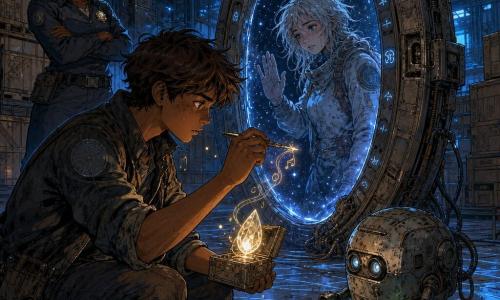
He stood with his palms resting on the railing of the upper walkway, watching the room below: rows of crystal consoles, copper wires braided like hair, and, at the center, a circle of energy totems. Each totem was a tall rod of dark stone wrapped in glowing bands. They pulsed in slow, steady beats, like a giant heart keeping time for the whole station.
On Orin's chest, beneath his worn jacket, hung his artifact: a flat, oval disk the color of storm clouds, strung on a simple chain. It was called an Observant, because it didn't just see. It listened. It noticed. It remembered details other people skipped—tiny shifts in tone, the pauses between words, the way fear made a voice go dry.
“New packet coming in!” shouted Jessa, the youngest signal-runner, as she sprinted between consoles with her braid bouncing. “From the Far Halo!”
“The Far Halo sends messages like people send bottles into the sea,” Orin said. “You never know if they'll arrive with poetry or a fish.”
Jessa grinned. “Or both.”
A console chimed, bright as a bell. The crystals over it glowed green, then flickered to a strange violet.
Orin's artifact warmed against his skin.
He straightened. That wasn't normal.
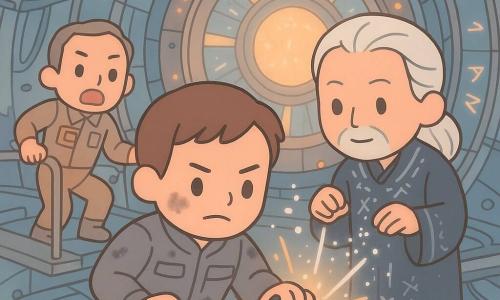
Down on the floor, Master Rell—chief communicator and proud owner of the station's biggest frown—leaned close to the console. “That's not our frequency. Who's meddling?”
Orin descended the metal stairs two at a time. “Let it through.”
Master Rell shot him a look. “Orin, we have protocols.”
“We also have curiosity,” Orin replied. He tapped the chain under his collar. “And this thing just sat up in its sleep.”
Jessa leaned in, eyes wide. “Did it do that on purpose?”
“It does everything on purpose,” Orin said, though he wasn't entirely sure.
Master Rell gave a theatrical sigh, the kind that said he'd complain later but allow it now. “Fine. But if this turns our totems inside out, I'm blaming you.”
Orin placed his hand near the console, not touching the crystals, just hovering. The Observant felt like a small sun, heating his chest.
The message arrived as a sound first—a low hum threaded with chimes—then unfolded into words that seemed to step carefully into the room.
“Starbridge Nine,” the voice said, calm but strained. “If you can hear this, your totems are still singing. Ours are… coughing.”
Jessa blinked. “Totems can cough?”
Orin kept his hand steady. “Shh.”
The voice continued. “This is Liora of the Lantern Guild. Our communication network is collapsing. Something is draining the energy lines—like a shadow drinking starlight. We've tried shields and spells and engines, but nothing holds. If the Halo goes silent, we won't just lose messages. We'll lose our way home.”
A pause, and the voice softened. “We heard you have an Observant. An artifact that notices what others miss. If you're willing, follow this beacon. Bring creativity. Bring patience. Bring… someone who welcomes the new.”
Orin's artifact pulsed once, sharp as a heartbeat.
Master Rell's frown grew so deep it looked like it could trap a coin. “The Far Halo is beyond our patrol lines.”
Orin smiled faintly. “Then it's beyond our boredom, too.”
Jessa grabbed his sleeve. “You're going, aren't you?”
Orin looked down at the totems. Their glow was steady, but he could almost imagine them listening, as if the rods themselves had ears.
“I don't know what's out there,” he said, “but I do know this: silence spreads if no one answers. Prepare a ship.”
Master Rell opened his mouth to argue, then saw Orin's expression—the one that meant Orin's mind had already taken off and was now waving from the sky. He pinched the bridge of his nose.
“I'll authorize a small craft,” he grumbled. “Small. And fast. And preferably one that doesn't explode if you sneeze.”
Jessa cheered. “I'll pack snacks!”
Orin's artifact cooled, as if satisfied.
Somewhere far away, in the dark between constellations, a network of totems was coughing—and Orin could almost hear it, faint as a distant drum.
Chapter 2: Totemlight Road
The ship Master Rell approved was called the Skyskipper, which sounded graceful until you saw it.
It was a compact shuttle with patched panels and a nose that had been replaced twice—once after a meteor scrape, and once after someone tried to paint a dragon on it and got carried away with the flames.
“It looks like a tin kettle that learned to fly,” Jessa said fondly, patting the hull.
“It flies,” Master Rell said. “That's the important part.”
Orin ran a hand along the side. The metal was cool, but his Observant warmed again as they approached the ship's core: a star-engine wrapped in runes. Technology braided with magic—coils of copper and silver, sigils painted in a careful spiral. The engine purred like a satisfied cat.
In the comms bay, they loaded three portable energy totems—shorter than the station's rods, but carved from the same dark stone. Each had a strap so you could carry it like an awkward backpack.
Jessa hoisted one and staggered. “Who decided ‘portable' should mean ‘heavy enough to bend your knees'?”
Orin adjusted the strap on his own. “Probably someone who never carried one.”
They lifted off from Starbridge Nine with a shiver and a thunk, like the ship was clearing its throat. Outside, space opened like an enormous velvet curtain scattered with bright pinpricks.
Jessa pressed her face to the window. “Every time I see it, I forget to breathe.”
“Don't,” Orin said. “We need you breathing.”
She laughed. “You always say the least romantic thing at the most romantic moment.”
Orin tapped the console. “That's my gift.”
The Far Halo beacon, transmitted through the totem network, appeared as a thin ribbon of light on their navigation screen. It wasn't a normal route line. It shimmered, as if drawn by someone's imagination instead of a computer.
They followed it.
As the Skyskipper moved, Orin felt the network around them—like invisible threads connecting station to station, ship to ship, totem to totem. Sometimes the threads vibrated with chatter. Sometimes they went quiet, like a held breath.
Halfway through the first jump, the ship's lights flickered.
Jessa's grin vanished. “Uh… Orin?”
A shudder ran through the hull. The star-engine's purr turned into a nervous growl.
Orin's Observant grew hot enough to sting.
“Something's tasting our signal,” he murmured.
On the screen, the ribbon-beacon dimmed. Around it, shadows gathered—soft at first, like ink dropped in water, then darker, thicker, shaping themselves into a drifting cloud.
The cloud had no eyes, no mouth, no claws. It didn't need them. It simply pressed against the ship's connection to the totem network, and the connection began to thin, like a rope being gnawed.
Jessa grabbed the edge of her seat. “Is that the shadow-drinker?”
“Looks hungry,” Orin said.
The ship's comms panel crackled. Not with a message, but with a sound like someone rubbing glass with sand.
Master Rell's voice, delayed from the station, burst through. “Orin! Your signal spiked—then dipped. Are you doing something stupid?”
Orin kept his voice calm. “Define ‘stupid.'”
“Orin!”
Jessa pointed. “It's pulling on the beacon!”
Orin inhaled slowly. Panic made mistakes. The Observant didn't like mistakes; it liked details.
He noticed how the shadow moved. Not randomly. In patterns—circling the brightest parts of their connection, avoiding the duller ones. Like a moth, but the opposite: it chased the light to eat it.
“Light attracts it,” Orin said.
Jessa swallowed. “So we… turn off the light?”
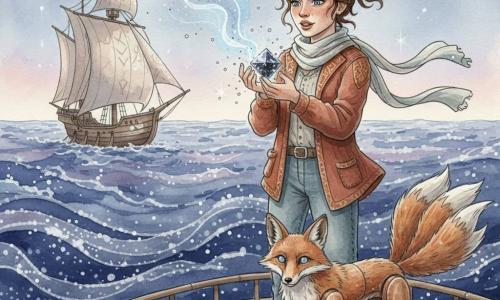
“In a way.” Orin unstrapped one of the portable totems and set it upright on the floor. He traced the carved bands with his finger, feeling the faint hum inside.
“Totems amplify,” he said. “But they can also redirect. We'll give it something tastier than our lifeline.”
Jessa's eyes widened. “A decoy?”
“A decoy with style.”
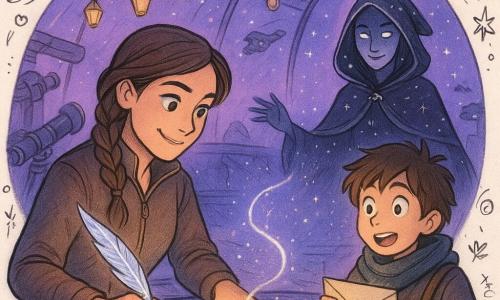
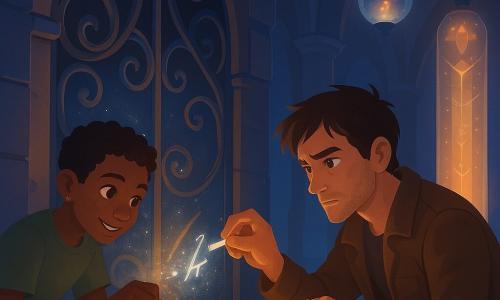
He opened a small kit—chalk, copper thread, a pinch of stardust salt. He began drawing a quick circle around the totem, not a perfect one, but lively, with little loops and swirls.
Jessa stared. “That's… not the standard totem array.”
Orin winked. “Standard is for people who don't like surprises.”
The ship lurched as the shadow pressed harder. The beacon ribbon flickered like a candle in wind.
Orin tied the copper thread into three knots and spoke a short charm—not ancient and fancy, but simple and clear, like a promise:
“Follow the brightest story.”
The portable totem flared.
Not with plain light, but with images—tiny, shimmering scenes: a comet wearing a hat, a moon juggling stars, a spaceship doing a clumsy dance. Ridiculous. Beautiful. Impossible to ignore.
Jessa let out a shaky giggle. “Did you just… prank it?”
The shadow swerved, as if curious. It drifted toward the totem's glow, pressing in, tasting the light. The ship's connection loosened, like a hand released from a tight grip.
Orin grabbed the console. “Now. We jump.”
The Skyskipper's engine howled, runes flaring. Space folded.
The last thing Orin saw before the jump was the shadow wrapped around the decoy totem, drinking in the silly little scenes like they were the finest feast in the galaxy.
When the ship steadied, Jessa exhaled so hard her cheeks puffed. “I thought we were going to become space dust.”
“We still might,” Orin said. Then, seeing her face, he added, “But not today.”
On the navigation screen, the Far Halo beacon glowed again—faint, but alive.
They followed it deeper into the stars.
Chapter 3: The Coughing Choir
The Far Halo wasn't a single place. It was a loose necklace of small worlds and stations circling a pale blue star. From a distance, it looked peaceful—soft rings of dust, slow-turning satellites, a few bright ships moving like fish.
Up close, it felt wrong.
Their comms were quiet. Not the comfortable quiet of sleeping people, but the eerie quiet of an empty theater after the lights go out.
As they approached the coordinates from Liora's message, they saw the Lantern Guild's main relay: a station shaped like a many-pointed star, each point capped with an energy totem as tall as a tower.
Those totems should have been blazing.
Instead, they sputtered, their glow uneven, as if they were trying to sing with sore throats.
“Coughing choir,” Jessa whispered.
Orin nodded. “And something's stealing their breath.”
They docked in a hangar lit by lanterns floating in midair—glass globes with tiny galaxies swirling inside. A welcoming detail, even now.
A group hurried to meet them. At their front was a woman with dark hair braided with silver wire and a cloak that shimmered like oil on water. Her eyes were sharp, but tired.
“I'm Liora,” she said. “You came.”
Orin bowed slightly. “Orin Vale. This is Jessa. Our station complains, but it cares.”
Liora's mouth twitched. “Most good places do.”
She led them through corridors lined with carved symbols and humming cables. The Lantern Guild had built their relay like a piece of art—arches shaped like crescent moons, panels engraved with star-maps that shifted when you stared too long.
But cracks showed. Some cables were blackened. Some symbols were smudged, as if erased by a careless hand.
In the central chamber, the main totem stood in a pool of light. It should have been roaring with power. Instead, it glimmered weakly, its bands dull.
Around it, guild members argued in low voices.
“It's an engine problem.”
“It's a spell problem.”
“It's sabotage!”
Liora raised a hand. “Enough. Orin Vale has an Observant. Let him look.”
Orin stepped closer. The heat from his artifact rose immediately, a warning and an invitation.
He didn't touch the main totem. He listened.
Not with ears, exactly. With attention.
The totem's hum was uneven. A rhythm missing beats. Beneath it, another sound—faint, slippery, like something dragging wet cloth across stone.
Jessa wrinkled her nose. “Do you smell… rain?”
Orin did. Not fresh rain. Old rain trapped in a cellar.
He crouched and studied the floor around the totem. The light there seemed thinner, as if the brightness had been scraped away.
“This isn't just draining,” Orin said. “It's… rewriting. Like someone is changing the rules of how the light flows.”
Liora's shoulders sank. “We tried reinforcing runes, adding extra batteries, chanting for hours. Nothing holds.”
Orin looked up at the tall totem. “Show me your network map.”
They brought a holographic star-chart. Lines connected stations and planets, glowing threads of communication. Several lines were dim or broken, especially toward the outer ring.
At the edge of the chart was a cluster of darkness—an expanding blot.
“That's where it started,” Liora said. “A dead station called Morrow Spire. No one lives there now. Too close to the Drift.”
Jessa leaned in. “What's the Drift?”
Liora's eyes flicked to her. “A region where gravity gets moody and magic gets… dramatic. Spells behave like they've had too much sugar.”
Orin studied the blot. His Observant cooled, then warmed again, as if puzzling through a riddle.
The shadow they'd seen before had been hungry, but not clever. This felt clever. This felt intentional.
“Something at Morrow Spire is teaching the shadow what to eat,” Orin said. “Like giving a beast a menu.”
Liora's jaw tightened. “Then we go to Morrow Spire.”
A guild member protested. “We'll lose the relay if we take ships away!”
Orin shook his head. “You'll lose it anyway if we do nothing.”
Jessa lifted one of their remaining portable totems. “We brought backups.”
Liora's expression softened slightly. “You really do welcome the new, don't you?”
Orin shrugged. “The old gets boring.”
They prepared quickly. Liora insisted on coming, along with a quiet mechanic named Brann who carried tools that looked like they could fix a ship—or start a small war.
Before they left, Orin stood by the main totem and opened his small kit again. He drew another circle, this time on a portable totem, and whispered a different charm.
“Remember your own song.”
The portable totem glowed steadily, then sent a thin beam into the main totem like a shared breath.
The main totem's light steadied—only a little, but enough to keep it from fading while they were gone.
Liora watched, impressed despite herself. “That's not a Guild technique.”
Orin smiled. “It's a ‘not panicking' technique.”
Jessa elbowed him. “Also a ‘doodling on the floor' technique.”
Orin pretended to be offended. “My doodles are strategic.”
With the Skyskipper refueled and the Lantern Guild's smaller ship—sleek and bright as a blade—flying beside them, they set out for Morrow Spire.
Behind them, the Far Halo's totems kept trying to sing.
Ahead, the darkness waited.
Chapter 4: Morrow Spire and the Shadow's Teacher
Morrow Spire appeared out of the Drift like a broken tooth.
It was a tall station, once proud, now scarred. Panels hung loose. Windows were dark. And around it, the shadow gathered in thick ribbons, drifting as if the station breathed it out.
The comms went fuzzy as soon as they approached. Not dead, but distorted—messages stretching into slow moans, then snapping back into static.
Brann muttered, “I hate places that chew on electricity.”
Jessa hugged her portable totem. “I hate places that chew on anything.”
Orin's Observant was hot now, almost painful. He kept one hand near it, grounding himself.
They docked with a clang that echoed too long.
Inside, Morrow Spire was cold. Their footsteps sounded loud, as if the station was empty enough to hear itself.
Liora's lantern—an orb she carried on a chain—cast a steady glow, pushing back the shadows. For a moment, the darkness seemed to recoil.
“Light hurts it,” Jessa said.
“Not all light,” Orin corrected. “It likes some light. It hates other light.”
“How do you know?” Liora asked.
Orin pointed to a wall where old murals still clung: painted stars, painted ships, painted heroes with ridiculous capes. The paint was faded, but not erased.
Beneath the mural, the shadow thinned, like it didn't know how to swallow a story that had already been told.
“It doesn't just eat energy,” Orin said quietly. “It eats meaning. It feeds on connection. On messages. On anything that says, ‘I'm here and you're there, and we still belong to each other.'”
Brann frowned. “That's… creepy.”
Jessa whispered, “That's… sad.”
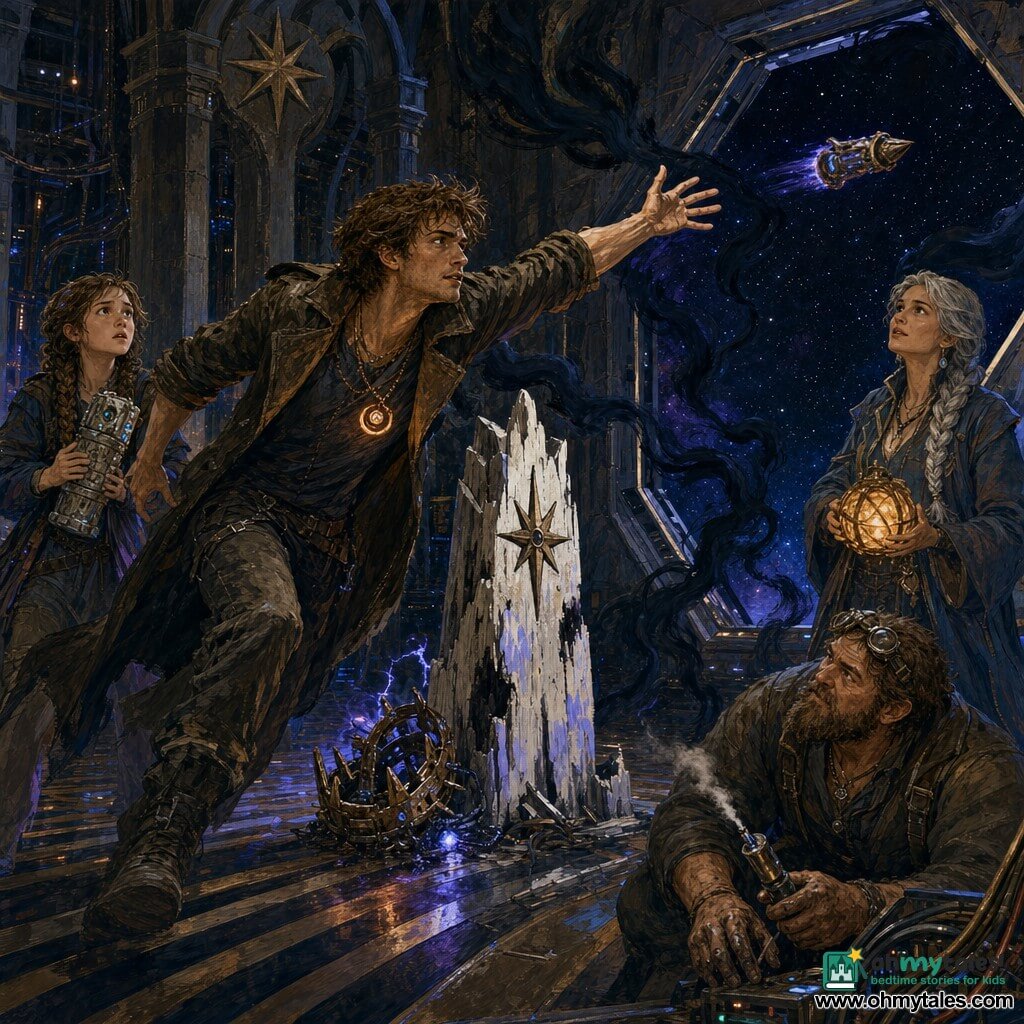
They reached the central tower. The main comms chamber was a cathedral of wires and crystal dishes. In the middle stood a totem unlike any Orin had seen: taller, jagged, carved with harsh angles instead of smooth bands. Its glow was not warm. It was a sharp, sickly white.
And at its base sat something like a crown—metal and bone and glass, wired into the station's systems.
Orin's artifact pulsed hard. Warning. Yes. Also… recognition.
Liora stepped forward cautiously. “That isn't Guild craft.”
“No,” Orin said. “That's a Listening Crown.”
Brann blinked. “A what?”
Orin swallowed. “A device that forces the network to answer you. Not by asking nicely. By grabbing the threads and pulling.”
Jessa's eyes widened. “So it's bullying the totems.”
“A polite word for it,” Orin said.
As if offended, the crown sparked. The jagged totem's light flared. The shadows in the room thickened, rising like smoke that had learned to stand.
A voice spoke—not from speakers, but from the air itself.
“So,” it said, smooth and cold. “Another listener arrives.”
Liora stiffened. “Who are you?”
The shadows shaped into a figure: tall, robed, with a face that seemed half-hidden by drifting mist. Its eyes glowed like distant ship lights.
“I am the Curator,” it said. “Keeper of Silence. Collector of Unspoken Things.”
Jessa whispered, “That sounds like someone who labels jars in a basement.”
Orin almost laughed, but he stayed focused. “You're draining the Halo.”
“I'm rescuing it,” the Curator replied. “Connections lead to conflict. Messages lead to misunderstanding. Plans lead to war. I remove the threads, and the screaming stops.”
Liora's voice shook with anger. “People don't scream because they can talk. They scream because they can't.”
The Curator tilted its head. “You believe in noise. In endless chatter.”
Orin stepped forward. “I believe in choice. Communication should be a door, not a chain.”
The Curator's eyes narrowed. “Your Observant… it sees too much. It will be quiet soon.”
The shadows surged toward Orin like a tide. The air turned heavy, pressing against his lungs.
Orin's mind raced. Force would fail. Pure light might get eaten. Standard spells would be rewritten.
Creativity.
He yanked a portable totem from his pack and planted it on the floor. Jessa did the same on the other side, despite trembling hands.
“Orin,” she said through clenched teeth, “what's the plan?”
“A new kind of message,” Orin said.
He grabbed a coil of copper wire from Brann's kit—Brann looked shocked, but handed it over—and linked the portable totems in a triangle around the jagged central one.
Liora stared. “That's not stable.”
“Neither is the Drift,” Orin replied. “Hold the line.”
He closed his eyes and listened with the Observant. Beneath the Curator's smooth voice was hunger, yes—but also loneliness. A carefulness. The way it spoke about silence sounded less like a victory and more like a blanket pulled tight.
Orin spoke, not to threaten, but to offer. “You don't have to steal meaning to stop pain.”
The Curator's shadows wavered. “Meaning causes pain.”
“Meaning also makes it worth surviving,” Orin said. “Watch.”
He pressed his palm over his artifact. It warmed, then steadied, like a hand squeezing back.
Orin began sending something through the totems.
Not a command. Not a blast of light.
A story.
He pictured a small station sending a joke to another station, and the other station laughing so hard it nearly dropped its tools. He pictured a pilot confessing they were scared, and someone answering, “Me too,” and somehow the fear shrinking. He pictured people making maps together—bright lines between dark places.
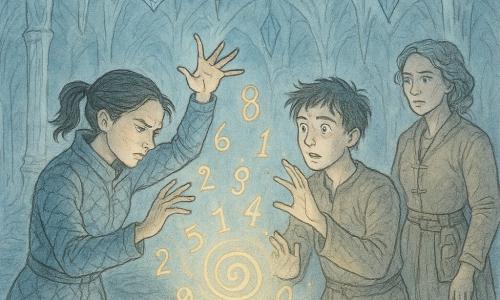
The portable totems pulsed, projecting quick, vivid images into the air, like living holograms made of memory and imagination. The chamber filled with scenes—funny, brave, awkward, kind.
Jessa added her own, blurting, “And a comet in a hat!” because she couldn't help herself.
The image popped into existence: a comet wearing a crooked top hat, zooming past a planet and tipping it politely.
Even Brann snorted.
The Curator recoiled as if struck. The shadows thinned.
“No,” it hissed. “Those threads—those attachments—”
Orin's voice stayed steady. “They're not chains if you hold them with open hands.”
The Listening Crown crackled, trying to override the totems. The jagged totem flared.
Liora stepped forward and lifted her lantern. “Lantern Guild,” she said, voice ringing. “We guide, we don't grab.”
Her lantern's glow brightened—not harsh, but warm, like a campfire on a cold night. The shadows shuddered.
Brann slammed a tool into the crown's wiring. “And we fix what's broken,” he grunted. Sparks flew.
The crown screamed—an awful metallic shriek—and the shadow surged wildly, desperate.
Orin acted fast. He shouted, “Jessa! The charm—‘Follow the brightest story'!”
Jessa's eyes snapped to his. She nodded, drew a quick swirl on her totem with chalk, and yelled, “Follow the brightest story!”
The portable totems flared with a flood of new scenes—creative, messy, alive. The shadows lunged toward them, hungry for the glow.
Orin yanked Brann back. “Now—cut the crown free!”
Brann tore the last wire. The crown clattered to the floor, suddenly just an ugly object, not a power.
Without it, the jagged totem's sick light flickered. The shadow lost its teacher.
It drifted, confused, then streamed toward the portable totems' bright illusion-messages, trying to feed.
Orin grabbed one portable totem and ran—straight toward an open maintenance hatch leading out to space, sealed by an emergency field.
“Orin!” Liora shouted. “What are you doing?”
“Taking out the trash,” Orin called.
He flung the portable totem through the hatch's field. It spun into open space, glowing like a little star.
The shadow followed, pouring after it like ink chasing a lantern.
Orin slammed the hatch controls. The emergency field snapped shut.
Outside, the shadow wrapped around the decoy totem, drinking the last of its bright story until the glow faded.
Then, with nothing left to chew, the shadow thinned—spread out—dissolved into harmless wisps that drifted away into the Drift like smoke that had forgotten why it rose.
Inside, silence fell.
But it wasn't the Curator's kind of silence.
It was the relieved quiet after a storm passes and everyone checks that the roof is still there.
Liora exhaled. “Is it… gone?”
Orin stared at the dead Listening Crown. “Not gone forever. But it's not in control anymore.”
Jessa nudged the crown with her boot. “So the Curator was… what? A person?”
Orin shook his head slowly. “A mind built from stolen signals. A creature made of other people's unspoken fears. It thought silence was safety.”
Brann rubbed his singed glove. “It was wrong.”
Orin nodded. “Yes.”
He picked up the crown carefully, as if it might bite. “We take this back. We make sure it can't grab the network again.”
Liora looked around the damaged chamber, then at Orin's Observant. “You didn't win with bigger power.”
Orin smiled tiredly. “No. Just a better idea.”
Jessa lifted her chin. “And a comet in a hat.”
Orin laughed then, the sound echoing up the tower like a promise.
Chapter 5: The Network Reborn
Returning to the Lantern Guild relay felt like swimming up toward the surface after being underwater too long.
As they approached, the totems around the station glowed steadier. Not perfect—still tired—but no longer coughing.
In the main chamber, guild members gathered as Liora placed the Listening Crown inside a containment ring of runes and insulated metal. Brann locked it down with a grim satisfaction.
Orin watched the network map. The dark blot had stopped expanding. Several dim lines brightened, like waking up.
Jessa bounced on her toes. “Does this mean messages can travel again?”
Liora nodded, her eyes shining. “Slowly at first. But yes.”
Orin walked to the central totem and held his Observant up, letting it catch the light. The artifact felt warm—not warning-hot, but content.
He spoke softly, as if addressing the totem like an old friend. “Remember your own song.”
The main totem responded with a clean hum, steady and rich. Around the chamber, other totems answered, their pulses aligning, their glow becoming a chorus.
A cheer rose from the guild members.
Jessa cupped her hands and yelled, “Tell the Halo we're back online!”
Messages began to spill through the network like water released from a dam: greetings, relief, jokes that had waited too long to be told. A pilot's voice crackled in, laughing, “I thought you all fell into a black hole!”
Someone replied, “We did. It was rude. We left.”
Orin leaned close to Liora. “The Curator wasn't just a villain. It was a warning.”
Liora's smile faded into something thoughtful. “About what?”
“About controlling the network,” Orin said. “About forcing connection instead of building it. About mistaking silence for peace.”
Liora looked at the brightening star-chart. “Then we build it better.”
Over the next day, the relay became a workshop. Guild members and Starbridge crew worked side by side. Brann rewired damaged conduits. Jessa ran between teams with a notebook full of ideas and a pocket full of snacks she insisted were “morale equipment.”
Orin sketched new totem patterns—less rigid, more adaptable. He taught the guild a simple trick: totems could carry not only pure signal, but intention, like a color in the light.
“If you send anger,” Orin explained, “the network amplifies it. If you send curiosity, it amplifies that too. The totems are honest mirrors. We should choose what we show them.”
A guild member squinted. “So… we should send nicer vibes?”
Orin smiled. “In scientific terms, yes.”
They added “story buffers” into the network—small magical filters that preserved meaning, so messages couldn't be rewritten into nonsense or drained into emptiness. They weren't perfect shields, but they were clever ones, built from creativity rather than brute strength.
When the work was done, Liora invited Orin and Jessa to the station's observation deck. The window stretched wide, framing the pale blue star and the halo of worlds like jewels.
Liora rested her hands on the railing. “The Halo owes you.”
Orin shook his head. “It doesn't owe me. It owes itself. You held on.”
Jessa pointed to a line of lights in the distance—ships traveling between stations, their paths crossing like stitched thread. “Look. They're moving again.”
Orin's Observant cooled, peaceful. He felt the network—alive, humming, full of people daring to speak and listen.
Liora turned to him. “What will you do with your artifact now?”
Orin touched the disk gently. “Keep noticing. Keep welcoming the new.”
Jessa smirked. “And keep drawing strategic doodles.”
Orin raised an eyebrow. “Absolutely.”
Below them, the Lantern Guild's main totem flared brighter than it had in days, sending a signal across the Far Halo: a clear, strong note that said, We are here. We are together. We are listening.
And far away, in places that had begun to fear the quiet, people heard it and answered.
That night, Liora recorded a message to send through every line of the network—simple enough for children, sturdy enough for commanders, and honest enough for anyone who had ever been lonely.
Her voice carried through the totems, steady and warm:
“We will not build peace by stealing voices. We will build it by sharing them. We promise to keep our connections kind, our curiosity brave, and our creativity bright. In this Halo, we choose peace.”
Orin listened, and the Observant on his chest pulsed once, like a heart agreeing.
In the wide, wonderful dark between stars, the network sang on—no longer coughing, but carrying a promise of peace from world to world.