Chapter 1: The Listening Pilot
The jump relay drifted between two quiet moons like a lantern hung in the dark. From far away it looked like a silver ring. Up close it was a busy little city of metal, glass, and humming spellwork—pipes wrapped in runes, antennae stitched with glowing thread, and windows that shimmered as if they were made of bottled starlight.
Lio Kestrel rested his forehead against the cockpit glass of his ship, the Mothwing, and listened.
Not with his ears. Not exactly.
He listened the way you listen for a friend's footsteps in a crowded hallway. The relay had a voice: a low, steady chord that lived in the bones of the station. In that chord were tiny changes—shivers, sighs, and the occasional grumpy squeak of an overworked engine spirit.
Most pilots relied on screens and numbers. Lio had those too, but his best tool was attention.
“Easy,” he murmured, fingers hovering over the control petals. “No need to complain. I heard you.”
The Mothwing's console glowed a soft green in answer. The ship liked being spoken to like a person. It made her feel brave.
Beyond the cockpit, the jump relay's ether beacons floated in a slow circle: tall spires of light anchored by black-metal frames. Each beacon carried a strand of ether—a magical current that braided through space, making a safe “step” for ships to jump across impossible distances.
If the ether was calm, a jump was like skipping over a puddle. If it was angry… well, Lio had once seen a cargo ship come out the other side with all its paint swapped to the wrong side, like it had turned itself inside out just for fun.
“Docking request accepted,” chirped the relay's traffic sprite through the speaker. Its voice sounded like a cheerful spoon tapping a cup. “Welcome, Pilot Specialist Lio Kestrel! Please do not feed the maintenance gremlins.”
“I wouldn't dream of it,” Lio said, though he had, on occasion, bribed a gremlin with a biscuit to retrieve a dropped wrench.
He guided the Mothwing into the docking cradle. The station caught his ship with gentle magnetic hands, and the airlock sealed with a satisfied thunk.
When Lio stepped into the corridor, the smell of warm metal and spiced tea met him. The relay was a crossroads: traders, couriers, wandering mages, engineers with soot on their cheeks, and monks with star maps tattooed along their arms. Languages mingled like wind chimes.
A small group of beacon-tenders hurried past, robes snagged with wires. One of them, a girl about Lio's height with copper-brown skin and hair braided with little nuts and bolts, nearly collided with him.
“Sorry!” she blurted. “Beacon Seven is sulking again.”
“Beacon Seven always sulks,” Lio said. “It has the personality of a damp sock.”
She snorted, then eyed his pilot badge. “You're the listening pilot, right? The one who can tell if a jump lane has a headache?”
“Something like that.”
“My name's Sera,” she said. “I help with the beacons. If you're here for a job, I hope you like puzzles. The relay has been… weird.”
“Weird how?”
Sera lowered her voice. “Like it's whispering in a language the beacons don't recognize.”
Before Lio could answer, an official-looking drone floated up, wearing a tiny sash that read ADMIN in glittering letters. It projected a warm but urgent voice.
“Pilot Specialist Lio Kestrel. You are requested in the Beacon Chamber. Immediately.”
Lio glanced at Sera. “Sounds like the relay's voice just got louder.”
Sera nodded quickly. “Come on. I'll show you the fastest way. The slow way goes past the snack vendors, and that's dangerous.”
“I'm not that weak,” Lio protested, and then his stomach growled at the mention of snacks.
Sera grinned. “That's what everyone says.”
They hurried through corridors lit by floating globes that looked like miniature moons. As they walked, Lio's listening sense brushed the station's chord. Under the usual hum, something new trembled—thin as a spider's thread, bright as a struck bell.
A whisper with a pulse.
And it sounded like a name he had never heard, but somehow already missed.
Chapter 2: The Ether Beacons' Secret
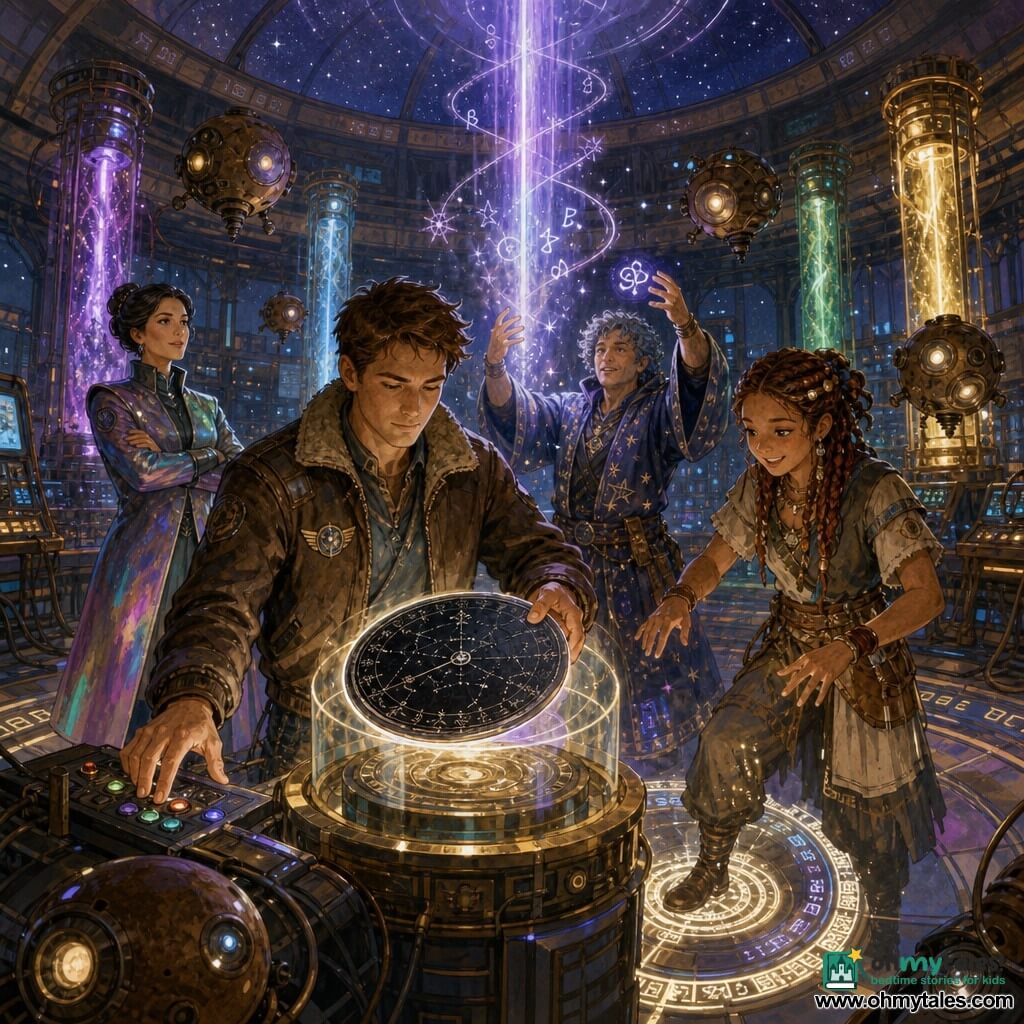
The Beacon Chamber was a vast round room with a transparent ceiling. Above it, stars hung like scattered salt. Ether beacons floated in a ring inside the chamber, each one tethered by ribbons of light to the floor's rune circles. The air smelled of ozone and peppermint.
At the center stood Overseer Maelin—tall, sharp-eyed, and wearing a coat that changed color depending on where you looked. Her hair was silver and braided so tightly it seemed to pull her thoughts into neat lines.
“Pilot Kestrel,” she said, wasting no words. “We have a situation.”
“Is it the sulking sock?” Lio asked, nodding toward Beacon Seven.
Sera made a choking sound that might have been laughter.
Overseer Maelin didn't smile, but her eyes flickered with something close to amusement. “If only. Three days ago, our ether alignment shifted by a fraction. Not enough to break jumps—yet. But enough to make the beacons… hear things.”
She gestured to the beacons. Their lights pulsed unevenly, like nervous hearts.
Lio closed his eyes and listened. The station's chord was there, steady. Beneath it, the thin bell-thread again—closer now, tapping against his mind.
“I hear it,” he said softly.
Maelin's shoulders loosened a little. “Good. Because none of our instruments can translate it. The beacons are tuned to known ether frequencies. Whatever this is, it's… older. Stranger.”
Sera stepped forward. “Or newer. Like a song nobody's learned yet.”
Maelin gave her a look that said, Please do not become poetic when lives are at stake. Sera pretended to dust an invisible speck off her sleeve.
Maelin continued. “We believe the relay is brushing against an artifact. Something powerful enough to bend ether currents. If that artifact fully wakes, it could twist our jump lanes, scatter ships, and turn this relay into a very expensive ornament.”
“And you want me to find it,” Lio guessed.
“We want you to listen for it,” Maelin corrected. “To pinpoint where the signal is coming from.”
Lio opened his eyes. “If it's an artifact, it might be hidden. Or protected.”
“Everything worth finding is,” Maelin said. She tapped a hologram into the air: a map of nearby space, dotted with glittering lanes and beacon nodes. One point shimmered like a bruise of violet light.
“That's the anomaly,” she said. “It appears between our beacon net and the old drift region known as the Singing Debris.”
Sera winced. “That place is full of abandoned satellites and haunted scrap.”
“Haunted by what?” Lio asked.
“By regret,” Sera said immediately, then shrugged. “Also by actual spectral drones. They get lonely.”
Maelin's gaze sharpened. “Pilot Kestrel, you will take a small team. Sera will accompany you—she knows the beacon language better than anyone here. And you'll take one of our relay wizards to keep the ether stable.”
A hatch opened on the far side of the room, and a man stepped in wearing star-patterned robes and a tool belt filled with crystals. He had a round face, kind eyes, and the cheerful expression of someone who absolutely would pet a dangerous creature because it looked soft.
“Hello!” he said. “I'm Brann. I do supportive magic, minor repairs, and excellent soup.”
Lio blinked. “Soup?”
“It's important,” Brann said seriously. “Adventures are hungry work.”
Maelin made a hand motion that meant, Please focus. “Your objective is to locate the source. If it is indeed an artifact, you will secure it and return. Do not attempt heroics.”
Lio lifted an eyebrow. “What if the artifact demands heroics?”
“Then negotiate,” Maelin said, as if negotiation with demanding artifacts was a normal Tuesday task.
Sera leaned toward Lio. “I bet it's the Stardial.”
Lio's head snapped toward her. “The Stardial is a myth.”
“Lots of myths are just history wearing a dramatic cloak,” Sera whispered back. “A relic that can tune the ether. They say it was forged when the first jump song was sung.”
Brann clasped his hands. “Oh! The Stardial! The one that can open doors between places and… moods.”
“Moods?” Lio repeated.
Brann nodded. “Ether responds to feeling. That's why angry pilots make bumpy jumps.”
Sera pointed at Lio. “So you're perfect. You're calm and you listen.”
Lio tried to look offended. “I can be dramatic.”
Sera smirked. “Sure. In a quiet way.”
Maelin's voice cut through them. “You leave within the hour. Pilot Kestrel—one more thing.”
Lio turned.
Maelin's expression softened just enough to surprise him. “Keep an open mind. The ether does not speak only one language. Neither should we.”
Lio nodded, and for a moment the chamber's hum seemed to agree.
As they walked out, the beacons' uneven pulse steadied—just slightly—as if relieved someone was finally answering.
Chapter 3: Through the Singing Debris
The Mothwing slipped away from the relay like a swallow leaving a nest. Behind them, the station's ring shrank into a bright coin against the dark. Ahead, the Singing Debris waited—a cloud of old metal and lost machines drifting in slow motion, catching starlight on their jagged edges.
Sera sat in the co-pilot seat, fastening her harness with practiced hands. Brann squeezed into the back, his robe sleeves stuffed into his belt so they wouldn't float into anything important.
On Lio's screens, the debris field looked like a mess. Through the cockpit glass, it looked like an art gallery shattered in space: broken solar sails fanning like pale leaves, antenna forests, and the curved bones of a forgotten cruiser.
And there was sound—no, not sound. A vibration in the ether. The debris field truly sang, each piece of metal humming with tiny static spells left behind by long-gone crews. Together they made a choir of leftover thoughts.
Brann leaned forward, eyes wide. “Listen to that! It's like the universe is clearing its throat.”
Sera pressed her palm against the dashboard. “Don't get distracted. These scraps have moods. Some of them hate being bumped.”
Lio guided the ship between two slow-spinning satellite husks. “I'll fly gentle,” he promised, and then whispered to the Mothwing, “We'll fly gentle.”
The ship's lights warmed, as if proud.
They followed the violet shimmer on the map. As they got closer, Lio's listening sense sharpened until it almost felt like taste—coppery, cold, and bright.
“Do you feel that?” Sera asked, rubbing her arms.
Brann nodded. “Like someone is watching with very polite eyes.”
Lio slowed the Mothwing. “It's right ahead.”
A broken ring of metal—maybe once part of a station—floated before them. Inside the ring, space looked wrong. Not darker, but deeper, as if someone had poured ink into the stars. A slow spiral of ether light turned there, not quite a portal, not quite a storm.
And in the center of that spiral hovered an object the size of a dinner plate.
It was a disk of dark crystal with a rim of silver markings. Tiny constellations moved across its surface like living tattoos. At its center, a star-shaped notch pulsed gently, as if breathing.
“The Stardial,” Sera whispered, almost reverent.
Brann made a soft “ooh” and then remembered to be quiet.
Lio's heart thumped. He had expected a trap, or a monster, or at least something that looked more… dangerous. But the disk looked calm. Patient. Like it had been waiting for someone who could hear it.
As the Mothwing approached, the Stardial's whisper rose in Lio's mind. Not words, exactly—more like meaning.
Come closer.
Lio's fingers tightened on the controls. “It's communicating.”
Sera swallowed. “Is it… safe?”
Brann raised a finger. “Define safe.”
The debris field shifted. A cluster of scrap drones—round, rusted machines with flickering eye-lights—stirred from behind an old sail. Their movements were jerky, like puppets with tangled strings.
Sera groaned. “Spectral drones. I told you. Lonely and cranky.”
The drones drifted toward the Stardial, forming a loose wall. Their eye-lights brightened, and the ether around them crackled. They weren't attacking yet, but they were clearly saying, Mine.
Brann's voice came out hopeful. “Maybe they want to play?”
One drone bumped another, and a spark snapped between them like a warning.
“Not play,” Sera said flatly. “Guard.”
Lio listened harder. The drones had a rough, buzzing tone, like broken instruments. Under that, he felt the Stardial's steady pulse—calm, but firm.
Not theirs.
Lio exhaled. “They're protecting it. Or trying to.”
Sera leaned forward. “Can you talk to them? With your listening thing?”
“I can try.” Lio opened the ship's comm channel, though he suspected words wouldn't matter. Still, people liked to be addressed. Even rusty spectral drones.
“Hey,” he said, keeping his voice gentle. “We're not here to steal. We're here because the relay is in danger. The ether beacons are getting twisted.”
The drones' lights flickered, as if puzzled. One of them spun slowly, showing a symbol painted on its side: a faded star with a line through it.
Brann squinted. “That's an old warning mark. It means ‘Do not wake.'”
Sera's face tightened. “They think taking the Stardial will wake it.”
Lio listened again. The Stardial's pulse brushed his mind like a cool hand.
Already awake.
The spiral of ether around it tightened, and the debris field's song wobbled—notes slipping out of tune.
Sera grabbed the side handle. “Okay, that's not good.”
The drones surged closer, and the spiral deepened into a whirlpool. Loose scrap began to drift toward it, as if pulled by an invisible tide.
Brann lifted both hands. Blue-white runes appeared around his fingers, forming a net of light. “I can stabilize the ether for a minute!”
Lio's mind raced. If the Stardial stayed here, half-buried in a growing ether whirl, it could tear a hole in the relay lanes. But if they grabbed it, the drones might fight, and the artifact might… do whatever artifacts did when annoyed.
Sera met Lio's eyes. “Open mind, remember? Maybe the drones aren't enemies. Maybe they're scared.”
Lio nodded slowly. He opened the cargo hatch controls. “I'm going to approach by hand—no tractor beam. Slow and respectful.”
Sera blinked. “In the middle of a magical whirlpool?”
Lio gave a crooked smile. “I said I could be dramatic.”
He eased the Mothwing forward, inch by inch, while Brann's rune-net shimmered around the ship like a bubble. The drones bumped the net and recoiled, buzzing angrily. One of them pressed close to the cockpit glass, its light-eye staring right at Lio.
Lio spoke softly, as if to an anxious animal. “We can help each other. We won't break what you're guarding.”
The drone's buzz softened by a fraction—less anger, more confusion.
Then the Stardial flared, and a clear tone rang through the ether.
Not a warning.
An invitation.
Chapter 4: The Stardial's Choice
The tone filled the cockpit like a chord struck on a giant harp. For a heartbeat, Lio saw—no, felt—a path in the ether: a thread leading from the debris field back to the relay, tangled and twisting like a knot in hair.
The Stardial pulsed again, and the knot loosened, as if the artifact was showing them the problem.
Sera whispered, “It's… teaching.”
Brann's rune-net trembled. Sweat beaded on his forehead. “Whatever it is, it's strong. My magic feels like a paper umbrella in a meteor shower.”
The drones buzzed in a tight circle, their lights flashing rapidly. They weren't attacking. They were arguing—with each other, with the Stardial, with the universe.
Lio keyed open the external hatch. A robotic arm unfolded from beneath the Mothwing like a careful insect leg, ending in a padded clamp.
He spoke aloud, though the Stardial seemed to prefer meaning over sound. “We need you. The relay needs you. But we'll return you. Or… we'll find you a safer place.”
The Stardial's surface constellations shifted. For an instant, the moving stars formed an image: the jump relay's ring, wrapped in a soft halo of ether light, stable and bright.
Sera's voice was hushed. “It wants the relay.”
“Or it wants to fix it,” Lio said.
One of the drones bumped the Stardial gently—almost like a nudge. The artifact did not flinch. It simply glowed, calm as moonlight.
Lio understood then: the drones weren't guards in the usual sense. They were caretakers left behind, doing their best with old programming and lonely years. They feared change, because change had once meant disaster.
Lio opened a comm line to the drones, then did something no pilot manual recommended: he stopped trying to control the situation and started trying to join it.
He let his listening sense expand. He “heard” the drones' buzzing as a language of impulses: Protect. Don't wake. Keep safe. Keep same.
He sent back a simple feeling through his voice and presence: Respect. Help. Together.
Sera watched him, eyes wide. “You're… negotiating with scrap.”
“Scrap with feelings,” Lio murmured. “Same as the rest of us.”
The closest drone's light dimmed slightly, as if thinking. Then it drifted aside, making a narrow opening.
Brann let out a breath he'd been holding. “Oh thank the stars. I was about to start offering soup.”
Lio smiled despite the tension. “Soup diplomacy is underrated.”
He guided the robotic arm forward through the opening. The Stardial hovered, waiting. The moment the padded clamp touched its rim, warmth flooded the ship—not heat, but a strange comfort, like standing near a fireplace on a cold day.
The ether whirlpool stuttered.
Then the Stardial's pulse synced with the Mothwing's engine hum, like two hearts learning the same rhythm.
Sera gasped. “It bonded to the ship!”
Brann's rune-net steadied, strengthened by the new harmony. The debris field's song smoothed into a gentler tune.
But the drones surged—not to attack, but to follow. They swarmed around the Mothwing like anxious birds.
Lio spoke quickly. “They're coming with us.”
Sera frowned. “To the relay? Maelin will have a fit.”
“Then she can have a fit in a stable jump lane,” Lio said, and pushed the controls.
The Mothwing pulled away from the ring of broken metal. Behind them, the ether spiral unwound, shrinking like a storm losing interest. The debris field stopped drifting inward and began to settle, as if relieved.
As they accelerated, the Stardial projected a faint star-map above the console—lines of light weaving between beacon points. One line blazed brighter than the rest, pointing straight to the relay's Beacon Chamber.
Brann leaned forward, awe shining in his eyes. “It's giving directions.”
Sera swallowed. “Or demands.”
Lio kept his voice steady. “Either way, we're listening.”
The jump to the relay was short, but it felt longer because the ether itself seemed to watch them. Lio guided the ship into the jump lane, and the Stardial's glow deepened.
Space folded.
For a moment, the universe became a page turning.
And then they were back—stars snapping into place, the relay ahead like a silver promise.
The drones poured out of the jump with them, wobbling but intact.
Sera stared at the rear sensors. “We just brought a haunted swarm home.”
Brann patted his belt. “Good. The relay could use more company.”
Lio couldn't help a laugh. “Let's hope Overseer Maelin agrees.”
Chapter 5: The Beacon Chamber Storm
Docking alarms greeted them the moment the Mothwing latched onto the relay. Yellow lights flashed along the corridor windows, and the station's hum had a sharp, stressed edge—like a violin string pulled too tight.
Overseer Maelin met them at the airlock with two security bots and a tired expression. Her gaze flicked from Lio to Sera to Brann, then past them to the swarm of drones hovering outside the docking bay like an awkward parade.
“You brought… that,” she said.
Sera raised both hands. “They followed us. Politely.”
Brann added, “They are emotionally complex.”
Maelin pinched the bridge of her nose. “Of course they are.”
Lio stepped forward, holding the Stardial carefully in a padded case. Even through the case, he felt its steady pulse, like a gentle drumbeat.
“The Stardial is the source,” he said. “It's awake, and it wants to tune the relay's ether. The drones are caretakers. They're scared we'll misuse it.”
Maelin's eyes narrowed. “Artifacts do not ‘want.' They are tools.”
The Stardial's pulse sharpened—just slightly. Not angry, but… offended.
Sera glanced at Maelin. “With respect, Overseer, you haven't met many artifacts, have you?”
Maelin's jaw tightened. “I have met enough trouble.”
A tremor ran through the floor. The chamber lights flickered. Somewhere deep in the station, a beacon gave a long, mournful groan.
Brann flinched. “That's Beacon Seven. It's really committing to the performance.”
Maelin's posture snapped into action. “Beacon Chamber. Now.”
They hurried through corridors as the relay's hum rose into a strained wail. Crew members clung to railings. Loose tools drifted in low gravity pockets, clinking like nervous teeth.
When the Beacon Chamber doors opened, the sight stole Lio's breath.
The ether beacons were misaligned. Their light-spires leaned as if pushed by invisible wind. Between them, the ether currents had become a tangled web, sparking violet—like the anomaly had reached out and grabbed the relay by the throat.
At the center of the chamber, the floor's rune circles flickered, struggling to hold.
Maelin's voice was sharp. “If we lose alignment, any ship attempting a jump could be scattered across star systems—or worse, fused with its own luggage.”
Sera grimaced. “Imagine explaining that to customs.”
Lio set the Stardial case on the central platform. “It can help.”
Maelin hesitated for the first time. Her eyes darted to the artifact, then to the beacons, then to the swarm of drones hovering at the chamber entrance like uncertain guests.
“Those drones cannot enter,” she said.
As if on cue, the drones buzzed loudly. Their lights flashed in patterns that made Lio's listening sense tingle.
They were saying: No harm. Let us.
Sera stepped closer to the drones. “They want to be part of it. They know the Stardial.”
Maelin's gaze hardened, but her voice softened by a hair. “And if they sabotage us?”
Lio met her eyes. “Then we will have been closed-minded at exactly the wrong moment.”
Silence, except for the relay's strained chord. Then Maelin exhaled—a long, controlled breath.
“Fine,” she said. “But I will personally eject anyone who causes chaos.”
Brann lifted a hand. “I will attempt to cause only constructive chaos.”
Maelin shot him a look that said, Don't.
Lio opened the case. The Stardial floated up on its own, rising into the air like a leaf caught by a gentle updraft. Its constellations spun faster, casting tiny star-shadows on the floor.
The drones drifted forward, spreading out around it in a wide ring. Their buzzing softened into a steady undertone—no longer argument, but harmony.
Sera stepped into the beacon circle, palms open. “Beacon language is mostly rhythm,” she said. “If we match the Stardial's rhythm to the beacons, we can retune the net.”
Brann moved beside her, runes blooming around his hands. “I'll stabilize the ether flow so it doesn't snap back like an angry rubber band.”
Lio took position at the relay's control console. His fingers hovered over the adjustment petals. “I'll listen for the right chord.”
Maelin stood back, arms crossed, eyes sharp—but she stayed. She didn't run. That, Lio realized, was its own kind of open-mindedness.
The Stardial pulsed.
The beacons answered with uneven light.
Lio closed his eyes and listened. He heard the relay's main chord, strained and high. He heard the beacons' individual notes, wobbling like nervous voices. He heard the drones' undertone, steady as a bass drum. And through it all, the Stardial's clear tone, patient and bright.
He began to adjust—tiny shifts, not forcing the beacons into place but coaxing them, like guiding a choir back to the melody.
Sera clapped a rhythm—tap, tap, pause, tap—matching the Stardial's pulse. The beacons flickered in time, as if remembering an old dance.
Brann's runes spiraled outward, forming a soft lattice that caught the sparking ether and calmed it, turning violent crackles into glittering threads.
Maelin watched, tense as a drawn bow.
Then the station shook again—harder. A surge of violet energy snapped through the web.
One beacon flared too bright, and the ether around it screamed.
Lio's eyes flew open. “It's resisting!”
Sera's voice rose. “Because it's scared! The relay is trying to hold its old alignment—like gripping a railing during turbulence!”
Brann shouted, “Everyone, breathe! Ether mirrors panic!”
Maelin, of all people, stepped forward. She placed her hand on the console beside Lio's and forced her voice into calm.
“Relay,” she said, speaking to the station as if it were a person. “We are not breaking you. We are helping you change without falling apart.”
The relay's hum wavered.
Lio felt it—an easing, like a clenched fist relaxing.
He adjusted again, gentler. The Stardial's tone softened. The drones' buzzing smoothed. The beacons straightened, one by one, their light-spires standing tall.
The tangled ether web unraveled into clean, shining lanes.
The violet bruise on the map faded.
And the relay's chord dropped into a deep, steady note that vibrated pleasantly in Lio's ribs.
For a heartbeat, the whole chamber glowed with quiet starlight.
Then the emergency lights shut off, as if embarrassed.
Sera let out a breathy laugh. “We did it.”
Brann slumped onto the floor, grinning. “Soup later. Definitely soup later.”
Maelin stared at the Stardial, which now hovered calmly above the platform, its constellations drifting like sleepy fireflies.
Her voice was quiet. “It listened to us.”
Lio corrected gently. “We listened to it.”
Maelin's expression changed—still serious, but less rigid, like a door unlatched. “Perhaps,” she admitted.
The drones circled the Stardial once, then settled along the chamber's edges, their lights dim and content.
Not haunting.
Belonging.
Chapter 6: A Shared Joy Among the Stars
By the time the relay returned to normal operations, the station felt lighter, as if someone had opened a window in a stuffy room.
In the common hall, crew and travelers gathered around long tables. Someone had rolled out lanterns filled with captured nebula-glow. Music drifted from a string-synth and a flute that sounded suspiciously enchanted. The air smelled like cinnamon, engine oil, and happiness.
Brann stood behind a huge steaming pot, ladling soup with the solemn pride of a royal chef. “Star-vegetable broth,” he announced. “With comet pepper! It might tingle. That means it's working.”
Sera took a bowl and sniffed. “If my tongue starts floating, I'm blaming you.”
“Fair,” Brann said.
Lio leaned against a pillar, watching the crowd. Even Overseer Maelin had accepted a small bowl, though she held it like it might file a complaint.
Near the ceiling, the spectral drones drifted in slow loops. Someone had tied little ribbons to a few of them, and the drones didn't seem to mind. One even flashed its light in time with the music, like a shy dancer.
Sera elbowed Lio. “Look. They're socializing.”
Lio smiled. “Turns out loneliness can look like hostility.”
Sera's expression softened. “And fear can look like rules.”
Across the hall, Maelin approached them. She didn't look entirely comfortable in the middle of a celebration, like a cat invited to a bath, but her voice was steady.
“Pilot Kestrel. Technician Sera. Wizard Brann.” She paused, then added, “Thank you.”
Sera raised her bowl in a small salute. “For what? The heroic chaos?”
Maelin's mouth twitched. Almost a smile. “For reminding me that control is not the same as safety.”
Brann nodded earnestly. “Sometimes safety is a group project.”
Maelin looked upward at the drones and the Stardial—now housed in a transparent containment sphere at the hall's far end, not locked away like a weapon, but displayed like a guest of honor. The sphere was etched with runes that said, in three languages: LISTEN FIRST.
“The Stardial will remain here,” Maelin said. “Not as property. As partnership. The drones will assist in maintaining its balance. And our beacon-tenders will learn their patterns.”
Sera's eyes widened. “You're going to let haunted scrap teach us?”
“I am going to let caretakers share what they know,” Maelin corrected. “There is a difference.”
Lio felt something warm in his chest that had nothing to do with soup. “That's… open-minded.”
Maelin studied him. “Do not make a habit of being right, Pilot. It encourages people.”
Sera laughed. “Too late.”
Music swelled. Someone invited Maelin to join a dance line that wound between tables like a playful comet tail. She hesitated. The line passed again, and this time she stepped in—stiff at first, then slightly less stiff, like a statue remembering it had knees.
Brann clapped along, soup ladle held like a baton.
Sera spun once, nearly tripping, and caught herself by grabbing Lio's sleeve. “Come on,” she said. “If the ether can change its tune, you can dance.”
“I am an advanced pilot,” Lio said. “I do not—”
Sera raised an eyebrow.
Lio sighed in defeat. “Fine. But if I crash, I'm blaming the music.”
He joined the line. The steps were simple—left, right, hop, turn—and the laughter around him felt like another kind of starlight.
Above them, the relay's hum stayed deep and steady. The beacons' light, visible through the hall's wide window, pulsed in perfect rhythm—no longer strained, but singing.
In the containment sphere, the Stardial's constellations drifted into a new pattern, one Lio hadn't seen before: not a map, not a warning, but a circle of tiny stars linked like hands.
Lio looked up and listened.
The whisper was gone.
In its place was a quiet, satisfied chord—shared between artifact, drones, relay, and the people who lived among them.
A tune that said, clearly as any words:
Together.