Chapter 1: A Spare Sandwich
Milo the otter liked being useful. He liked it the way other kids liked shiny stickers or fast scooters. Useful felt warm, like sun on wet fur.
On Monday morning, Milo packed his lunch at the kitchen table. His mother slid a jar of berry jam toward him.
“Two sandwiches?” she asked, whiskers twitching.
Milo nodded. “Just in case. Someone always forgets something.”
He wrapped both neatly. One peanut-butter-and-jam, one cheese-and-cucumber. He added an apple and a small bag of crunchy river chips.
At school, the hallway buzzed with paws and claws and wings. Lockers clanged. Someone laughed too loud. Milo hopped up to his classroom door, balancing his backpack like a little boulder.
Inside, Ms. Juniper, their fox teacher, clapped her paws. “Settle in, everyone.”
Milo sat beside his friend Tessa the squirrel, who was already sharpening a pencil like it was a tiny spear.
Across the room, a new student slipped into a chair—Nia the raccoon. Her mask-markings made her look as if she was always thinking hard, even when she wasn't. She kept her eyes down, and her backpack looked strangely flat, like it held mostly air.
When lunchtime came, Milo noticed Nia didn't open a lunchbox. She took out a single water bottle and held it like a shield.
Maybe she already ate, Milo told himself. Or maybe she wasn't hungry.
But her stomach made a small, honest sound. Like a frog croaking in the wrong place.
Milo hesitated. He didn't want to embarrass her. He also didn't want to pretend he hadn't heard.
He slid his spare sandwich out of his bag and nudged it across the table.
“Hey,” he said softly, “I packed an extra by accident. Want it?”
Nia's ears flicked. “By accident?”
Milo tried to sound casual. “My paws are terrible at counting. Two sandwiches always sneak in.”
Tessa raised an eyebrow but said nothing.
Nia stared at the wrapped sandwich as if it might bite. Then she reached, quick as a shadow, and tucked it into her paws.
“Thanks,” she murmured.
Milo smiled. “No problem.”
But as she ate, carefully, taking tiny bites like she was saving each one, Milo felt a strange heaviness. It wasn't guilt exactly. It was the feeling that a small, hidden door had opened, and behind it was a room he didn't understand yet.
Chapter 2: The Cracked Porch
After school, Milo walked home along the canal path. The water moved steadily beside him, carrying leaves and bits of reed. He liked the sound of it. It reminded him that things could keep going, even when they bumped into rocks.
Halfway home, he spotted Nia ahead, turning off the main path.
She didn't head toward the bright row of burrows and tree-houses where most of their classmates lived. She went toward the edge of town, where the boardwalk boards were uneven and the streetlamps were fewer.
Milo slowed. It wasn't that he wanted to spy. He just… wondered.
Nia stopped at a small building tucked behind a leaning fence. The porch steps were cracked, like someone had tried to glue them and gave up. A tarp was tied over part of the roof with rope.
Nia glanced around, then hurried inside.
Milo's paws froze on the path.
His home had a sturdy door and warm lights and a pantry that always had something extra. This place looked like it was holding its breath.
A voice in Milo's head said, Don't stare. Another voice said, Don't ignore.
He walked a little closer, not all the way up the porch. Just close enough to see a wind chime made from bottle caps clinking softly.
“Nia?” he called.
The door creaked open. Nia peered out, eyes wide.
“Milo? What are you doing here?”
Milo swallowed. “I—I live that way. I saw you turn. I wanted to… return your water bottle. You left it under the bench.”
That was not true. But it was gentle, and it gave Nia a way to answer without feeling cornered.
Nia blinked, then her shoulders loosened a little. “Oh. Okay.”
Milo held up his own bottle as if it could magically become hers.
Nia snorted, a tiny laugh. “That's not mine.”
Milo's cheeks warmed under his fur. “Right. Sorry. My brain is… soggy.”
Nia's mouth twitched. “Soggy otter brain.”
“Exactly,” Milo said, relieved she was joking.
A smaller raccoon—maybe a little brother—peeked from behind Nia's legs. His fur was fluffier, his eyes even bigger.
“Nia, who is it?” came a tired voice from inside.
“My classmate,” Nia said. “Milo.”
A pause. “Hello, Milo,” the voice called, polite but careful.
Milo nodded even though no one could see him nod through the doorway. “Hi.”
He didn't ask to come in. He didn't want to push. Still, as he walked away, his mind kept circling the tarp, the cracked steps, the flat backpack.
Some animals had less. Not just less candy or fewer toys. Less safety. Less space. Less… ease.
Milo's useful feeling returned, but this time it was tangled with questions.
Chapter 3: The Pencil That Wouldn't Last
On Wednesday, Ms. Juniper announced a group project. “You'll build a model of a town,” she said. “A town that works for everyone. Roads, homes, a library, a clinic, a market—think carefully.”
Milo loved projects. Projects were puzzles you could solve with glue.
He ended up in a group with Tessa, Nia, and Bruno the badger. Bruno cracked his knuckles like he was about to wrestle the cardboard.
They spread their supplies on the floor: colored paper, tape, markers, craft sticks.
Nia placed a small, worn pencil on the mat. The eraser was almost gone, the metal band rusty.
Bruno pulled out a new box of markers. “We should use these. They're better.”
Nia's paws tightened around her pencil. “I'm fine.”
Tessa noticed. She leaned close to Milo and whispered, “That pencil has been to war.”
Milo whispered back, “Shh.”
When they started drawing houses, Nia kept pressing too hard, trying to make the pencil last longer by making the lines darker. The tip snapped.
It was a small sound. Not dramatic. Just a tiny crack.
But Nia's face went still, like a pond in winter.
Bruno shrugged. “Just sharpen it.”
“I can't,” Nia said. “I don't have a sharpener.”
Bruno frowned. “Doesn't everyone have a sharpener?”
Nia looked at the floor. “No.”
The word landed quietly. It didn't accuse anyone. It didn't beg. It just told the truth.
Milo rummaged in his backpack. He found his little metal sharpener, the one shaped like a fish.
He held it out without a big gesture. “Here. You can keep it. I have another at home.”
That part was true. Milo did have another. He just hadn't thought about it much.
Nia hesitated again. Milo could tell she didn't like needing things. She wanted to stand on her own paws.
“It's not a gift,” Milo added quickly. “It's a trade. You sharpen your pencil and… you help me make the library roof not look like a squashed turtle.”
Tessa snorted. “It does look like that.”
Nia's shoulders eased. She took the sharpener. “Deal.”
As she twisted the pencil, shavings curled out like little cinnamon rolls. She didn't waste a speck.
While they worked, Milo watched the way Nia reused tape by sticking it to her fur, then peeling it off again. The way she chose the smallest pieces of colored paper and fitted them perfectly, like a puzzle master. She was careful, not because she was slow, but because she was skilled.
Dignity, Milo realized, could look like quiet smart choices.
At the end of class, Ms. Juniper walked by and nodded at their model. “Nice teamwork. I can see thoughtfulness here.”
Nia's eyes flicked up. For a moment, she looked proud.
Milo felt proud too—of her, and of the fact that he hadn't made a show of helping. Help didn't have to be loud.
Chapter 4: Truth, Like a Clean Window
That afternoon, Milo found Nia by the bike racks—well, the paw-powered scooter racks. She was tightening a strap on her backpack with a piece of string.
“Hey,” Milo said. “Do you want to walk home together?”
Nia's first instinct was to say no. Milo could see it in the way her tail stiffened. Then she exhaled.
“Okay,” she said. “But I'm slow.”
“I'm an otter,” Milo said. “We're slow on land. It's a fact.”
They walked along the canal. Leaves scraped across the path.
After a while, Milo said, “If I ask something, you can tell me to mind my own whiskers.”
Nia glanced at him. “That's a funny way to say it.”
“I'm practicing honesty,” Milo said. “My question is… are things hard at home?”
Nia's steps faltered. She stared at the water, where a stick spun in a small whirlpool.
“Hard,” she repeated. “Yeah. Kind of.”
Milo waited. He didn't fill the silence with guesses.
Nia's voice came out thin but steady. “We moved. My mom lost her job at the bakery. My dad is looking for work, but he's sick a lot. We live with my uncle sometimes, but his place is crowded. So… we're here for now.”
Milo tried to picture it: moving, not by choice, with your life in boxes that never quite unpacked.
Nia continued, faster now, like she had started and couldn't stop. “Sometimes we have enough food. Sometimes we don't. I don't tell people because they treat you like you're broken. I'm not broken.”
“I know,” Milo said immediately. “You're not.”
Nia's eyes were shiny, but she blinked the wetness away. “And I don't want pity. Pity feels like someone looking down at you. I just… want things to be normal.”
Milo nodded slowly. “Okay. No pity. Just… real.”
Nia let out a breath, as if she'd been holding it for days. “Real is good.”
They walked a little more.
Milo said, “Thanks for telling me. I won't tell anyone else unless you want me to. Sincere promise.”
Nia studied him. “You mean it.”
“I mean it,” Milo said.
The canal reflected the sky like a clean window. Milo realized something simple and important: honesty wasn't just saying true words. It was keeping someone's trust safe.
Chapter 5: A Plan That Doesn't Point Fingers
On Friday, Ms. Juniper announced a “Share Fair” for the next week. “Bring something you no longer need,” she said. “Books, supplies, games. We'll set up tables. Take what you need. Leave what you can. No names, no scores.”
Bruno raised a paw. “Like trading?”
“Like sharing,” Ms. Juniper said. “Some of us have extra. Some of us don't. All of us can be kind.”
Milo's heart thumped. This could help Nia. But only if it didn't make her feel exposed.
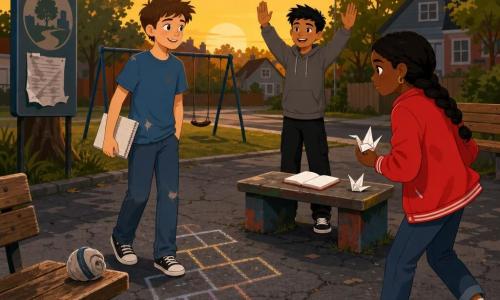
At recess, Milo gathered Tessa and Bruno by the hopscotch squares.
“I have an idea,” Milo said. “For the Share Fair. Let's make it normal to take things. Like, everyone takes something, even if they don't need it. Then no one sticks out.”
Bruno scratched his head. “But that's… weird.”
Tessa's eyes lit up. “Not weird. Brilliant. We can call it ‘Take-One-To-Try.' Like you're trying a new pen or a new book.”
Milo nodded quickly. “Exactly. And we can add a ‘fix-it corner.' If someone has a broken zipper or a wobbly wheel, we help fix it.”
Bruno grinned. “I can fix wobbly wheels.”
“And I can organize,” Tessa said, already making a list on her paw with an imaginary pencil.
Milo swallowed, then said the harder part. “Also… we shouldn't talk about who needs what. No whispering.”
Bruno's grin faded a little. “Yeah. That's fair.”
Later, Milo approached Ms. Juniper after class.
“Can we add the fix-it corner?” he asked. “And maybe signs that say, ‘Everyone is welcome to take something'?”
Ms. Juniper's tail swished thoughtfully. “I like that. It keeps things dignified. Thank you for thinking it through.”
Milo walked home feeling hopeful—and nervous. He wanted to help, but he didn't want to accidentally hurt.
When he passed the leaning fence near Nia's place, he didn't stop. He didn't want to make her feel watched. Instead, he made a quiet promise to himself: Help should feel like a hand offered, not a spotlight.
Chapter 6: The Share Fair
The gym smelled like floor polish and paper. Tables lined the walls, covered with piles: notebooks, jackets, lunchboxes, storybooks, art supplies, even a soccer ball with only a little scuffing.
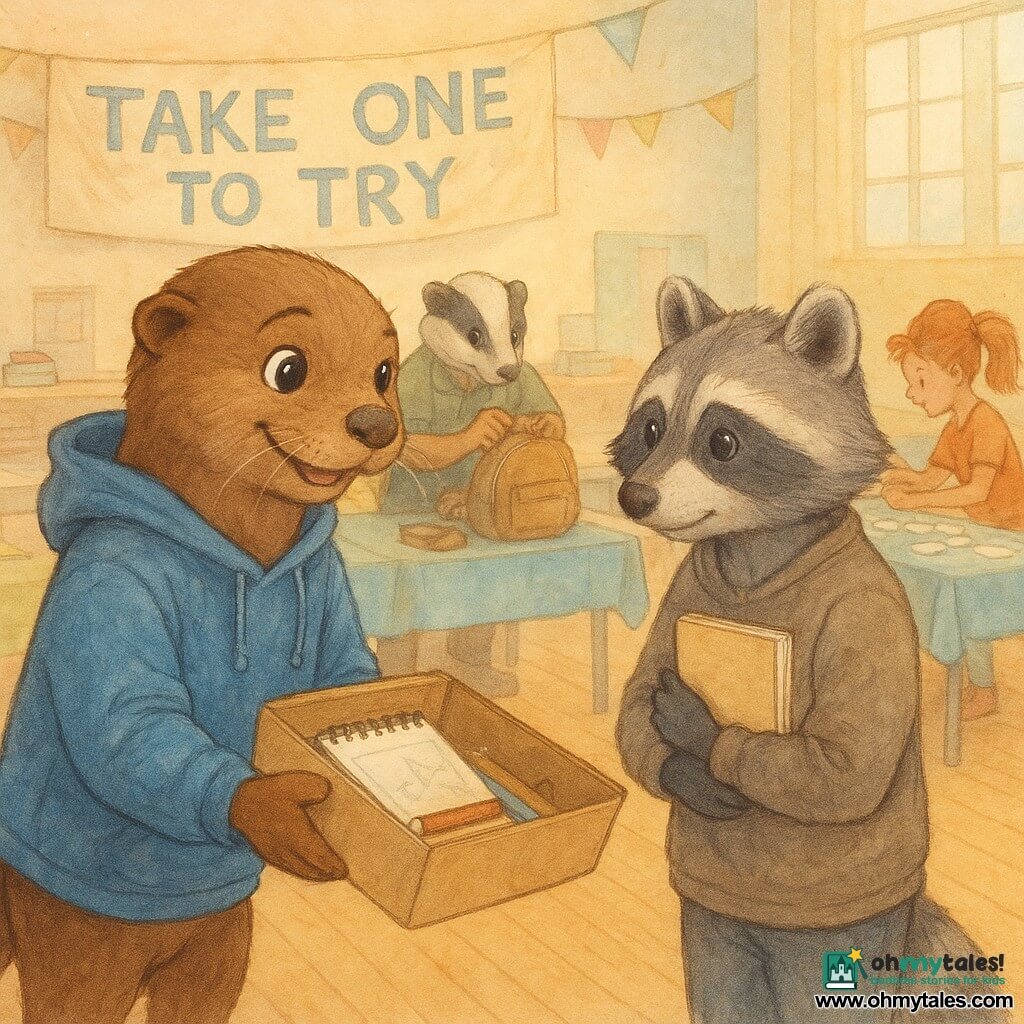
A sign in big letters said: TAKE ONE TO TRY. TRY ONE TO TAKE. EVERYONE WELCOME.
At the “fix-it corner,” Bruno set out tools: a tiny screwdriver, tape, spare buttons, and a small bottle of glue. Tessa labeled everything with neat handwriting.
Milo carried a box from home: two hoodies he'd outgrown, a set of colored pencils, and a backpack that still had strong straps.
He placed them quietly, then walked away. No announcement. No heroic pose.
Students swirled around, chatting.
“Look, a mystery novel!” chirped a rabbit.
“I'm taking this pencil case to try,” said a frog, winking like it was a joke.
It worked. Animals took things openly. Some took because they needed them. Some took because it was fun. The air felt light.
Milo spotted Nia near the book table. She stood with her paws behind her back, pretending to browse without reaching.
Milo didn't go up and push something into her paws. He stayed a few steps away and picked up a book too.
“Ooh,” Milo said loudly enough to be heard, “this one has maps.”
Nia glanced at him. Her eyes softened a little.
Tessa bounced over. “Nia, you like drawing, right? There are sketchpads over there. Take one to try.”
Nia hesitated, then walked to the supply table. She picked up a sketchpad and ran her thumb along the clean pages. For a second, she looked like she might put it back.
Then she lifted her chin.
“I'll try it,” she said.
“Good choice,” Milo said, simply.
At the fix-it corner, Nia brought her backpack. “The zipper sticks,” she said to Bruno.
Bruno leaned in. “I can handle sticky zippers. That's my specialty.”
As he worked, Nia watched carefully, learning. Milo realized she wasn't only receiving help. She was collecting skills, like tools in a pocket.
Later, Ms. Juniper gathered them for a quick circle.
“I'm proud,” she said. “Not because of the stuff on the tables, but because of the respect in this room. That's what makes a community.”
Milo looked around. No one was teased. No one was singled out. Everyone looked… normal. Different, yes. But equally included.
Nia caught Milo's eye and nodded once, small and sincere.
It felt like a thank you, but also like something else: a shared secret that honesty could bring people closer, not tear them apart.
Chapter 7: River Lights
A week later, Milo and Nia sat on the canal bank after school, kicking pebbles into the water. The sky was pale gold. Streetlamps clicked on one by one, like fireflies that had learned to behave.
Nia held the sketchpad from the fair. She had drawn their model town again, but improved: smoother roads, a bigger library, more trees. She had added a sign over the market that read: “PAY WHAT YOU CAN.”
Milo pointed. “That's smart.”
Nia shrugged, but her mouth curved. “It's realistic. Sometimes you can't pay much. Sometimes you can. But you still need bread.”
Milo nodded. “And sometimes you can help in other ways.”
“Like fixing zippers,” Nia said, and they both laughed.
A comfortable silence settled. Not empty. Just calm.
Finally, Nia said, “I used to think if people knew, they'd look at me differently.”
Milo skipped a pebble. It hopped twice, then sank. “Some might,” he admitted. “But the good ones will just… adjust. Like, they'll make room. Without making it weird.”
Nia's paws tightened around her sketchpad. “Thanks for being sincere. Not pretending you didn't notice, but also not acting like I'm a sad story.”
Milo felt heat in his chest again, the good useful kind. “You're my classmate,” he said. “And you're good at a lot of things. Also, you called my brain soggy. That's basically friendship.”
Nia chuckled. “Your brain is still soggy.”
“True,” Milo said. “But it's learning.”
They watched the canal carry the light away, shimmering. Milo understood, in a simple, steady way, that poverty wasn't a character flaw. It was a situation—sometimes sudden, sometimes long—and it could happen to families who worked hard and tried their best.
He also understood something else: help could be practical, private, and respectful. A spare sandwich. A sharpener. A fair where everyone could take something. A promise kept.
As they stood to leave, Nia said, almost casually, “If you ever need something, you can ask me too.”
Milo smiled. “Deal.”
They walked toward town together, their footsteps matching, the streetlamps lighting the path—not as a spotlight, but as a guide.