Chapter 1: Roof-Gardens and Skywalks
In the year 2147, the city of Lumen had learned a neat trick: it grew upward without feeling crowded. Every roof was a garden. Every wall held a strip of green. Between towers, slim skywalks stretched like ribbons, and below them, the streets hummed with quiet delivery drones and buses that purred instead of roared.
Mina loved the skywalks most. Up there, the wind smelled like mint and warm soil, and you could see the whole city shining—glass, solar tiles, and the soft glow of screen-signs that changed colors when the weather did.
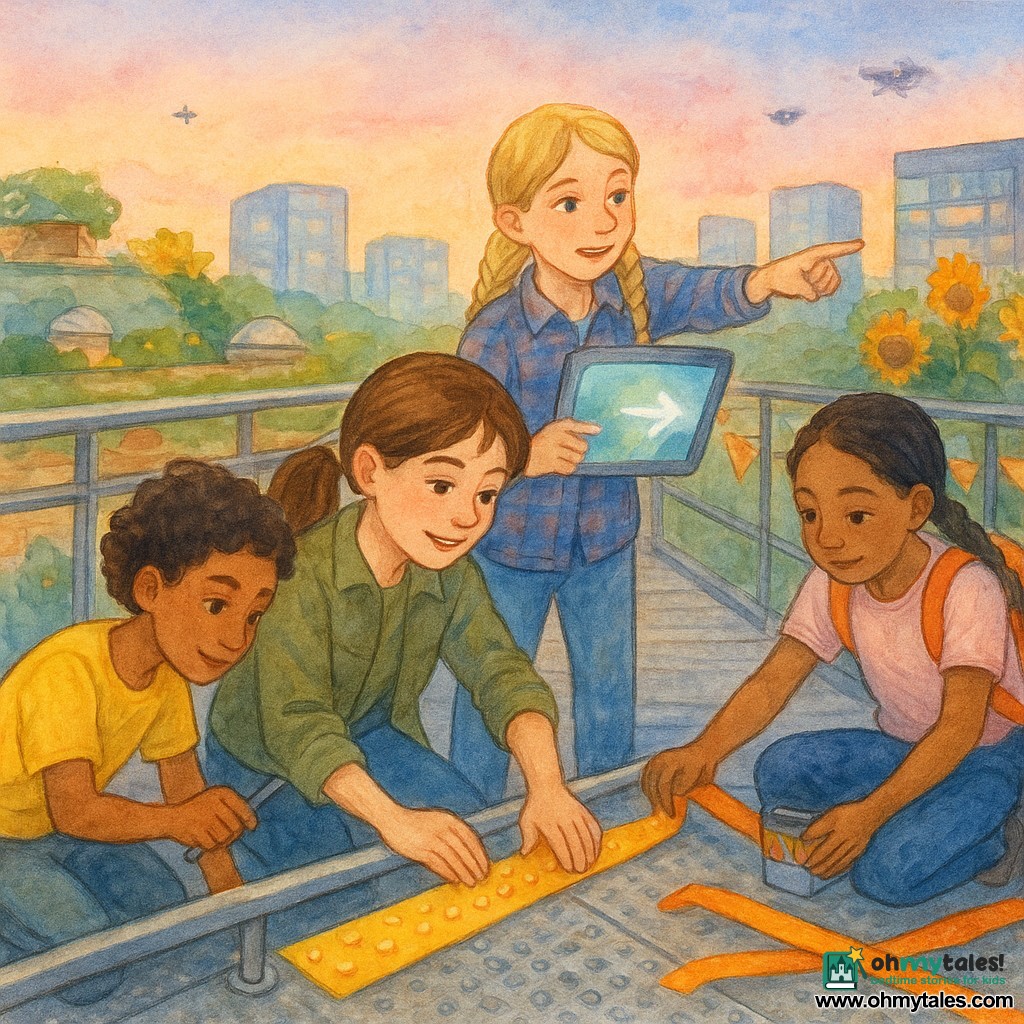
Mina wasn't alone. Her team of four was walking in a loose line, their sneakers tapping the metal-plank walkway.
There was Jada, who could fix almost anything with a paperclip and a grin.
There was Solène, who noticed patterns the way other people noticed puddles.
There was Inez, who carried a small backpack full of useful things—snacks, bandages, and a roll of bright orange tape.
And Mina, who carried something else: a small pouch of tactile markers—little bumps and strips that you could stick onto railings and walls so your fingers could “read” the path.
They were a curiosity club, even if no one had officially made them a badge. Their neighborhood block had an open workshop on the first floor, like every block in Lumen: doors rolled up, tools hanging in tidy lines, tables ready for anyone to make, mend, or invent.
Today they had a mission. Not a secret mission. Not a dangerous mission. A mission that sounded small until you really thought about it.
The city had just added a new set of skywalks to connect the north gardens to the river towers. It was beautiful, and it was also confusing. The paths curved and split and rejoined like a maze drawn by someone who loved swirls.
Last week, Mina had watched an older neighbor named Mrs. Kwon stop at a junction and frown. Mrs. Kwon tapped her cane gently against the floor, then turned the wrong way and ended up at a dead-end garden with only a compost bin and a very offended pigeon.
Mina had helped her back, but the moment stayed in Mina's mind like a pebble in a shoe.
So now Mina held up her pouch and said, “We place tactile markers at every confusing spot. Simple. Friendly. Finger-readable.”
Jada squinted at the map on her wrist-screen. “There are… twelve confusing spots.”
Solène corrected her softly. “Fourteen. Because the two ‘almost confusing' spots will become ‘very confusing' when it rains.”
Inez pulled out the orange tape like it was a superhero cape. “We can use tape for temporary markers, and Mina's bumps for the important ones.”
They started walking, the city stretching around them—rooftops crowded with tomatoes and basil, little bee-domes that protected pollinators, and water collectors shaped like silver leaves.
At the first split in the skywalk, Mina knelt and pressed a strip of textured dots along the right-hand railing: three bumps, then one long ridge. Their code. Three bumps meant “junction.” The long ridge meant “turn toward river.”
She ran her fingers over it once to be sure. The bumps felt like tiny moons.
“Perfect,” Mina said. “Now anybody can know where the river is, even without looking.”
A gentle chime sounded from above. A maintenance drone drifted by, its camera-lens blinking. It paused, as if watching them.
Jada waved. “Hi. We're improving your city.”
The drone didn't wave back. It just floated on, quiet as a thought.
They continued, placing markers at each twist and fork. Mina liked the rhythm: walk, notice, decide, stick, press, test. Like making the city kinder one bump at a time.
Then, at the fourth junction, the skywalk lights flickered.
Not out. Just… unsure. Like they were trying to remember if they were supposed to be bright or dim.
Solène stopped. “That's new.”
The air felt the same, but the city's glow changed, as if someone had turned the brightness down a notch. Far away, a tower sign sputtered, then steadied.
Inez hugged her backpack closer. “Is the city… blinking?”
Mina's fingers tightened on the railing. “Maybe it's just one section.”
But the flicker traveled, hopping along the skywalk like a line of falling dominoes—light, dark, light.
And then every screen-sign around them flashed one message, in plain letters:
WAYFINDING NETWORK: OFFLINE.
The message vanished. The lights steadied. The garden smells returned like nothing had happened.
But Mina knew that when a city as smart as Lumen blinked, it wasn't just sleepy.
It was trying to tell them something.
Chapter 2: The Block of Open Workshops
They hurried back to their home block, not running—running was for panics and spilled soup—but walking fast enough that their ponytails bounced and their backpacks thumped.
Inside the open workshop, the air was warm with the smell of solder and lemon cleaner. People were working at long tables: a teenager repairing a hovering scooter, a grandmother weaving flexible screen-fabric into a curtain, a man printing replacement buttons for his jacket.
Above the main table, a community display showed the neighborhood map. Usually, it was sprinkled with friendly icons: elevators working, skywalk open, garden event, music practice in rooftop pod.
Today, chunks of the map were gray.
Mina leaned close. The gray patches crawled along the skywalk routes like spilled ink.
Jada whistled. “Okay. That is not normal.”
A workshop volunteer named Tarek looked up from sorting tiny screws. His eyebrows lifted. “You girls see the wayfinding network alert?”
Solène nodded. “And the lights flickered on Skywalk Seven.”
Tarek set the screws down carefully, like they were sleeping. “Wayfinding helps people and delivery bots find the safest, fastest routes. If it's offline, the city still works, but… it gets messy.”
“Like when you drop noodles,” Inez said. “You can still eat, but it's everywhere.”
Tarek laughed once, but it sounded worried. “Exactly. The central system is probably rebooting, but sometimes it needs help. There's a local relay node on the roof—think of it like a little brain that talks to the big brain.”
Mina's curiosity sparked bright and hot. “Can we check it?”
Tarek hesitated. He looked at their faces—their hopeful, stubborn, ready-for-a-problem faces. In Lumen, kids weren't treated like glass. They were treated like learners.
“Go,” he said. “But take a safety tether, and don't touch anything live.”
Inez already had the tether clipped to her backpack. Of course she did.
They climbed the stairwell to the roof-garden. Up there, the plants grew in neat beds between solar tiles. A small wind turbine turned lazily, like it was bored.
Near the far edge, a metal cabinet stood with a glowing panel. The RELAY NODE. It usually blinked green, steady as a heartbeat.
Today it blinked yellow—fast-fast-slow, like it couldn't decide.
Mina reached out but didn't open it. She traced the cabinet seam with her fingers. “It's like it's… confused.”
Solène crouched to look at the cables running into the cabinet. “A cable might be loose.”
Jada pulled a small tool from her pocket—because Jada always had a small tool. She checked the outer connections. “Everything looks tight.”
The panel suddenly displayed a new line of text, and it made Mina's stomach dip:
LOCAL ROUTE DATA: MISMATCH.
Inez tilted her head. “Mismatch like… wrong?”
“Mismatch like two people giving directions and disagreeing,” Solène said.
Mina thought of Mrs. Kwon and the pigeon. She thought of the flicker traveling down the skywalk.
“Maybe the city's map updated,” Mina said, “but this node didn't get the update.”
Jada tapped the cabinet gently, like you might tap a sleepy friend. “So we tell it the right map.”
Solène pointed to a small port on the side. “There's a manual input slot.”
Tarek had said don't touch anything live. But manual input wasn't the same as poking random wires. It was the city's way of saying, If you know what you're doing, help me.
Mina looked at her friends. They looked back. Four faces, one decision.
“We don't have to fix the whole city,” Mina said. “Just our routes. Just enough to keep people from getting lost.”
Inez unzipped her backpack and pulled out a palm-sized data tile—one of the reusable kind the workshop used for sharing designs. “I borrowed this yesterday for a project. I can erase it later.”
Jada grinned. “We make a mini-map.”
Solène's eyes narrowed the way they did when she was building something in her mind. “But it needs to be accessible. Not just visual.”
Mina's pouch felt heavier in her pocket, in a good way. “We can pair it with our tactile markers. The node can broadcast basic directions, and the markers can guide fingers at the tricky spots.”
They weren't just fixing a system. They were layering help on top of help, like warm blankets.
Mina slid the data tile into the slot. The panel asked for an input sequence. The city didn't want a lot. It wanted something clear.
So they gave it clear.
They spent the next hour building a neighborhood route set: from the river towers to the north gardens, from the market to the clinic, from the transit hub to the workshop blocks. Solène checked for patterns and missing links. Jada double-checked the entry steps. Inez made sure they included safe, low-traffic paths. Mina added tactile-route notes to match their marker code.
When they were done, Mina pressed “SEND.”
The cabinet blinked yellow.
Then green.
Then yellow again.
Mina held her breath.
The panel displayed one more line:
LOCAL ROUTE DATA: ACCEPTED.
SYNC: PARTIAL.
“Partial?” Jada repeated. “That's not as satisfying as ‘Complete and Amazing.'”
Inez pointed at the city beyond the roof edge. Down in the air, delivery drones were beginning to circle at intersections, unsure. A couple of people stood at the base of a sky-bridge looking up, as if expecting the walkway to answer their questions.
Mina's curiosity didn't fade. It sharpened.
“If the sync is partial,” Mina said, “then something is blocking the full update.”
Solène glanced toward the river towers, where the tallest buildings pinched the clouds. “Like a missing link between districts.”
Jada's grin returned, brighter. “So we become the link.”
Chapter 3: The Long Walk Over the City
They clipped on the safety tether and set out across the skywalks again. The city felt a little different now, like a song with one instrument missing. Still music. Just… thinner.
At each major junction, Mina placed tactile markers—bumps and ridges, dots and stripes. She chose spots where hands naturally landed: the right railing by a turn, the post by an elevator door, the wall panel beside a bench.
Sometimes people watched them. A man with a grocery crate stopped and ran his finger over a new ridge. His shoulders loosened.
“Oh,” he said, quiet like he didn't want to bother the air. “River this way.”
He walked on, quicker, happier.
That was the best kind of thank-you. The kind that happened inside someone, and you could see it.
They reached Skywalk Nine, the one that connected to the river towers, and found the problem.
A section of the walkway had slid a few inches off alignment. Not enough to fall—Lumen built its bridges with safety locks and backup locks and backup-backup locks. But enough to stop the clean data link that ran through the handrail.
A maintenance panel on the side blinked red: CONNECTION INTERRUPTED.
Jada crouched and looked under the railing. “The fiber strip is bent.”
Solène ran her fingers along the joint without touching the live parts. “It's like a kink in a garden hose. The signal can't flow.”
Inez scanned the area. “Do we call city maintenance?”
Mina thought of the gray patches on the map. Maintenance would already be busy. People would be waiting. Routes would tangle like noodles.
“We can do a simple fix,” Mina said. “Realign the rail joint. If it's designed for quick repair, it should have a manual latch.”
Jada found it: a recessed handle with a symbol—two lines meeting. She tried it, but it wouldn't budge.
“It's locked,” she said.
Inez dug into her backpack and produced a small, sturdy clamp and a wedge. “For when doors swell in humidity,” she explained, like that was a thing everyone carried around.
Solène looked at the latch again. “It's not locked. It's… stuck from grit.”
They could see it now—a smear of fine soil and leaf bits packed into the seam. Rooftop gardens were wonderful, but the wind liked to share them.
Mina laughed, a little. “The city is being defeated by… dirt.”
Jada's eyes twinkled. “We can handle dirt.”
They didn't do anything dramatic. No sparks. No big hero music. They did what workshops taught everyone to do: clean, align, test.
Inez used a brush from her kit and a tiny spray bottle of water. Solène held a small catch tray so the dirty water wouldn't drip onto people below. Jada worked the latch gently, back and forth, until it moved.
Mina counted under her breath, because counting made hard things feel possible. “One… two… three…”
The latch clicked open.
Together, they pressed the rail joint back into place until the lines matched perfectly. Jada closed the latch. It clicked again, satisfied.
The red light turned yellow.
Then green.
A soft pulse ran along the handrail, like the city had taken a deep breath.
On Mina's wrist-screen, a message appeared:
WAYFINDING NETWORK: RESTORING.
Far below, one of the gray patches on the neighborhood map brightened. Then another. Like lights waking up in windows.
Solène's smile was small but real. “We reconnected the link.”
Jada wiped her hands on her shorts. “We should get a reward. Like a free cookie every time we save a city.”
Inez shook her head solemnly. “A cookie economy would collapse society.”
Mina giggled, and the tension she hadn't admitted she was carrying slid off her shoulders.
But they weren't done yet. Restoring the network didn't automatically restore confidence. People still needed to feel safe moving through the changed paths.
And Mina knew exactly what could do that.
Not a screen message.
Not a drone announcement.
Something you could touch.
“We keep placing markers,” Mina said. “All the way through the river district. Make it a trail that anyone can follow, even if the network blinks again.”
They walked on, the river breeze cooler now, and the towers ahead reflected sunlight in long, bright stripes. Along the railings, Mina left their tactile code like friendly footprints.
Three bumps. Long ridge. Safety in your fingertips.
Chapter 4: The Festival That Almost Fell Apart
By late afternoon, the river district was buzzing. That evening was the Floating Lantern Festival—one of Lumen's favorite traditions. People made lanterns in the open workshops, then carried them to the river deck where they glided on the water like tiny stars.
Usually, the wayfinding signs guided everyone to the right decks and ramps. Usually, vendors rolled their carts to the correct platforms without thinking about it.
Today, the city was half-fixed and still shaky in places. The network came back in waves, and each time it hesitated, a new knot of confusion formed.
A group of parents stood near an elevator pod, staring at three different arrows on a screen-sign that kept changing its mind. A delivery bot rolled in circles, politely, like it was practicing for a dance show.
Mina saw the worry beginning—the kind that spreads quietly, not loud like thunder but steady like drizzle.
If people got frustrated, they might go home. If the festival thinned out, the district would feel separate again, each neighborhood tucked into itself like a turtle.
“A city is a lot like a friendship,” Mina said softly. “It works best when everyone can reach everyone.”
Solène nodded. “And when people don't feel silly for needing help.”
So they did the simplest, most powerful thing they could do.
They became guides.
Not with big speeches. With small actions.
Mina placed tactile markers at the elevator posts and along the ramp rails, matching the safest route to the lantern deck. Inez used orange tape to make bright temporary lines on the ground—easy to follow, easy to remove later. Jada borrowed a chalk marker from a workshop cart and drew friendly symbols: a little lantern, a little river wave, a little arrow that looked like it was smiling.
Solène stood at the busiest junction and watched the flow of people, noticing where they hesitated. Each time she saw a pause, she pointed Mina to another spot that needed a tactile cue.
A small boy approached the railing and ran his fingers over Mina's bumps. His eyes widened.
“It's like braille,” he said, proud of the word.
“It's like a path you can feel,” Mina said. “Try it.”
He did, and then he tugged his grandpa's sleeve. The older man smiled as he followed the ridge and turned the right way without asking anyone.
Nearby, Mrs. Kwon appeared again, her cane tapping. She paused at the junction where the festival route began.
Mina's heart did a little hop. She walked over, not to grab Mrs. Kwon's arm—because help didn't have to mean taking over—but to stand beside her.
Mrs. Kwon felt the railing with careful fingers. She found the bumps. She traced the long ridge.
“Ah,” Mrs. Kwon said. “River.”
Mina couldn't stop her grin. “Yes.”
Mrs. Kwon's eyes crinkled. “You girls have been busy.”
Jada leaned in and whispered, “We're trying to earn cookies.”
Mrs. Kwon snorted—an undignified sound that somehow made her seem even cooler. “If you want cookies, you should ask the baker on Block Twelve. He respects initiative.”
As the sun sank, lanterns began to appear everywhere—paper ones shaped like fish, round ones with painted moons, square ones with silly faces. The open workshops spilled people out like a happy flood.
And the routes—both digital and tactile—held.
When a sign flickered, the tape lines still pointed the way. When the tape ended, the tactile bumps continued. When someone still looked unsure, Jada would say, “Lanterns this way,” in a voice so cheerful it was hard to argue with.
By the time the first lanterns touched the water, the district was full. Not crowded like a squeeze, but gathered like a hug.
Mina stood on the deck and watched the glowing shapes drift. The river carried them gently, and their reflections wobbled, turning one lantern into two, then three, then a whole galaxy of small lights.
Solène leaned close. “The network is stable now.”
Inez exhaled. “Good. I was starting to imagine the delivery bot becoming mayor.”
Jada nodded seriously. “It would be polite. But too many circles.”
Mina laughed, and the sound mingled with the splash of water and the soft “ooh” and “aah” of people watching their lanterns sail.
Still, Mina wasn't thinking only about tonight. She was thinking about tomorrow, and next week, and how easy it was for a city to build new paths and forget that people needed time—and tools—to learn them.
A thought bloomed, bright as a lantern.
“What if,” Mina said, “we don't just fix this once? What if we make a neighborhood project—tactile wayfinding, made by people who live here?”
Solène's eyes lit up. “A community layer.”
Inez already looked like she was making a supply list in her head.
Jada bumped Mina's shoulder gently. “Curiosity Club becomes City Club.”
Mina watched the lanterns float on. The river didn't care where they came from. It carried them all together.
That felt like a promise.
Chapter 5: A District Reunited
Two weeks later, Lumen looked the same from far away—tall, shining, green at the edges—but up close, it felt more connected.
The city's wayfinding network was fully repaired now. The central map had synced with every relay node. Maintenance drones zipped neatly along their routes again, no longer doing confused ballet at intersections.
But the new layer the girls had added stayed.
In their home block workshop, a table had been set aside with a hand-painted sign that read: TOUCH PATHS.
Anyone could come and help. People brought ideas and materials. A skateboarder suggested textured strips near sharp turns. A florist offered leftover waterproof labels. A librarian showed them how to make simple codes that could be learned quickly.
Mina's pouch of tactile markers had turned into a whole drawer system: dots, ridges, zigzags, smooth panels with one raised corner. Each one had a meaning, and a guide chart hung nearby, printed large and also embossed so it could be read by touch.
They weren't only placing markers on skywalks now. They added them near workshop doors, at elevator panels, by community gardens, and along ramps leading to clinics and markets. They asked people who used canes, people who pushed strollers, people who carried heavy crates, and people who simply liked clear directions.
Curiosity made it better each time.
On a warm Saturday, the neighborhood council invited everyone to a “Connected Blocks Walk.” Not a parade, not a lecture. A walk.
People gathered at the north gardens, where vines climbed trellises shaped like musical notes. Kids bounced on their toes. Adults sipped tea from cups that kept themselves warm. A city planner stood with a tablet, looking both proud and slightly amazed.
Mina and her friends stood at the front, not on a stage—Lumen didn't need stages for this—but beside the first railing where three bumps and one long ridge waited.
Mina spoke loudly enough to carry, softly enough to feel friendly.
“If you've ever been lost,” she said, “you're not alone. If you've ever needed help, you're not behind. This is just another way to make sure the city fits all of us.”
Then she stepped back, and she let the city speak through touch.
People followed the route across the skywalks. Some used the tactile markers, smiling when they understood the code. Some followed the bright signs. Some followed the crowd. Some asked questions, and the answers came easily, because the answers were right there under their fingertips.
At Skywalk Nine, where the rail had once been misaligned, the maintenance panel was now spotless, and a small engraved plate had been added:
COMMUNITY CHECKED. THANK YOU.
Jada pretended to wipe away a tear. “Fame.”
Inez nudged her. “Don't let it change you.”
Solène was watching the crowd flow, seeing the neighborhood like a moving picture. “Look,” she said, her voice quiet with wonder. “No bunching. No confusion. Everyone's… smooth.”
Mina watched, too. People from different blocks walked together, chatting. A baker from Block Twelve handed out real cookies—small ones shaped like lanterns—because Mrs. Kwon must have said something.
Mina took a cookie and bit into it. It tasted like cinnamon and victory, but not the loud kind. The steady kind.
As they reached the river deck, the planner approached Mina. “We're updating the city standards,” he said. “Tactile markers will be part of every new skywalk build. And we want your group to help teach the code.”
Mina blinked. She wasn't used to adults asking kids for help in a serious voice, but in Lumen, it made sense. Cities were built from ideas, and ideas didn't care how tall you were.
Mina looked at her friends. Jada was already trying to balance two cookies on her nose. Inez was giving a safety reminder to a kid who was leaning too far over the railing. Solène was explaining the marker pattern to a woman who listened with her whole face.
Mina felt something settle inside her, warm and sure.
The city hadn't only repaired a network. It had found a new habit: listening, adjusting, trying again.
Above them, the skywalks stretched like shining threads between garden roofs. Below them, workshops glowed with open doors and busy hands. Around them, the district felt like one big neighborhood instead of separate islands.
Mina pressed her fingers to the nearest tactile ridge—smooth, raised, dependable.
Curiosity had led them into a problem.
Kindness had helped them solve it.
And now, the whole neighborhood could move forward together—one clear path at a time.