Chapter 1: The City That Listens
In the year 2148, the city of Lumenfold never stayed the same for long. It learned. It listened. It adjusted itself the way a person might pull a scarf tighter when the wind turned cold.
From above, Lumenfold looked like a bright puzzle. Towers rose like smooth stone reeds, and between them ran covered walkways—long glass tunnels wrapped in vines. The vines were real, leafy and brave, clinging to warm rails that hummed softly, fed by the city's gentle heat.
Milo, ten years old and always in a hurry to help, crossed one of those walkways with a small toolkit bouncing at his side. He wasn't tall, but he walked like someone who had promised to arrive.
On the inside of the glass, tiny lights blinked in a row, watching footsteps. When a crowd grew, the floor warmed and brightened so no one slipped. When someone slowed—an old woman, a child with a limp—the moving belt beneath their feet softened, matching their pace.
“Morning, Milo,” said a voice from the air. It came from the walkway itself, from the slim speakers hidden under vines.
“Morning, Lumenfold,” Milo replied, because it felt polite to answer a city that knew your name.
He was on his way to the Skybridge Garden, where volunteers cared for the vines and checked the little machines that kept them watered. Milo liked the garden. It smelled like wet leaves and oranges, even though there were no orange trees. The city made that scent on purpose, because once someone had written, I miss oranges, on a public message wall. The next day, the bridges smelled like sunlit fruit.
Today, though, something felt different. The air was too still. The walkway lights were dimmer, as if they were thinking hard.
Ahead, a group of people had stopped. Their voices bounced around the glass tunnel like worried birds.
“The road below is blocked,” someone said. “Delivery drones can't get through.”
Milo pressed his hands to the glass. Far beneath, a main street shimmered with vehicle-lights—but none of them moved. A line of service carts sat frozen, like beads caught on a string.
Lumenfold had made a mistake. Or maybe it needed help.
Milo tightened his grip on his toolkit. “Okay,” he whispered. “Let's fix it.”
Chapter 2: A Jam of Good Intentions
The entrance hatch to the street level opened when Milo showed his volunteer badge. He slid down a spiral ramp lined with vines that grew in neat circles, like green handwriting.
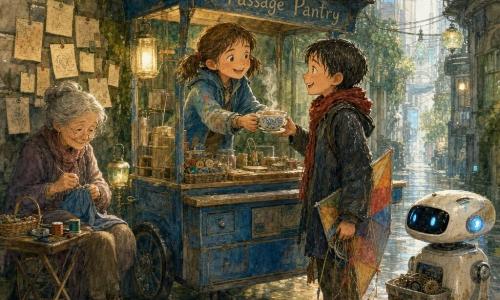
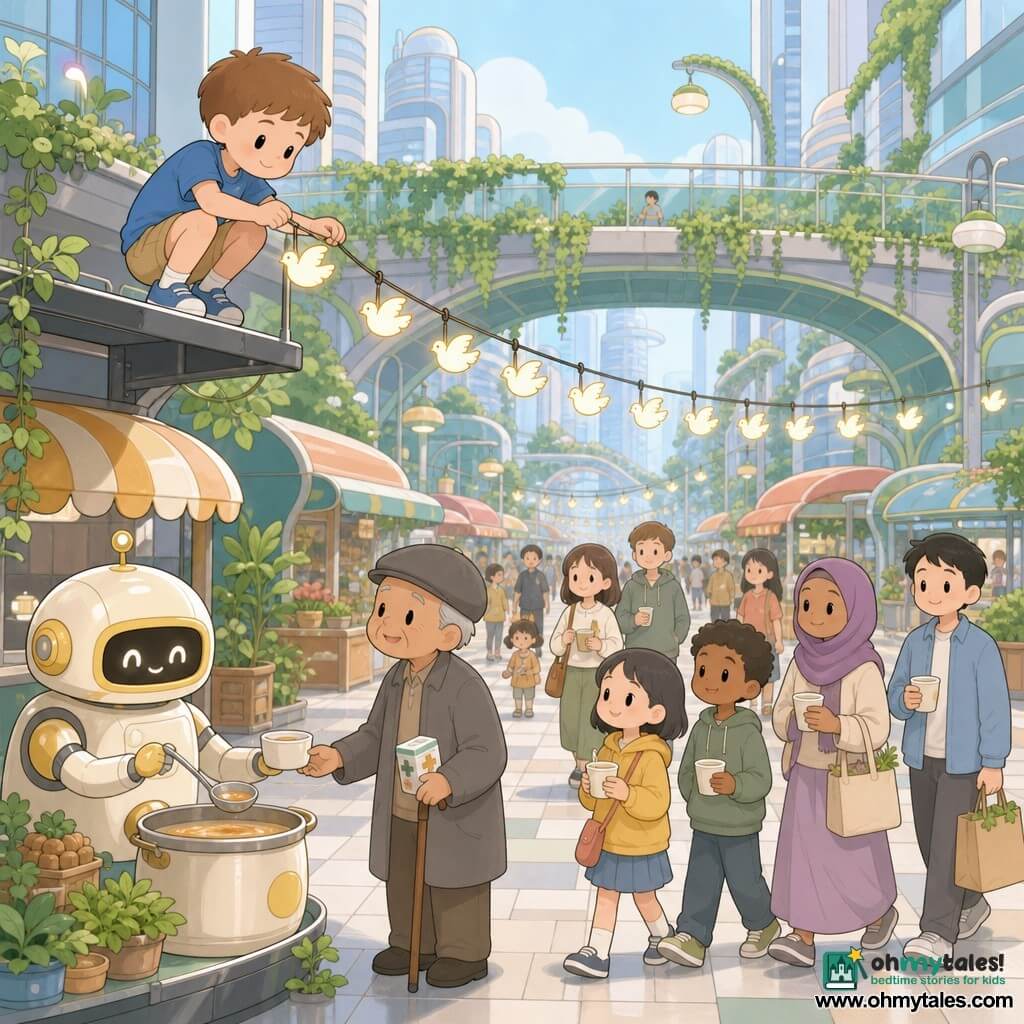
On the main street, the problem was clear. The city had built a pop-up market overnight—bright stalls with awnings that changed color to match people's moods. It had meant well. Yesterday had been rainy, and lots of residents had searched for “warm soup” on their wrist-screens. So the city had decided: soup stalls, right here, right now.
Only it had chosen the busiest road.
“Free soup!” called a cheerful vendor-bot, ladling steaming broth into cups. “Extra noodles for anyone who smiles!”
People did smile. They also crowded in. They clustered and chatted and forgot about the street behind them. The service carts couldn't pass. The delivery drones circled above, confused, like flies around a closed jar.
Milo wove through knees and shopping bags, careful not to spill anyone's soup. He spotted an older man with a cane staring at the jam with a frown that seemed tired.
“Can I help you, sir?” Milo asked.
“I'm trying to get medicine to my sister,” the man said. “The cart's stuck.”
Milo's chest tightened. A blocked road wasn't just annoying. It could be serious.
He raised his wrist and spoke to the city. “Lumenfold, can you move the market?”
The air replied in a gentle tone. “Market created to meet comfort needs. High approval. Moving may reduce happiness.”
Milo glanced at the soup, the laughing people, the warm lights. Happiness mattered. But so did getting medicine through.
He thought the way his mother had taught him: not me or them—us.
“What if we help the city choose a better place?” Milo said aloud, mostly to himself. “What if we show it a kinder plan?”
A child bumped into him, giggling. A cup of soup sloshed. Milo steadied it and smiled back, even though his mind was racing.
Above, the covered walkways shone with vines like calm rivers. Milo pictured them as paths. Paths could guide crowds. Paths could open roads.
He needed a sign. Not a strict order. Something friendly that everyone could follow together.
That was when he remembered the bundle in his toolkit: a special string of lights he'd been saving for the next volunteer day—soft white bulbs shaped like tiny doves. The label on the packet read: Peace Garland. For gentle gatherings.
Milo's eyes brightened. “Perfect,” he whispered. “If I can place it right…”
Chapter 3: The Peace Garland Plan
Milo climbed a maintenance ladder onto a low awning and crawled carefully along the frame. The vendor-bot looked up.
“Unauthorized roof use detected,” it said, but its voice wasn't angry—just concerned, like a teacher watching someone stand on a chair.
“I'm not stealing soup,” Milo called. “I'm making a path.”
He pulled out the peace garland and clicked its first hook onto a metal loop. The little dove bulbs lit up at once, bright but not blinding. They glowed like moonlight caught in glass.
Milo stretched the garland toward the nearest vine-covered walkway entrance, making a gentle arc of light above the crowd. Then he clipped another section, then another, so the doves formed a floating ribbon pointing away from the blocked road.
People noticed. They always noticed lights in Lumenfold; the city loved to communicate in colors and sparkles.
A girl tugged her dad's sleeve. “Look! The doves!”
A teenager stopped sipping soup. “That's kinda cool.”
Milo waved to get attention without shouting. “Hey! The market is awesome,” he called, “but the road needs to breathe. If we follow the doves, there's a bigger space near the Skybridge Garden. We can eat there—under the vines!”
The words “under the vines” worked like magic. Everyone loved the walkways. They were warm in winter and cool in summer. They smelled of green life and a little bit of orange.
The older man with the cane nodded slowly. “That's a good idea,” he said, loud enough for others to hear. “Let's make room. Someone needs to get through.”
A few people began to move, and once the first steps happened, the rest followed. It wasn't a stampede. It was more like a flock turning in the sky—each person watching the next, trusting the curve.
The vendor-bot tilted its head. “Relocation increases overall access,” it said. “Calculating…”
The streetlights blinked twice. A soft chime rang out, like a bell made of water.
“New plan accepted,” Lumenfold announced. “Guidance activated.”
The city joined Milo's idea. Floor arrows lit up, matching the peace garland's doves. The covered walkway doors slid open wider. Fans breathed in fresh air so the tunnel wouldn't feel crowded. Even the vines above seemed to lean, making a welcoming arch.
Milo climbed down as the crowd flowed toward the garden. He caught the older man's eye.
“Medicine first,” Milo said.
The man smiled, and the smile looked like relief. “Bless you, kid.”
Milo shook his head. “Not just me,” he said, watching people help each other carry soup pots and fold awnings. “It's everybody.”
Chapter 4: When the City Learns a New Kind of Map
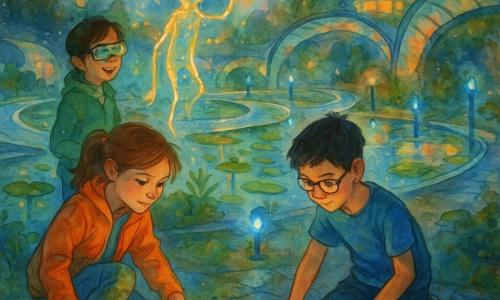
At the Skybridge Garden, the market settled into its new home as if it had always belonged there. Stalls lined the wide platform between two towers. Above, vines draped from curved beams, thick as braids. Water misted gently from hidden sprinklers, catching the light and turning it into tiny rainbows.
Milo clipped the last section of the peace garland across the entrance. The dove bulbs hovered over the walkway like a promise: this way is safe, this way is shared.
Lumenfold spoke again, quieter now, as if it didn't want to interrupt. “Milo. Why peace garland?”
Milo wiped his hands on his shorts. “Because people follow kindness better than commands,” he said. “And because everyone's in a better mood when the path looks friendly.”
There was a pause—just long enough for the city to think.
“Kindness recognized,” Lumenfold replied. “New rule added: Keep main roads clear. Move gatherings to vine walkways. Use friendly signals.”
Milo's stomach fluttered with pride, but he tried to stay practical. “Also,” he added, “maybe ask volunteers before building a surprise market on a highway.”
A nearby stall changed its awning color from worried purple to laughing yellow.
“Suggestion accepted,” said the city.
On the edge of the platform, a service cart rolled in at last, its wheels humming softly. The older man hurried to it. Milo watched him receive a small package, then turn and lift it high like a trophy.
“Got it!” the man called. “Thank you!”
People cheered—not a loud stadium cheer, but the warm kind that fills your chest.
Milo looked around at the crowd. A woman was sharing extra cups with strangers. Two kids were holding the door open for someone carrying a heavy pot. The vendor-bot was offering “emergency noodle refills” to the volunteers.
Solidarity, Milo thought, wasn't a grand speech. It was a hundred small hands choosing to help.
A breeze moved through the vines. The peace garland doves swayed, shining.
Down below, through the glass, Milo could see the main street again. It wasn't jammed anymore. It was open.
Lumenfold dimmed and brightened its lights in a slow, satisfied rhythm, like a city taking a deep breath.
Chapter 5: The Cleared Road
Later, when the last soup cup had been recycled and the last stall had folded into a neat box, Milo walked back along the covered walkway. The vines brushed the glass with soft leaves, and the air smelled of green and a little bit of orange—because someone, somewhere, must have felt they needed it.
The peace garland remained above the garden entrance, its dove bulbs glowing gently in the evening. It wasn't just decoration now. It was part of the city's memory, a bright thread in its learning.
As Milo crossed a bridge, the floor under his feet warmed a little—just enough to feel friendly. Lumenfold spoke, almost like a whisper.
“Road status: clear,” it said. “Thank you for helping me adapt.”
Milo grinned. “You helped too,” he answered. “You listened.”
Below, the main street stretched forward, smooth and free. Service carts rolled along it. A delivery drone zipped by with a tiny package. People crossed safely, guided by soft lights and patient signals.
Milo rested his hands on the walkway rail and watched the moving city for a moment. It wasn't perfect. It would make new mistakes, because learning meant trying. But it was trying with its people, not around them.
He turned toward home, his toolkit lighter now, as if the air itself had carried some of the weight.
Behind him, the vines swayed, the peace garland shone, and the road stayed open—wide enough for everyone to pass.