Chapter 1: The Pedestrian Skies
On the morning of his tenth birthday, Milo zipped up his silver hoodie, slipped on his light-up sneakers, and stepped onto the estacade. Below, the city buzzed: loops of floating buses glided between glass towers, drones ferried fresh fruit baskets overhead, and everywhere, the soft whirr of machines blended with laughter and chatter. But up here, high above the fast lanes, Milo could breathe the cool air and watch the sky change from blue to orange.
The estacades were Milo's favorite part of the city. They stretched for miles, wide walkways woven between the buildings, reserved only for people on foot, scooters, and the occasional robot dog. Milo always felt a bit like an explorer when he walked here, peering at tiny gardens blooming in the corners or listening to the hum of the city AI, named Vera, as she adjusted the sunlight filters.
“Good morning, Milo,” Vera's calm voice sang from the speakers hidden in the railings. “How may I help you today?”
Milo grinned at the friendly tone. “Good morning, Vera! I'm going to the plaza to try my new invention.”
“Wonderful! Do you need directions?”
“No, thank you, Vera. It's more fun to find my own way.”
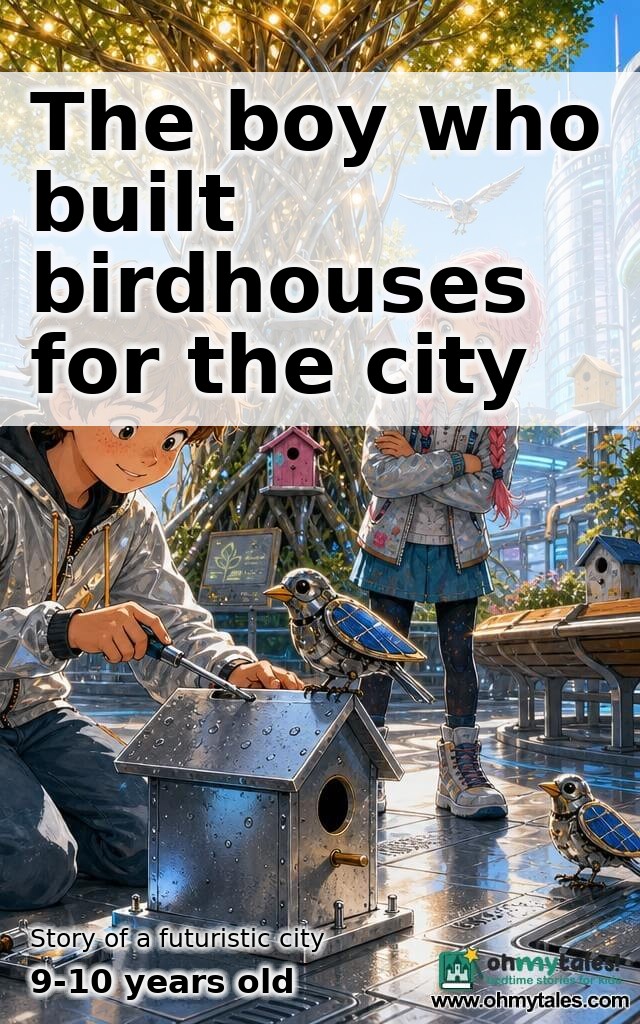
He set off, weaving around a group of children balancing on hoverboards, and hurried past a stand where a robot sold strawberry-pear ice cream. In his backpack, something clinked softly—his collection of miniature birdhouses, each carefully built from recycled metal and painted with bright, hopeful colors. They were for the mechanical birds that flitted through the city, keeping pollens moving and seeds spreading.
Milo glanced up as one swooped past, its wings shimmering with solar feathers. He waved hello, then hurried on. He had a mission.
Chapter 2: The Invention Plan
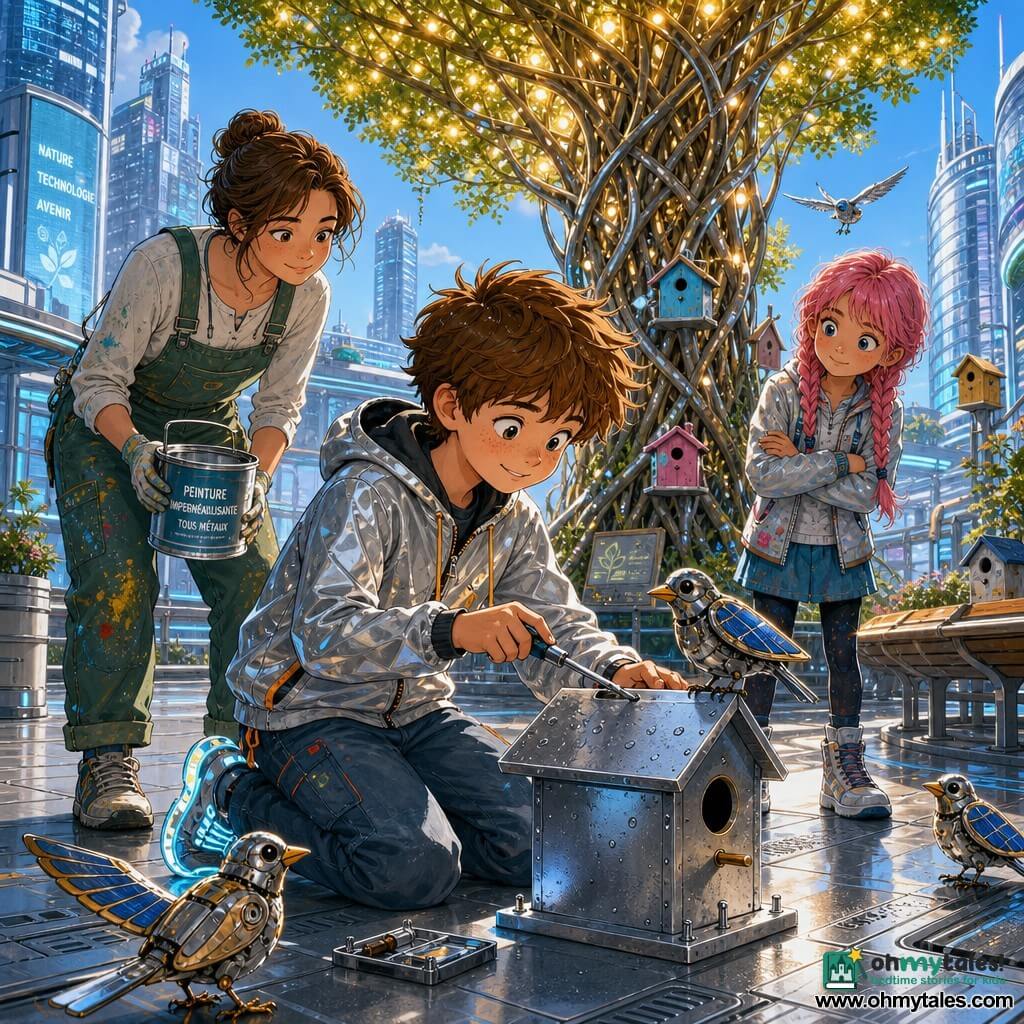
Milo's favorite spot in the city was Harmony Plaza, where a huge digital tree glowed in the center—its trunk made of woven carbon thread, its leaves twinkling with points of light. Underneath it, people lounged on benches while mechanical birds sang from the branches, their songs a gentle mix of chirps and synthesized whistles.
But something was missing. Milo saw it every morning: the birds landed only for short rests, then flitted off, never staying long. He wanted to make the plaza a real home for them.
He sat beneath the tree, unpacked his birdhouses, and set about attaching one to the lower branch. The houses were snug, with small warming pads and seed dispensers designed just for the mechanical birds, who needed a quick recharge after long flights.
As Milo worked, a pair of girls watched curiously. “What are those?” one asked, her hair glowing faintly pink in the filtered sunlight.
“Birdhouses,” Milo replied, smoothing a sticker onto the roof. “For the mechanical birds. I've added solar chargers so they can rest here longer. I think they get tired.”
The other girl leaned closer. “Will they like them?”
“I hope so,” said Milo. “I painted them in colors they seem to like—blue, yellow, and a bit of shiny silver.”
Suddenly, Vera's voice chimed in. “Would you like me to adjust the plaza's lighting to attract more birds, Milo?”
Milo grinned. He loved how Vera listened and responded, always learning from the city's people. “Yes, please! Make it a little brighter and warmer around the tree.”
A soft glow spread through the plaza. One by one, the mechanical birds circled down, attracted by the light and Milo's new houses.
Chapter 3: When the City Learns
Milo returned the next day with a handful of seeds and a new idea. As he crossed the estacade, he noticed small changes everywhere: benches had shifted to catch the morning sun, and the railings now held boxes of wildflowers. Vera was adapting, learning from what people liked and needed.
In the plaza, the scene was different. The birdhouses had visitors—at least three mechanical birds perched in each, their metal feathers glinting.
“It worked!” Milo exclaimed. He scattered seeds in front of the houses. Two birds hopped down, tiny mechanical feet clicking on the ground, and pecked at the seeds.
A soft whirr caught Milo's attention. Vera's gentle voice returned, “I noticed the birds enjoyed the new homes, Milo. Would you like more birdhouses installed on other estacades?”
Milo's eyes shone. “Yes! And maybe some in the rooftop gardens too. Some birds like it quieter.”
“Request noted. I'll suggest it to the building caretakers,” replied Vera.
A boy on rollerblades joined the small gathering. “Did you really make those houses? That's awesome! Can I help you next time?”
“Of course,” Milo said, feeling proud. “The more, the merrier. The city's for everyone, right?”
The children laughed, and even the mechanical birds seemed to chirp louder, their songs echoing from the digital tree.
Chapter 4: A Little Trouble, A Simple Solution
That afternoon, dark clouds rolled in over the city, and a gusty wind swept through the estacades. Milo ran to the plaza, heart pounding. He found two birdhouses blown to the ground, their doors bent and solar panels scratched.
One of the mechanical birds fluttered beside him, its wing askew. Milo knelt down, talking gently. “Don't worry, little one. We'll fix everything.”
He dug into his backpack. Using a small screwdriver and a roll of silver tape, he patched the solar panel and straightened the door. The bird hopped into his palm, a tiny “beep” of gratitude sounding from its chest.
A grown-up approached—a city gardener, her overalls streaked with green. She watched Milo repair the birdhouse and smiled. “Would you like some waterproof paint for your houses? The city can share some.”
“That would be great!” Milo replied eagerly.
While the gardener painted, Milo taught the other children how to anchor the houses with stronger hooks. “If we all work together, nothing will blow away,” he said.
By the time the rain started, the birdhouses were secure. The birds found shelter inside, safe and cozy while the storm passed overhead.
Chapter 5: The Emptying Plaza
The rain stopped as quickly as it had begun. Bright drops clung to every surface, glinting in the neon-lit dusk. Milo stood beneath the digital tree, looking at the cluster of birdhouses, now safe and dry. Families gathered to admire the birds, and people huddled on benches, sharing warm drinks. For a moment, the plaza felt like the heart of the city—alive, connected, full of hope.
Then, slowly, people drifted away. The light from the digital tree softened. Children followed their parents home, laughter echoing off the glowing walkways. Even the mechanical birds tucked into their new houses, tiny eyes blinking sleepily.
Milo sat on a bench, feeling the peaceful hush. The plaza, once busy and bright, became quiet—almost empty except for him, a few distant footsteps, and Vera's gentle presence.
“Well done, Milo,” Vera said softly. “You've given the birds a home, and the city has learned from you. It will remember.”
Milo smiled, proud and content. He understood that the city was not just made of metal and glass, but of little things people did to help—like a boy who built birdhouses and a city that listened.
As the plaza emptied, Milo zipped up his hoodie and whispered good night to Vera and the birds. He knew he'd return tomorrow, ready for another adventure in a city that never stopped learning.