Chapter 1: The City That Solved Things
Mira liked to say the city breathed. Not with lungs, but with clever little machines that popped open shade-sails in the morning, washed the sky-screens at noon, and hummed softly to themselves at night. It was the kind of city where a new simple idea could become a new helpful thing before supper. People invented gentle solutions here: rain-catchers that watered street-gardens, benches that warmed when someone shivered, and tiny drones that delivered extra seeds to anyone who was planting trees.
Mira was nine and an expert at finding mischief. She had a freckled nose, a backpack full of sticky notes, and a grin people called trouble with a halo. Her favourite place was the venelles fraîches—cool, narrow alleys that threaded like secret stitches through the tall glass and brass buildings. These alleys kept out the hot glare and smelled of citrus and wet stone. Mira knew every twist, every sliding door, every little shop that fixed old toys with bright new ideas.
One morning, the city announced a contest: invent a tiny solution to make the venelles fraîches even kinder. Mira decided to enter. She had no giant machine in mind, only a puzzle: some alleys were bright and noisy while others were whisper-dark and empty. What if a passage could offer both shade and welcome? That question made her hum. She slipped her sticky notes into her pocket and set off, skipping between cool walls that whispered the city's secrets.
Chapter 2: The Shaded Passage
Mira's hunt led her to the oldest part of the venelles, where lamps looked like glass flowers and the cobbles had small, sun-worn portraits carved into them. There she found a narrow opening she had never noticed: a passage so shaded that moss grew on its stones, and the air felt soft as a cat's paw. Light filtered through slats above, painting green lattices on the floor. It was the kind of place that made you slow your breath without trying.
This shaded passage smelled of lemon tree sap and cool metal. Mira crouched and ran her fingers along the wall. In the mortar between stones, someone had left messages, tiny folded papers stuck like seeds. They were notes from people who had come here long ago, thanking someone for shelter, for a warm soup, for a fix to a broken cart—small kindnesses that added up like stars.
Mira felt a thrum of happiness. The passage was not just cool; it was a quiet friend. It seemed to hold solutions already: a hook for a lost umbrella, a shelf with a spare cup, a patch of herbs that grew without much fuss. She decided the solution she would propose would be simple: a kindness corner that could travel along the venelles, carrying small tools and warm words to anyone who needed them.
Chapter 3: Little Inventions, Big Smiles
Mira set to work. She borrowed a folding cart from a playground maker—light, wooden, and painted sky-blue. On it she placed clever little things she found or made: a jar of spare buttons, a roll of thread, little vials of herbal tea, a cloth banner that read "Need a Hand?" and a music box that played a two-note tune when the lid opened. Each item had a sticky note explaining how to use it, drawn in Mira's squiggly school-handwriting: "Buttons! Sew on with tiny loop. Tea! Pour, breathe, smile."
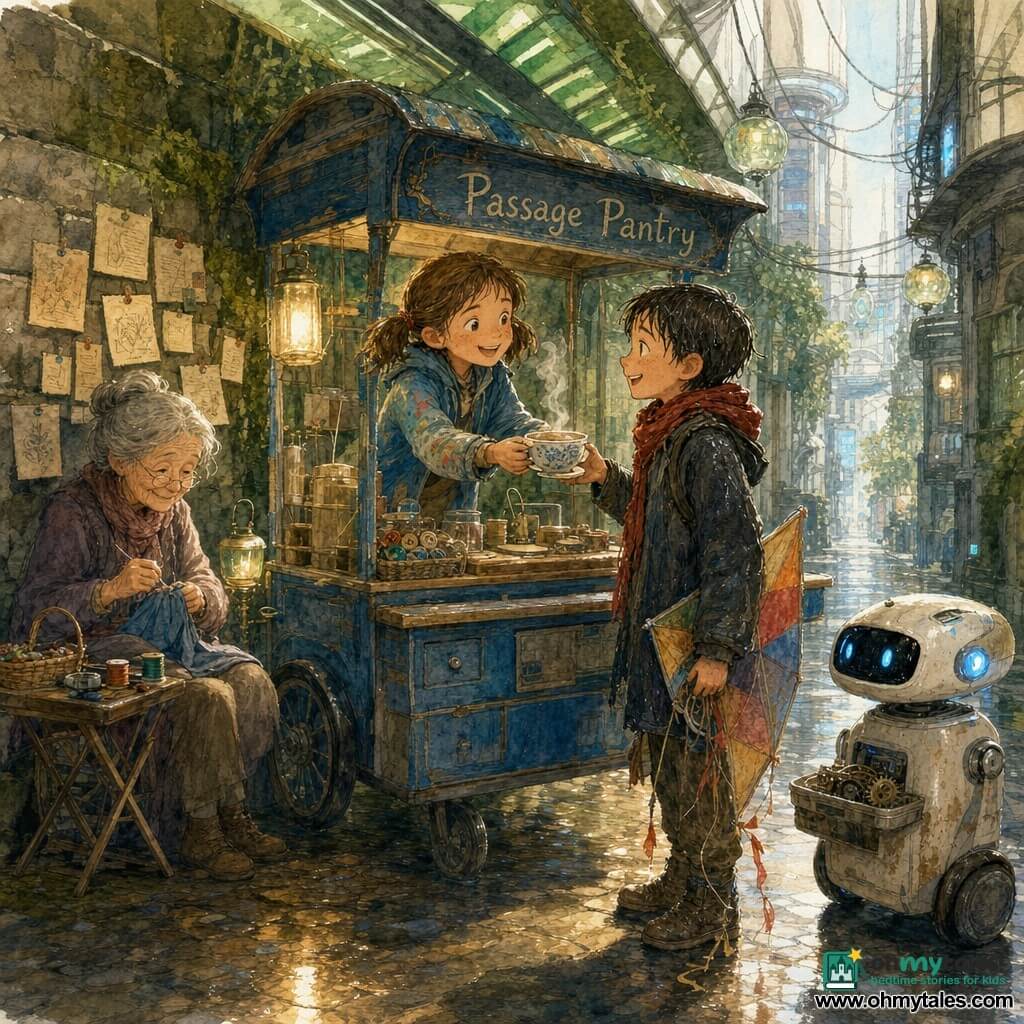
She rolled the cart into the shaded passage and left it near the mossy wall. She added a tiny sign: "Passage Pantry—take what helps, leave what heals." Then she waited, watching from behind an overturned crate like a pirate who has forgotten the map but remembers the rum.
People came. An elderly woman found the sewing things and mended a torn sleeve for a child who'd been born on a rainy day and always carried a damp rag. A delivery robot, its wheel slightly bent, received a spare cog that made it hum straight again. A tired apprentice painter paused, took tea, and left a scrap of colorful cloth for someone else. Each small exchange made the passage brighter, as if the stones themselves were smiling.
Mira loved the way the city loved small, sensible solutions. Here, a paper note could turn into warmth. The cart taught her a big truth: you did not always need flashy machines to make things better. Sometimes you only needed a place where people could share what they had. That idea felt like a light brush on her cheek—gentle, sure.
Chapter 4: A Mischief Well Spent
Her mischief changed into something else—quiet planning. Mira realized the cart would do more good if it could move. She tinkered with a small solar pulley she'd seen on a rooftop garden and attached it to the cart. The pulley caught the passage's mottled light and turned the cart a few inches at a time. It was not fast, but it nudged the cart along, like a snail with a purpose.
Soon, the Passage Pantry rolled a little every day, leaving gifts where the shadows met sun. People began to add things: a pair of gloves, a screwdriver, a drawing made by a child who had found courage. Neighbours who had been too busy to speak now patted each other on the shoulder. The simple cart stitched the venelles together with acts of care.
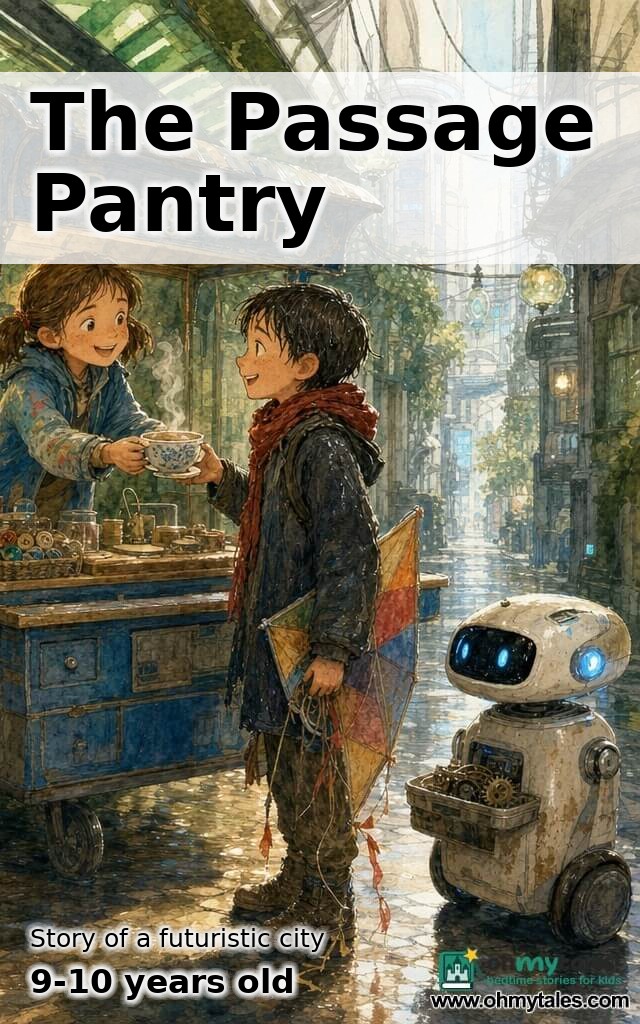
One afternoon, a sudden rainstorm sent the city darting for cover. Mira dashed into the shaded passage and pulled the cart closer under a slat of the roof. A boy with a kite, soaked and shivering, huddled by the wall. Mira handed him a cup of warm tea and a dry scarf. He looked at the cart, then at Mira, and grinned. "You made this?" he asked.
"I made the idea," she said, proud and a little bashful. "We all made the rest."
Chapter 5: Clap for the City
News of the Passage Pantry traveled like a friendly rumor. Children started drawing maps with little hearts where the cart had rested. City engineers—quiet, curious people who made useful things—came to see how a simple cart could change paths. They listened to Mira and the people who used the cart, and they took notes in neat, looping hands.
On a bright evening, the city held a small gathering in the venelles fraîches. Lanterns glowed like jars of fireflies, and the air smelled of baked apples. Mira stood beside her cart, now polished and patched by friendly hands. People shared stories of how a button had saved a coat, how a cog had kept a delivery from missing medicine, how a kind word had been enough for a lonely painter.
Then, as if the whole city had been waiting to do something together, everyone began to clap. The clapping started soft, like rain on a tin roof, then grew into a full, cheerful salvo of claps that echoed along the cool alleys and up into the glassy towers. Mira felt the sound like a warm wave, and she laughed—no mischief now, only a bright, pleased sort of happiness.
The city still breathed in helpful machines and clever ideas, but Mira had shown that tiny, simple solutions could be the kindest kind of invention. People went home smiling, the Passage Pantry rolled on a little farther, and the shaded passage kept its moss and its messages, ready for the next small hand that needed help.
Outside, the stars blinked like punctuation marks on a long, kind sentence. The claps kept ringing, and Mira tucked a final sticky note into the wall: "For anyone who wants to try being kind." Then the applause finished, like a circle closing, and the venelles fraîches sighed contentedly into the evening.