Chapter 1: The Map That Wouldn't Sit Still
Lark was a young otter with whiskers that quivered like question marks. While other otters practiced perfect belly-slides or argued over the shiniest pebble, Lark preferred mysteries—the kind that hid under rocks and inside stories.
The Riverwood Library was a hollowed willow tree, smelling of ink, moss, and old rain. Lark padded inside, tail flicking with ambition. She wasn't just curious; she was hungry for a puzzle big enough to chew on for days.
On the highest shelf sat a glass jar sealed with pine resin. A label dangled from it like a tired tongue: THE ANCIENT RIDDLE OF STARWELL.
“Starwell,” Lark whispered. The word tasted like midnight.
She climbed the shelves, careful as moonlight on water, and tugged the jar down. Inside was a rolled scrap of silver bark. When she unrolled it, the bark shimmered and rearranged itself, like fish scattering and returning.
The map wouldn't sit still.
Lines wriggled. Symbols drifted. A tiny drawing of a well blinked once, as if it had an eyelid.
Lark's ears perked. “Oh, you're cheeky.”
From below, a voice called, “If you're planning to steal the sky, at least bring a ladder.”
Moss, a tortoise with spectacles made from polished snail shells, trudged into view. He was the librarian, and his patience was legendary—mostly because it moved at his speed.
“I'm not stealing,” Lark said, trying to look innocent while holding a living map. “I'm… borrowing a question.”
Moss adjusted his spectacles. “That ‘question' has been unanswered for centuries. Many have tried. Some returned soggy. Some returned… less.”
“Less?” Lark echoed.
“Less confident. Less polite. Less willing to admit they were wrong.” Moss's eyes twinkled. “The Starwell mystery is like a mirror made of water. It shows you what you bring to it.”
Lark felt the map's cool silver against her paws. Her heart thumped like a drum calling a parade. “Then I'll bring courage. And curiosity. And—”
“Dry socks?” Moss offered.
Lark laughed. “And dry socks.”
Moss sighed the way old trees sigh in wind. Then he reached under the counter and slid out a small brass compass. Its needle didn't point north; it spun, hesitated, and then pointed straight at Lark.
“That's odd,” Lark said.
“It's meant for seekers,” Moss replied. “It points to the next true step, not the easiest one. Take it. But remember: ambition is a sail. Without kindness as ballast, you'll tip.”
Lark tucked the compass and the squirming map into her satchel. Outside, the river glittered like a ribbon of secrets. Lark stepped onto the bank, and the adventure stepped into her.
Chapter 2: The Singing Bridge and the Unfriendly Wind
By noon, Lark reached the Singing Bridge, a long arch of roots braided together over a gorge. Whenever the wind slid through its twists, it hummed a tune—sometimes bright, sometimes mournful, as if it remembered every traveler.
The map in Lark's satchel shivered. A symbol floated to the surface of the bark: three spirals, one cracked.
“Looks like… swirls?” Lark muttered. “Or cinnamon buns. Please let it be cinnamon buns.”
A jay swooped down and landed on a root. Her feathers were ink-blue and her eyes were the sharp kind of clever.
“Traveling alone?” the jay asked. “That's either brave or foolish.”
“Both, depending on the day,” Lark said. “I'm Lark. Who are you?”
“Quill,” the jay replied, puffing her chest. “Collector of shiny facts and occasional coins.”
Lark lifted her satchel a little defensively. “I don't have coins. I have a mystery.”
Quill's head tilted. “Mmm. Those are shinier than coins. What's the mystery?”
“The Ancient Riddle of Starwell,” Lark said.
Quill whistled. “Big bite for a small otter.”
“I'm not small,” Lark said quickly, then realized Quill was smiling.
“Fine, not small,” Quill conceded. “Just… streamlined.”
A gust surged through the gorge and slammed into the bridge like an angry drumbeat. The Singing Bridge groaned. Its music turned sour.
Quill spread her wings, wobbling. “The wind's in a mood.”
Lark stepped onto the bridge. The roots felt alive under her paws, tense as tightened ropes. Halfway across, the wind rose again—this time with a hiss, as if it had learned words it shouldn't use.
The bridge's song shifted into a low warning.
Lark's compass needle trembled, then pointed down at the bridge itself.
“The next true step,” Lark murmured, “is not running.”
Quill flapped to keep balance. “I vote for running.”
Lark dropped to her belly and pressed her paws into the roots. “Hold on!”
Quill scrambled, claws scraping. “I am holding on! To panic!”
Lark reached out. “Grab my tail!”
“You want me to grab—”
“Now!”
Quill clutched Lark's tail feathers—well, fur—and Lark anchored herself like a stone in a river. The wind shoved, but the two of them became a single stubborn sentence: Not today.
The gust finally blew itself out, sulking away into distant trees. The bridge's music softened into relief.
Quill lay panting. “Your tail is… surprisingly reliable.”
Lark grinned. “It's trained in emergencies.”
Quill sat up and eyed the satchel. “All right, streamlined otter. I'm coming with you. Mysteries are more fun with someone to argue with.”
Lark felt a warm fizz of happiness. She hadn't expected a companion, but the adventure seemed to be collecting friends the way Quill collected facts.
Together they crossed the rest of the bridge. Its song followed them like applause.
Chapter 3: The Clockwork Marsh
The land beyond the gorge dipped into the Clockwork Marsh, where reeds clicked like tiny gears and lily pads spun slowly, as if time itself had cogs.
“Who built this?” Quill asked, hopping from a rock to a hummed-up mound of moss.
“No one,” Lark said. “I think it grew this way. Like… magic learned to count.”
The air smelled of iron and peppermint. Dragonflies zipped past, their wings ticking.
Lark unrolled the silver-bark map. It rippled, then settled into a clear picture: a marsh shaped like a sleeping animal, with a dot where its heart would be.
The compass needle swung toward the center.
As they waded in, the water made soft clinking sounds, and bubbles rose in perfect circles. A heron statue stood among the reeds—except it blinked.
It wasn't a statue.
It was a heron, standing so still it seemed carved from patience.
“You step on my marsh like it's a sidewalk,” the heron said, voice thin as a blade of grass.
Lark swallowed. “We mean no harm. We're seeking Starwell.”
At the name, the heron's eye narrowed. “Many seek. Few listen.”
Quill cleared her throat. “We can listen. We're excellent listeners. Lark once listened to a snail cross a stone.”
“That was a dramatic snail,” Lark muttered.
The heron leaned forward. “The marsh tests travelers with the Weight of Want. Your desire pulls you down. If you crave glory, you sink. If you crave only answers, you sink slower.”
Quill whispered, “That's… not encouraging.”
Lark looked at her own reflection in the water. Her ambition stared back, bright and impatient. She imagined herself returning to Riverwood with the riddle solved, everyone gasping, Moss blinking in surprise. The image was delicious—like honey on the tongue.
The water around her ankles suddenly felt heavier.
Lark's ears flattened. “Uh-oh.”
The marsh tugged at her feet as if it had hands.
Quill flapped to a reed. “Lark! Your wanting is… getting you eaten by puddles!”
Lark forced herself to breathe. The heron watched, unblinking.
Moss's warning floated into her mind: ambition is a sail.
Lark closed her eyes and pictured something else. Not applause. Not gasps. She pictured the riddle opening like a flower, not for her, but for everyone who wondered. She imagined young otters in the library reading the story and feeling brave enough to ask their own questions. She imagined the marsh itself, satisfied to be understood instead of conquered.
The pull loosened.
Lark opened her eyes. “I want to solve it,” she said aloud, “but not to be important. I want it because the world is full of locked doors, and someone should learn how to open them gently.”
The marsh water lightened, sighing like a relieved animal. The clinking reeds seemed to approve.
The heron dipped its long beak. “Better. Remember: curiosity is a lantern. It's meant to light the way, not set the forest on fire.”
Quill fluttered down beside Lark. “You just talked to water and won.”
Lark wiped mud from her paws. “I didn't win. I… listened.”
They continued toward the marsh's “heart,” where the lily pads spun faster, as if excited.
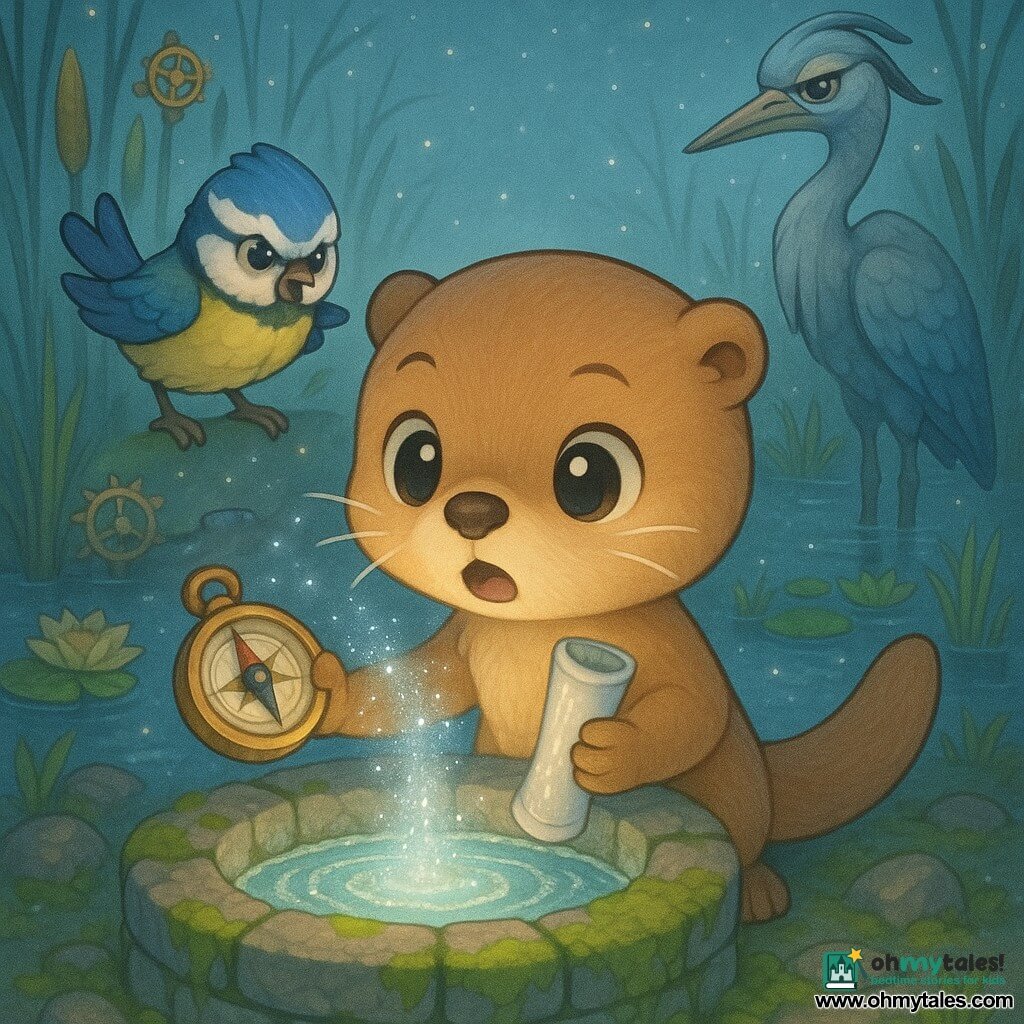
In the center stood a stone ring half-submerged—an old well rimmed with star-shaped carvings.
Starwell.
Or at least, Starwell's first doorstep.
Chapter 4: The Riddle Beneath the Ripple
The stone ring was cold and slick with moss. Carved stars surrounded it, each one different—some sharp, some soft, some with tiny smiling faces like mischievous children.
Quill peered into the darkness. “I don't see stars. I see… a throat.”
Lark held the brass compass over the opening. The needle spun, then pointed straight down, steady as a promise.
The map in her paws glowed faintly. Words rose from its silver bark, forming letters as if written by moonlight:
WHAT FALLS WITHOUT BREAKING,
WHAT OPENS WITHOUT A KEY,
WHAT SHINES WITHOUT BURNING?
Quill read it aloud, voice suddenly quiet. “That's the ancient riddle?”
“Part of it,” Lark said. “I think it's asking for three answers.”
Quill tapped her beak against the stone. “Something that falls without breaking… Rain?”
“Rain falls,” Lark agreed, “and it doesn't break.”
Quill paced along the rim. “Opens without a key… a flower?”
“A flower opens,” Lark said, picturing petals yawning at sunrise.
“And shines without burning…” Quill looked up at the sky. “The moon.”
Lark felt a spark of delight. The answers weren't trophies; they were simple wonders, the kind you could hold in your mind without owning them.
She spoke into the well, voice echoing down. “Rain. Flower. Moon.”
For a heartbeat, nothing happened. Then the well answered with a sound like water laughing. The darkness brightened, not with fire, but with a soft silver glow, as if starlight had melted into liquid.
The surface inside the well rose, climbing like a gentle creature. It became a round mirror of water, level with the rim.
Quill leaned in. “It's… showing something.”
The water-mirror shimmered. An image formed: a tunnel of smooth stone lit by glowing fungi, spiraling downward. At the bottom, a door made of tangled roots, crowned with a single star-shaped lock.
“So the riddle was the invitation,” Lark breathed.
Quill's eyes widened. “You mean we have to go down there?”
Lark's stomach fluttered. Heights didn't bother her, but depths felt like secrets with teeth. Still, her courage—small but stubborn—stood up inside her.
“We came for an ancient mystery,” she said. “Ancient mysteries don't usually sit on the surface and wave.”
Quill swallowed. “I'm a bird. I'm not designed for… under.”
“You can turn back,” Lark offered, trying to keep her voice light.
Quill lifted her chin. “And let you get all the glory? Absolutely not.”
Lark laughed, then grew serious. She tied the satchel straps tight and tested the rope ladder hanging inside the well—old, but sturdy, woven from reeds that seemed to hum with the marsh's clockwork rhythm.
As Lark climbed down, the walls smelled of wet stone and clean darkness. Quill hopped after her, muttering, “I am definitely going to complain about this later.”
The tunnel spiraled, and with every step, Lark felt as if she were walking into the inside of a story.
At the bottom, they reached the root-door with the star-shaped lock.
It had no keyhole.
Quill squinted. “How do you unlock a lock with no hole?”
Lark placed her paw on the star. It felt warm, like a pebble that had been sitting in sunlight.
The compass needle pointed at Lark's chest.
Lark frowned. “Oh.”
Quill blinked. “Oh what?”
“I think… the lock wants something from me,” Lark said. “Not a key. A… truth.”
The root-door shivered, listening.
Chapter 5: The Chamber of Echoed Selves
Lark pressed her paw harder to the star-lock and spoke before she could overthink it. “I'm afraid of being ordinary.”
The words fell between them like a dropped stone.
For a moment, Lark wanted to scoop them up and hide them. But the star-lock pulsed, gentle as a heartbeat. The roots uncurled with a sigh, and the door opened.
Inside was a wide chamber filled with floating lights—tiny orbs drifting like patient fireflies. The ceiling was an upside-down pond, reflecting their faces in a wavering mirror.
In the center stood a pedestal carved from quartz. On it lay a small object: a star-shaped shard, translucent and humming faintly.
Quill whispered, “That's it? That's the ancient secret? A sparkly snack?”
Lark approached slowly. The shard seemed to brighten as she neared, as if it recognized her curiosity. The air smelled like rain on dry earth—promising and fresh.
When Lark touched the shard, it sent a ripple through her mind.
Images burst like bubbles: animals through the ages standing where she stood—rabbits with brave eyes, foxes with restless tails, badgers with muddy paws. Each one asked the riddle and opened the way, but each one also brought a different fear.
A voice—not loud, not booming, but clear as a bell in fog—spoke from everywhere and nowhere.
THE STARWELL DOES NOT GIVE GLORY.
IT GIVES LIGHT.
Lark's throat tightened. “Light for what?”
The shard warmed in her paws. Another ripple, another answer:
TO SEE YOURSELF WITHOUT COSTUMES.
TO FIND YOUR TRUE STEP.
TO SHARE WONDER, NOT OWN IT.
Quill shifted beside her. “So… it's like a truth lantern?”
Lark nodded, feeling both small and strong at once. “It's a piece of starlight that helps you be brave in the right way.”
The chamber's floating orbs drifted closer, circling them like curious thoughts.
Quill cleared her throat, suddenly sheepish. “If it wants truth… I should probably say something too, huh?”
The orbs bobbed, as if listening.
Quill took a breath. “I'm afraid that if I stop joking, no one will like me.”
The air softened. One orb bumped Quill's beak gently, like a friendly nudge.
Quill blinked hard. “Okay. That was… surprisingly not terrible.”
Lark felt her chest loosen, like a knot undone. The shard's glow steadied, not brighter, but clearer—like the difference between a shout and a steady voice.
The voice spoke once more:
TAKE THE LIGHT.
LEAVE A LIGHTER HEART.
Lark tucked the star-shard carefully into her satchel. The floating orbs parted, revealing a tunnel slanting upward.
Quill tilted her head. “That's it? No trap? No guardian with teeth?”
“Maybe the trap was our own pride,” Lark said.
Quill snorted. “Rude. Accurate, but rude.”
They climbed the upward tunnel. As they went, the stone seemed less heavy, as if the underground itself was pleased to let them go.
Chapter 6: The Sky That Felt Close Enough to Touch
They emerged near dusk on a hill above the marsh. The world outside looked freshly washed, as if the adventure had scrubbed their eyes.
The sky was a deepening blue, and the first stars pricked through like shy freckles.
Quill spread her wings, stretching. “I have never been so happy to see air that isn't trapped in a hole.”
Lark laughed. The sound came easily now, not forced, not sharp. She pulled out the star-shard. In the open air, it didn't blaze; it glimmered softly, like a small promise.
The compass needle stopped spinning and finally pointed north, calm and ordinary.
“So,” Quill said, hopping close, “what do we do with the truth lantern?”
Lark thought of the library, of Moss's patient eyes, of young animals peeking between shelves. She thought of the marsh and its Weight of Want.
“We take it home,” she said. “Not to show off. To share. To inspire questions. To remind everyone that wonders aren't prizes—they're invitations.”
Quill nodded slowly. “And maybe… we write the riddle down somewhere, so seekers don't have to drown in their own wanting.”
“Exactly,” Lark said. She looked at Quill. “And we tell the truth, even when it's awkward.”
Quill gave a crooked smile. “I will still joke sometimes.”
“Please do,” Lark said. “Joy is part of the light.”
They started back toward Riverwood, the path turning golden under the last sun. The reeds of the Clockwork Marsh clicked a gentle farewell, like a thousand tiny applauses.
As night fell, Lark held the shard up. It didn't outshine the stars; it matched them, like a note joining a song.
Her ambition was still there—bright as ever—but now it felt less like a hungry net and more like a sail catching a friendly wind.
Lark's heart felt lighter, as if it had learned it didn't need to be the biggest thing in the sky to be brave.
Beside her, Quill said, “If anyone asks how we solved an ancient riddle, what do we say?”
Lark grinned at the darkening road ahead. “We say we listened. We were honest. And we kept our sense of wonder dry—like socks.”
Quill laughed, and their laughter bounced down the path, nimble and warm, as they walked home under a sky full of shared light.