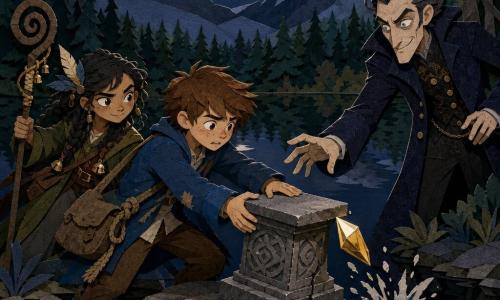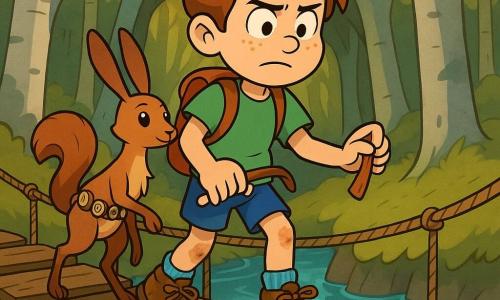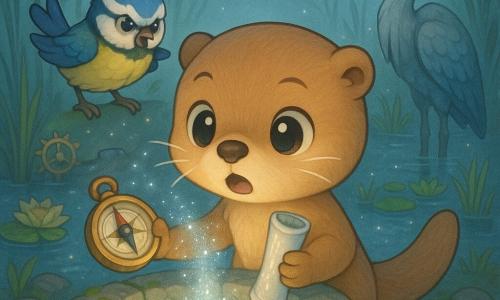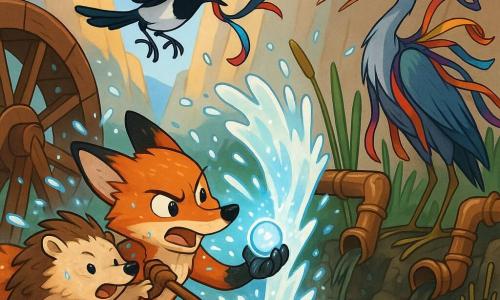
Chapter 1: The Map That Smelled of Storms
Mira Lark was eleven and famous for being in two places at once—her feet in the dusty attic, her mind sailing somewhere far beyond the rooftops of Brindlewick.
The attic belonged to her grandmother, who said it was “a museum of almosts and maybes.” Sunlight slipped through the slats like curious fingers, poking at trunks, jars of buttons, and a cracked telescope that still looked as if it could spy on dragons.
Mira pushed aside a curtain of cobwebs. Something thin and stiff hid behind an old music box.
A paper tube.
It was tied with blue twine that had faded to the color of sky just before rain. When Mira untied it, the roll sprang open with a sigh—as if it had been waiting to stretch for a hundred years.
An ancient map.
The parchment was the color of toasted bread, speckled with age. Ink lines curled like river-snakes. Symbols winked: a mountain drawn like a sleeping giant, a forest shaped like a hand, and a tiny star that seemed to glow when she tilted it.
At the top, in careful, slanting letters, it read:
FOLLOW WHERE THE BRAVE WONDER.
Mira's heart made a small leap, like a fish breaking the surface of a pond.
Behind her, the attic floor creaked.
Gran stood in the doorway, holding a basket of folded laundry as if it were a shield. Her eyes went straight to the map.
“Well,” Gran said softly, “so it found you.”
“It smells like storms,” Mira whispered. She wasn't even joking. The map had a faint, sharp scent—wet stone and lightning far away.
Gran stepped closer. “That map isn't for decoration. It's for… choices.”
Mira's fingers traced a dotted line that began at a tiny sketch of Brindlewick's windmill. The line marched onward—over a bridge, into a forest, across a lake shaped like an eye.
“Where does it go?” Mira asked.
Gran's mouth tried to be strict but failed. A smile escaped, the kind that kept secrets. “To the place where people stop being only what they've been told they are.”
Mira gulped. “That's… extremely dramatic.”
Gran snorted. “Adventure tends to be.”
Mira rolled the map carefully. Her thoughts buzzed like bees. “Can I follow it?”
Gran studied her. In Gran's gaze Mira saw a whole library of worries—wolves, weather, wrong turns, regrets. But underneath, there was another thing too: pride, bright as a coin freshly minted.
“I won't pretend it's safe,” Gran said. “But I will say this—wonder is a door. If you never open it, you'll always wonder what was on the other side.”
Mira's hands tightened around the map. “Then I'm opening it.”
Gran nodded once. “Take this, at least.”
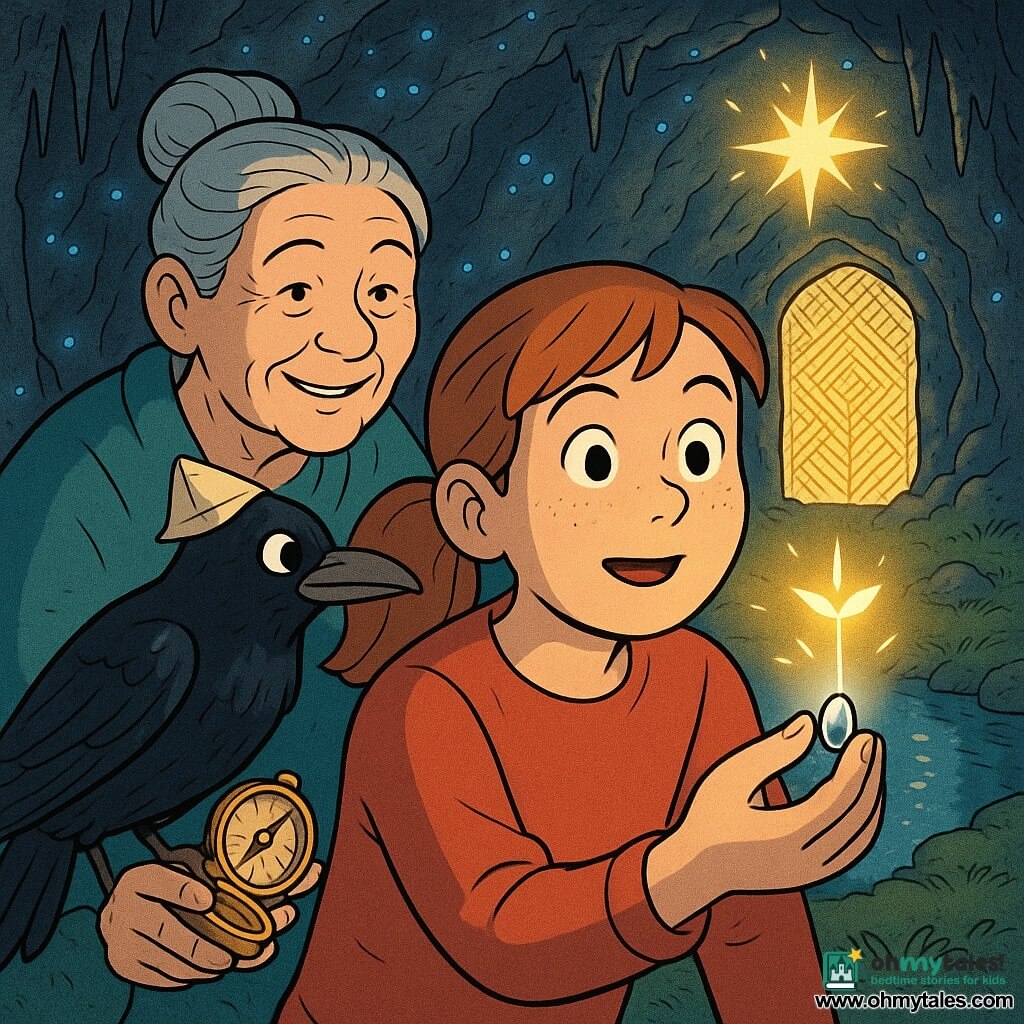
She reached into her pocket and pulled out a small compass. Its case was brass, scratched and stubborn. The needle trembled, then steadied.
“It doesn't point north,” Gran said. “It points to what you're seeking. If your heart lies, it will spin like a dizzy dancer. If your heart tells the truth, it will be calm.”
Mira swallowed her excitement like a fizzy drink. “What if my heart is… confused?”
“Then you'll learn,” Gran said, and she tapped Mira's forehead lightly. “You always do.”
That afternoon, Mira packed a satchel: bread rolls, a tin of strawberry jam, a notebook, a pencil, and the old compass. She tucked the map close to her chest like a second heartbeat.
When she stepped outside, the wind lifted her hair and whispered, Go on, go on, go on.
And Mira did.
Chapter 2: The Bridge That Asked Questions
The first part of the map led to the Old Ribbon Bridge, a long wooden crossing over the River Fable. People called it Ribbon because it twisted slightly, as if it couldn't decide which bank it preferred.
The river beneath was dark and quick, carrying leaves like tiny boats on urgent errands.
Mira reached the bridge and stopped short.
A sign hung from the first post, freshly painted in bold letters:
ONLY THOSE WHO ANSWER MAY CROSS.
“That seems new,” Mira muttered.
A voice floated from the planks, dry as a cracker. “New to you, perhaps.”
Mira looked down.
A raven stood there, glossy as spilled ink. It wore a lopsided little hat made from a folded scrap of newspaper.
“You can talk,” Mira said, because adventure had already begun, and she refused to waste time being shocked.
The raven bowed. “I can talk, I can question, and I can judge your dramatic facial expressions. I am Quill. Guardian of this bridge and part-time critic.”
“I'm Mira,” she said. “I'm following this map.”
Quill hopped closer, peering at the parchment. “Ah. One of those. Old maps are like old relatives—full of opinions and unexpected turns.”
Mira lifted her chin. “So what do I have to answer?”
Quill fluttered to the railing and pointed one wing toward the river. “The bridge doesn't want brave feet alone. It wants brave thoughts. Three questions.”
Mira exhaled slowly. “Okay. Ask.”
Quill cleared his throat as if preparing for a speech. “First: What is courage?”
Mira's mind darted through images—knights with shining swords, explorers with flags, Gran lifting heavy boxes without complaining. But her own courage felt smaller, like a candle.
She answered anyway. “Courage is doing something even when your stomach feels like it's full of jumping frogs.”
Quill nodded, approving. “Excellent. Second: What is curiosity?”
“That,” Mira said, “is when your brain pokes things with a stick—politely.”
Quill's beak opened, and Mira realized ravens could grin. “Very good. Third: What are you truly seeking?”
Mira hesitated.
The map promised something, but she didn't fully know what. Treasure? A secret place? Proof that she wasn't just a daydreamer in a small town?
The compass in her pocket seemed suddenly heavier, as if listening.
“I think…” Mira began, and her voice went quieter, like a lantern turned low. “I think I'm seeking who I am when I'm not trying to fit into other people's stories.”
For a moment, the river sounded louder, as if it liked her answer.
Quill hopped down and pecked the first plank. It thumped, and the sound rippled along the bridge like a drumroll.
“Accepted,” Quill declared. “Proceed, O Seeker of Self.”
Mira stepped onto the bridge. The wood felt warm beneath her shoes, as if it remembered sunshine. Halfway across, she glanced over the side.
The river reflected her face—wide eyes, wind-reddened cheeks, a small smile she hadn't planned.
“You coming?” she called.
Quill flapped up and landed on her shoulder as lightly as a thought. “Of course. Someone must narrate your foolish choices.”
“Nice,” Mira said. “I always wanted a sarcastic bird.”
Quill preened. “Sarcasm is a public service.”
Together they crossed. On the far side, the landscape changed, as if the world had turned a page.
The path ahead led into a forest shaped like a hand.
And the map's dotted line marched straight into its palm.
Chapter 3: The Forest That Held Its Breath
The Whisperwood Forest earned its name honestly. The leaves did whisper—soft, swishing secrets that tickled Mira's ears. The trees leaned close, their branches woven overhead like the ribs of a giant umbrella.
Mira walked beneath them, the light turning green and gold. Her steps sounded too loud, as if she were disturbing a room full of sleeping animals.
“Do you hear that?” she whispered.
Quill cocked his head. “The sound of you being nervous? Yes, it's quite obvious.”
“No, not that.” Mira pointed.
Ahead, the path split around a wide tree with a hollow in its trunk—an open mouth of darkness. Something shimmered inside, faint as moonlight in water.
Mira unrolled the map. A symbol sat right where they were: a tree marked with an eye.
“Looks like a checkpoint,” Quill said.
Mira approached the hollow. Cold air breathed out. She knelt, peering in.
A small lantern hovered inside, floating without chains. Its flame was pale blue and steady, like a patient stare.
Under it lay a silver acorn.
Mira reached in. Her fingers closed around the acorn—and the forest went still.
No whispering leaves. No birds. Even the breeze froze in mid-sigh.
Quill stiffened on her shoulder. “Mira,” he croaked, “I believe we have offended the atmosphere.”
The lantern bobbed, and a voice seeped out of the hollow, slow and deep, like roots speaking.
“WHO TAKES FROM THE WHISPERWOOD?”
Mira's throat tightened. The acorn felt heavy, like responsibility.
“I—I did,” she said. “But I didn't mean to steal. The map—”
“MAPS DO NOT EXCUSE,” the voice said. “WHY DO YOU TAKE?”
Mira swallowed. A truth pushed up inside her, uncomfortable as a pebble in a shoe.
“Because I want to prove I can,” she admitted. “Everyone thinks I'm just… dreamy. Like I'm made of clouds. I want something real.”
The silence held, considering.
Then the lantern brightened, and the voice changed—still deep, but warmer, like a fire behind stone.
“REALNESS IS NOT LOUD. IT IS TRUE. THIS ACORN IS A SEED OF LISTENING. PLANT IT WHEN YOU FORGET TO HEAR OTHERS.”
Mira blinked. “So… I can keep it?”
“CARRY IT,” the forest said. “AND LET IT CARRY YOU TOWARD UNDERSTANDING.”
The whispering returned all at once, a rush of relieved conversation. Leaves rustled like applause.
Quill exhaled dramatically. “Wonderful. You have acquired a magical guilt nut.”
“It's not guilt,” Mira said, though she smiled. “It's… a reminder.”
They continued, deeper into the hand-shaped forest. The path curled like a finger, and at its tip, the trees parted.
Beyond was a lake shaped like an eye.
The water was so smooth it looked like a polished mirror that had forgotten how to blink.
On its shore sat a boat—small, wooden, and empty, tied to a post carved with swirling symbols.
Mira checked the map. The dotted line went straight across the lake.
Quill leaned forward. “Let's hope you can row.”
Mira stared at the lake's perfect surface. “Let's hope it doesn't stare back.”
Chapter 4: The Lake That Reflected More Than Faces
The boat creaked when Mira stepped in, as if it were clearing its throat. Two oars lay inside like sleeping arms.
Quill hopped onto the bow. “I shall be your fearless lookout,” he said, “which means I will point out dangers while contributing absolutely no physical effort.”
“Fair,” Mira replied, pushing off.
The boat slid onto the lake with a quiet shush. Mira dipped the oars. The water accepted them without a splash, as if it didn't want to ruin its own reflection.
As she rowed, Mira saw herself in the surface. Not just her face—her whole body, moving in silent duplicate below.
At first it was normal.
Then the reflection smiled when she didn't.
Mira's hands faltered. The boat drifted.
Her reflection raised its own oars, but instead of rowing, it held them like a pair of question marks.
Quill's feathers ruffled. “Mira,” he whispered, “your watery twin seems… suspiciously confident.”
The reflection's mouth moved, though no sound came up from the lake.
Then the lake itself spoke, its voice soft as fog.
“WHO ROWS ACROSS THE EYE MUST LOOK WITHIN.”
Mira licked her lips. “I'm looking.”
“NO,” the lake murmured. “YOU ARE GLANCING. LOOK.”
The water darkened, and Mira's reflection changed. It showed Mira standing in a classroom, raising her hand—and being ignored. It showed Mira laughing too loudly at a joke she didn't find funny, just to belong. It showed Mira shrinking her own opinions like folding a bright flag into a tiny square.
Mira's chest tightened. “Stop,” she whispered.
The lake did not.
It showed her also in the attic, holding the map with fierce joy. It showed her crossing the bridge, answering honestly. It showed her listening to the forest's voice, admitting why she took the acorn.
The images swirled like pages in a book caught in wind.
Quill spoke gently, for once leaving sarcasm in his pocket. “It's showing you both versions. The one you hide and the one you could be.”
Mira's eyes stung. She hated how true it felt.
“I don't always know how to be brave,” she admitted to the lake. “Sometimes I feel like courage belongs to other people.”
The compass in her satchel began to hum—so faint she wondered if she imagined it. She pulled it out. The needle trembled, then pointed straight ahead across the lake.
Mira gripped the oars again. “But I'm learning,” she said, louder. “And I'm rowing anyway.”
The reflection beneath her finally matched her expression. It nodded, serious and proud.
The lake's surface brightened. The boat glided as if helped by an unseen current—like the water itself had decided to support her effort.
Halfway across, something broke the surface: a stone arch, rising from the lake like a whale's spine. It formed a gateway just above the water, carved with tiny scenes—children climbing hills, friends sharing food, strangers helping each other cross a stream.
Mira rowed through the arch. As she passed under it, a cool shiver ran through her, but it wasn't fear. It felt like the moment you step into a new pair of shoes that fit perfectly.
On the far shore, the land lifted into hills dotted with blue flowers. In the distance, a mountain lay like a sleeping giant—exactly as drawn on the map.
Quill shook out his feathers. “Congratulations,” he announced. “You survived a metaphor.”
Mira laughed, wiping her eyes. “Thanks for the encouragement.”
They pulled the boat onto shore. Mira unrolled the map again. The dotted line climbed toward the mountain's heart.
And there, drawn in ink darker than the rest, was a symbol she hadn't noticed before:
A door, with a star above it.
Chapter 5: The Mountain With a Locked Heart
The climb began in bright spirits and ended in puffing misery.
Mira's legs ached. The wind grew sharp, biting at her cheeks like an overexcited puppy. The mountain path zigzagged, cruelly revealing that every time she thought she was near the top, the mountain simply unfolded another stretch of “not yet.”
Quill flew in short bursts, then perched, pretending he'd been walking the whole time. “You're doing splendidly,” he said. “By which I mean you haven't collapsed into a dramatic heap. Yet.”
Mira stuck her tongue out at him, but she was smiling. “I can do hard things.”
The mountain seemed to hear her, because the air suddenly smelled like flint and snow. The clouds above gathered, thick as wool.
At last, they reached a flat ledge. Set into the rock was a door.
Not a cave opening—an actual wooden door, reinforced with iron bands, as if someone had built a house inside the mountain and then forgotten to finish the rest of it.
Above the door was the same star symbol from the map.
Mira's breath came in white puffs. “This is it.”
On the door was a lock with no keyhole—just a smooth circle of metal like a closed eye.
Quill landed beside it. “That seems… uncooperative.”
Mira pulled out the compass. The needle pointed straight at the lock and then began to spin.
“Oh no,” Mira murmured. “Gran said it spins if my heart lies… or is confused.”
Quill tilted his head. “Are you confused?”
Mira stared at the door. She imagined what might be behind it—treasure, power, answers wrapped in gold paper.
Her mind raced. “I want… I want to be special,” she admitted. “I want to find something no one else has.”
The compass spun faster, as if dizzy with disagreement.
Mira's face heated, though the air was cold. She hugged her satchel. “That sounds selfish.”
Quill didn't tease her. He simply said, “Wanting to matter isn't selfish. But chasing admiration can be a trap. Like trying to fill a bucket with smoke.”
Mira thought of the bridge questions. Of the forest's seed of listening. Of the lake showing her both the hidden and the possible.
She took a slow breath and tried again. “I want to understand myself,” she said. “And… I want to bring something good back. Something that helps. Not just something that makes people clap.”
The compass slowed.
The needle steadied.
It pointed to the lock and held still, calm as a settled mind.
The smooth metal circle on the lock warmed. A thin line appeared, splitting it like an eyelid opening.
The lock clicked.
Mira's mouth fell open. “So the key was… honesty?”
Quill puffed out his chest. “As I suspected. Mountains appreciate emotional maturity.”
Mira pushed the door. It creaked inward, releasing a breath of air that smelled like pine and old songs.
Inside was a tunnel lit by tiny glowing stones embedded in the walls—stars trapped in rock. The passage sloped downward, deeper into the mountain's heart.
Mira hesitated at the threshold. This was the moment when turning back would be easy and continuing would be true.
She stepped in.
The door swung shut behind them with a soft, final thump.
Quill's voice echoed. “Well. No going back now. Excellent for plot development.”
Mira's laughter bounced off the stone, brave and bright. “Let's see what the mountain has been hiding.”
They walked on, and the glowing stones lit their way like a trail of patient fireflies.
Chapter 6: The Star Door and the Gift That Grew
The tunnel ended in a chamber so wide Mira couldn't see the far walls. The ceiling arched high, dripping with crystal stalactites that chimed softly when the wind moved through them—like the mountain was playing a lullaby to itself.
At the center stood another door.
This one was not wood and iron. It was made of something that looked like woven moonlight—pale, shimmering, and softly pulsing. Above it hovered a star, not carved or drawn but floating, real as a candle flame.
Mira's map grew warm in her hands, as if excited to be correct.
Quill's voice dropped to a whisper. “That is definitely not standard architecture.”
Mira approached. The floating star drifted closer, hovering above her head like a curious firefly with manners.
Then a voice spoke—not from the door, not from the star, but from everywhere at once, like music filling a room.
“MIRA LARK.”
Mira jumped. “Yes?”
“YOU HAVE FOLLOWED THE OLD MAP. YOU HAVE CROSSED QUESTIONS, SILENCE, REFLECTION, AND STONE. WHAT DO YOU OFFER IN RETURN?”
Mira blinked. “Offer?”
Quill murmured, “Ah. The part where the universe charges a fee.”
Mira's fingers tightened around her satchel strap. What did she have to offer? Bread rolls? Jam? A notebook full of doodles? None of it seemed big enough for a star door.
Then she felt the silver acorn in her pocket, cool and steady.
She pulled it out and held it up.
“I offer this seed,” she said, “and what it means. Listening. Understanding. Not just for me—if I can, for others too.”
The chamber's crystals chimed, as if pleased.
“AND WHAT DO YOU ASK?”
Mira's throat tightened again, but this time with hope instead of fear.
“I ask for a way to bring courage back with me,” she said. “Not the kind that makes you famous. The kind that helps you be yourself, and helps other people feel safe being themselves too.”
The floating star brightened until Mira had to squint.
Then it drifted to the silver acorn and touched it like a kiss.
The acorn cracked open—quietly, neatly. From inside, a tiny sprout unfurled, glowing faintly. It wasn't green; it was the color of sunrise.
A warm breeze swirled around Mira and Quill, smelling of spring mornings and fresh starts.
The voice spoke again, gentler now.
“COURAGE IS NOT A TROPHY. IT IS A TREE. IT GROWS WHEN SHARED.”
The moonlight door dissolved into sparkling mist, revealing what lay beyond:
A small garden, impossibly alive inside the mountain. Moss like velvet covered the ground. Flowers glimmered with dew that looked like liquid pearls. In the center stood a young tree—its trunk slender, its leaves shimmering like stained glass.
Under the tree sat a stone basin filled with clear water. Beside it was a simple pouch stitched from soft leather.
Mira stepped into the garden. The air felt lighter here, as if worries had trouble breathing.
She approached the basin. In the water she saw not a reflection but scenes—people helping each other: a boy sharing his lunch, a girl standing up for a friend, a group rebuilding a fallen fence after a storm.
Small courage. Real courage.
Mira lifted the pouch. Inside were tiny, smooth stones, each with a faint star-shaped mark.
Quill peered in. “Souvenirs?”
The voice answered as if it had heard him—which, Mira suspected, it had.
“STAR-SEEDS. GIVEN TO THOSE WHO DARE TO KNOW THEMSELVES. PLANT THEM WITH KINDNESS, AND THEY WILL HELP OTHERS FIND THEIR WAY.”
Mira's eyes widened. “How?”
“THEY DO NOT DO THE WORK,” the voice said. “THEY REMIND. THEY LIGHT. THEY INVITE.”
Mira held one of the stones in her palm. It was warm, like it had been sitting in sunlight.
She thought of Brindlewick. Of classmates who pretended they didn't care. Of kids who acted tough because they were afraid. Of herself, shrinking and stretching depending on who was watching.
She understood then: the map hadn't led her to a pile of gold. It had led her to a way of seeing—like getting a new lens for the telescope in the attic.
Mira tucked the pouch into her satchel, carefully beside her notebook. Then she knelt and pressed the glowing sprout—still attached to the cracked acorn—into the rich soil of the garden.
“Thank you,” she whispered.
The crystals chimed like laughter.
Quill gave a small bow to the air, because he was dramatic even when he pretended not to be. “We accept your mysterious generosity, O Mountain.”
The garden's light dimmed gently, like a story nearing its end.
Behind Mira, the tunnel brightened again, the star-stones in the walls glowing patiently, ready to guide them back.
Mira took a steadying breath. “Let's go home.”
Quill fluttered onto her shoulder. “Home,” he agreed. “Where people will doubt your tale, and you will have the annoying task of proving them wrong by being quietly wonderful.”
Mira grinned. “I can handle that.”
Together they walked out of the mountain's heart, carrying not treasure that could be stolen, but a gift that could be planted.
Chapter 7: The Return and the Shared Happiness
By the time Mira reached Brindlewick again, the sun was low, turning the town's windows into squares of honey.
Gran was waiting on the porch, arms folded, face stern—until she saw Mira's grin. Then Gran's sternness melted like butter on warm bread.
“You're late,” Gran said.
“I'm alive,” Mira replied.
Gran pulled her into a hug that smelled like soap and safety. “I noticed.”
Quill landed on the porch rail. “You're welcome,” he announced.
Gran blinked at the raven. “Oh. Wonderful. My granddaughter has brought home a talking bird.”
Quill tipped his little paper hat. “I am Quill. I accept crumbs and compliments.”
Gran stared, then let out a laugh that startled even her. “Fine. You can have both.”
Inside, Mira spread the map on the kitchen table. It looked ordinary now—still beautiful, still old, but no longer humming with storm-scent. Like it had completed its job and gone to sleep.
Mira opened her satchel and showed Gran the pouch of star-seeds.
Gran touched one gently. “So the map led you to a way of helping others,” she murmured. “Not just yourself.”
Mira nodded. “It led me to… me. And to this.”
Gran's eyes shone. “That's rarer than gold.”
The next day, Mira went to school with a star-seed in her pocket. When she saw a new student sitting alone, shoulders hunched like a folded umbrella, Mira felt her old shyness rise up—a familiar wall.
But she also felt the compass in her satchel, calm and steady in her memory.
She walked over.
“Hi,” Mira said, and her voice didn't wobble much. “I'm Mira. Want to sit with me at lunch?”
The student blinked. “Really?”
“Really,” Mira said, and she placed a star-seed stone on the table between them, not making a big show of it. Just a small, warm reminder. A tiny invitation.
It didn't sparkle or explode. It simply sat there, quietly bright, like a thought that refuses to be unkind.
At lunch, Mira shared her jam sandwich. The student—Kai—shared a packet of spicy crisps that made Mira's eyes water.
“This is weaponized,” Mira coughed.
Kai laughed, and the sound was a door unlocking.
Over the next weeks, Mira planted star-seeds in small ways. She slipped one into the lost-and-found box with a note: IF YOU'RE MISSING SOMETHING, ASK. She left one on the librarian's desk with a thank-you. She gave one to a classmate who always acted tough and never admitted he was scared before tests.
Sometimes the stones did nothing anyone could see.
But sometimes, a kid who usually stayed quiet raised their hand. Sometimes someone apologized without being forced. Sometimes laughter spread where teasing had been.
Courage, Mira realized, was not a thunderclap. It was a lantern passed from hand to hand.
One evening, Gran and Mira sat in the garden behind their house. Mira had planted the last star-seed under the old apple tree.
Quill perched above them, pretending he wasn't listening.
Mira leaned back on the grass. The sky overhead was a deepening blue, stitched with stars like bright buttons.
“I thought the map would make me special,” Mira admitted.
Gran rested a hand on Mira's hair. “And what did it make you?”
Mira watched the apple leaves stir. “Braver,” she said. “But also… softer in the right places. Like I don't have to be loud to be real.”
Gran nodded. “That's the kind of bravery that lasts.”
Quill cleared his throat from the branch. “For the record,” he said, “I remain loud and real.”
Mira laughed, and Gran laughed too, and their laughter rose into the evening like warm smoke.
Under the apple tree, the soil seemed to glow faintly—as if something small and good was growing, patiently, where kindness had been planted.
Mira looked at her grandmother, at her home, at the wide sky full of possible roads.
The adventure had changed her, but it hadn't taken her away from happiness.
It had brought her back to it—shared, steady, and shining.