Chapter 1: The Day the Skybell Fell Silent
On the morning the Skybell fell silent, Lark Brightwater was already smiling.
She was eleven, with a grin that could untie knots and eyes that kept secrets like little blue jars. She lived in Windmere, a village where the trees whispered old legends and weather vanes turned their noses to the breeze as if smelling stories. Every dawn, the Skybell—an enormous bell nestled in the mountain clouds—rang once. Its single note drifted across the valley, a silver thread that stitched the day together. Birds found their routes. Bees remembered flowers. People remembered the names of paths and old promises.
That morning, they waited. The mountains breathed. The clouds balanced like sleeping whales. The note did not come.
For a heartbeat, the valley held its breath too. Then a flock of ravens flew in circles, arguing loudly. A hat rolled down Windmere's main street, chasing nobody and laughing at everybody. The river, usually humming a tune learned from the bell, gurgled nonsense.
Lark reached for her grandmother's old compass—a round, scratched trinket that didn't always point north. It pointed toward whatever her heart wanted most. Today its needle trembled and swung toward the mountain mist.
“Skybell,” she whispered. “What happened to you?”
In the market, voices bloomed like startled flowers.
“The legend is clear,” muttered Old Bram, his beard full of crumbs. “If the Skybell stops, the valley forgets the way home.”
“That's dramatic,” said Toma Reed, an apprentice mapmaker Lark's age, trying to keep his hair out of his eyes and failing. He peeked at Lark. “But… I think the maps are fading.”
Lark blinked. “Fading?”
He tugged her sleeve and led her to the Mapmaker's Attic. Dusty stair steps creaked like wooden knees. On a table lay the Whispering Map, a sheet of pale parchment famous in Windmere. It drank whispers and drew paths to match them. Now it was nearly blank, as if a white fog had spilled across it.
“It won't hold anything,” Toma said. “It keeps smearing, like butter on a hot stone.”
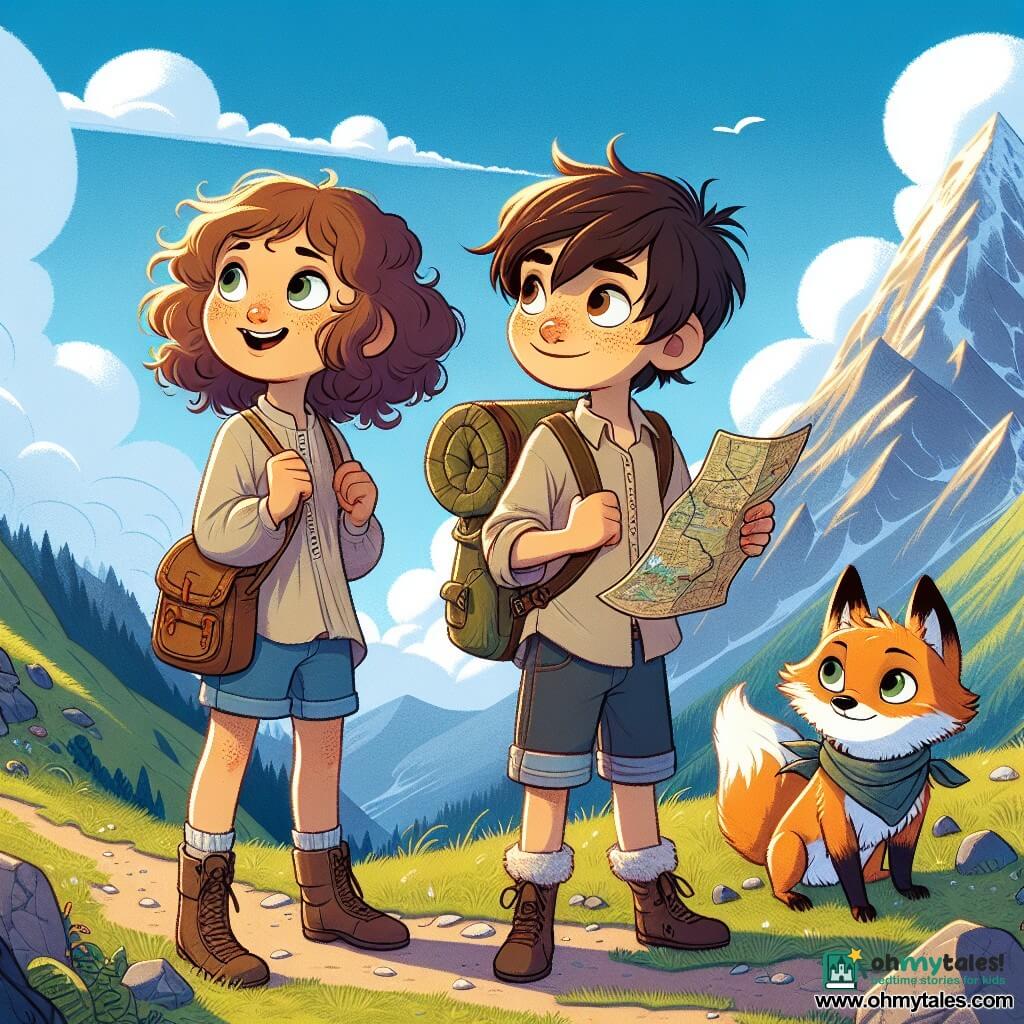
Something brushed Lark's leg. A fox, small and flame-orange, hopped onto the table. Its paws were stained black, as if it had stepped in ink. It blinked at them, tilted its head, and said, very politely, “If no one objects, I'd like to nap on that map. It radiates despair, and despair is surprisingly warm.”
Lark laughed, because the fox's serious voice sounded like a teacher who had misplaced lunch. “Who are you?”
“Ink,” the fox said, curling its tail gracefully. “I used to live in the Librarian's pocket. I can smell secrets.”
Toma stared, stunned. “Did—did that fox just—”
“Talk?” Lark finished. “I guess the world is trying to keep us awake.”
Ink sniffed the map and sneezed. “The bell's note kept the valley's memory in tune. Without it, maps forget. Birds forget. You'll forget where you're going even while you're going.”
Lark felt her smile become a steady light. “Then we'll fix the bell.”
“You're eleven,” Toma argued, whispering as if he didn't want the mountain to hear. “It's in the clouds.”
“I know,” Lark said, her cheerful voice simply stating a fact, as if she had announced her age, which she had. She glanced at the compass. The needle shivered and pointed toward the fog. “That's where we'll begin.”
The Whispering Map lay quiet. Lark bent over it and spoke, clear and soft: “We are going to the Skybell.”
The map quivered. A faint line, like a spider's silk, appeared and climbed the page, spiraling upward. Words formed beside it: Wind Stair.
Toma's mouth fell open. Ink's tail flicked. “At last,” the fox said, “something sensible.”
“The legend of the Wind Stair,” Toma murmured. “Steps made out of breath, woven by the first storm. You can only see them when you're brave or when you hold hands.”
“I'm good at both,” Lark said, grinning. “Let's find them.”
Chapter 2: The Wind Stair
They found the Wind Stair where the hills pressed the sky close, like children hugging a mother. The air thickened into shapes. Steps formed from nothing more than braided breeze and the smell of rain, each one the color of clear glass.
“Don't look down,” Toma said, promptly looking down. His freckles went pale. “Too late.”
Ink hopped daintily onto the first step, which bent but held. “The trick,” said the fox, “is to think you are lighter than your worries.”
“That's easy,” Lark replied, still smiling. “My worries are heavy. I barely carry them as it is.”
She offered Toma her hand. “Together?”
He took it, palm damp. “Together.”
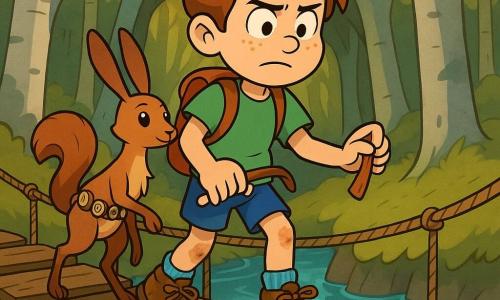
They climbed, the valley shrinking until houses looked like the buttons in Lark's sewing tin. The wind tugged Lark's hair and tried to borrow Toma's hat. He clutched it like a soldier shield. Ink trotted ahead, a bright dot on a road of air.
Halfway up, a cloud drifted by like a ship with torn sails. A face peered out from its gauzy side: an old woman with hair like cirrus and a smile like a soft rain. “Climbers,” she said in a whisper that sounded exactly like a kettle thinking about boiling. “Welcome to the Cloud Library.”
Lark wobbled on her step. “A library?”
“Of course.” The old woman's eyes were gray and kind. “Mistress Cumulus. You can call me Miss Cum. Come in. Your feet are making the wind jealous.”
Inside, the cloud was bookish. Shelves made of condensed fog held stacks of air-thin volumes. Pages flickered with lightning script. A small cloud-lamb snoozed on a pile of glossaries.
“We need to fix the Skybell,” Lark began.
“Of course,” Miss Cum said. “Everyone forgets things when it keeps quiet. Yesterday I called thunder by the wrong name. It sulked and wouldn't clap.”
“What happened to the bell?” Toma asked.
Miss Cum's gaze went far. “The Skybell's voice has a heart—a clapper carved from a Star-Seed. It shines with the memory of the first dawn. It was taken.”
“Taken?” Ink's ears flattened. “By whom? I'd like a word.”
“The Dusk-Fisher,” Miss Cum sighed. “He trawls the twilight, catching the glints that slip between day and night. Lanterns. Fireflies. Little lost star-crumbs. He is not cruel, only lonely. But he took the Star-Seed, and without a heart, the bell is just a mouth.”
“How do we find him?” Lark asked, leaning forward.
Miss Cum glanced around, as if the cloud had ears. “Under the Lake of Glass is the Cavern of Echoes. In it, the old songs still practice their scales. Spend a truth there, and a path will answer. You must catch an echo and tie it with this.”
She handed Lark a coil of silver string that glowed like moonlight on spoons. Then she gave Toma a small jar with a cork. “The jar will keep what you catch—from fading, from falling, from worrying itself away.”
Toma held the jar close. “Thank you.”
“And for Ink,” Miss Cum said, producing a tiny scarf knitted from mist. “So your neck doesn't get chilly.”
“I don't get chilly,” Ink sniffed, taking the scarf and wrapping it twice. “But I suppose the scarf might.”
Miss Cum's voice softened. “One more thing. The Wind Stair will not let you down if you don't let each other go.”
“We won't,” Lark promised, her smile gentle and firm, like a lantern lit and carried.
As they descended, something tugged at Lark's ear, a small whisper, a tiny maybe. She heard a voice—not Miss Cum's, not Ink's, not Toma's—like a bell held in a dream. It said, Clear things can break. That is not a warning; it is a choice.
Lark touched her compass. The needle swung toward the north, toward water.
“Lake of Glass,” she said. “Let's go.”
Chapter 3: The Cavern of Echoes
The Lake of Glass was exactly as advertised: so still it mirrored the sky, so slick it kept the footprints of clouds. Lark and Toma simply had to look down to see what heaven looked like when it studied itself.
“How do we… go under?” Toma asked, poking the surface with a reed. The lake did not answer.
A boat emerged along the reeds, stitched from willow leaves, its prow shaped like a swan's thoughtful head. A boy no older than Lark stood at the oars, but he was not quite a boy. His skin had the soft color of river stone. Moss dotted his shoulders like constellations. When he smiled, the lines in his cheeks looked like riverbeds.
“I'm Peb,” he said. “My mother is a hill. Get in.”
Lark didn't hesitate. “I'm Lark. This is Toma. This is Ink. We're looking for echoes.”
“I can take you,” Peb said. “But you must sing the lake's name as we go beneath. It only opens for manners.”
“What's its name?” Toma asked.
Peb dipped his oar. “Call it by what you see.”
They peered at the water. Lark saw the sky, her own face, clouds like boats, a hawk, and a wish.
“Mirror-of-Maybe,” Lark said.
The lake sighed. A circle opened, a mouth of light in the surface, as if the lake had decided to yawn. They glided down, and the world folded into cool blue. The water did not wet them; it held them, polite and curious.
The Cavern of Echoes smelled like rain and the inside of a seashell. Glittering stones hung from its ceiling. The echoes were not just sounds that had stayed behind. They were alive, like shy fish, shaking their tails and watching the boat with bright attention.
Ink's fur puffed. “I don't like caves,” he announced calmly. “Caves are made of black thoughts.”
Peb's voice echoed kindly. “This one is made of what people are brave enough to say. Don't worry.”
They came to a bridge shaped from sound, an arch woven from voices. Words floated by, thin as silk. Lark reached out and caught one: “Stay.” It melted to warmth on her palm and was gone.
At the middle of the bridge, a chime sounded without a bell. A calm voice rose from the stone, old as chain lightning. “Spend a truth, and a path will respond.”
Lark glanced at Toma. He swallowed. “A truth?”
The echoes gathered like children at a story.
Lark lifted her chin. “I'm afraid of wasting time,” she said. “I keep trying to do everything, and I think I forget the important thing. It makes me rush, even when I smile.”
The cavern held that truth and shook it gently, as if checking for loose corners. Then a line of light unspooled from the far wall, pointing deeper.
Toma took a breath. “I'm afraid of heights,” he said. The cavern sighed, a kind, recognizing sound. He added quickly, “But I'll climb anyway.”
The path brightened.
Ink squinted, then said, “I'm afraid of being found out—that I'm not as clever as I pretend.”
The cave hummed. A glow grew beneath the arch, and the bridge settled, solid as stone. Peb's eyes shone like wet pebbles. He added, softly, “I'm afraid to be left behind.”
The cavern trembled, pleased. The echoes drifted toward them, less shy, more curious.
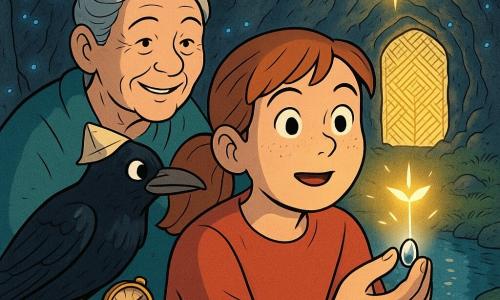
They left the bridge and followed the light to a lake of dark inside the cave, like night poured into a bowl. On its shore stood a stone pedestal. On it, a small bell of glass. Inside the bell, not a clapper, but a hummingbird's heartbeat.
“Catch an echo,” Lark whispered.
Toma uncorked the jar. The air wobbled, and the echoes drew near, choosing their favorite places to sit and wait. Lark spoke into the jar, careful and simple. “We're looking for the bell's heart. Where is it?”
For a moment, nothing. Then the jar filled with a sound so soft it was almost a color: a note that felt like a hand refusing to let go. Words rode that note, wearing it like a coat: “The bell's heart sleeps in a mouth of light that opens only to those who sing together.”
Toma clapped the cork back on, his eyes huge. “We did it.”
Ink's whiskers trembled. “Of course we did. We're remarkable.”
Peb's stone fingers touched the jar's glass. “Be careful. Echoes bruise easily.”
Lark tied Miss Cum's silver string around the jar. It pulsed once, like a vow.
“How do we find the mouth of light?” Toma asked.
Peb pointed toward a tunnel where shadows swam like fish. “That way. To the cliffs at the edge of Twilight. That's where mouths of light hang open, yawning between day and night. The Dusk-Fisher will be there.”
Lark set her shoulders, and her smile became a compass. “Then that's where we go.”
Chapter 4: The Dusk-Fisher
Out of the cave and up through the polite water they rose, their leaf-boat surfacing like a breath let out. They walked until the land thinned and the sky thickened, and there the valley ended in a line of cliffs as crisp as the edge of a turned page. Beyond lay twilight, a sea of purple air where fish swam: streaks of silver, lantern-bellied minnows, old moons shedding scale.
On a ledge, a figure cast a net made of hair-thin starlight. He drew it in hand over hand, patient, careful, pulling up a net-full of glows. He wore a cloak of dusk and boots of cloud. His face was lined, not with anger, but with long listening.
“Hello,” Lark called, her voice friendly as a porch light.
The Dusk-Fisher turned, startled, the net sagging in his hands. His eyes were the color of evening when everything becomes a maybe. “You should not be here,” he said. “It's not safe for the day-bright.”
“We need something you have,” Lark said, stepping closer. “The Skybell's Star-Seed. Without it, the valley forgets itself. We forget our way home.”
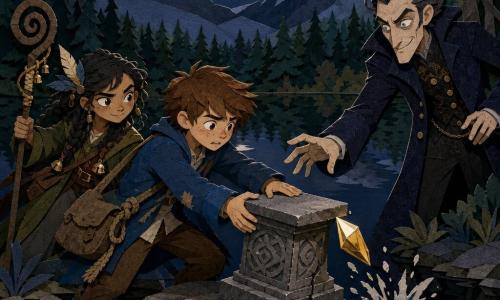
The Dusk-Fisher's fingers tightened on the net. A firefly flickered like a worried heartbeat. “I took it because the dark is wide,” he said. “I am alone in it. The light tells me where I end, and the night begins. The bell's heart… it keeps me company. It never goes out. When it's in my net, I am not a hole.”
Ink sat with careful dignity. “We understand loneliness,” he said. “We also understand that stealing a bell's heart is bad manners.”
Toma elbowed Ink. “We're trying diplomacy,” he hissed.
Lark lifted the jar. “We brought an echo that may open a door. Will you listen with us?”
He glanced at the jar, then at Lark, whose smile was not a weapon or a trick, but a warm place to sit. Slowly, he nodded.
They walked to a cleft in the cliff, a mouth of light curled like a sleeping animal. It was closed, a lip of brightness pressed tightly together. Lark could feel something behind it, an old pulse, a gentle, patient heartbeat.
“Open to those who sing together,” Toma read from the memory of the echo, as if reading a secret ingredient on a pastry label.
“My singing spoils bread,” Ink said primly. “But I can hum.”
“What should we sing?” Peb asked.
Lark closed her eyes. She thought of the bell ringing and the day stitching itself to the valley. She thought of the moss on Peb's shoulders, Miss Cum's kind eyes, Toma's brave hands, Ink's little proud voice. She thought of the Dusk-Fisher's long night. She opened her mouth and sang the simplest song she knew—the old nursery tune her grandmother used to hum while baking: a melody like warm butter, like a hand patting flour into calmness. Toma found the tune and joined in, his voice true if a little shy. Ink hummed, a tiny bee in a jar of honey. Peb added a low note like a stone rolling in a river. The Dusk-Fisher listened for one, two, three heartbeats. Then, almost unwillingly, he sang too—a thin line at first, a thread of twilight that wove itself through their daylight melody until the song filled the crack with something like a handshake.
Light uncurled. The mouth opened.
Inside, a small chamber glowed gold and white, and on a pedestal made from cloud, the Star-Seed rested: a little heart of bright, a clapper shaped like a teardrop that was glad it had been cried.
The Dusk-Fisher's breath hitched. “It is so loud in its quiet,” he whispered.
Lark walked in, cradled the Star-Seed in both hands, and felt a pulse that matched her own. She looked back at the Dusk-Fisher. “Come with us,” she said. “Bring your net. Help us put it back. Then—after—we'll make the nights less alone. We'll give you a lantern made from stories. Or we'll visit. Or—” She laughed, bright and sturdy. “We'll teach you to bake. Your cloak smells like someone who needs cinnamon.”
He stared at her smile as if it were a bridge he didn't trust yet. “You would invite me? Knowing I took what you love?”
Lark shrugged, shoulders small and brave. “Perhaps you took it because you didn't know how else to ask.”
Ink muttered, “Diplomacy. Celebrities will write about this.” But his eyes were warm.
The Dusk-Fisher's dusk-thin face softened. He nodded, very slowly, like a night agreeing to give morning a turn.
They left the yawning mouth open, because sometimes the world needs a little extra light, and carried the Star-Seed toward the mountain where the Skybell slept.
Chapter 5: The Mountain and the Mouth
The climb to the Skybell was not easy. The mountain wore a crown of storms, and its slopes were littered with the bones of old thunder, bleached white and harmless. The bell hung between two peaks, a great bronze giant with its mouth drinking the sky.
Wind buffeted them. Toma pressed a hand to the mountain, as if asking it nicely to please not drop him. Ink's mist scarf fluttered like a small, indignant flag. Peb carried them over gaps when the path gave up, his stone hands gentle as bread dough.
At a narrow ledge, the Dusk-Fisher paused. He looked small without the twilight sea. “I cannot climb this bit,” he said, ashamed. “It is too… bright.”
Lark turned. Her smile wasn't blinding; it was smoothing. “Then I'll go first. You go last. That way the bright and dark can talk to each other, and no one is left behind. Peb in the middle.”
“I always wanted to be the middle,” Peb said happily.
They reached the bell. It was larger up close, the size of a house turned upside down. Its bronze sides were carved with storms learning manners, and its lips were nicked from years of ringing a single perfect note.
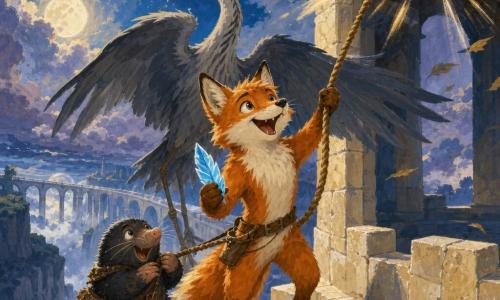
Inside, hooks waited for the clapper that wasn't there. The bell felt like a hollow promise. Lark swallowed hard and climbed a lattice of old rope and iron to the hooks. Toma followed, carrying the Star-Seed wrapped in cloth. Ink scrambled up the rope as if he had been born to be a sailor. Peb and the Dusk-Fisher waited below, watching carefully as if they could catch them with their eyes if they fell.
“I don't love this,” Toma confessed to Lark, cheeks pink. The wind tried to steal his hat again. “But I love being with you while I don't love it.”
“I love that,” Lark said, and meant it. She reached the hook and held out her hands. “Star-Seed.”
Toma lifted it carefully, delicately. It glowed in his palms as if it had decided he was a safe secret. Lark took it. The Star-Seed felt warm and very old, like a story your grandmother tells that her grandmother told and so on until the first fire.
She lifted it to the hook, but the wind shoved hard, a rude elbow from an old aunt. Lark lost her footing.
For a second the world tipped. The Star-Seed slipped. Toma's hand shot out. Ink grabbed Lark's sleeve with his teeth and hung there, a tiny scarfed anchor. Peb pressed his palm against the bell's side. The Dusk-Fisher threw his net upward; it flared out, catching light, catching hope, catching the falling clapper like a spider catching a star.
Lark planted her foot, laughed breathless, and said through her teeth, “Thank you.”
“Cooperation,” Ink puffed, spitting fabric. “The universe's least advertised miracle.”
They lifted the Star-Seed together, Toma steadying, Ink bracing with his whole little body, the Dusk-Fisher's net a sling of twilight. Peb hummed low, a steady base note, and the hook accepted what it had been missing. The Star-Seed settled with a sound so soft it was almost a sigh.
“Now,” Lark panted, “we ring it.”
“How?” Toma asked.
Lark pulled the silver string from her pocket and tied one end to the Star-Seed, the other around her wrist. She winked. “With this. And with the echo.”
They climbed down. The wind howled. The bell moaned, a door wanting to open.
Toma uncorked the jar. The captured echo rolled out like a cat who had been waiting for the right invitation. It stroked the air, feeling the shape of the bell, finding its old cradle. The Dusk-Fisher took a breath and sang the nursery tune, thin at first, then stronger. Peb's low note filled the bell like a river rising. Ink hummed, a bee in a cave full of flowers. Toma and Lark joined, their voices a braid, and Lark pulled the silver string, setting the Star-Seed in motion.
The clapper swung.
The bell opened its mouth.
And the valley listened.
The note that poured out was not a sound. It was a decision. It said: I am here. You are here. We are a place. It threaded into the birds' wings and the bees' paths and the river's old chorus. It floated into Windmere and reminded the bread to rise and the weather vanes to point and the old men to laugh and the young ones to look up. It kissed Miss Cum's cloud and made her laugh like rain on tin.
Lark felt it ring inside her chest, in the space behind her ribs where fears had kept small rooms. It swept the rooms clean, knocked down a few unnecessary walls, and opened a window that had been painted shut.
They held the note until their lungs ached and their hearts felt enormous. Then it settled, not gone, just stretched across the valley like a hammock.
Lark tied the silver string in a neat bow and let it dangle. The Star-Seed glowed steadily. The Dusk-Fisher lowered his net, eyes wet and shining.
“You could come by on Tuesdays,” Lark said, catching her breath. “We can trade stories. Or cinnamon bread. Or both.”
The Dusk-Fisher set his net on his shoulder. “I will bring the night earlier on Tuesdays,” he said solemnly. “For your bread.”
“Deal,” Ink said. “As long as I get the crunchy corner.”
Peb patted the bell's side fondly. “It remembers us.”
“It will,” Lark agreed, her smile luminous and honest. “Because we remembered it first.”
Chapter 6: The First Chime
They went down the mountain in the light that followed the note, a light that seemed to balance on things before sliding away, as if it wanted to touch everything one more time.
In Windmere, the Whispering Map unfaded. It drank the words Lark whispered into it: Skybell. Lake of Glass. Dusk-Fisher. Wind Stair. It drew their path with little flourishes, decorating their bravery with swirls because the map liked to praise. Toma added tiny symbols: a fox's tail, a stone palm, a jar with a bow. He grinned when he saw Lark looking.
“I wanted to remember where we laughed,” he said. “The map should know.”
Miss Cum sent down a rainstorm full of warm syllables to wash the dust off the rooftops. Peb visited the baker and, to nobody's surprise, produced the best bread-rise the village had ever seen simply by humming. Ink strolled along the counters as if he had invented pastries.
The Dusk-Fisher came at dusk, shy under his net. People gathered, wary and curious. Lark introduced him the way she would a new neighbor. He bowed, deeply, and held out lantern fish who blinked in polite greeting. The village laughed like a door opening.
That night, a dozen lanterns lit the square—some oil, some glows caught from Miss Cum's library, one strange little jar that Toma placed carefully on the steps. Lark sat beside him, her smile tired in the best way. She removed the jar's cork.
A tiny chime unfolded, small and perfect: the first ring of the bell, the one that had come after so much climbing and almost-falling and steady hands. The sound reached into everyone and tucked a little quilt around their hearts.
“Now that,” Ink declared, blinking slowly as if pretending not to be moved, “is a memory worth catching.”
Lark looked at her friends, her village, the Dusk-Fisher leaning in, Peb humming to the bread the baker had brought, Miss Cum's cloud drifting low with librarian curiosity. She looked up at the sky, where the bell hung like a promise kept.
She thought of the legend Old Bram had muttered—the one about forgetting the way home when the Skybell went quiet. It turned out the way home was not a path at all. It was people making a circle around a sound. It was neighbors learning a stranger's name and a stranger learning the word for bread. It was a fox with ink on his paws accepting a scarf he did not need. It was a stone boy with moss-constellations who knew how to carry others. It was a map that needed whispers. It was a girl whose smile was not a solution but a lantern and a door.
Toma nudged her. “We solved the big mystery,” he said softly, as if saying it too loudly might make it roll away.
Lark nodded. “Yes. It wasn't just about finding a missing thing. It was about finding our voices and weaving them into a rope.”
“And cinnamon,” Ink added, catching a crumb and pretending it had attacked him first.
They laughed, and the jar on the steps caught that laughter too, placing it gently beside the chime.
Lark's grandmother used to say, “Keep your best memories in your pocket like warm stones.” Lark slid her hand into her pocket and found one there—the feel of a rope in her grip, the tug of a silver string, the weight of a tiny clapper like a tear that was glad it had been shed, Toma's hands steady, Peb's hum, Ink's small brave hum, the Dusk-Fisher's first shy note. She closed her hand around it, and it buzzed with the old bell's bright.
Years later, when the map had collected so many whispers it needed a nap, and Toma could climb without remembering to be afraid, and Ink had written a small book titled Polite Caves I Have Known, and Peb's mother the hill had grown a little taller from pride, Lark would still take out that memory and hold it up to the light.
Each time, she'd hear the bell's first chime again—small, then huge, then the size of the world—and see the faces around her, lit from inside. She would remember how the Wind Stair had felt under her feet and how courage had felt in her throat like a song she had been learning her whole life.
And she would smile, the same smile she wore the morning the Skybell fell silent, because the secret of the valley was in her pocket. It was simple. It was grand. It was a bell made of everyone, rung by a tug of together.
If you listened very carefully that night, you could hear the sky purring.
“I can't hear it,” Toma said the first time someone said that.
“Shh,” Lark told him, grinning. “Don't worry. It can hear you.”