Chapter 1 — The Day the Wind Sang
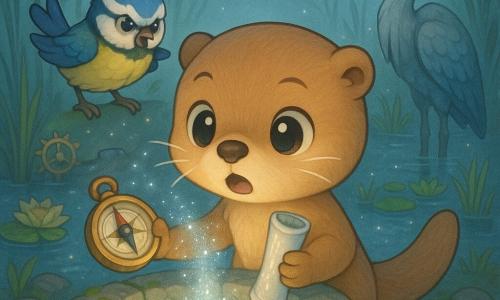
Morning spread like warm honey over the valley of Lanternwood. Pipes of tree trunks hummed with sap, and the river stitched silver stitches across the meadow. In a crooked attic above the old clockwork mill lived Pip, a small brass compass whose needle jingled like a laugh whenever the wind told a joke.
Pip loved two things: exploring and making new friends. He was round and glossy, his face a map of tiny scratches that looked like constellations. His needle was quick as a thought and forever restless. Each sunrise he would spin on the windowsill, whispering, "Today, today!" and the attic would answer with a sigh of dust and memory.
One morning, a note slid under the hatch like a sunbeam. It was a ticket folded from sky-blue paper: A journey to the Moonstone Glade. The Glade was a place of old stories, a meadow where stones hummed and the moon bowed low. But to reach it, travelers had to cross the Whispering Marsh — a place known for traps that smelled like promises.
Pip's needle shivered with glee. He jumped from the sill. "I'll go," he sang. "I will outwit any trap and find the Moonstone Glade!"
A tiny lock of chain around his hinge chimed like encouragement. The attic clock, whose hands swam like slow-finned fish, warned, "Be careful, little one." Pip only grinned. Curiosity was a compass rose inside him; even caution seemed an ornament.
Chapter 2 — The Trail of False Lights
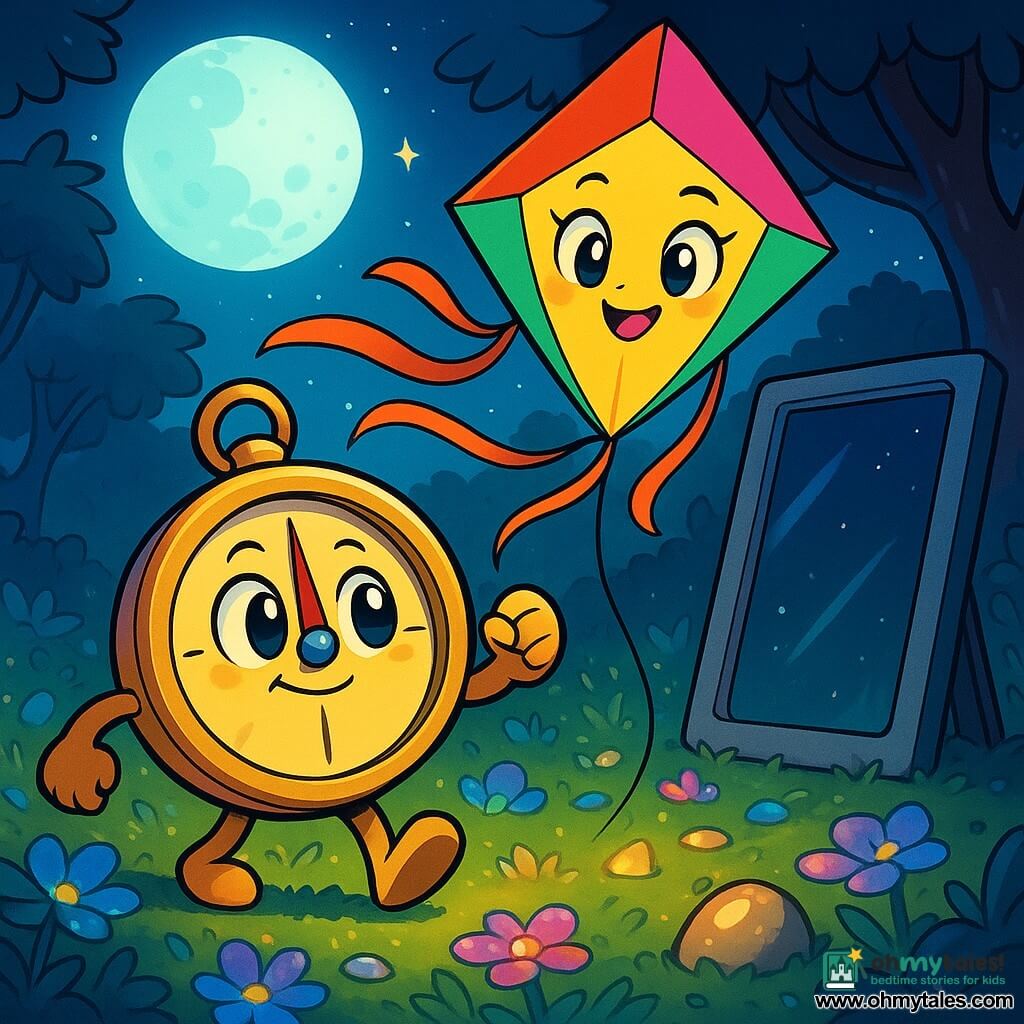
Pip set off, rolling down lanes where daisies leaned like listeners. He met a paper kite named Mira who danced on gusts and told him riddles in ribbons. "The Marsh shifts like a piano," she said, "and its keys like footsteps." From Mira he learned the first lesson: traps liked to imitate what travelers loved.
That evening the path narrowed into reeds. Lanternflies blinked like scattered stars, each a promise: follow me, follow me. Pip's needle quivered; the lights made little constellations on his glass. He remembered Mira's riddle and hummed aloud to keep steady: "Not every light is lanternlight."
Then, from the reeds, a soft voice called, silky as oil. "Come closer, little friend. The Moonstone Glade waits. Walk this way." Two glow-worms bobbed, spelling the word "shortcut" in tiny fire. Pip's heart polka-dotted with eagerness. His needle tugged toward them. For a breath he almost rolled into their braid of light.
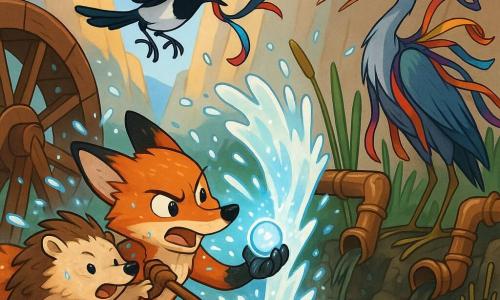
— "Hold!" snapped a reed, taller than a tree's eyebrow. It clicked its segments like castanets. From its mouth peered a Marsh-spider named Weave, with legs like knitting needles and eyes like dropped buttons. Weave loved riddles and bargains. She offered a trade: "A path for a trinket."
Pip thought of home, of the attic window, of the clock's slow fin. He felt small. He could give something; his hinge jingled with possibility. But then he saw the way the glow-worms' lights bent toward Weave's web, how the web shimmered like promises. He smelled trickery — a scent like candied rope.
"No bargains with webs," Pip whispered to himself. He remembered his scratches — the constellations of lessons. He rolled the other way, choosing the darker path where shadows had honest edges. Weave hissed and spun a stitch of shadow as a finger to point him back. Pip laughed, a bright chime. He'd slipped out of the first trap by trusting the small compass inside him that said, "Not all bright things are safe."
Chapter 3 — The Mirror That Wanted a Name
Beyond the Marsh lay a field of glass flowers — petals that reflected faces too eager to be seen. In the center stood a mirror propped on brambles. It was polished to a lie, and in it pip saw a brass compass grown tall, wearing a crown of dew. The mirror spoke in a voice that smelled like polished silver: "Name yourself to pass. Say who you truly are."
Pip's needle trembled. Sometimes he called himself Explorer, sometimes Friend, sometimes merely Pip. The mirror expected grand titles, carved-in-stone names. It wanted a banner to keep. Pip felt small against the mirror's appetite for labels.
A moth flapped by, powdered with moonlight. It landed on Pip's rim and whispered, "Names are like maps, but maps don't tell the forest how to feel. Tell it what you do."
— "I am Pip," he said, the name catching like a bell on a breeze. "I seek the Moonstone Glade. I listen to winds and follow true things. I try, and I laugh, and I unpick traps."
The mirror shimmered, and for a beat, Pip's reflection smiled back with proud scratches and a needle that shone like a compass rose in sunrise. The glass folded and opened like a grateful mouth, letting him pass. He learned that names could be simple and still valiant. Rooted in what you do, small names can steer big hearts.
Chapter 4 — The Snare of Echoes
Night pressed down when Pip reached the Marsh's heart. Here, the air was thick and full of echoes that could clone a voice like a mischievous parrot. He heard his own laugh bounce back, louder, then a second laugh — softer, sweeter — calling, "Pip! Pip! This way, this way!" The voices braided into a chorus of him that smelled like home.
He rolled forward, tempted, until the ground exhaled and a circle of reeds rose like teeth. The Echo Traps had sprung — glassy reeds that tinkled with every repeated sound and tightened when a traveler answered too gladly.
Pip's needle spun dizzy with all the reflected calls. He nearly answered them all. Somewhere an image of his attic flashed: the windowsill, the clock's fin. The echo called, "Leave what you're carrying. Come back to where it's warm." The reeds tightened with anticipation.
Pip paused. He remembered the mirror and Weave, the kite's riddle. He took a breath — a small, brass breath — and hummed a tune only he knew, a crooked lullaby his hinge liked to sing when the rain wrote letters on the roof.
He sang softly, not repeating the echoes' calls. The reeds listened, puzzled. Their hold loosened. Then, with the courage of someone who knows his own voice, Pip whistled a pattern, sharp and true, like the north-star's wink. The echoes tried to copy but missed a beat. They tangled themselves instead.
— "You won't trap me with my own name," Pip said aloud. "I am the one to choose my steps." The reeds folded down like embarrassed letters. Pip rolled through the clearing, the echoes trailing like paper boats, harmless.
Chapter 5 — The Puzzle of the Moonstones
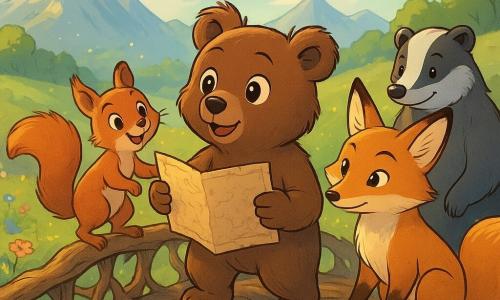
At last he reached the rim of the Moonstone Glade. The stones lay scattered like sleep-heavy moons, each glowing with a different mood: one blue with longing, another amber with laughter, another green with new beginnings. In the center stood the Moonstone Keeper, a statue of a fox carved from river-silk, its eyes set with tiny stars.
"To touch the Moonstones is to find the light," the Keeper intoned, voice like pebble and tide. "But the Glade keeps a test: one stone hides a trap, a mirror for the heart. Choose wisely."
Pip rolled among them, listening. Each stone hummed secrets, promising courage, a friend, a path home. One stone hummed the hardest, a deep drumbeat. It called to him, whispering, "Choose me, and you will never doubt again." Pip felt the lure — his needle shivered toward certainty. Doubt was a heavy cloud he sometimes wished away.
He paused, thumb-screw of a thought: traps liked promises of certainty. He thought of Mira, who spun her ribbons in wind; Weave, who loved bargains; the Echoes who mimicked home. Pip nudged the stones with careful curiosity, not hunger.
He pressed the amber stone gently. It laughed and brightened, sending out a warm ripple that looked like a grin. The green stone shivered and offered sprouting ideas. The deep drum-stone faltered, revealing a face carved like a mask. It was the Trap in guise, selling certainty at the cost of movement.
— "I choose being brave, not sure," Pip said. He set his small brass edge upon the green stone. A blossom of light uncurled, and the Keeper's eyes blinked as if awoken from a pleasant nap. The Glade sang, a tone that was both laugh and lighthouse. The trap? It crumbled into dust like a bad story.
Pip learned that courage lives in choosing despite not knowing everything.
Chapter 6 — A Light in the Night
As he stood in the Glade's heart, the moon leaned close, like an old friend pressing a cheek. The stones gathered their light and poured it into Pip. He felt warmth crawl through his screws, a glow filling his glass face. His needle flashed, steadier than ever.
— "The Marsh will remember you," the Keeper murmured, "for you outwitted its music with your own."
Pip laughed, a sound like a bell-sparkle. He looked back the way he'd come. The path was quieter now, honest as a well-told secret. The traps were only stories left to be learned from. He understood — traps spring where someone forgets to listen to themselves.
Night wrapped the world in velvet. Pip rolled to the Glade's edge and set himself upon a soft moss pillow. He couldn't carry the Moonstones, but he had gathered their light. He opened his tiny face and let the glow spill out, like a lantern uncorked. It painted the trees in soft silver, lit the faces of passing clouds, and turned the river into a ribbon of molten glass.
In the distance the Whispering Marsh exhaled and then sighed, like it had learned a new song. From then on, travelers would find a faint brass gleam by the marsh entrance, a small light to guide them past false promises and toward true ways. Pip's light was not bright enough to blind the dark, but bright enough to say, "This way, but watch the signs."
He thought of his names and his needle and all the riddles he had walked through. He understood now: courage is a lamp you build one careful step at a time, and trust in yourself is the wick. That night, the glade held him like a hand, and the valley slept with a new star.
When dawn came, Pip's light faded into the morning like a secret smile. He rolled home with scratches turned into new constellations and a needle that gleamed with a certainty you earn by trying. In the attic, the clock ticked to meet him. He hummed his crooked lullaby and settled onto the sill.
Outside, the sky kept its promises. Inside, a tiny brass compass had found a light to give, not hoard. And somewhere in the marsh, a faint glow remained, waiting for the next curious heart brave enough to choose their own way.