Chapter 1: The Checklist
Elias woke to the soft chime of the cabin clock and the thin blue light of the ship's orbit counter. He sat on the edge of the bunk, feet finding the warm mat like a habit. Every morning began the same: boots, suit inspection, water ration, navigation review. He liked checklists because they made a loud universe calmer.
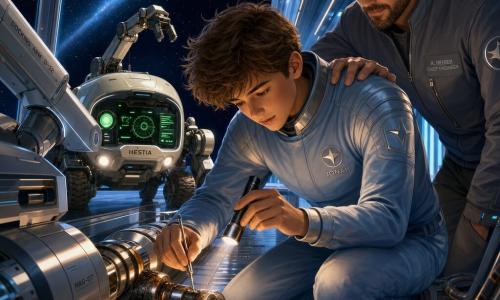
His handwriting was neat, each task crossed with a slow, satisfying motion. "Suit seal: green. Air scrubbers: green. Thermo-loop: green." He read the live feed from the geostationary port on the tablet floating in front of his face. Port Kestrel glittered like a careful city in the sky, a ring of docks and solar sails anchored above a quiet blue planet. Elias had arranged to live and work there—maintaining docking arms, calibrating sensor arrays, teaching young technicians protocol.
Today's list added: "Deliver spare regulator to Dock 7B. Report to Supervisor Ana at 1000. Practice lunar landing drills."
He smiled. Practice was not exciting, but it kept mistakes small. Elias pulled on his jacket, folded his checklist, and hummed as he walked through the narrow corridor. The ship hummed back—a friendly, engineered purr. He loved this—machines with predictable sounds, systems that answered when you asked them to. Predictability allowed people to breathe.
At the hatch, he paused. Outside the porthole, the planet turned slowly. The geostationary port hung in the distance, a cluster of platforms in perfect balance. Elias tapped the comm-panel, and Supervisor Ana's voice crackled in. "Elias, Dock 7B logged a loose coupling. They need hands in an hour."
"On it," he replied. He checked the spare regulator twice and stowed it under the seat. The checklist had spoken; the day had shape.
Chapter 2: The Calm Route
Transit to Kestrel was a gentle negotiation of gravity wells and precise burns. Elias liked to watch the burn indicators rise and fall like a heartbeat. He moved through procedures with a rhythm: ignite, monitor, correct. On long trips he hummed old songs; on short runs he counted the ticks.
Halfway there, the ship's sensor grid pinged—anomalous drift in a cargo freighter nearby. Small noises in space could mean many things: micrometeors, thermal flex, a tired thruster. Elias toggled the scope and slowed the ship. The freighter rotated slowly, its antennae arrayed like tired arms.
"Contact," he reported. "Freighter Delta-seven. Navigation error, low propellant."
"Stand by," Ana said. "Can you assist? They're at the edge of the corridor."
Elias considered the extra stop. It would delay him, but helping others was part of being allowed to live in a shared sky. He adjusted the course and sent a short ping to the freighter. The captain, a woman with a scratched voice named Mara, answered gratefully. Her ship needed a nudge and a trimmed burn profile—simple work, like adjusting a rug so it lies flat.
They worked together across the vacuum—Elias instructing, Mara piloting. He felt small and important at once: small because they were a speck of humanity in vastness; important because a correct sequence of thruster taps would keep them safe. The cargo ship settled into a stable hold near a beacon. Mara sent him a cup of synth-coffee through the docking convey—an old kindness.
"Thanks," she said. "You save us hours."
"Checklists," Elias said, and both laughed. It was a brief human knot in a long day.
Chapter 3: The Quiet Moon
Back on course, Elias set a steady pace toward Kestrel. The port's silhouette grew, but then the ship shuddered—a low, unfamiliar vibration. Lights blinked. He consulted the diagnostic screen: micro-debris strike on a solar vane; attitude control struggling. He had seen worse, but the port required him to be present; he couldn't arrive spinning.
"Adjusting," he said aloud, hands moving through the air as if turning invisible knobs. The ship corrected, but not fully. Sensors showed a slow leak in the attitude tank. Not enough for catastrophe, but enough that docking at Kestrel would be risky.
Ana's voice was calm. "If you can't secure attitude, approach is denied. You need a safe landing."
Elias thought of his checklist again. A landing, he realized, could be the right, sober choice. Use what you have, not more. He scanned for nearby places to settle—habitable moons, emergency pads. The map showed a small gray moon in a quiet orbit: little atmosphere, soft gravity, a name he'd never heard.
"Divert to Lune 3," he said. "Requesting temporary landing permission."
The port cleared him with a delay. Landing on an unprepared moon required careful planning. Elias went methodical. He adjusted thrust vectors to match the moon's gentle pull, ran through fuel estimates, and rationed power. He spoke aloud to keep his hands steady and his mind clear: "Approach 12 degrees. Engines green. Touchdown windows open."
The surface approached like a grayscale ocean frozen in time—pipes of rock and dust, wide plains that caught the ship's shadow. Elias guided the craft to a natural depression, a bowl-shaped crater that would cradle them. He cut engines at the last tick, and the ship sank into the dust with a soft, controlled thud.
Outside the hatch, the moon was quiet in a way he had never known. No whir of urban life, no distant buzz of other craft. The sky above was an honest black with a scattering of stars. Elias breathed—and felt how thin and precious that breath was. He checked the exterior cameras. The landing had been cleaner than he expected.
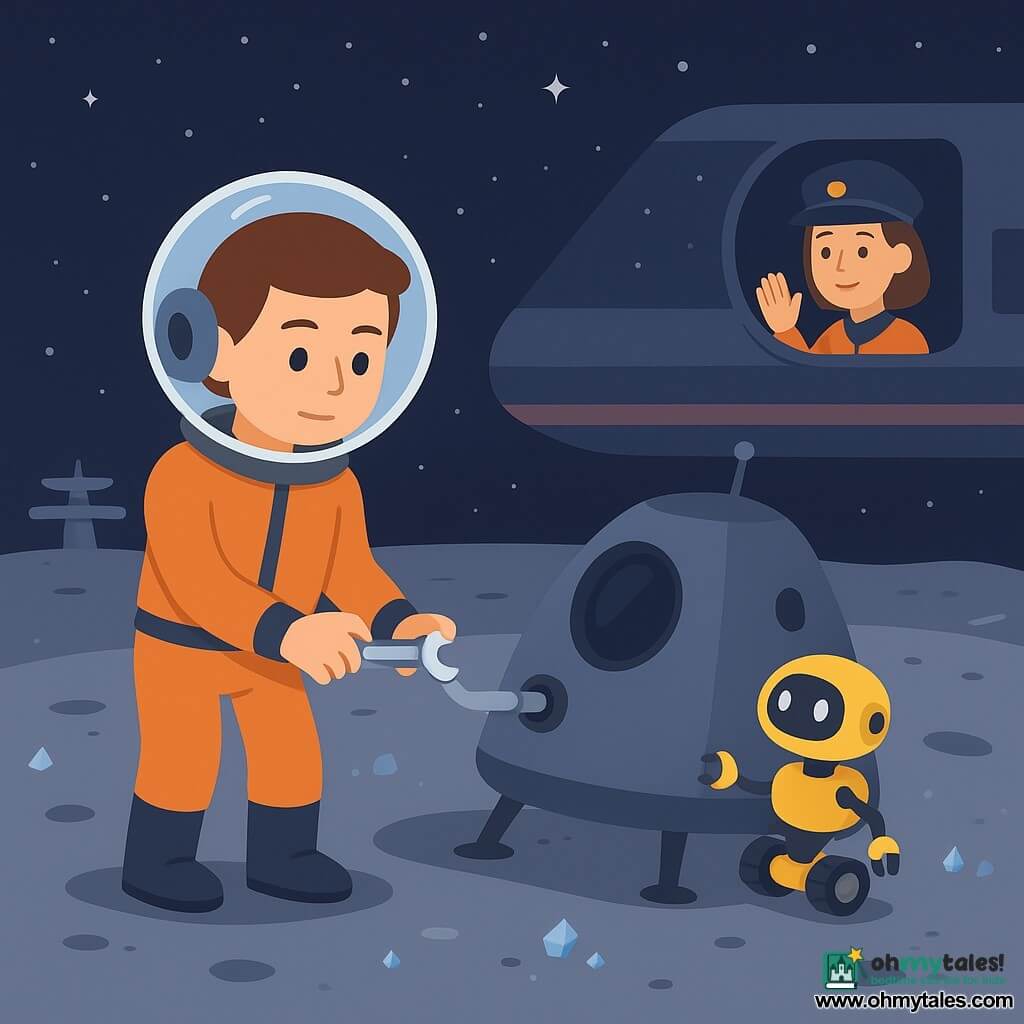
He stepped onto the surface. The suit hissed; his boots made neat prints on the gray ground. He carried the spare regulator like a small talisman. He walked a careful perimeter. The moon held no hunger, only stillness. He set a beacon and secured the ship with anchors. Then he did something small and sensible: he brewed hot water in the ship's compact kettle and shared a cup with his own shadow.
He spent the hours fixing the attitude tank as much as he could with the tools on board. He soldered, adjusted, conserved power. He ate a ration bar and thought about the freighter's captain and the neatness of checklists. If you planned well, you could give more.
At dusk—or what the moon called dusk—the sky blued faintly near the horizon, and a tiny smile of something like a sun warmed his faceplate. He pulled a small scrap of cloth from his pocket and laid it on the seam of the hatch, not to fix anything but to keep a memory. It was a child's cape someone had given him years before, when he first left the planet. He didn't need to do that, but he liked little rituals. They made the world kinder.
Chapter 4: The Return and the Panel
Repairs held. The attitude tank would keep for the short hop to Kestrel, but not without care. Elias sent a message to Ana: "Temporary touchdown on Lune 3. Repairs nominal. Will proceed at first window."
While he waited for clearance, the moon offered unexpected gifts. Small crystalline formations shimmered under his boot. He found a shallow pool of frozen vapor that reflected the stars. He recorded data to share with the port's archive—simple measurements, honest numbers. He packed the spare regulator and stowed his tools. He practiced a final checklist, folding habits into action.
When the port opened a safe window, he launched. The ascent was the inverse of landing: deliberate, patient. He nudged the ship's nose toward the open corridor and felt the steady tilt into orbital travel. Docking at Kestrel felt like returning home after helping a neighbor. Supervisor Ana met him at the airlock, a small smile and a clipboard.
"You handled that well," she said. "Quick thinking, calm hands."
"It was a quiet moon," Elias said. "Good place to remember how small we must be—how carefully we use what we have."
Ana's eyes softened. "We need people like that. People who choose less wasteful paths."
Inside the port, life went on with its soft hum of industry: technicians polishing panels, apprentices learning to read the long lists on screens, gardeners tending to potted greens under artificial light. Elias took his place at Dock 7B and set the spare regulator in the inventory rack. He unpacked the little mementos from his pocket—the child's cape, the tiny folded checklist that had traveled with him. Someone called for him to oversee a recalibration; he went.
Before leaving the central promenade, Elias took a moment. There was a small public wall, a narrow panel where travelers left notes or thanks. He had seen it on his first arrival and thought of the many hands that kept the port alive. He reached into his kit and found a thin sheet of metal salvaged from the freighter—a clean piece, like a small mirror. He engraved one short word on it with a careful hand.
merci
He fixed the panel into place for others to see. It was not a show of grandeur; it was a small, sober thanks to all that had kept him safe: the quiet moon, the helpful captain, the port's slow competence. He folded his checklist and put it away, feeling the rightness of routine and restraint.
That night, as the port's lights turned soft and the stars steadied, Elias walked to the observation deck. He watched the planet hang below, the moon a small pale dot. He thought of engines and lists, of small repairs and shared cups of coffee. He felt the steady confidence that comes from careful choices.
He returned to his cabin, set the kettle on low, and crossed one last item on his list: "Gratitude: noted." Then he turned out the light and slept, the ship's thoughtful hum like an old friend's breathing. The world outside remained wide and demanding, but inside him lay a promise that things could be done simply, patiently, with respect for the small measures that keep us afloat.
merci