Launch Day
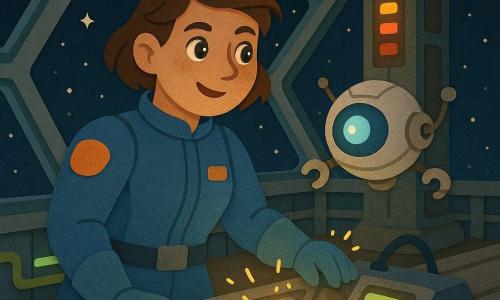
When Mara stepped into the cockpit of the shuttle Orion, her boots made a small, certain sound against metal. The control panel glowed like a careful map: soft blues, warm ambers, lines that suggested direction more than demand. Outside the hangar, the sky over New Europa was the thin, bright blue of a place far from sea level. Inside, the air smelled faintly of ozone and coffee from the crew lounge. She tightened the strap of her harness and felt the familiar tug of nerves settle into determination.
She was twenty-eight, with a short haircut that had no patience for helmets, and a neat scar along her knuckle from when she was learning to weld as a teenager. People who worked in space tended to collect small proofs of survival. Mara liked to think of that scar as one of her better souvenirs.
"Everything nominal?" asked Juno, the flight systems AI. Its voice was calm and slightly amused, as if it enjoyed the small human dramas it observed.
"Nominal," Mara said. The word felt like a promise. She ran her hand over the logbook case at her side. It was old-fashioned—a leather satchel with a magnetic clasp—because she preferred reading the original crew logs in their original form when she could. There was comfort in ink and paper, even if the ink was synthetic and the paper polymer. It made history feel closer.
Orion lifted. The upward motion was a gentle insistence, a firm handshake between metal and the thin sky. The launch ramp lit the shuttle's belly in a honeycomb of shadows. New Europa fell away, a neat grid of greenhouses and solar arrays, and beyond them, the migration towers that reached like fingers toward the low sun. Mara watched the world contract, then become a patchwork of light until at last the stars took their place and the planet was a crescent below.
She had been chosen to ferry a small team to the Titan Observatory: a compact research station built into an island of rock that peered from beneath Titan's orange haze. The observatory was a century ahead in technology, designed to study the outer systems and test an array of adaptive telescopes. It had been a site of triumph and, some decades before, of desperate repairs that had become legends in the crew logs. Mara had read those logs many times on nights when she couldn't sleep. They kept her company on long flights; they taught her how to be patient with people, machines, and weather.
"Course plotted," Juno said. "Eta to Titan interface: seventy-two hours."
"Set a coffee timer," Mara told it. "And wake me if anything asks to be fixed."
"Affirmative." Juno's tone warmed almost to a chime.
She settled into the slow, measured rhythm of transit: maintenance checks, small repairs, hours when the glow of instruments replaced faces. Orion hummed like an animal comfortable with its path. Mara sat with her hands folded, focusing on the logbook satchel. When the ship's artificial gravity softened for rest cycles, she opened it.
The first log she chose was from Captain Imani Reyes, written during a storm of hydrocarbon winds that had once threatened to close the observatory forever. Mara followed Imani's sentences like a trail of breadcrumbs—notes about pressure valves, a description of the way the wind played the station's struts like harp strings, a quiet line about the crew's laughter at three in the morning when someone had boiled sludge instead of coffee.
The words did something calm to Mara's mind. They showed a world where people made small, sensible choices under pressure. She imagined herself in that world, steady hands on familiar controls. Resilience, she thought, was mostly ordinary: patience, the willingness to try again, and the grace to accept help.
Outside the window, a comet winked past—brief and bright. Mara smiled and closed the book, tucking the satchel beneath her seat. Titan waited ahead, velvet and secret, and the observatory's lights were a promise.
The Approach
As Orion approached Saturn, the planet rose on the starboard side like a slow, immense thought. The rings threw their reflections across sensors, and Juno calculated a flight corridor that threaded through the safest gap. Titan was smaller in sight than Mara had imagined; in reality, it was a dim, layered world, clothed in mist. It made the heart tilt, the way distant things did: both close enough to touch in imagination and too distant for comfort.
They dropped out of faster transit for the final burn, a routine that felt less like a machine's decision and more like a ritual. Mara checked the panels—propellant levels, radiator status, burn vectors—and ran her fingers across the logbook satchel again. The second log she selected was from Technician Erik Sol: a short, precise hand, full of lists and quiet jokes. Erik's entries were anchored in detail: cracked rivets, a map of spare parts, a note that two of the station's sensors liked to be tapped at the same place to wake them from sleep.
"Latitude correction?" asked Mara when the station's automated docking sequence spit out a miss by a fraction.
"Small drift," Juno said. "Geo-station reference shifted by five tenths. Recommend remote thruster burst."
"Execute at my mark," Mara said, fingers steady. She watched gauges stitch into line. When the thrusters fired, the shuttle felt the shove of a small animal resettling into its bed. The trajectory smoothed. She breathed out.
Titan's atmosphere was an amber curtain from which the observatory's dome emerged like a lighthouse. The approach was slow; the sky was thick and the sensors algebraic with noise. The station's docking port winked open to accept them, a mouth of warm light against the cold world.
A small tugway connected the station to the observatory's core. Workers—three other specialists and a veterinarian for the bio-experiments—moved with practiced calm. Mara studied their faces: there was excitement, yes, but also the attentive look of people who had rehearsed trouble in their heads and decided, anyway, to go.
"Welcome, Pilot Mara," said Dr. Lensa, the station lead. She had eyes that focused like lenses themselves—clear, perceptive.
"Happy to be here," Mara said. Her voice sounded like a new instrument.
The observatory smelled of electronics and sun-warmed seals. Panels held constellations printed like braille to remind the crew where windows used to be and where they might be again. At night, the structure gleamed faintly as if remembering sunlight.
Later that evening, while the team ate a recycled stew, Dr. Lensa handed Mara a plastic-wrapped stack of the station's historical logbooks. "They arrived with the central core," Lensa said. "We thought you might like them."
Mara accepted them with a small, serious bow. The logbooks sat on the table like a pile of small planets, each one with its own gravity. She flipped through them: handwritten entries, margin sketches, a child's list of imaginary constellations tucked between maintenance reports. The station's history felt like a family album, with notes of joy threaded through repairs and resilient jokes.
That night, alone in the sleeping cubicle, Mara read a log from Navigator Jun Park about an emergency comms blackout. Jun had written, simply, "We lost chatter, but we kept listening." The line made Mara breathe in a different way. She made a mental note: when things failed, listening could become a tool as sharp as any wrench.
Storm on the Dome
On the third day, the observatory warned of a storm. Titan's weather was a slow, patient thing—clouds that roamed like flocks and winds that learned when to be clever. The dome's external sensors registered a rise in charged particles and a shift in wind layers. Dr. Lensa consulted the station's projected models and made a decision that felt like folding hands: they would secure the dome, postpone outside work, and run a deep systems check.
Mara liked being busy. She found a list of tasks the way other people found music. She tightened bolts on a maintenance hatch that had shown tremor readings, rewired a feed that had been humming at a frequency like a distant beating heart, and ran diagnostics on an old thermal coil that had stubbornly insisted on aging.
Then the lights shuddered.
It began as a small stutter, a micro-flicker that crawled like an insect along the light rails. The emergency systems engaged—red along the walls, a soft drone of backup power. Conversation folded into calculation. The team moved without drama: rope lines secured, sensors isolated, a plan enacted like practiced choreography.
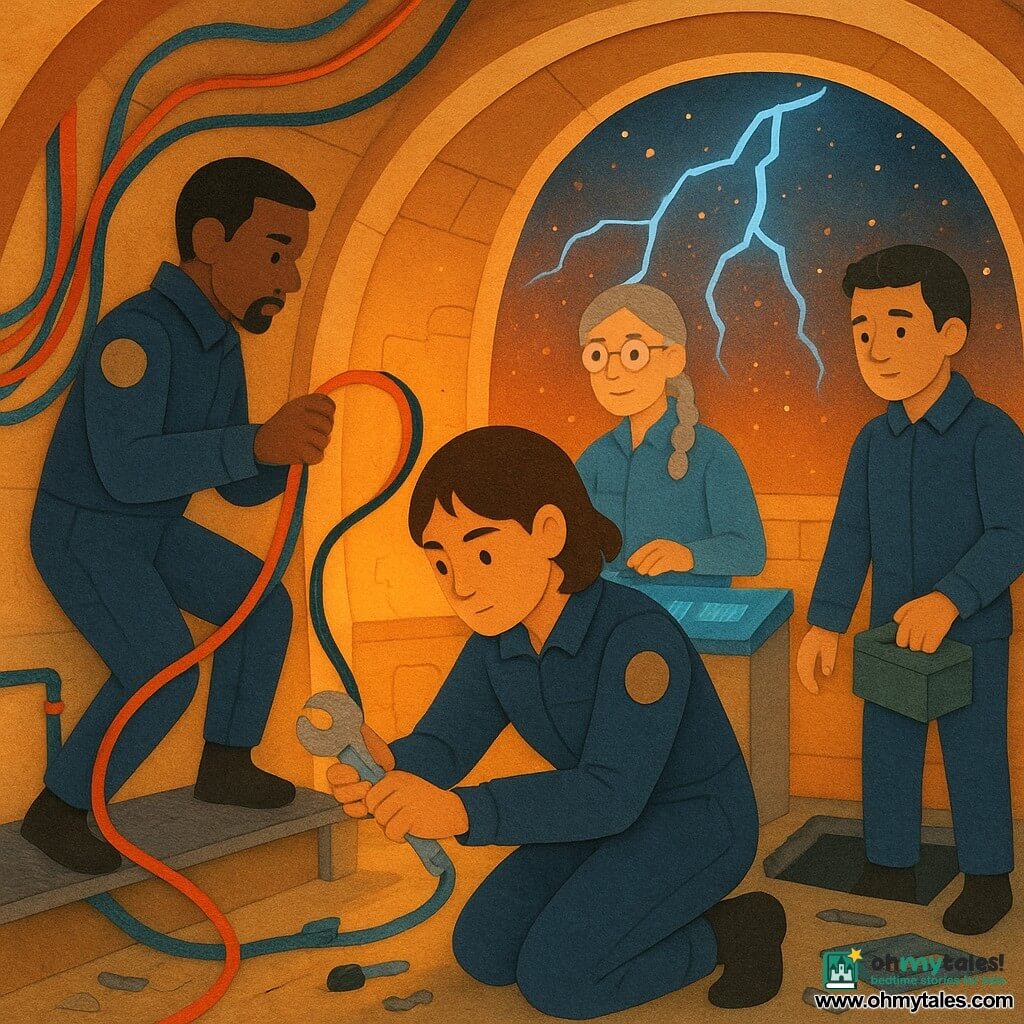
But the storm was clever. It sent a wave of charged particles that found a seam—a small, forgotten splice in the observatory's oldest power conduit. The splice arced. A bang of metal and the smell of overheated insulation filled the air. The dome's main cameras blinked and went dark.
"External optics offline," Juno reported. "Image feed lost."
"Status on primary array?" Mara asked.
"Critical circuits tripped. Manual override required," Dr. Lensa replied. Her voice did not rise. It was the voice of someone who knew that panic was the more dangerous element.
Mara felt a tightness in her chest, a little spike of fear that tasted like iron. She tuned it into action. "Give me the logs for the original splice work," she said. "And the location of spare couplers."
The logbooks were at her side. She flipped to the report written long ago by Engineer Kaito, who had marked that particular splice with a small triangle. Kaito had written in a tidy, stubborn hand: "Old habits fail under strain. Put in a bypass and leave a note." The note was there, faded but clear: a drawing of a bypass route that avoided old metal fatigue.
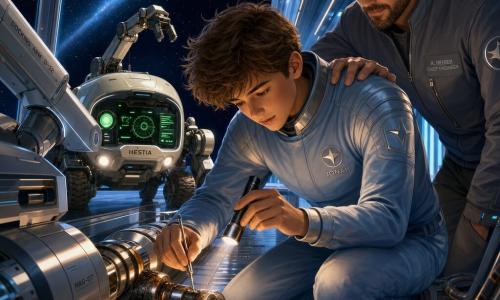
Following Kaito's drawing, Mara and a small team climbed the service ladder into the ribs of the observatory. The storm pressed against the hull like a question. Each step was measured. The service corridors creaked with age and purpose. Mara worked fast, installing the bypass coupler as Kaito had drawn and fastening it with bolts whose grooves fit like puzzle pieces. She tightened the last nut and felt the satisfying click of a job finished. The team engaged the manual relay. Power flowed again to the external cameras, which blinked and returned to life like waking eyes.
There was a cheer, brief and human, that seemed to escape the careful atmosphere. Dr. Lensa placed a hand on Mara's shoulder and said simply, "Thank you."
Mara's hands were gritty with grease and she felt both tired and very awake. The logbooks had guided her hands. She had read those notes not as a museum-goer but as someone listening for instructions left by friends across time.
That night, she read Kaito's entry over and over, thinking of how people left traces of themselves: a sketch, a note, a worn bolt. It felt to Mara like the best kind of company—knowledge passed forward, a chain she was now part of.
Voices from the Past
With the observatory stable, downtime arrived like a gentle tide. While others ran experiments or inspected the outer array, Mara sat in the archive room where the logbooks were stored. The room smelled of warm polymer and the faint metallic tang of old pens. The daylight lamps were low, the kind that suggested evening even in mid-cycle.
She picked a log at random and found the entry of Commander Imani again, but earlier than the storm notes she had first read. This one was written during the installation of the main telescope. Imani's words were full of wonder: the first image captured of a distant, ringed planet; the laughter when a sensor misinterpreted a bird as a comet; the way the crew ate dehydrated fruit and declared it the best fruit they'd ever had.
Mara read until the lines blurred. Each log was a voice: Jun's quiet pragmatism, Erik's small jokes, Kaito's precision, Imani's steady courage. Sometimes a sentence would glow with a truth so bright she could have leaned toward it and touched it. "We were afraid," a log would say plainly, "but we were also curious." Another time, a margin note: "We learned to fold our fear into plans."
The logs did more than tell what had happened; they taught the living how to be. They offered recipes for making coffee in a pressure loss, or how to rig a sensor with a paperclip and a dream. They contained instructions about humility—admit what you don't know—and about stubbornness—try again.
Mara began to record her own notes in the margin of one log. They were small: "Checked harness cams," "Bypass coupler—match Kaito's drawing." It comforted her to put her handwriting next to theirs. She felt connected to something larger: a history that made living through difficult things a shared enterprise rather than a lonely trial.
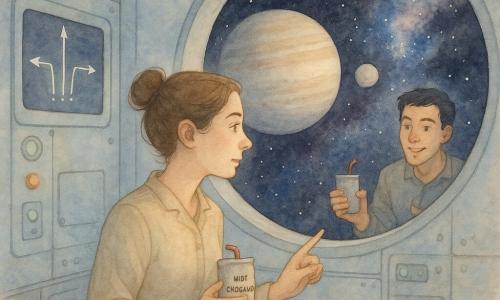
That evening, she sat on the observation terrace with a cup of synthetic tea and watched Saturn rise. The planet hung near the edge of the sky like an old friend arriving. The rings caught light and scattered it in a fine shawl. The station hummed around her, an organism of learning and needed fixings. People inside had been resilient in the face of storms; they had left instructions and held hands across time. That made the vastness feel less cold.
"Do you ever get homesick for Earth?" Jun asked, having joined her without warning.
"Sometimes," she said. "But I like that homesickness keeps me moving forward. It makes me curious."
"Curiosity keeps us resilient," Jun replied.
Mara watched a meteor streak past, a bright scratch across the black. It felt like a message: small, fleeting, and beautiful.
Night of Stars
Their mission's final week was a gentle blend of maintenance and wonder. The team recalibrated the main array, smoothed the telescope's focus, and shared stories under the soft light of the mess. Mara guided a small unmanned probe to the outer sensor ring and watched its controlled drift like a kite. The station settled into a rhythm that felt like a living poem—steady heartbeats of machinery and small acts of care.
On the last evening before Mara's return flight, Dr. Lensa invited her to the dome. The external optics were open, and the observatory had set a modest public feed: images of distant systems that bloomed in colors the human eye could not normally see. People on New Europa would see the stream in a delayed broadcast, but here, in the dome, they would watch raw and close.
They sat together and quieted their voices. The main telescope was an enormous thing: a mechanical hand cupped gently around a sliver of cosmos. As the shutters opened, the first light poured in—a river of old photons that took a long time to travel, patient and sure. Mara thought of the logbooks and their small, persistent instructions. She heard the echoes of Imani, Jun, Erik, and Kaito in the way the room breathed.
A projected image came alive: a field of stars burned like lanterns against velvet. Nebulae glowed in colors that were not names but feelings—saffron and sorrowless blue, lavender like a child's laughter. A whisper of a galaxy turned like a wheel in slow motion. The feed carried a faint rhythm, a music made of light.
"Do you ever think about how small we are?" Dr. Lensa asked softly.
"We're small," Mara agreed, "but we are also very loud when we need to be." Her voice was a private laugh. It held the sort of steady humility that had become part of her.
They watched in companionable silence until the dome's dome lights dimmed and a hush fell. The observatory's instruments recorded and stored data with a delicacy that felt like creation. Many hours later, when the dome closed and the crew dispersed to their tasks and quiet quarters, Mara walked to the terrace alone.
She opened the satchel and took out the logbook she had been annotating. The margins were full now of small notes and a few drawings: a diagram of the bypass coupler with an extra bolt circled, a tiny map of where she'd liked to sit during storms, and the last line she'd written that day: "We keep listening."
Mara lay back on the terrace bench. Above, the sky over Titan was a velvet canopy pierced by countless lights. They were steady and peaceful, not the flash of a single comet but the persistent truth of long journeys. Saturn hung like a guardian in the distance, its rings a pale halo.
She thought of the storm, of Kaito's triangle and Imani's laughter, of the way the team had moved as if each person were part of a machine and each person was also more than a tool. Resilience, she realized again, was not a single heroic act. It was a collection of small courage: the choice to keep reading, to leave notes, to tie a bolt one more time, to listen when someone else spoke. It was the way people stitched themselves to one another across time.
A breeze—not the wind that could batter a hull, but the thin, precise movement of refrigerated air—brushed her cheek. The stars seemed to watch like friends.
Mara closed the logbook and tucked it back into the satchel. She imagined the pages waiting for future hands, the loop of knowledge continuing. Tonight, she thought, the night belonged to those who had kept going.
She breathed in, slow and deep, and let the hush of the observatory settle around her like a warm blanket. The stars were bright and patient. She had fixed what needed fixing, learned what needed learning, and left a note in the margin. Tomorrow she would steer Orion home, carrying with her the careful, human instructions of those who had come before.
Under the broad, star-speckled canopy, Mara felt small and whole. She closed her eyes and, for a moment, imagined a thousand tiny lights rising and falling—each one a story, each one a person deciding to try again. The observatory hummed. The planet watched. The night was kind.