Chapter 1: The Quiet Wake-Up
Commander Elias Rowan woke to the soft hum of the habitat ring and the slow blue light of the control console sliding across his bunk. Outside the thin window, the new world—Aurelia-3—hung like a coin of green and amber. The voyage had been long, precise, and above all planned. Elias liked plans. They were maps for worry and routes for hope.
"Morning, commander," said Mara, the systems officer, through the intercom. Her voice was a warm knot of coffee and careful numbers.
"Morning," Elias answered, rubbing the stiffness from a shoulder still tight from yesterday's checks. He sat up and scanned the day's list pinned to the wall: surface scouting, soil tests, habitat anchoring, deploy solar arrays. Each task carried a small symbol: a triangle for caution, a star for success. The solar array had two triangles.
He dressed in a lightweight suit and walked the corridor past sleeping crew members. Their faces, lit by small bulbs, looked younger than their ranks. That was how space made people: smaller around unknown things and larger where they were kind.
At breakfast, Elias gathered the team. "Today's priority: power," he said. "We need full arrays up before the storm forecast. Temperatures will drop and our heaters will need steady energy. We move with care."
There was a murmur of assent and a collective tightening of shoulders. Planning was one thing; the planet's weather maps, patched together from orbital scans and a single buoyed probe, could surprise them. Elias loved the unknown in idea, not in danger. Prudence was not timidness—it was the quiet strength that kept a crew together.
Chapter 2: First Steps and Loose Soil
Outside the habitat, Aurelia-3 greeted them with a wind that smelled faintly of iron and rain. The planet's gravity was a friendly pull, a reminder that this was not Earth but a place with its own rules. Elias led the surface team to the intended site for the solar field: a gentle valley with a southern exposure and a bed of loamy regolith.
"Samples first," Elias reminded them. He knelt and brought up a scoop, hands steady. "We're checking composition and compaction. Solar mounts need true ground."
Mara ran the soil probe and shared a readout. "Organic traces low, mineral clay content higher than expected. Hold on anchors—this will shift under heavy load."
Elias looked at the landscape: a carpet of short, waxy plants, a shimmer of distant ridges. The prospect of standing arrays there, catching the planet's light to power new homes, thrilled him. But the anchor readout was a stitch across his plan. He paused, feeling the weight of decision.
"Adapt," he said. "We'll use wider base plates and dig to firmer layers. Extra time now avoids a collapsed field later."
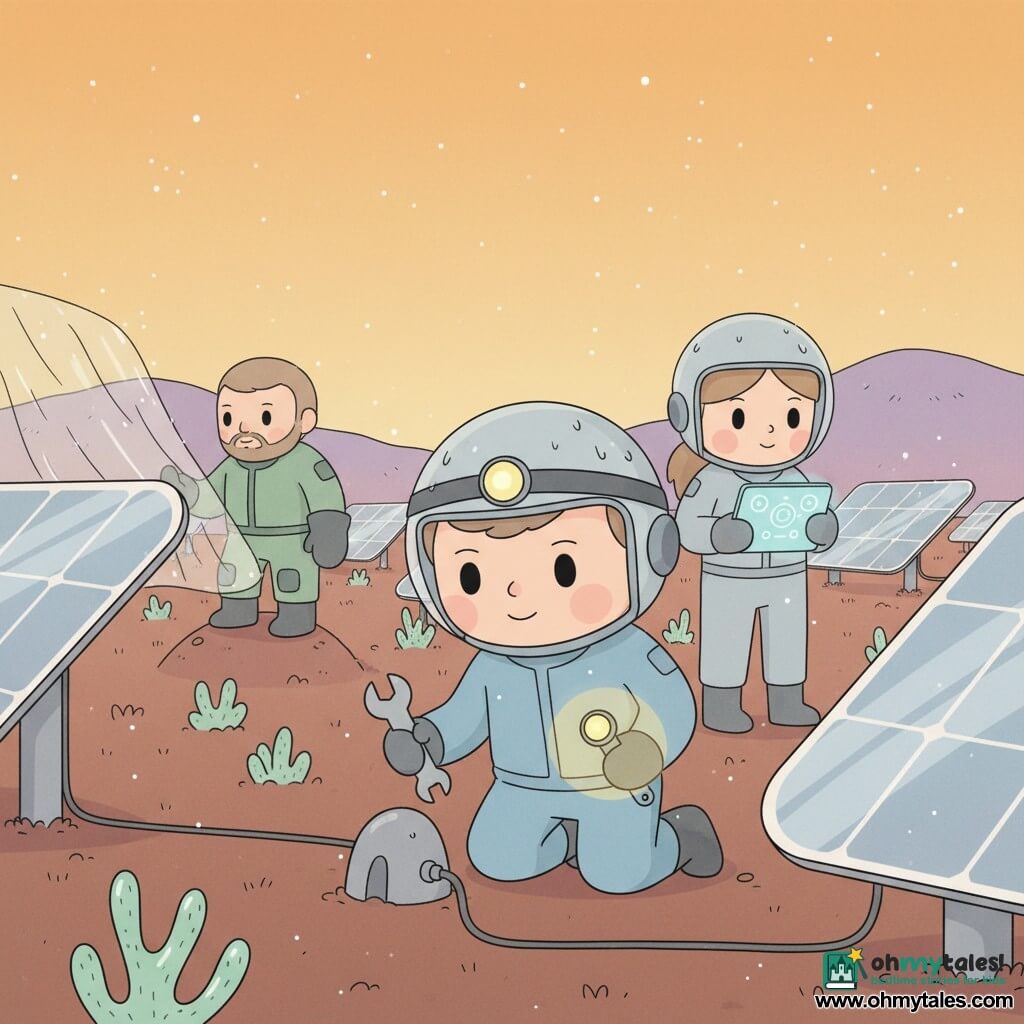
They set to work with the calm choreography of people who had practiced restraint. Two crews dug trenches, set wider plates, and tested pull strength. When a plate yielded more than predicted, Elias called for reinforcement. Sweat collected at the temples under their helmets, and laughter bubbled up once when someone accidentally covered a rover in regolith. Small things like that kept spirits balanced against the hum of caution.
At the end of the day, the first foundation plates were secure. The sun slipped low and painted the valley gold. Elias stood and felt something like a heartbeat underfoot—the long, slow start of life taking hold. He allowed himself a brief smile and the satisfaction of choices made with care.
Chapter 3: Nightfall and a Fault
Night came fast on Aurelia-3, colder than the day's pleasant warmth. The crew returned to the habitat to monitor the overnight data. Outside, the temporary lights they brought blinked against the dark like patient fireflies.
At 02:14, an alarm threaded through the quiet. A red band pulsed on the console: External Array Field B—integrity fall. Mara's hands were already at the panel. "One of the anchors shifted," she reported. "Pressure cascade in the northern spans."
Elias grabbed the suit pack. "I'll go," he said. "We can't let a collapse take the whole line. Nobody else rushes out until I confirm it's safe."
His voice was calm but his mind moved a dozen steps ahead: check atmosphere seals, test for surface tremors, approach from downwind, secure temporary guy-lines. He slapped the manual lock on the airlock and moved into night.
The wind had risen. A distant ridge threw up a line of dust that shimmered like beaten metal. The array field was a quilt of silver panels, some crooked now, their mounts strained. One panel leaned at an angle that made its connectors groan.
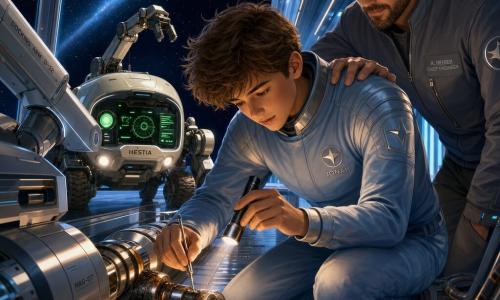
Elias knelt and methodically checked voltages and stress points by handlamp. The temperature dropped his breath to mist. He attached a stabilizer cable, then another, always keeping a safety line back to the rover. On a planet, small errors could become large consequences. He thought of the crew asleep in the habitat—each life a reason to be thorough.
"Heavier anchors," he spoke into his comm. "We need to anchor to bedrock. The soil's giving."
Mara's voice came, steady. "Rover-mounted drills prepped. We'll dig slots and pour polymer set. That should lock them in."
They worked together, hands moving in practiced sequences, and the array's tilt corrected inch by careful inch. The worst passed with no drama, only the quiet satisfaction of problem-solving. When the last stabilizer locked, Elias let himself unclench and laugh, a small sound in the cold.
Back in the habitat, he reviewed the log. "Good decisions tonight," he told Mara. "Prudence kept us from more work."
"Prudence and your insistence on a safety line," she teased. Elias smiled, feeling the warm return of companionship.
Chapter 4: Storm and Creativity
Two days later, the forecasted storm arrived. It began as a nervous breath, then a wall of wind and chilled particles that turned the sky to a moving mural. The habitat shuddered with gusts. In the operations bay, the crew watched readouts climb: wind shear, particulate density, rapid temperature drop.
"We can't leave the arrays exposed," said Leon, the engineer. "We risk cumulative damage."
Elias considered options. Shutting down and folding the panels would leave them without the full power needed for life support the next day. Leaving them up risked damage and the loss of future energy. He made a choice rooted in the same careful pragmatism that had saved them nights before.
"Partial retract," he commanded. "Angle them low, lock the edges, and deploy the windbreak membrane. We'll sacrifice peak output to guarantee survival."
They worked under the shelter of the habitat, suited crews running tether lines, guiding panels into defensive positions. The membrane, a flexible reflective sheet, snapped into place like a synthetic skin. Rain—fine and metallic—began to hiss against it. The wind howled, testing their work. At one point, a gust that came faster than any forecast tugged a panel free of its strap.
Elias was already there, hands moving to clamp and secure. He felt the strain of the wind against his back, taste grit on his lips. There was a moment when a panel snapped like a tired hinge, but Leon's quick thinking braced a temporary stay that kept the rest from cascading.
When the storm passed, they measured losses. One panel was ruined beyond repair, a second bent but serviceable. The counts were lower than they might have been because of their decision to take the conservative approach. The habitat's power dipped but held; the crew slept with heaters humming and data streams steady.
Elias walked the field at dawn, boots leaving prints in a ground washed clean. "We learned," he said, noting bent hinges and where the polymer anchors had held. "We must adjust design for this planet's storms."
There was a tired cheer from the crew. They had been tested and had passed because they had chosen caution over bravado. Prudence had meant fewer losses and more tomorrow.
Chapter 5: Assembly, Sunlight, and a Pause
After the storm, the pace steadied into constructive rhythm. The crew replaced damaged segments, and together they assembled the main solar arrays. Elias oversaw each step: aligning panels to the sun, checking connection trays, calibrating trackers to follow Aurelia-3's slower day. He moved among them like a careful conductor, hands on bolts one moment and offering quiet encouragement the next.
"Remember to torque to spec," he reminded, and then softer, "Good work, Ana." The panels were elegant in their simplicity: flat, efficient surfaces that turned light into electricity with an economy Elias admired. He loved that while the planet's challenges were immense, the solution could be a simple hinge tightened to the right degree.
At midday, they prepared to unfold the final array, a sweep of panels meant to power the new habitat fully. The crew gathered at a distance, bundled against a breeze that now felt like a greet. Elias keyed the initiation and the panels rose, unfurling like a metallic field of sunflowers turning their faces.
Power lights climbed. The habitat's array meters hummed into full charge. Machines recalibrated, heaters eased their strain, aquifers and air recyclers hummed with extra energy. The view of the array from the ridge was beautiful in a way that had nothing to do with technology and everything to do with purpose: a durable ribbon of light turned into life.
Elias felt a fatigue that was clean and earned. He sat on the habitat steps as the crew returned, hands joined in high-fives and quiet clapping. They had built something lasting through patience and sensible choices.
"Take the rest of the afternoon," he said. "We deserve a pause."
They lay out a blanket and shared dehydrated fruit and hot tea brewed from concentrates, the kind of simple comforts that tasted miraculous after hard work. The sky arced across Aurelia-3, and for a few hours they let the heavy urgency of survival go. They told jokes that were smaller than a joke on Earth, more careful, more tender. Children of their imaginations played in the wind.
Elias leaned back, watching solar panels glint in the late light and listening to the soft conversations nearby. He felt the crew breathe as one, each person a part of a mechanism that worked because it valued caution and clarity.
When the sun dipped, he stood and folded his blanket with methodical care. "Tomorrow we expand," he said. "But tonight we rest."
They rose and went inside, heated air wrapping them in a civilized comfort. Elias took one last look at the field before closing the hatch: steady arrays, anchors sunk to hold, and a future that would bloom slowly, safely, built by hands that had chosen prudence over haste.
Then he turned off the exterior lights, and the habitat settled into a soft, earned silence. Outside, the planet breathed on, an indifferent but watchful partner. Inside, the crew slept, and Elias allowed himself a pause—brief, honest, satisfied—knowing that careful choices had carried them this far and would carry them further.