Chapter 1: A Future Painted in Light
The world Jonah woke into was not the world his grandparents remembered. Cities floated on silent pylons over green seas. Solar sails like soft glass unfurled above parks, collecting light and storing it in cool, humming rings. Machines mended bridges and gardens by dusk; tiny drones pollinated rooftop orchards. People lived more simply because machines took the heavy chores — but they still had to decide what mattered.
Jonah had grown up on stories of the old ocean-bound arks, but now the dream was an ark of a different kind: a star-borne refuge called the Helios Ark, a self-contained city designed to travel between stars. It was meant to carry ideas, plants, and people to another system, to give life a new chance where resources here ran thin. The Ark's builders had combined gentle engineering with strict logic. Their designs were transparent: schematics in public libraries, decision logs open to citizens. Machines could propose solutions, but humans had the final say. That rigour — the habit of asking why — had helped Jonah decide to become an astronaut.
Jonah was twenty-five, still young and soft around the edges, with stubborn brown hair and a constant habit of tapping his thumb against the inside edge of his glove when he thought. He loved small facts: the exact angle starlight made on the Ark's biolum gardens, the way rover treads left thin, tidy marks on unfamiliar soil. When the Helios Ark announced volunteers to travel to its orbiting launch node and later to its distant habitat, Jonah signed up, imagining a life tied to telescopes, soil samples, and careful choices.
The launch node was a machine of polished rings and patient algorithms sitting in geosynchronous orbit. It hummed with a thousand soft engines and employed a transparent governance: each major decision logged on a public ledger and explained in plain language. Jonah learned how the Ark balanced sunlight and shadow, how its recyclers turned breath into water, and how its seed vault rotated to keep varieties of life safe. It was a future built on clear procedures and human trust.
On a gray morning that smelled faintly of ozone, Jonah stood before the Ark's boarding platform, his rover packed and checked. He said goodbye to his sister, Mira, who pressed a small woven ribbon into his hand. “Don't forget to ask why,” she said, smiling like she always did. Jonah tucked the ribbon into his suit pocket, felt its soft curl, and stepped onto the path that would lead to the star-ship waiting beyond the pale glass curtain.
Chapter 2: The Rover and the Route
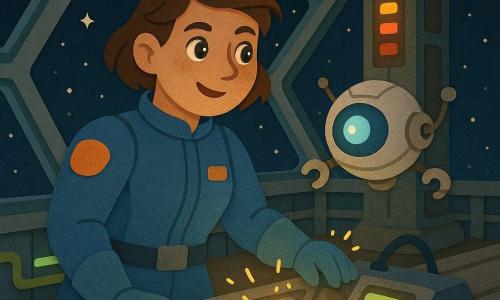
Jonah's rover, called Hestia by the crew who maintained it, was a compact, all-terrain vehicle with wide treads, a low center of gravity, and a cheerful display that blinked like a companion. Hestia had gentle sensors and a precise arm that could lift seedlings, scoop dust, or tap a rock to see what lay underneath. It was not faster than the larger exploration machines, but it was careful, and that suited Jonah.
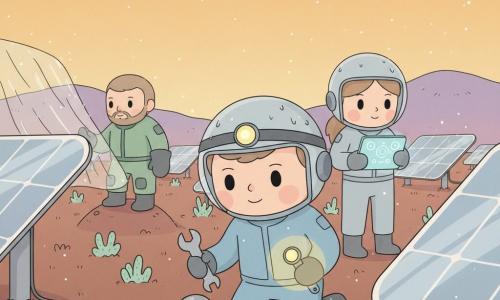
The mission was simple on the map: pilot Hestia across the Ark's outer terraces, gather diagnostic samples, and practice long-range navigation to the Ark's orbital docking arm. But simple maps rarely tell everything. As Jonah rolled Hestia past sunlit hydroponic terraces and through gardens of engineered moss, he watched how the Helios systems balanced themselves. Sensors told the Ark when algae needed more blue light; the Ark replied by tilting light sails by fractions of a degree. Machines and people had conversations in pulses of light and precise language. Jonah learned to listen.
At midday, the sky looped with the slow shadow of a maintenance drone. Jonah steered Hestia toward a cluster of pale planters where a bloom did not open. He extended Hestia's arm and took a sample. The display read: nutrient balance fine, water content low, microcontroller fault in nearby irrigation node. Jonah's fingers flew over Hestia's simple interface. He traced the fault through a public maintenance ledger and found a note left by a technician: “We adjusted for thermal drift last week. Monitor closely.”
Jonah could have sent an automated patch. The system could have fixed it and forgotten the incident. But he remembered Mira's ribbon and the habit of asking why. He adjusted the irrigation software and ran a simulation. The patch stopped the immediate drain, but the simulation showed a cycle that would leave the node unstable in a month. Jonah logged his findings and appended a question to the ledger: “What assumptions did the last fix make about thermal variance?” A technician replied later that night with a calm, precise explanation and a plan to recalibrate. The community learned because Jonah asked.
Hestia's treads hummed as they crossed a narrow catwalk into the Ark's shadow. Jonah mapped the route, updated the maps with his notes, and felt a small, steady glow of satisfaction. On long missions, small records saved big mistakes. He felt ready for the larger voyage: to pilot Hestia beyond the Ark's skin and toward the Helios docking arm that would transfer him to the Ark proper in a few days.
Chapter 3: A Fault in the Night
The night Jonah's transfer was scheduled, a soft alarm woke him. Hestia's display showed a cluster of anomalies on the docking arm: misaligned magnets and a slow power bleed. The Ark's central AI had flagged the issue. Engineers debated whether to delay the transfer. Lives were not at immediate risk, but the docking arm had to be precise. The logs showed a recent software update from a third-party contractor that altered the arm's feedback loops.
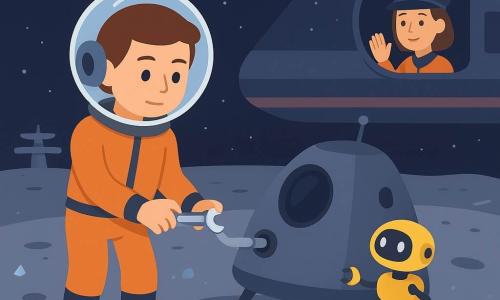
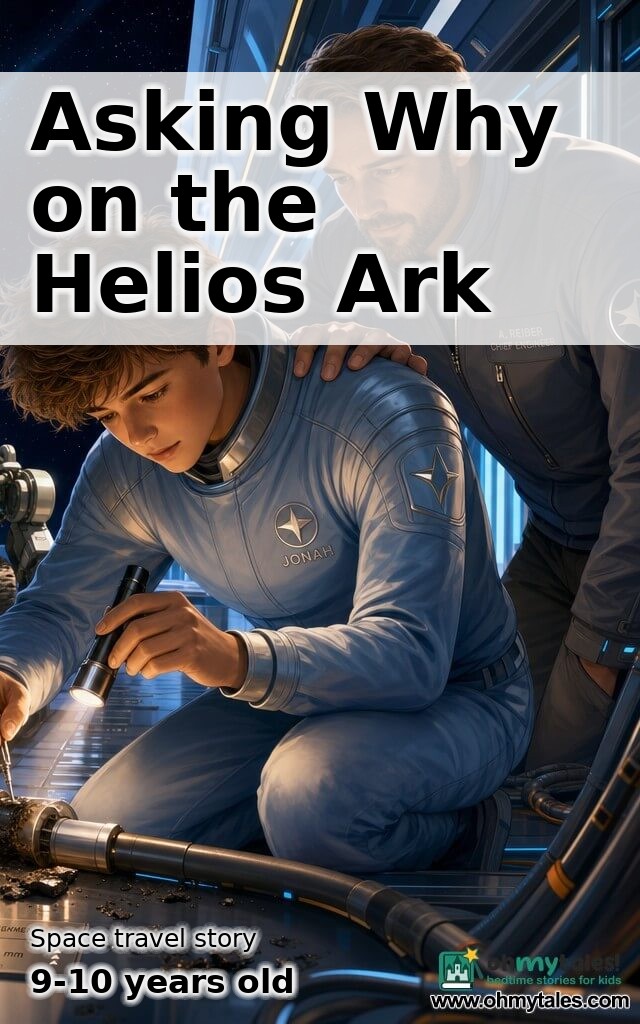
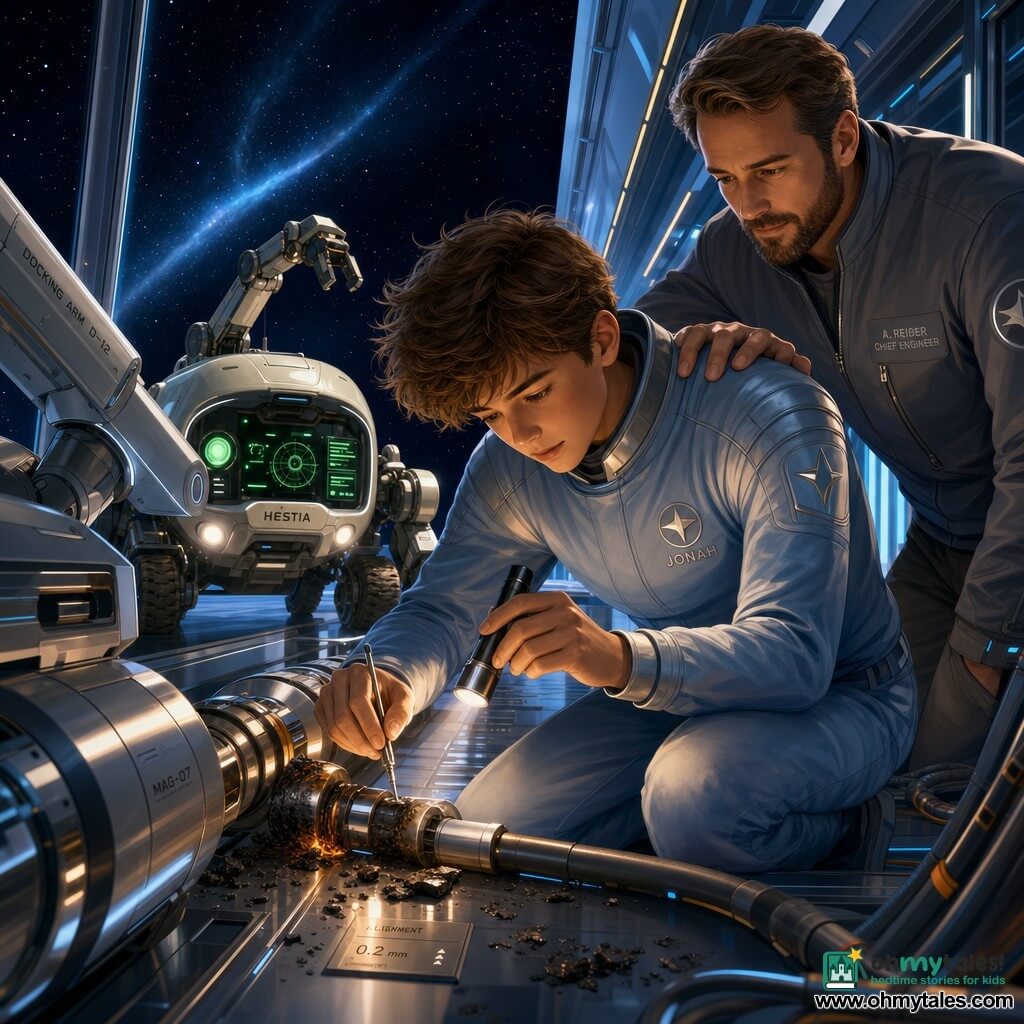
Jonah could wait and let others decide, but waiting was a decision too. He climbed into Hestia and told the rover, “Let's take a closer look.” Hestia's sensors recorded everything. At the base of the docking arm, Jonah found a simple, almost poetic problem: a tiny patch of slag — a byproduct from a maintenance burn — had fused two clamps, subtly twisting a magnet's alignment. The software update amplified small physical inconsistencies rather than correcting them.
He reported the physical fault, the slag, and cross-referenced the contractor's update notes. The contractor's log used a favorite phrase: “self-compensating feedback.” Jonah knew how seductive that phrase could be; it suggested a system could fix anything if left alone. He asked a steady question into the public ledger: “What tests were run to simulate small physical irregularities?” The contractor answered with simulation data, but the simulations had used perfect clamps, not slightly warped ones.
Jonah suggested, simply, that the team run a physical stress test using slightly warped clamps and see how the updated feedback behaved. Engineers were tired and cautious, but the Ark valued testing in the real world. They ran Jonah's test. The results mirrored his suspicion: the update amplified the misalignment. The fix was practical: remove the slag, revert the feedback loop to a safer baseline, and add a new test to the maintenance routine.
Jonah's insistence on checking the physical matter beneath the elegant software reaction had prevented a potential accident. He realized that in a future of clever machines, human judgment was not obsolete; it was the filter that asked whether a simulation matched a messy reality. In the quiet afterward, an engineer clapped his shoulder and said, “You kept us honest.” Jonah smiled, thinking of Mira's ribbon, and felt his doubts settle like dust.
Chapter 4: Crossing into the Ark
When the docking arm finally engaged, lights flowed like slow rivers along its spine. Jonah steered Hestia forward one last time. The Ark's passage was a narrow throat of glass and light, and Jonah watched the stars smear into soft ribbons as the mass of the Helios Ark shifted in its orbit. Inside the docking tube, systems sang with precise timing. Jonah read the logs out loud, aloud in his helmet as if to steady himself. Hestia hummed approval.
Onboard the Ark, Jonah met a community that valued clarity. Scientists discussed theories with gardeners. Children asked up-close questions during meal cycles, and teachers answered with full, patient explanations. There were debates about which seeds to prioritize for the Ark's new gardens and careful votes about oxygen allocation during maintenance. Jonah learned committees and voted, but he also learned how to listen and to ask the awkward questions that freed assumptions from their comfortable nests.
A week into his stay, a small crisis arrived: the Ark's compost cycle slowed. Food scraps were not breaking down as quickly, and nutrient output lagged. Automated composters suggested turning the piles faster, but old compost wisdom said turning too much disturbed beneficial fungi. Jonah volunteered with the compost team, steering Hestia across the management bays to transport sensors and fresh waste. He listened to the senior bioculturist, who explained the chemistry in plain, almost poetic steps. Together they ran a simple experiment: varied the turning frequency, measured pH, and watched microbe activity. The answer was neither machine's automatic fix nor a refusal to change; it was a balanced schedule informed by data and observation. Jonah found the rhythm of work familiar and satisfying.
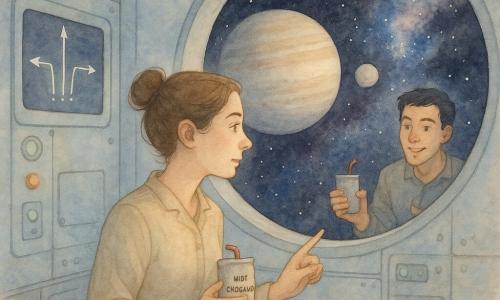
In quiet hours, Jonah sat by a window that looked out into interstellar space. He pressed his palm against the cool glass and watched distant suns pinprick the black. He thought of the slag on the docking clamp, of the irrigation node, of compost microbes. He thought of Mira's woven ribbon, still in his pocket, a small thing that reminded him to ask why.
The Ark's life was not a string of heroic events but a seam of steady choices: calibrate, ask, test, listen. Jonah had come expecting to pilot, to explore, but he found his chief role was to hold the habit of careful thinking in place. That, it turned out, was what made a voyage wise.
Chapter 5: A New Day Among Bright Doors
Months later, Jonah took Hestia to the outer terraces one more time. The Ark glowed with a gentle health. Gardens ran smoothly; the compost cycles hummed; the docking arm bore a small plaque listing the incident and who had contributed fixes. Jonah signed the ledger with a short note: “Ask; test; repeat.” It was not a proclamation, only a modest reminder.
As the Ark slid past a thin filament of cometary dust, a new day began. In the Ark's communal hall, people exchanged soft greetings, seeds swapped hands, and a child asked a hard question about why stars flared. The reply was not a single answer but a lesson: we look, we record, we think together. Outside, Hestia's treads left neat marks on a narrow maintenance path that would blur with time.
Jonah woke to the quiet light of the Ark's morning. He rose, took Mira's ribbon from his pocket, and looped it into his hair out of habit. He stepped outside and felt the gentle breeze of recycled air on his face. The stars were still there, patient and distant. On the Ark, people moved with the steady certainty of a community that trusted evidence and kindness.
A serene new day began, shaped by small decisions and the simple courage to ask why. Jonah smiled, set Hestia's schedule for the day's work, and walked toward the gardens, ready to listen, to test, and to do what needed doing.