Chapter 1: The Pigeon With the Silver Toe
In Skylark City, the streets always sounded like something was arriving.
Overhead, the elevated trains clattered along iron ribs, and the windows flashed like coin faces when the sun caught them. Below, people hurried past newspaper boys and street musicians, past corner shops with jars of boiled sweets, past tall buildings that wore soot like old coats. It was the early years of the new century, when everyone seemed to believe the future was a bright thing—if you polished it enough.
Mina believed it too, but for a different reason.
She was nine, small and quick, with a satchel that never looked full even when it was. She worked as a messenger between two worlds—the ordinary one, where teachers frowned at ink stains, and the other one, where the ink sometimes wriggled into words all by itself.
Her friends worked with her, because Mina did not like being brave alone.
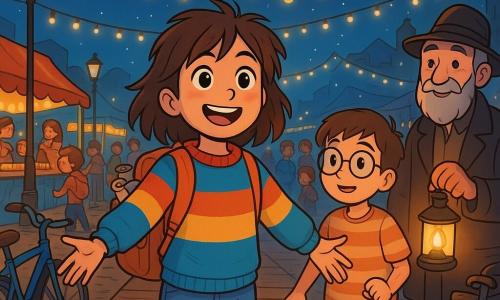
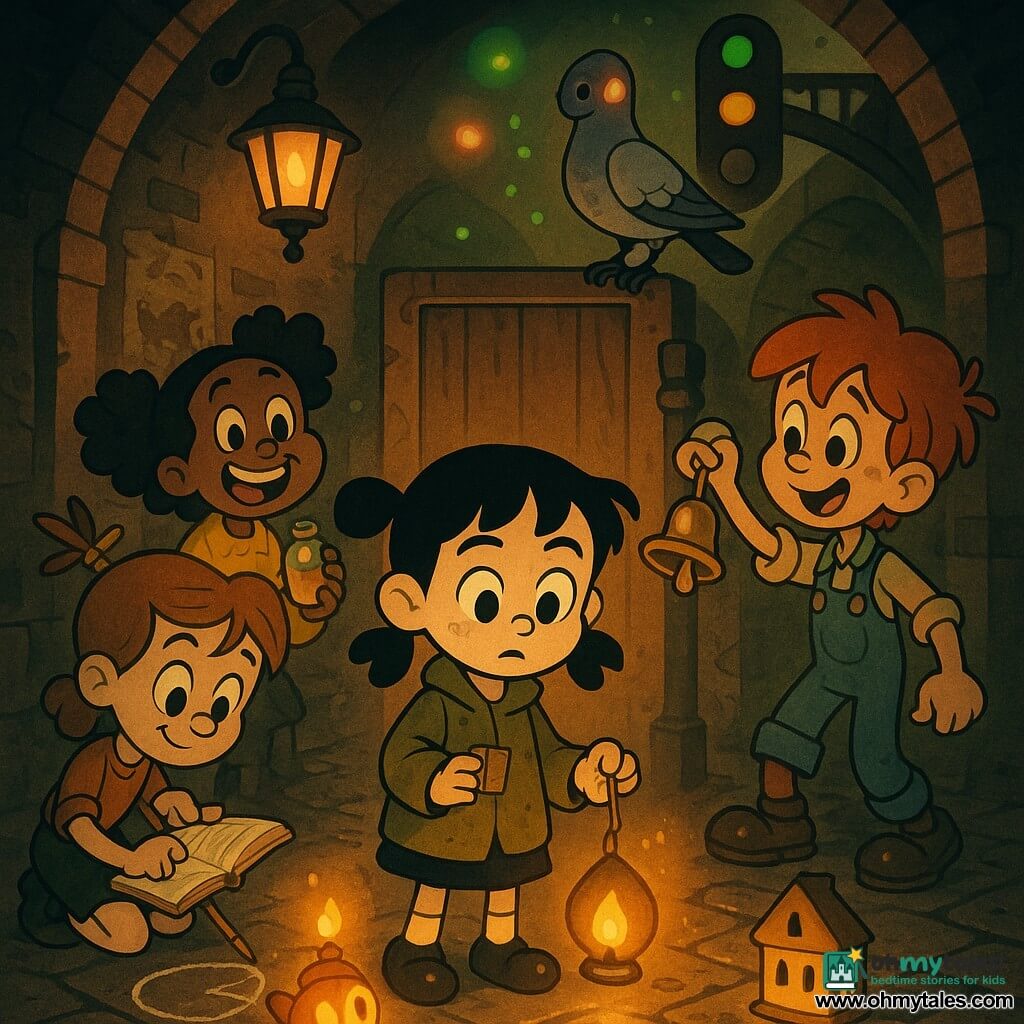
There was Jo, who could whistle so sharply the air paid attention. There was Tess, who always carried a pencil behind her ear and drew maps of places she'd never visited—yet somehow got them right. And there was Suri, who laughed in the exact middle of scary moments, as if her laugh was a lantern she could hold up.
They met after school under the arch of Trolley Street Station, where the elevated tracks made shadows like ladder rungs.
Above them, the train spirits watched.
They were not ghosts in sheets. They were made of steam and sparks, with faces that appeared only if you looked sideways. Sometimes they perched on signal lights like sleepy cats. Sometimes they rode the wind beside the carriages, counting passengers with eyes like tiny moons.
Most people never noticed them.
But Mina did, because she carried urgent messages, and urgent messages shimmered. They smelled of rain on warm stone. They sounded like a bell you could almost hear.
That afternoon, something tapped her shoulder.
She turned and found a pigeon standing very politely on the railing. It had one ordinary pink foot and one foot that gleamed silver, like it had stepped in moonlight and forgotten to wipe it off.
The pigeon bowed.
Then it opened its beak and, incredibly, a folded note dropped out. The note landed in Mina's hand as neatly as if it had been placed there by a librarian.
Jo leaned close. “Did that bird just deliver mail?”
Tess squinted. “That is not city-approved pigeon behavior.”
Suri grinned. “I love it already.”
Mina unfolded the note. The paper was thin and warm, as if it had been held near a small flame.
The words were written in neat black ink:
LIGHTS ARE GOING OUT. FEAR IS WALKING IN.
MEET BEFORE NIGHTFALL. BRING THE FOUR.
—THE LAMPKEEPER
Mina's throat tightened. In Skylark City, people liked to pretend fear belonged somewhere else—across oceans, inside dark alleys, under beds. But Mina knew fear was a clever traveler. It slipped through cracks. It rode on sighs. It hid behind jokes.
“The Lampkeeper,” she whispered.
Jo stopped whistling mid-breath. Tess's pencil nearly fell. Even Suri's grin softened.
The Lampkeeper was an old name. A friendly one. The kind you said when you struck a match and hoped it would catch.
Mina tucked the note into her satchel. “We're going,” she said.
“Where?” Tess asked, already pulling out her notebook.
Mina looked up at the tracks. A train roared past, shaking the air. In its wake, for one moment, Mina saw a glowing symbol on the underside of the bridge: a little flame inside a circle.
“A place under the rails,” Mina said. “Where the city keeps its night-lights.”
Jo's eyes widened. “The Nightlight Rooms?”
Suri bounced on her toes. “Sounds like trouble. Delicious trouble.”
Mina nodded. “And if the lights are going out…”
“…then someone needs to light them,” Tess finished.
They were only nine. Their shoes were scuffed. Their homework was still waiting in their bags.
But the city was waiting too.
The silver-toed pigeon hopped once, then launched into the air. It circled the station clock, as if making sure they would follow, and flew toward the river of streets.
The four girls ran after it, their footsteps quick as punctuation marks.
Chapter 2: The Spirits on the Signal Lights
They hurried through Skylark City as the afternoon thinned into gold.
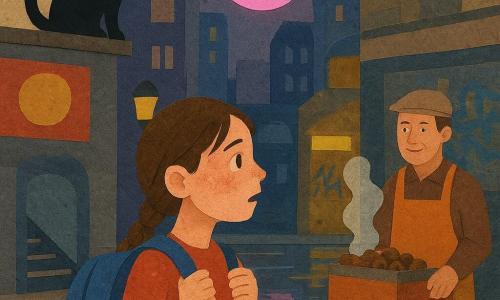
They crossed Market Square, where the smell of hot chestnuts mixed with perfume and coal smoke. They dodged a man pushing a cart of umbrellas—even though the sky was clear—because in Skylark City, it was always wise to be prepared for weather you couldn't see.
They followed the pigeon beneath the elevated tracks, where the noise of the trains made its own kind of ceiling.
At Signal Junction, the tracks split like a metal fork. Three signal lights stood on tall poles: red, yellow, green. The spirits liked this place. They gathered around the lights, flickering in and out of view.
Mina felt them before she saw them. Her satchel grew a little heavier. The note inside it seemed to hum.
A spirit unfolded from the green light like a ribbon of mist. Its face appeared—just for a moment—like a sketch in chalk. It wore a tiny cap, as if it was trying to look official.
“Four small feet,” it murmured, voice like brakes sighing. “Four brave hearts. Late.”
“We're not late,” Jo protested, though her voice wobbled. “It's still daylight.”
“Daylight is a rumor,” said the spirit, and drifted closer. “Night is already writing its name on the windows.”
Tess stood very straight. “We have a message from the Lampkeeper.”
At the name, the spirits around the red and yellow lights shivered, and their glow steadied, as if they'd been reminded of something kind.
Another spirit appeared, perched on the red light like a crow made of steam. “The Lampkeeper hasn't called in years,” it said. “Not since the old tunnels were sealed.”
Mina's stomach flipped. “Sealed?”
Suri lifted her chin. “Cities seal things all the time. Doesn't mean they stay sealed.”
The green-light spirit made a sound like a soft chuckle. “That one speaks true.”
The silver-toed pigeon landed on the rail beside Mina and pecked the air impatiently.
Jo stepped forward. “Can you help us get under the rails? To the Nightlight Rooms?”
The spirits exchanged glances without turning their heads, because spirits rarely had proper necks.
“You will need a door,” said the red-light spirit. “A door that isn't a door. You will need a key that isn't a key.”
Tess flipped to a blank page in her notebook. “Where?”
The yellow-light spirit, who had been quiet, leaned down. Its face looked like a woman's face made of lamplight, gentle and tired.
“Follow the sound of the city's smallest song,” it whispered. “Where the river goes under the station and forgets to be loud.”
Mina listened.
At first she heard only trains and carts and voices. Then, underneath it all, she caught it—a thin, brave sound. A tinkling, like a spoon tapping a glass.
“Come on,” Mina said. “I hear it.”
They followed the sound past a row of closed shopfronts and a brick wall painted with faded advertisements. The alley narrowed, then widened into a little courtyard tucked beneath the tracks. A drainpipe dripped steadily into a puddle, making the exact music Mina had heard.
Plink. Plink. Plink.
In the back of the courtyard stood an old door. It was the color of dust and had no handle. Above it, someone had painted a small flame inside a circle.
Jo rubbed her hands together. “No handle. Wonderful.”
Tess studied the door like it was a puzzle that might be offended if solved too quickly. “Key that isn't a key,” she murmured.
Suri stepped closer, fearless as a cat. “Maybe it opens if you're polite.”
Mina placed her palm on the door. The wood felt warm, as if it remembered summer. She took the note out of her satchel and pressed it gently against the flame symbol.
The paper brightened. The ink lifted like smoke and sank into the painted flame.
The door sighed.
A seam of light appeared, thin as a thread. Then the door swung inward on silent hinges.
Warm air drifted out, smelling of candlewax and oranges.
Mina swallowed. “That's our door.”
Behind them, a train thundered past, and the spirits on the signal lights flared—watching, guarding, hoping.
The four girls stepped into the light.
Chapter 3: The Nightlight Rooms
The passageway sloped down beneath the city, and the noise above became distant, like thunder remembering itself.
Along the walls, small lamps hung in glass cages. They were nightlights—hundreds of them—each one no bigger than a teacup. Some were shaped like stars. Some like birds. Some like plain, brave flames. They floated slightly, bobbing as if they were breathing.
But too many were dark.
Mina felt it like a chill behind her ribs. Darkness in a lamp wasn't just the absence of light. It was a kind of silence.
At the bottom of the passage, the corridor opened into a round room. Shelves climbed the walls, packed with more nightlights. In the center stood a worktable covered in matches, wicks, and jars of glowing oil that looked like captured sunsets.
And beside the table was the Lampkeeper.
He was not tall. He was not scary. He wore a coat with many pockets and had hair like gray feathers. His eyes were bright, though, bright the way streetlamps are bright—steady and patient.
“You came,” he said, as if he'd known they would. His voice was soft, but it filled the room.
Mina stepped forward. “You called us.”
The Lampkeeper nodded and tapped the table. On it lay a map of Skylark City. Tiny dots of light marked the neighborhoods—except several dots were dim, and a few had gone out entirely.
“Fear,” he said, simply. “It has been walking up from the old tunnels. It slips into people's dreams. It tells them the city doesn't care. It tells them they are alone.”
Suri's smile turned serious. “That's rude.”
“It is,” agreed the Lampkeeper.
Jo pointed at the map. “Why now?”
“Because someone forgot,” the Lampkeeper said, and his eyes looked sad for a moment. “Cities grow. People hurry. They stop leaving lanterns in windows. They stop singing the small songs. They stop believing in gentle magic because loud machines seem easier to trust.”
Tess frowned. “But the trains are loud and useful.”
“They are,” said the Lampkeeper. “And the spirits who watch them are kind. But even kind things need light.”
Mina touched one of the dark nightlights on the shelf. It was shaped like a tiny house, and its windows were black.
“How do we fix it?” she asked.
The Lampkeeper opened a drawer and took out four objects.
A box of matches, silver-edged and elegant.
A small bell on a blue ribbon.
A stubby piece of chalk that glimmered faintly.
And a bottle of oil that swirled with pale gold, like liquid dawn.
He handed the matches to Mina. “You carry messages. You know how to keep them safe. Fire is a message too.”
He gave the bell to Jo. “You know how to make the air listen.”
He gave the chalk to Tess. “You draw maps that tell the truth.”
He offered the bottle of oil to Suri. “And you,” he said, “you bring laughter where fear tries to settle. This oil is made from brave moments. Use it kindly.”
Suri held it carefully, suddenly respectful. “I will.”
The Lampkeeper leaned closer, as if telling a bedtime secret. “There are four nightlights in the city that matter most tonight. They are the first ones ever lit here. They sit in places where many paths cross—where fear likes to gather.”
Tess's pencil moved fast. “Where?”
The Lampkeeper pointed to the map.
“One at the river underbridge, where echoes like to play.”
“One in the Grand Library, where stories sleep.”
“One in the rooftop garden of the Clocktower Hospital, where worries gather like pigeons.”
“And one at Signal Junction itself, under the green light's watch.”
Mina's heart beat faster. Four lights. Four girls.
“What happens if we don't light them?” Jo asked quietly.
The Lampkeeper did not try to make it sound less frightening. “Then the city will still stand. People will still go to work. Trains will still run.”
He paused.
“But more and more windows will feel empty. And children will start to believe the dark has the final word.”
Mina clenched the matchbox. “Then we'll light them.”
The Lampkeeper smiled, and the room seemed warmer. “Remember,” he said, “fear hates two things most: light—and open doors.”
Suri tilted her head. “Open doors?”
“Open minds,” he corrected gently. “Fear tells you there is only one way to be. Only one sort of person to trust. Only one story. But cities are made of many stories stitched together. So are you.”
Tess nodded slowly, as if placing that thought carefully into her notebook.
The pigeon with the silver toe fluttered down to the table and pecked at the map right where the river underbridge was marked.
It was time.
The four girls turned back toward the passage. The dark nightlights on the shelves seemed to watch them, hopeful as unlit candles.
Mina looked back at the Lampkeeper. “Will you come?”
He shook his head. “Someone must stay and keep the flame ready. Besides,” he added, eyes twinkling, “this is your city too.”
They climbed the passageway, carrying their strange tools and their ordinary courage.
Above, Skylark City waited—vibrant, mysterious, and hungry for light.
Chapter 4: Four Lights, Four Stories
They started with the river underbridge.
The river slid beneath the station like a secret, dark and shining. The underbridge was made of stone blocks that always felt damp. Echoes lived there, bouncing words around until they sounded braver or meaner than they were.
A cold patch of darkness clung to the arch. It wasn't just a shadow. It looked like a smear of ink that had decided to stop being polite.
Suri shivered. “That's… not a normal shadow.”
“No,” Mina agreed. She took out a match. Her fingers trembled, but the matchbox felt steady in her hand, as if it wanted to help.
The silver-toed pigeon hopped onto a stone ledge where a little nightlight sat—shaped like a fish, its glass belly dull.
Jo tied the bell ribbon around her wrist. “Okay,” she said. “Air, listen up.”
She rang the bell once. The sound was clear and bright, and it made the echo-singing underbridge hush, as if someone had lifted a finger to their lips.
Tess knelt and drew a circle on the stone with her chalk—smooth, confident lines. “This is the place,” she said, “and it belongs to light.”
Mina struck the match.
The flame bloomed, small but fierce. She held it to the nightlight's wick.
For a second nothing happened.
Then the fish nightlight glowed from inside, turning the river's darkness into deep blue glass.
The ink-smear shadow wriggled, unhappy. It slid backward, as if the light had become a broom.
Suri uncorked the bottle of oil and tipped one shining drop into the nightlight. The glow steadied, warmer now, like a friendly kitchen window.
Suri cleared her throat and told a joke—not a perfect one, but hers.
“What do you call a frightened shadow?” she said loudly. “A shade that needs a nap!”
Jo groaned. Tess giggled. Mina laughed, surprised by it.
The shadow crumpled like paper and slipped into a crack between stones, as if it couldn't bear being laughed at kindly.
“One down,” Jo said, rubbing her wrist like the bell had taken a little of her worry with it.
Next: the Grand Library.
The library was a grand building with pillars and wide steps, and inside it smelled of ink and dust and old adventures. The air was quiet in the way a cat is quiet—aware of everything.
In the children's reading room, the nightlight sat on a windowsill. It was shaped like an open book. Tonight, it was dark.
And the darkness nearby was busy. It fluttered at the edges of shelves, whispering in corners.
Mina heard it, like a mean little poem:
No one will understand you.
Stories are only for some people.
You don't belong in every chapter.
Tess's jaw tightened. “That's not true,” she said.
She opened her notebook, but instead of drawing a map, she wrote a list—four names, one under another: Mina, Jo, Tess, Suri.
“We belong together,” she said, and underlined the names so hard the pencil nearly tore the page.
Jo rang the bell. The whisper-poem stumbled.
Mina lit the match, and Suri added a drop of oil.
The book-shaped nightlight flared to life, and the library shelves looked less like tall cliffs and more like helpful ladders.
A librarian, passing by, blinked at the sudden warmth. She didn't seem surprised, exactly—more like someone remembering something pleasant.
“Good evening,” she said, softly, and moved on.
The darkness backed away from the windowsill and crept under a table, smaller now.
“Two,” Suri said, holding up her fingers. “We're collecting them.”
Next: the Clocktower Hospital rooftop garden.
They climbed many stairs. The city spread around them, roofs and chimneys and distant train lines threading the skyline. On the roof, the garden was small but stubborn—pots of herbs, a little bench, a row of flowers that refused to mind the soot.
A nightlight sat on the bench, shaped like a heart. It was meant for people who sat there and worried.
Tonight, worry had gathered indeed. The air felt heavy, and the darkness wore a gentler mask here. It didn't snarl. It sighed.
What if you can't help?
What if you're not enough?
What if something bad happens and it's your fault?
Mina's chest tightened. Those were familiar questions. Fear liked to use familiar words.
Suri uncorked the oil, then hesitated. “This feels… sad,” she whispered.
Jo took Suri's free hand. “Then we do it gently.”
Tess drew a circle again, slower, careful as a hug.
Mina lit the match and touched it to the wick.
The heart nightlight glowed softly, not bright like a streetlamp, but steady like a bedside light. Suri added two drops of oil this time, and the glow turned golden, like morning sneaking in.
Jo rang the bell once—quietly.
The sighing darkness loosened, as if it had been holding its breath. It drifted away over the edge of the roof and vanished into the evening air.
On the stairs down, a nurse passed them and smiled as if she'd just remembered to drink tea.
“Three,” Tess said, and her voice sounded proud and a little amazed.
Last: Signal Junction.
By the time they returned, the sun had slipped behind the buildings. The sky was purple, the color of spilled ink—friendly ink, not the mean kind.
The signal lights glowed: red, yellow, green. The spirits perched there, watching.
But beneath them, on the fence post by the tracks, sat the fourth nightlight. It was shaped like a tiny train car, and it was the darkest of all.
The darkness around it was thick. It curled up the pole like smoke. It leaned close to the spirits, trying to make them flicker.
The green-light spirit's face appeared, strained. “It is here,” it whispered. “It wants the tracks. It wants the moving. It wants to ride into every neighborhood.”
Mina stepped up, matchbox in hand. “Not tonight.”
The darkness shifted. It seemed to look at them, though it had no eyes.
And then it spoke—not aloud, but inside their heads, each in a different voice.
To Mina: You're too small to carry this.
To Jo: Your sound is silly.
To Tess: Your maps are wrong.
To Suri: Your laughter doesn't matter.
Suri's grin flashed like a spark. “Oh,” she said. “That's the meanest thing you could say to me.”
She held up the bottle of oil. “My laughter matters a lot, actually. It annoys fear. Deeply.”
Jo lifted her bell and whistled—not her sharpest, but her bravest. The whistle cut through the air like a ribbon.
Tess drew a circle so fast the chalk squeaked. “This is our city,” she said. “All of it.”
Mina struck the match.
The flame fought the wind, and for a heartbeat it almost went out.
The green-light spirit leaned down, and a warm gust sheltered Mina's hands. The flame steadied, grateful.
Mina lit the tiny train nightlight.
Suri poured a long, shining thread of oil, and the nightlight blazed—bright as a window full of candles. The darkness hissed, not like an animal, but like a lie being corrected.
The spirits on the signal lights flared in answer. Red, yellow, green—all three brightened, and their glow spilled down the pole, wrapping the nightlight in color.
The darkness peeled away, retreating along the tracks like a shadow being chased by dawn. It tried to cling to the rails, but the rails gleamed, and the spirits watched, and the little train nightlight shone bravely at the junction of paths.
The darkness fled into the old tunnels below, grumbling in silence.
For now.
The silver-toed pigeon cooed triumphantly.
Mina's legs felt wobbly. Jo's cheeks were flushed. Tess's fingers were chalky white. Suri smelled faintly of warm sunshine from the oil.
They had done it.
Four lights. Four stories told with flame.
Chapter 5: Open Doors, Open Minds
The city did not suddenly become perfect.
It was still loud. It still had alleyways that made you walk a bit faster. It still had grown-ups who forgot to look up.
But that night, Skylark City felt… kinder.
As the girls walked back toward Trolley Street Station, they noticed small changes.
A shopkeeper lit a lantern in his window, though it wasn't required.
A street musician played a softer tune, and people slowed down to listen.
On a stoop, a boy helped a smaller child tie a bootlace, and neither of them acted like it was embarrassing.
They passed the Grand Library again, and through the glass they saw the book-shaped nightlight glowing in the children's room. A few kids sat on the carpet, heads close together, sharing a story. One of them pointed at a page and laughed.
Mina's satchel felt lighter now.
At the station arch, the Lampkeeper waited, as if he'd stepped out of a shadow that was friendly.
“You did well,” he said. His eyes held the same steady brightness as the nightlights. “The city will breathe easier tonight.”
Jo lifted her bell ribbon. “Will fear come back?”
“Fear always tries,” the Lampkeeper said. “It is stubborn. But so is light. And so are you.”
Tess held up her notebook. “I wrote where the lights are. And… other places that felt dark.”
The Lampkeeper nodded approvingly. “Good. Maps are promises.”
Suri shook the oil bottle. “There's still some left.”
“There will be,” said the Lampkeeper. “Bravery makes more of it.”
Mina looked up at the elevated tracks. A train rattled past, windows glowing. The spirits rode beside it, bright-eyed, keeping watch. She felt the city's magic sitting right alongside its modern gears, like two friends sharing a bench.
“What did you mean,” Mina asked, “about open minds?”
The Lampkeeper leaned on the station railing. “Tonight, fear tried to tell each of you a narrow story,” he said. “That you were only one thing. Too small. Too silly. Too wrong. Unimportant.”
Suri scoffed. “Nonsense.”
“Exactly,” he said. “An open mind is when you refuse to live in fear's tiny room. You let in more light. More ideas. More people. You listen. You learn. You allow surprises.”
Jo looked thoughtful. “Even from… strange pigeons?”
The silver-toed pigeon puffed its chest proudly.
“Especially from strange pigeons,” the Lampkeeper said.
Mina smiled. She thought of the librarian who hadn't been afraid of the sudden glow. The nurse who'd smiled on the stairs. The spirits who had helped shelter a match flame.
Skylark City was made of many worlds overlapping—steam and sparks, books and bells, chalk circles and train tracks, jokes and whispers, night and light.
And she, Mina, was part of that stitching.
The Lampkeeper reached into his coat and pulled out four small objects—tiny nightlights on chains.
A fish for Mina.
A bell-shaped flame for Jo.
A little compass-star for Tess.
A laughing moon for Suri.
“Not to keep fear away forever,” he said, fastening each chain gently. “Only to remind you that you know how to answer it.”
Mina touched the tiny fish nightlight. It warmed under her fingers.
The streetlamps flickered on, one by one, along the avenue, like a line of fireflies choosing to be brave together.
Overhead, the signal lights glowed steady. The spirits perched comfortably, watching the trains and the people and the thin line where both worlds met.
The four girls stood under the station arch, listening to the city's endless arriving sound.
“Same time tomorrow?” Suri asked, as if this were a game of hopscotch.
Jo laughed. “Let's at least do our homework first.”
Tess nodded, but her eyes were already shining with new maps.
Mina looked down the street, where windows glimmered like friendly eyes.
“Tomorrow,” she agreed. “And if anyone needs a light…”
She held up her satchel, and it felt ready.
They walked home through the vibrant, mysterious streets, carrying a little glow each—small, ordinary, magical.
And in Skylark City, that was enough to make the dark think twice.