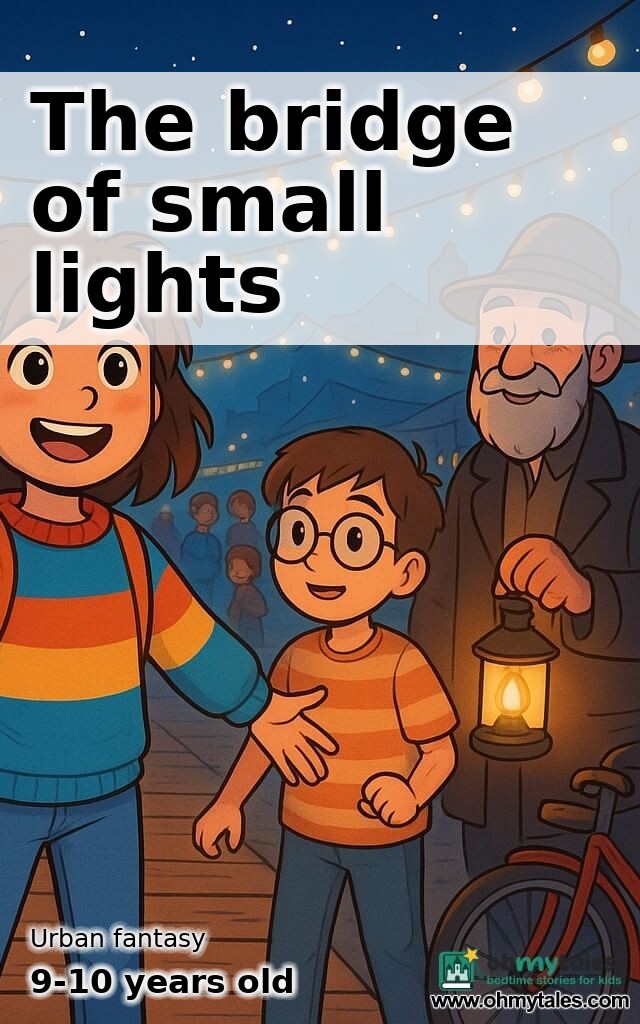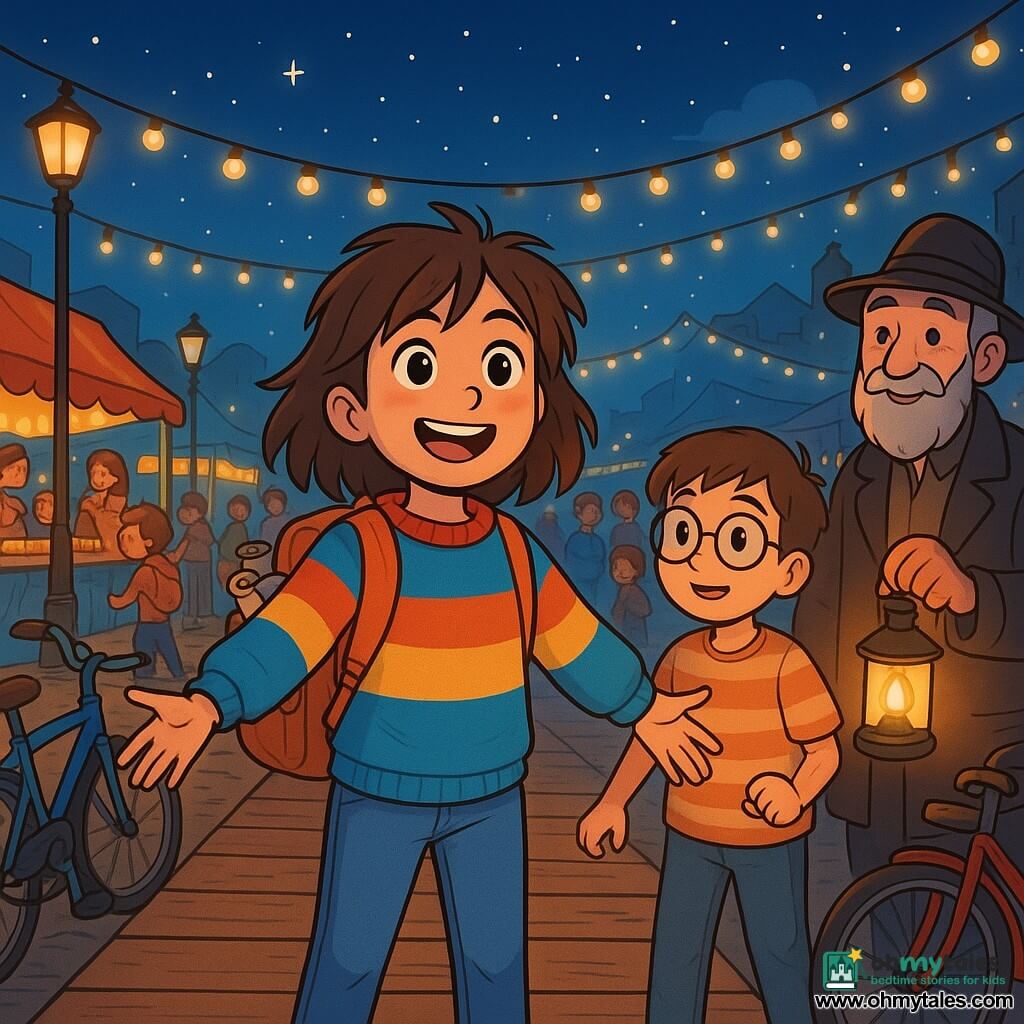
The Wind on the Esplanade
The esplanade unrolled along the river like a shawl, stitched of stone and laughing metal, and every morning it took a deep breath of wind and walked itself anew. Trees leaned low and whispered secrets to the lampposts. Commuter cables hummed tunes older than the trams that rattled by. Neon signs glowed as if trying to remember constellations. It was the year when flip phones tucked into pockets like paper birds and the radio still played songs that smelled like summer. It was also the year the city kept one foot in the ordinary and one foot in stories.
Mira lived on the top floor of a building with a roof garden that caught clouds like laundry. She was nine, and she collected quiet things: lost buttons with names stitched on the back, tickets to shows that had never happened, and the soft, folded apology of unread letters. She had a laugh that went up like the flame of a birthday candle and a serious habit of noticing when something or someone was left out.
Every autumn the city held the Great Night Market and Lantern Walk. It was a festival that curdled the grey air into gold; it made music out of the city's many voices. But in recent years, the market had draped itself with ropes and signs that read BIG SPONSOR, VIP ONLY, MEMBERSHIP REQUIRED. Some stalls set up small fences; some musicians were paid to play behind velvet ropes. The esplanade felt smaller under those ropes, though it was still wide enough for a thousand promises.
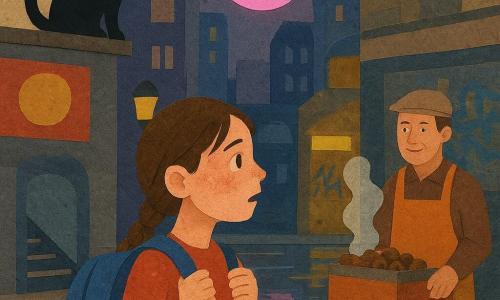
Mira kept wondering how a festival meant for the whole city could fence itself like a secret garden. There were children who could not afford the shiny tickets, old people who missed the loud conversations of their youth, school bands whose instruments were tied to rent. On an evening when the wind tasted of roast chestnuts and crows did cartwheels over the river, Mira sat on a bench and watched a group of children press their faces against the glass of a stall display, their breath fogging a small, sad moon.
She decided the festival must be for everyone. She decided, too, that the city needed a bridge. Not a bridge of stone alone, though there were many of those, heavy and polite. She wanted a bridge that would reach from one side of the esplanade to the other, from a street of polished glass towers to a lane of laundries and impromptu storytellers. A bridge of peace, because the neighborhoods had begun to argue—about space, about music, about who could trade what, who could eat and who could only watch.
That night she walked the esplanade with a backpack filled with essentials: a flashlight, a spool of bright thread, a half-eaten sandwich wrapped in waxed paper, a small notebook, and a worn tin whistle that hummed when you held it to your ear. The wind tugged at her scarf like a friendly ghost and the city hummed back like an impatient cat. Above the river, lights from ferries stitched paths in the dark.
At the foot of an old bridge—one with stone teeth and moss caught in its jaw—Mira found a companion. It was neither pigeon nor pigeon alone; it wore a little brass tag and had feathers like ink. It cocked its head and dropped something into her palm: a fragment of stone, not big, but warm, engraved with a symbol Mira did not know. When she pressed the fragment to her heart, she felt a small, steady heartbeat answer. The city around her exhaled, and she knew the bridge she wanted to build might not be only for walking. It might be something else: a way of joining people with the things that matter most—food, music, kindness.
She slept that night with the stone under her pillow and dreamed of a bridge that hummed like a chorus of old friends. When dawn came, she had a plan as clear as a bell and as simple as a loaf of bread: she would gather pieces of generosity and weave them into a bridge.
The Missing Stone and the City's Rules
In the morning the esplanade smelled of coffee and the river's dry laundry. Mira hopped down to the market where stalls began to bloom like bright mushrooms. She wanted to ask for help. People she knew—Mrs. Ko, who sold sticky pastries; Mr. Del, who mended bikes; a band of teenagers who played the saxophone in a park—were all used to the city's polite barriers. They peered at the festival announcements with tired, careful eyes.
She showed them the stone fragment. It lay in her palm like a secret waiting to be told. Mrs. Ko's fingers trembled with the habit of warm generosity; Mr. Del's eyes, behind the grease, had a softness Mira had seen only in old photographs. The saxophone players hummed a long note.
“We could put up lanterns,” one said. “We could make a path from here to the laundromat, so everyone can come.” They made a list: lights, music, food, a place where no one would be asked for money. The list fit on a napkin like a little island.
But the city had rules. There was a lean building where papers lived: the Office of Permits, with a door that always creaked. Inside, a woman in a grey coat arranged stamps and smelled faintly of thrice-brewed tea. Her desk had a drawer for "applications" and a drawer for "exceptions," and the "exceptions" drawer was full of cobwebs and polite refusals. Mira took a breath and walked in.
“Can I build a bridge?” Mira asked. Her voice was small but steady.
The woman behind the desk looked at Mira as though she were a question that had wandered in from a different city. “Bridges are built with contracts,” she said, and slid a form across the desk. The paper required signatures, fees, and a plan that listed materials in capital letters. Mira read the list and felt the edges of the world turn crusty. She had no money. She did not want money. She wanted kindness.
When the woman asked who would maintain the bridge, Mira touched the stone fragment and felt warmth answered by a chorus of small heartbeats, like a crowd of tiny lamps. “Everyone will,” she said. “We will keep it.”
The woman waited. Outside the window, a tram passed by carrying a ribbon of rain. At last, the woman stamped the paper with a sigh that sounded almost like a softly folded apology. “You can try,” she allowed. “But if anyone asks for paid entry, send them to me.”
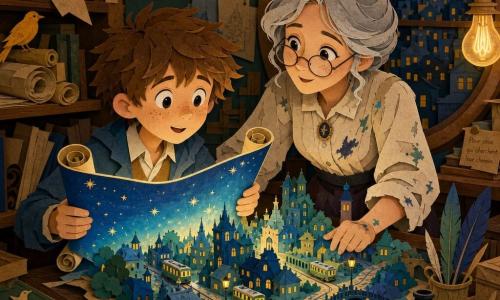
Mira left with a paper that smelled faintly of damp ink and began to collect the pieces she needed. She spoke with a lamplighter who had a pocket full of stories and a key ring of clear, glass buttons. She visited an old boatman who traded in river songs and a librarian who kept the city's forgotten maps. Every person offered something that could not be bought: a bowl of soup, an old lantern, a promise to teach a song. A child gave her a comic strip showing heroes who fixed things with glue made from kindness.
Once, a group of market guards in polished shoes tried to turn the idea into a business. “Make a line,” one suggested. “Charge a small fee for the highlight of the night.” Their words smelled of pennies. Mira listened as the wind braided itself through a nearby awning and made a small music. She held up the stone fragment. “This bridge is for everyone,” she said. “We will not build doors.”
They laughed, and then someone who had been watching—an old woman with a hat full of badges—stepped forward and handed Mira a spool of silver thread. “You'll need to stitch the edges,” she said. “Stitches bind things that wood cannot.” The guards did not see how this counted. But Mira did. She learned that permits could be honored not only with signatures but with promises kept by people who cared.
At dusk, the esplanade looked like a bowl being cupped by hands. Mira spread the napkin list on the ground and placed the stone fragment in the center. People came with jars of honey, with guitar strings, with pots of soup whose steam smelled like distant kitchens. Each offering felt small and large at once. Small because it was one loaf, one song, one bowl. Large because together they began to shape something the city had forgotten how to name: fellowship.
The Gathering and the Night of Small Bridges
They worked under a sky that kept changing its mind. The lamplighter lit his lamps and told jokes about the ones that refused to glow. Teenagers strung fairy lights across railings; an itinerant sculptor hammered together a frame of old bicycle rims and a bakery supplied crates for seats. A group of shoemakers offered wooden planks that had once been shelves; they sanded them until the wood shone like the inside of a story. The laundromat owner donated fabric that hung like flags.
Mira stood in the middle of it all, the stone fragment tucked into her pocket so she could feel it thrum like a second heart. She did not command the work; she gathered it—like compost, like starlight. She knew how to ask people to share, and more importantly, how to listen when they did. Someone who had felt too old to dance found a rhythm; someone who was always busy learned to stand still and be listened to. Little by little, their contributions knit together.
There was a problem, as there always is when things worth doing get close to being done. A narrow alley divided the two neighborhoods like a line drawn in chalk. On the other side of that alley lived people who had a way of saying no before anyone asked. They had a tall sign that read PRIVATE and a small, guarded little sourness in their eyes. If the bridge could not cross that gap, then half of the city would be a window at the market and not a door.
Mira went there at twilight. A gate gave a short creak and a boy about her age stood watching her from the top step. He had a small dog with a proud nose. “Why are you building a bridge?” he asked, as if asking how she could be certain the stars would come out.
“To make a place where everyone can come,” she said. She held out a bowl she had been given, filled with sweet, warm soup. “Share with me?” she asked.
The boy hesitated. In his pocket jingled a coin he'd been saving for a comic book. Mira did not mention the coin. She listened to the silence that hung between them like a lampshade. Then he reached out and accepted the bowl. The dog licked the rim. The boy's eyes softened.
There are bridges that need nails and rope, and there are bridges that need nights like this: a shared bowl, a laugh, a song. The boy stood and went to fetch his sister, who had a mouth full of stories and a heart full of maps. She stepped forward, skeptical at first, then curious, and finally, very slowly, she contributed a curled-paper map that showed hidden stairways and short-cuts, the useful kind of magic only known by people who move through a city every day.
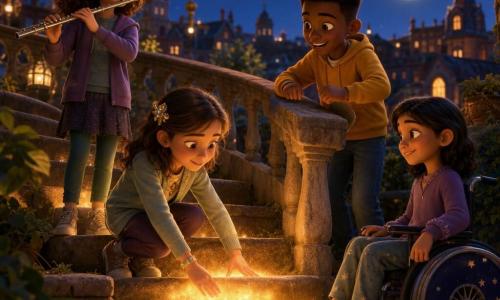
That night the esplanade hummed with small bridges. Children hopped across a rickety span used as a stage; an old woman walked from stall to stall without paying to see her hometown musicians. Mr. Del fixed a squeaky cart wheel for a teenager who returned the favor by playing a tune that smelled of summer. The lamplighter lit a lantern and, with a small bow, gave it to a child who had never been allowed past the velvet rope. Everything that could have been sold was instead given: music for a coin of laughter, food for a shared story.
Above them the fragment in Mira's pocket warmed like a tiny sun. When she took it out and placed it at the heart of the makeshift bridge, something gentle and startling happened. The thread strung across the planks began to glow. It did not glow like a lamp; it glowed like an understanding. People who stepped onto the planks felt the glow in the space between their ribs. Old quarrels softened, names were spoken gently, and someone who had been lonely found a hand to hold.
There was one last test. A man with a fine coat and a paper badge came and asked, in a voice that had practiced refusal for many years, whether the bridge was official. He held out his hand for a fee. The crowd stilled. Mira stepped forward and said softly, “This bridge keeps its magic because it is for everyone.” She handed him a small paper folded into a bird; inside it was a note that read: If you still have space in your pockets for kindness, please, keep it. The man looked at the paper and then at the faces around him, warm with lantern light. Something in his chest unbent. He tucked the bird into his coat as if it were a secret he might like to carry.
The Bridge of Peace
When the festival night came in its fullest, the esplanade had become a necklace of lights, each bead a kindness. People walked from one side of the river to the other without a single printed ticket. Laughter echoed like bowls being tapped. The bridge stood in the middle, small of span but wide of welcome, made of sanded planks, bicycle rims, fabric flags, and light lifted by hands. It had not been built by one architect but by a thousand small builders who mended a city of ordinary grievances.
Mira climbed to the middle and looked out. Below, the river moved with a slow and patient grace. Above, the sky had a face of deep blue and kept a watchful promise. The stone fragment at her feet hummed with a steady, contented pulse. It had been warmed by hands and stories and soup. It had learned the language of generosity.
Across the bridge, two women who had argued for years about the location of a fruit stall stood and smiled. Two children who had been kept apart by school bus routes found each other and exchanged stickers. The lamplighter told a joke that made the entire market laugh so loud the pigeons forgot to be careful. A family who had not been able to come before because of the cost of the main arch of the festival sat on a crate and tasted free pastries and cried softly with the relief of being seen.
Mira had imagined something grander, perhaps, but the bridge she had built was truer: it was a living thing, a poem the city kept reading aloud. People continued to mend and add planks, and sometimes the wind tugged on the flags and wrote new lines of color across the esplanade. When arguments resurfaced, the bridge did not pretend to stop them. Instead it invited people to sit down, to exchange bread, to play a tune, to remember that a city is only as big as the space it gives away.
On the final evening of the festival, the city councilwoman came to the bridge. She had watched from the offices where decisions gather and sometimes forget the shape of people's needs. She took Mira by the hand and, in front of everyone, said, “You made this happen.” Mira felt the words like light stepping onto bare feet. The councilwoman promised to protect the bridge from ropes and paid signs. She promised that permits would be used to open doors, not close them.
Mira did not want applause. She wanted people to have what they needed—cooler nights under warm lamps, songs without prices, soup for hungry hands. She had come to the city with a list on a napkin and a stone under her pillow. She left with a bridge that would be walked on and a map that would be taught to children: the map of how to be generous. The esplanade would remember how it felt to be wide.
Years later, people would tell the story as though it had always been true: that a nine-year-old with a tin whistle and warm pockets of determination stitched the city back together. They would say that the bridge glowed not because of anything carved into its wood but because it was kept alive by giving. Children would run across it and drop painted pebbles into its crevices, and their laughter would make the lampposts lean in, curious.
Mira sat on the rail once more, older by a little, and felt the wind as if it were a hand on her shoulder. She thought of the day she first found the warm stone and smiled, because the bridge had taught her something else: generosity is not a single gift but a trail of small lights. Give one, and you may start a lantern parade. Give two, and you may mend a quarrel. Give a thousand, and you may build a bridge that keeps a city kind.
The esplanade kept breathing. The city kept making up stories to match its streets. And when the lamps were lit on winter nights, people walked across the bridge and remembered how a single small hand had shown them the way to a larger, welcoming world.