Chapter One: The Whispering Lamps
Leo Finch lived in a city that hummed like a pocket watch. Trains clicked teeth on rails, cafes breathed steam, and billboards blinked like patient eyes. At nine, Leo noticed things other people hurried past: the way pigeons drafted letters in the air, the soft sigh of rain down an alley, the tiny silver stitches of light that ran along the curbs at night. Best of all, he noticed the streetlights.
They whispered.
It started on a Tuesday when Leo missed the bus and had to walk home through Old Market Row. A halo of warm orange leaned over the pavement. When Leo slowed and listened, the light shivered and said, very quietly, "Psst. Little one."
Leo's knees turned to jelly. "Who—who's there?"
"A boy with shoelaces untied," the lamp said. Its voice sounded like coins rolling in a jar. "Tie them. Tying helps."
Leo knelt and tied his laces. The lamp hummed a small laugh. "Better," it said. "City worries spill from pockets. We catch a few at night."
"City worries?" Leo repeated. He had one of his own—math that swam when he tried to learn it—but he didn't curl it up like a pocket.
The lamp dimmed like someone thinking. "We were made to hold light, but many years ago we took on more. The Flame under the city grew hungry for worries. We feed it a handful each evening. It keeps quiet then. But tonight…it sounds tired."
A cold wind slid down the street. The lamp's glow blinked, then whispered, "Find the cat named Soot. It remembers fire-maps." The lamp sighed like a page turning. "Hurry, little one."
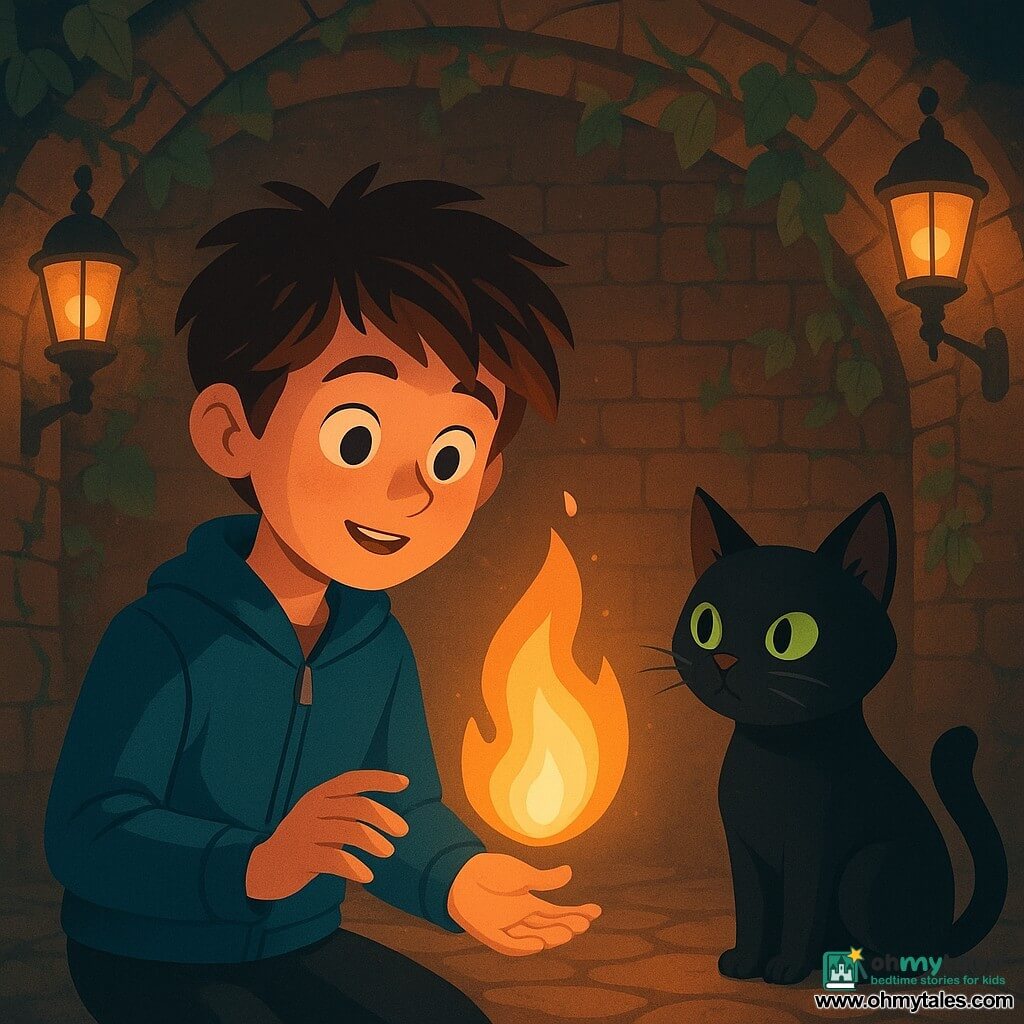
Leo followed the lamp's sound to a narrow courtyard where puddles mirrored neon. There, curled on a milk crate, was a soot-black cat with eyes like two spare coins. It opened one eye as if annoyed at being interrupted and yawned like a gap-toothed balloon.
"You!" the cat said. Its voice was gravel and honey. "You who can hear light. I've been waiting."
"How do you know my name?"
"Scent of your shoes," the cat replied. "And that look in your head—curious and a little worried. I'm Soot. You're late for tea."
Leo blinked. "You're a talking cat."
Soot flicked its tail. "So are you a boy who can hear streetlamps. Also true."
Leo felt as if the city had folded into a storybook just for him. He walked through the puddled courtyard, where reflections of towers looked like sleeping giants. "The lamp said there's an old Flame that's hungry," he said. "What is it?"
Soot stretched. "Long ago, the city made a bargain with a Flame that kept night dangers at bay. People fed it worries—small, like lost socks, and big, like thunderous debts. The Flame burned quietly with those worries and warmed roads and kept some knives from getting sharp. But if it eats too much, it aches. If it aches, it coughs up heat that roasts hope into ash. Tonight the lamps said it's tired. We must soothe it."
Leo felt his own small worry—how to do the math on Friday—but it seemed small beside a hungry Flame. "How do we soothe it?"
Soot's whiskers twitched. "With rain, because rain washes weight. With true joy, because joy tastes like sunlight to flame. And with laughter, because flame remembers being warm and silly, not just anxious. Come. The city has the pieces."
Chapter Two: The Rain Bottle
They moved together through a city that smelled of frying onions and late trains. Soot led Leo under brick archways where ivy held onto stories and above markets where lamps dangled like lanterns at a festival. The lamp-lights leaned close, murmuring, "Hurry," and "Watch your step," and "Bring starlight."
Soot hopped onto Leo's shoulder like a living scarf and gave a soft purr. "We need rain first. Not the puddles or the drizzle—real rain-bottle rain. There's an old weather kiosk by the river. It keeps a finger of cloud in a jar. They guard it with umbrellas."
Leo worried he would be scolded if he took something that wasn't his. "Do we ask?"
"Sometimes you must borrow with promises," Soot said. "Say please to weather. You'll be surprised who listens."
At the kiosk, an elderly woman with silver hair braided like lightning sat polishing brass bells. When Leo explained—voice trembling but honest—she smiled as if remembering songs. "A child who listens to lamps," she said. "That's rare. Rain is generous if you ask with a clean hand."
She opened the jar. Inside a tiny curling mist shimmered like the breath of a sleeping dragon. "This is a finger of rain. One drop will do." She handed Leo a small glass bottle cradled in velvet. "Carry it careful. Never let it sing alone."
Leo felt the rain-bottle pulse cool against his palm—like holding a teardrop of the sky. He tucked it into his jacket. Soot purred as if pleased. "Two down," the cat said. "Now to find joy."
Chapter Three: The Pocket of Joy
Joy in the city didn't sit conspicuously like shops or signs. It hid in small things: a busker's ukulele, the corner bakery's secret recipe, a child's balloon that bobbed free and did a graceful dive over a fence. Soot and Leo wove through pedestrians, following laughter like a scent.
They arrived at a laundromat that smelled of lemon and soap. Inside an old man was folding shirts but couldn't stop tapping his foot to a tune only he could hear. A group of children were performing shadow-puppet stories against a dryer door. Their audience—moms, teenagers, a delivery driver—leaned forward, forgetting their lists, counting the stories by applause.
"Joy wants to be asked for," Soot explained. "You can't barge into someone else's pocket."
Leo thought of his math, the way numbers tangled his thoughts. He watched a little girl in the corner make shapes with her hands and then turn them into a dragon that sneezed bubbles. She giggled and the bubbles popped like tiny suns.
"Excuse me," Leo said, feeling shy. He told them about the Flame, the lamps, the rain-bottle. The laundromat grew quiet as if the machines were listening, too.
"Joy comes from sharing," the old man said, the lines around his eyes softening. He handed Leo a small paper packet. Inside were three bright paper stars, folded and fragrant with the smell of starch and laughter. "One for singing, one for dancing, one for telling. Use them true."
Leo tucked the stars into his pocket. They crinkled like promises. Soot nosed them and hummed, "Almost there. Laughter remains."
Chapter Four: The Echo of Laughter
Laughter, Soot said, lived in echoes and alleys. It liked surprises and the sound of people tripping over their own feet without falling. They sought the Laughing Bridge, a small footbridge that arched over a hidden canal. It was a place where buskers told jokes that went rusty and children left them polished and whole.
On the bridge a troupe of clumsy street-magicians performed tricks that sometimes worked. A hat swallowed a bouquet by mistake and a rabbit came out wearing glasses. The crowd grinned, half because the tricks were funny and half because they loved the messy attempt.
A boy in the crowd kept trying to make a paper airplane fly straight, but it would wobble and dive into the canal. Each time everybody laughed—not meanly, but as if they were helping the plane try again. Leo's own laugh came out before he realized it; it felt like a bell being rung.
"That laugh," Soot said, licking his paw. "Keep it. Laughter must be given without being begged. Let it be free."
They sat on the bridge and Leo let his laugh bubble up—at a magician who produced a frog instead of a dove, at Soot pretending to be scandalized, at the way the paper stars tickled his pocket. The laugh rolled like a marble and gathered echoes. People around them joined in, and the sound swelled warm and bright.
"That's the sound," said a streetlamp, leaning so close Leo could have leaned against its pole. "Bottled rain, folded joy, and laughter's echo. Go, little one. The Flame waits under the old plaza."
Chapter Five: The Nap of the Flame
Underneath the old plaza, where the city's oldest bricks kept secrets in their mortar, there was a stairwell that led down like a throat. The air smelled of gingerbread and old coins. At the bottom, behind a grate of iron vines, a fire smoldered in a shallow hearth. It was not a bright flame but something ancient and tired, like a library with too many books on overdue notice. Its color was a slow amber that trembled as if trying to stand.
Leo set the rain-bottle on the stone. Soot hopped beside him, tail flicking. The cities' lamps peered through the grate, and their voices threaded through the room like ribbons.
Leo opened the bottle carefully. A thin ribbon of rain sighed out, cold and clean, and the air cooled like someone drawing a blanket up to their chin. The Flame shivered and looked less prickly. Leo unfolded the paper stars, one at a time, and placed them around the hearth. They smelled of soap and stories. "For joy," he said.
Then he laughed—soft, then louder—until the sound filled the little room and made the bricks remember summer. The Flame blinked. The heat that had been sharp and restless softened. It inhaled the rain and the joy and the laughter like a person taking a big, relieved breath.
"Little one," it said in a voice that was both many and one—like a kettle singing in a language of steam. "You gave me what I forgot how to take."
"Will you be all right?" Leo asked. He felt the old worry—math and small things—shrink as if someone had sat on it.
"I will nap," the Flame said. "I will take only what needs to be kept. Worries are heavy, child. They need washing and sharing, not dining. Tonight you taught me that."
Soot curled on Leo's shoe and purred. "And remember, Flame," the cat said, as if cats were the right sort of creatures to admonish fire, "laughter on an empty stomach is the worst kind of hunger. Eat happiness sometimes."
The Flame flickered a smile. Outside, the streetlamps brightened as if a famous musician had played the right note. The city breathed easier. Weight fell off the rails; pigeons twitched their wings with renewed fancy. Leo felt, deep in his chest, that a small, important thing had been mended.
"Will you come visit?" the Flame asked, embers whispering like bedtime stories.
"If you let us," the lamps said all at once. "We will bring stories. Bring pies."
Leo laughed. "I'll bring pies."
As they climbed, the city had a new sound—the lamps hummed like lullabies, rain dripped with contentment, and somewhere, someone told a joke that landed like a warm coin in a fountain. Soot walked beside Leo like a shadow with opinions.
On his street, Mrs. Ortega at the bakery gave him an extra tart with a wink. The bus that had once made his math class late slowed down for a stop it normally missed. People held doors a moment longer that week. The Flame took fewer worries and kept a small, cozy warmth below the plaza; people who visited felt the heat of hope instead of the burn of fear.
That night, Leo lay in bed and listened. A lamp outside his window hummed a tiny, contented tune. He thought of the rain-bottle safe in his drawer and the paper stars under his pillow. He felt lighter, as if someone had unbuckled a heavy strap from his shoulders.
"Goodnight, little listener," Soot's voice drifted from the window sill where he had curled like a comma.
"Goodnight," Leo whispered. He closed his eyes and, for the first time in a long while, his worries folded into neat squares at the corner of his mind. They were there if he needed them, but not shouting. The Flame had taken a nap, and the city—brisk, stubborn, full of small miracles—glowed with a warmth that smelled like bread and rain.
Outside, the streetlights whispered to one another, their words soft as feathers. Leo slept, and the city kept watch, listening for laughter.