Chapter 1
In the city of Latticed Lanterns, night did not fall—it folded itself like velvet, and the stars were stitched in by patient hands. In the House of Measures, where merchants came to borrow brass scales and honest rulers, Mistress Samira kept the ledgers straight as spear shafts and the doors open to anyone who arrived with an empty bowl.
That evening, she sat on a talking carpet that grumbled like an old uncle.
“You are writing too neatly,” the carpet complained. “Neatness attracts trouble.”
Samira dipped her reed pen again. “Then let trouble read my handwriting and learn manners.”
The carpet harrumphed. Its patterns were not just patterns—diamond and spiral, line and star—each shape a quiet rule the world agreed to follow. On its edge, a row of tiny embroidered numbers shone like fish in moonlight: 1, 2, 3… and then, strangely, gaps, as if someone had plucked the right digits out like raisins from a cake.
A knock came, fast and frightened.
At the threshold stood a boy with dust on his cheeks and fear in his throat. “Mistress Samira,” he whispered, “the Market of Steps is in chaos. People are being cheated. The weak ones—children, widows, old men—are paying double for half.”
Samira's smile faded the way a lamp dims when the oil is low. “How?”
“The numbers,” the boy said. “They're… wrong.”
Samira rose. In the House of Measures, “wrong” was a wild animal. It bit first the smallest ankles.
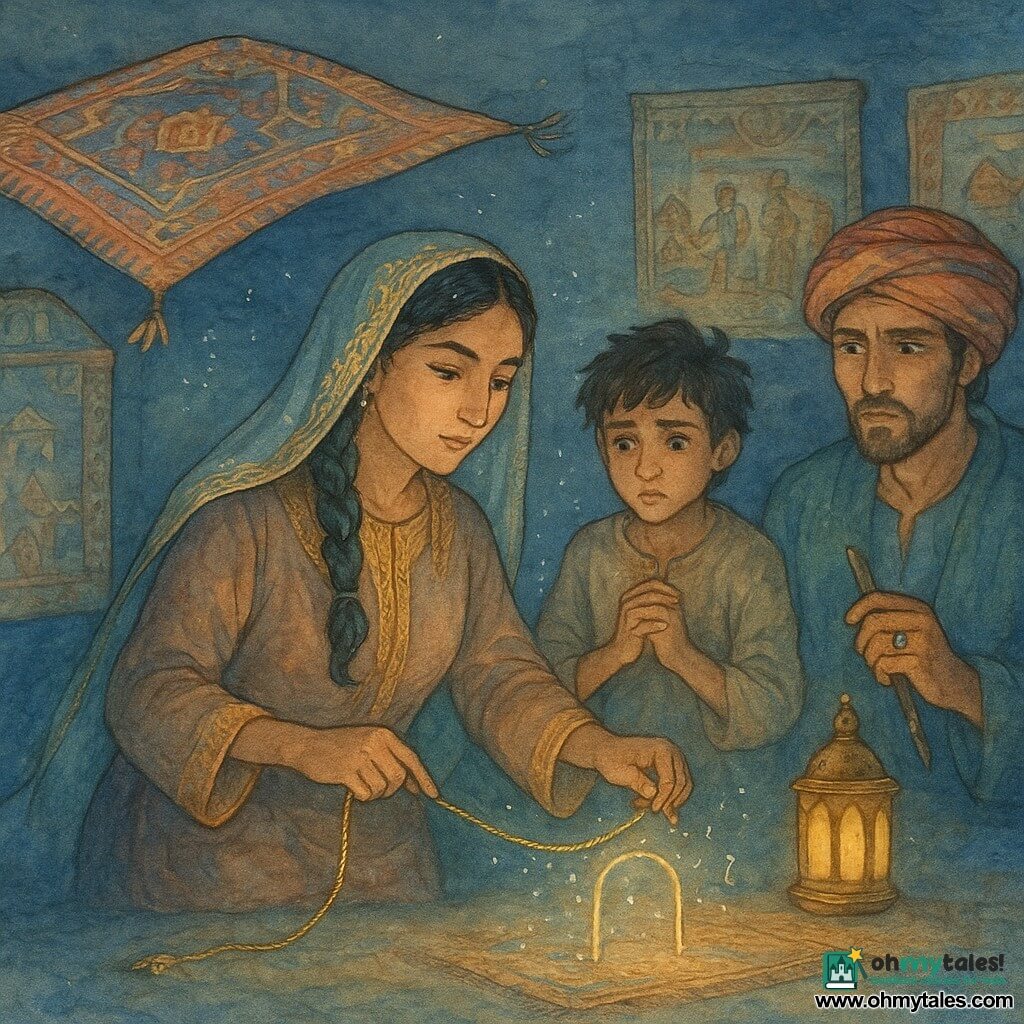
She took her measuring cord—silk braided with tiny knots—and wound it around her wrist. “What is your name?”
“Yasin,” he said.
“Then, Yasin, you will walk with me and tell me everything. And you,” she added, looking down at the carpet, “will stop grumbling and start guiding.”
The carpet sighed. “I guide. I grumble. It is my art.”
They stepped into the street where lanterns swung like glowing fruit, and the air smelled of cardamom and warm bread. Above them, rooftops wore mosaics of geometry, a city built from patience and patterns. Yet that night the patterns felt… scratched, as if an invisible hand had dragged a nail across the world.
Samira listened to the city's heartbeat and heard it stumble.
Somewhere, the art of just numbers had been stolen.
Chapter 2
In the Market of Steps, merchants called out like trumpets, and buyers flowed between stalls like a river learning new bends. But the river was muddy tonight.
An old woman held a sack of rice and argued with a vendor whose smile was sharp enough to cut rope.
“It's three coins,” he said.
“It was two yesterday,” she protested.
“Yesterday's numbers are tired,” the vendor replied. “Today's numbers are… refreshed.”
Samira watched the vendor's scale. The brass pans looked honest, but the engraved markings were strange—like a familiar face with one eyebrow missing. When Samira leaned closer, she saw it: the line for half a weight had been moved, just a breath, just enough to steal.
She stepped forward. “Good sir,” she said politely, “your scale is suffering from dizziness.”
The vendor's eyes narrowed. “And you are?”
“A friend of balance,” Samira said. “May I borrow your scale?”
He snatched it away. “No borrowing. Only buying.”
Behind Samira, Yasin whispered, “They all changed. Even the stone steps have wrong numbers painted on them.”
Samira looked down. On each step, someone had painted a number in bright blue. But the sequence limped. After 7 came 9. After 10 came… a crooked symbol that wasn't quite 11. The steps themselves seemed to hesitate, as if unsure how high to lift a foot.
“That,” Samira murmured, “is not just cheating. That is sickness.”
A laugh drifted from a nearby stall where rugs hung like waterfalls of color. A man stood there, thin as a reed, with rings on every finger and a turban folded like a secret. He held a small brush and a pot of blue paint.
“Numbers are so serious,” he said. “Why not let them dance?”
“Because when numbers dance,” Samira replied, “children trip.”
The man's smile widened. “Ah. The House of Measures sends its guardian.”
“I send myself,” Samira said. “Who are you?”
“Call me Nadir,” he said lightly, and bowed. “I make the world… flexible.”
Samira noticed the rugs behind him. Their patterns were beautiful, but the geometry was slightly off—stars with one point too many, spirals that didn't return. The rugs whispered to each other in itchy, nervous voices.
One rug coughed. “Help us,” it rasped, so softly only Samira heard. “He is pulling our threads.”
Samira's heart tightened. Rugs were not only objects here. They were witnesses. They remembered footsteps, laughter, tears. To warp their patterns was to warp their memories.
She spoke gently, as if calming a startled horse. “Nadir, return the true markings. Restore the steps.”
Nadir tapped his brush against the pot. “Why should I? The strong can still climb. The clever can still bargain. It is… entertaining.”
Samira's gaze sharpened like morning light on a knife. “Entertainment that preys on the weak is only cruelty wearing a mask.”
Nadir shrugged. “Then chase me, Mistress Balance.”
He snapped his fingers. A rug behind him shivered, then unrolled itself like a tongue, and—before anyone could shout—slid under Nadir's feet. It rose, carrying him above the crowd, sailing toward the northern quarter where the old embroidery towers stood like sleeping giants.
Yasin gasped. “He's flying!”
The carpet beneath Samira's feet rumbled. “He is using stolen pattern,” it growled. “And he is doing it badly.”
Samira stepped onto her own carpet. It lifted with a reluctant grace.
“Hold tight,” she told Yasin.
Yasin grabbed the edge. “I am holding my whole life!”
As they rose above the market, Samira looked down at the old woman clutching her rice. The woman's shoulders were hunched like a question mark.
Samira whispered, “I will straighten this.”
The city opened beneath them, a quilt of rooftops and courtyards. Somewhere ahead, wrong numbers were spreading like ink in water. And if ink reached the House of Measures, the whole city could drown in dishonest counting.
They followed Nadir into the moonlit north, where embroidery and geometry ruled like quiet kings.
Chapter 3
The Embroidery Quarter was where cloth learned its stories. Tall towers held looms, and windows glowed with the warm light of hands at work. Threads hung from balconies like colorful rain.
Nadir's rug darted between towers. Samira's carpet, older and wiser, took a steadier path, rising and dipping like a boat on gentle waves.
Yasin pointed. “There—he's going into that tower!”
The tower's door was carved with interlocking shapes—hexagons, triangles, and stars—fit together like friends who never argued. But someone had scratched at the edges, making the fits imperfect.
Samira landed in front of the door. The moment her feet touched stone, she felt it: the air hummed wrong, like a song with missing notes.
Inside, the tower smelled of dye and dust. On the walls hung unfinished tapestries: gardens, deserts, ships, and moons. In the center stood a great wooden frame where a gigantic embroidery was being stitched—not with thread, but with light.
Numbers floated there, bright and slippery, trying to settle into their places. Yet they kept sliding away, as if the fabric itself refused to hold them.
Nadir stood by the frame, humming. He held a spool—not of thread, but of blue paint that dripped upward instead of down.
“Welcome,” he said. “You arrived just in time to see the world become… improv.”
Samira took a slow breath. Anger was a fire; she needed it, but she would not let it burn her house down.
“You are stealing certainty,” she said. “Without certainty, the weak are pushed aside.”
Nadir twirled his brush. “The weak should learn to be strong.”
Yasin stepped forward, voice shaking but clear. “My little sister counts bread pieces so my mother won't go hungry. She's eight. How strong should she be?”
For a moment, Nadir's smile faltered like a candle in wind. Then he laughed too loudly. “Touching.”
Samira's eyes moved over the room. On a low table lay a bundle of measuring sticks—some snapped, some shaved shorter. On the floor, chalk marks formed a spiral of numbers that did not end where it began.
A symbol stood at the center: a small door drawn on the stones, no bigger than a book. Around it, the wrong numbers circled like flies.
Samira understood. “You're not only cheating the market,” she said. “You're opening something.”
Nadir's rings gleamed. “Invisible doors, Mistress Samira. Doors that open when rules loosen. The city is too stiff. Too proper. I will make it… bend.”
“And what comes through a door opened by lies?” Samira asked.
“Possibility,” Nadir said.
“Or monsters,” the carpet muttered behind her.
Nadir snapped his fingers again. The floating numbers on the giant frame jerked and spun. The room tilted—not in space, but in sense. Samira's stomach clenched as if the floor had turned into a question.
“Now,” Nadir said, “try to measure in a world that won't hold still.”
The door symbol on the floor shimmered. The air there rippled like heat above sand. Something pressed from the other side, curious and hungry.
Yasin's voice was small. “Mistress Samira… what is that?”
Samira placed a hand on his shoulder. “An invitation we did not write.”
She stepped toward the shimmering door and held up her knotted measuring cord. Each knot was a promise: one, two, three—truth made tactile.
“Numbers,” she said softly, “are not chains. They are bridges. They help the small cross safely.”
The knots glowed faintly, as if agreeing.
Nadir's eyes narrowed. “Pretty speech won't stop my door.”
Samira met his stare. “Then I will use more than speech.”
She turned to the nearest tapestry, one that showed a simple scene: a mother hen sheltering chicks beneath her wings while a fox watched from grass.
Samira touched the stitched wing. “Wake,” she whispered.
The tapestry shivered. The hen's wing lifted, and the fox's eyes blinked in confusion. Thread became motion, symbol became ally.
The hen stepped out of cloth into air, not as a real hen, but as an idea made visible—protection given feathers.
It clucked once, sternly, at Nadir.
Nadir blinked. “That's—”
“Embroidery remembers,” Samira said. “And it can choose.”
The hen spread its wing over the shimmering floor-door. The ripple dulled, as if covered by shade. The thing behind the door hissed, disappointed.
Nadir's face hardened. “Fine. If you love rules, drown in them!”
He flung his brush. Blue paint flew in an arc and splattered across the giant frame. The numbers screamed—yes, screamed—like startled birds.
Samira ran. Yasin ran beside her. The carpet surged in, growling.
They had to reclaim the art of just numbers before the door learned to open wider.
Chapter 4
The paint did not behave like paint. It crawled. It sought edges, corners, seams—everywhere patterns met. Wherever it touched, the numbers slipped again, losing their place like children in a crowded festival.
Samira reached the frame. Light-numbers spun: 4 chased 6, 9 hid behind 2. The sequence became a prank.
Yasin grabbed a fallen measuring stick. “What do I do?”
“Protect,” Samira said. “Stand between Nadir and the door. If anything pushes through, shout.”
Yasin swallowed. “I can shout.”
Nadir circled, pleased with his chaos. “Look how alive it is!”
“It's not alive,” Samira said. “It's careless.”
She lifted her measuring cord and began to speak—not spells with secret words, but truths with strong bones.
“One is a beginning,” she said, and tightened the first knot.
“Two is a pair of hands,” she continued, and the second knot warmed, like palms by a hearth.
“Three is a roof with three beams,” she said, and the third knot steadied the air.
As she spoke, the floating numbers slowed, listening. Numbers, after all, liked being known.
Nadir scoffed. “You think you can lull them into obedience?”
“Not obedience,” Samira replied. “Belonging.”
She reached toward the number 5 as it darted past. “Five,” she said, “is a starfish, holding fast even when waves pull.”
The 5 paused. It glowed brighter, as if proud to be remembered, and drifted closer to its proper place.
Nadir's brush-hand twitched. “Enough.”
He lunged toward Samira—but the tapestry-hen clucked sharply and pecked the air in front of him. It didn't hurt him. It embarrassed him, which was worse. He stumbled back, scowling.
Samira continued, voice rhythmic as weaving.
“Six is a honeycomb cell—shared, not stolen.”
“Seven is a lantern—guiding those behind.”
“Eight is a loop—what you give returns.”
“Nine is a drumbeat—steady in the dark.”
With each image, a number calmed and slid into the embroidery of light. The frame began to glow evenly, like a sunrise that had decided to arrive on time.
But the blue paint still crawled, trying to interrupt. It reached the bottom of the frame and dripped onto the floor, toward the shimmering door.
Yasin shouted, “It's going to the door!”
Samira's mind snapped into clarity. Nadir wasn't only messing up markets. He was feeding the door with wrongness, loosening the world's hinges.
She grabbed a spool of plain thread from a nearby shelf—simple, uncolored, humble. She threw it across the paint's path.
The thread landed and—because plain truth sometimes has its own magic—began to drink the blue, turning dark and heavy. The paint recoiled, offended.
Nadir stared. “That thread is worthless!”
“It's honest,” Samira said. “Honest things are never worthless.”
She tied the thread to her measuring cord and, with a quick twist, made a small net. Then she cast it over the crawling paint. The net tightened, trapping the wrongness like a fish in mesh.
The door on the floor shuddered. The ripple dimmed further.
Nadir snarled and kicked the net. “Stop interfering!”
Samira didn't flinch. “Stop endangering.”
He raised his hands, rings glittering like tiny moons. The air around him thickened. Shadows gathered, but not the frightening kind—more like sulky cats.
“Fine,” he hissed. “If you protect the weak so much, let's see how you do when you must choose.”
With a flick, he sent a gust toward the tapestry wall. Several tapestries tore free, fluttering like startled birds. They spun toward the door, dragged by invisible wind.
Each tapestry carried a symbol: a boat, a child, a loaf of bread, a sleeping old man.
Yasin cried, “They'll fall into the door!”
Samira's chest tightened. If those symbols slipped into whatever waited beyond, they might come back twisted—protection turned to trap.
She had only one measuring cord, one net, two hands.
The carpet growled, “Choose quickly!”
Samira's eyes darted. The weakest symbols—the child and the old man—were closest to the door.
She ran, not toward Nadir, not toward the paint, but toward them.
“I won't bargain with someone's safety,” she said, and threw herself under the fluttering cloth.
The tapestry of the child wrapped around her shoulders like a cloak. The old man's tapestry slid into her arms. She held them tight, as if holding real people.
The door hissed. It wanted them.
“Yasin!” Samira called. “Cut the wind—close the window!”
Yasin spotted a high lattice window thrown open. He sprinted, climbed a stack of crates, and slammed it shut with a bang that echoed like a drum.
The gust weakened. The remaining tapestries settled, sighing.
Nadir's face tightened. His trick had failed. Samira had chosen the vulnerable without hesitation, and the room had felt it—like a judge nodding silently.
For the first time, Nadir looked uncertain.
“Why?” he demanded. “Why put yourself in the middle?”
Samira stood, breathless, holding the rescued tapestries. “Because the strong can step aside. The weak can't.”
Chapter 5
Silence spread through the tower, soft as falling ash. Even the floating numbers seemed to hold their breath.
Nadir's voice lowered. “Do you know what it's like,” he said, “to be invisible unless you are useful? To be laughed at unless you can twist something?”
Samira studied him. Under the rings and cleverness, she saw a hunger—not for gold, but for being noticed.
“I know what it's like to be underestimated,” she said calmly. “But I also know this: hurting others does not make you seen. It only makes you feared.”
Nadir's jaw clenched. “Fear is a kind of attention.”
“A cheap kind,” the carpet muttered. “Like watered soup.”
Yasin snorted despite himself, and the small laugh made the room feel warmer.
Samira set the tapestries back on their hooks with care, as if tucking children into bed. Then she walked to the floor-door and knelt beside it.
The ripple still trembled faintly. The wrong numbers had weakened it, but it wasn't fully closed.
“Nadir,” she said, not accusing now, but inviting, “you opened this with loosened rules. Help me close it with steady hands.”
He scoffed, but his eyes flicked to the door as if it made him uneasy too. “And if I refuse?”
“Then I will do it alone,” Samira said. “But the city will remember who tried to unmake it. The rugs will whisper your name in every home.”
One of the rugs hanging near the ceiling murmured, “We will,” in a voice like dry leaves.
Nadir swallowed. For the first time, he looked smaller than his rings.
Samira held out her measuring cord. “Not as a chain,” she said, “but as a bridge back.”
Yasin added, bold now, “And you can start by fixing the steps. My sister would like to stop tripping over math.”
Nadir's mouth twitched. It wasn't a smile yet—more like a reluctant crack in a wall.
He stepped closer. “If I help,” he said, “will you… lock me away?”
Samira shook her head. “The House of Measures is not a cage. It is a place of repair. You will repay what you harmed. You will learn to build instead of bend.”
Nadir stared at the cord, then slowly reached out. His fingers trembled as they touched the knots. The moment he did, the floating numbers steadied further, as if relieved.
Together, Samira and Nadir held the cord over the shimmering door. Samira spoke quietly:
“Ten is a table with room for guests.”
“Eleven is a set of stairs—each step earned.”
“Twelve is a clockface—time shared fairly.”
Nadir, voice rough, added, “Thirteen is… is a lantern again. For those who walk behind.”
Samira glanced at him. “Good.”
They lowered the cord. The knots touched the drawn door's outline. Light spread from each knot like warm tea soaking into bread.
The ripple flattened. The hiss faded to a sulky sigh. The invisible door closed as if it had never been there.
Nadir exhaled, long and shaky. “It's… quieter.”
“Yes,” Samira said. “Quiet is where the weak can sleep.”
But there was still the matter of the market and the city. Wrong markings remained. Cheating had roots.
Samira looked at Nadir. “You know where you spread the blue. You will help clean it.”
His shoulders slumped. “That will take days.”
“Then we will take days,” Samira said, steady as a ruler. “Protection is not a shortcut.”
The carpet grumbled approvingly. “Finally, someone who respects time.”
Chapter 6
By morning, the city woke to a strange sight: Mistress Samira, Yasin, and Nadir walking through the Market of Steps with buckets of warm water, sponges, and new brass stamps for true markings.
People stared. Some whispered. A few crossed their arms, ready to be angry.
Nadir kept his head down. His rings looked less shiny in daylight.
At the first stall, the sharp-smiled vendor sneered. “What is this parade?”
Samira held up a stamp, engraved with the correct measure. “This is justice,” she said pleasantly. “Hold out your scale.”
The vendor hesitated. Behind Samira, rugs rolled and unrolled along the street, their patterns watching like many eyes. One rug murmured, “We remember.”
The vendor gulped and handed over the scale.
Nadir stepped forward, hands shaking, and carefully pressed the stamp into softened wax on the scale's markings, resetting them true. He scrubbed away the blue paint with a sponge until the brass shone honestly.
Samira watched him closely. “Gentle,” she reminded. “Truth doesn't need bruises.”
Nadir nodded. “Gentle.”
Yasin worked on the steps, repainting the numbers in correct order. “Seven,” he muttered. “Eight. Nine. Ten. There. Stop pretending to be fancy, eleven.”
Samira laughed softly. “Eleven is allowed to be tall.”
As they repaired, something changed in the market. A woman who sold dates began to measure extra carefully. A man who cut cloth started offering small discounts to older customers. A group of boys helped an elderly seller carry jars.
It wasn't magic that made them kinder. It was a feeling—like a lamp being lit and everyone noticing the room had corners worth seeing.
Near noon, the old woman from the rice stall returned. She watched Samira fix a scale and then pressed a small bag into Samira's hands.
“What is this?” Samira asked.
“Almond sweets,” the woman said. “For your strength.”
Samira began to refuse, but the woman wagged a finger. “Take them. When you protect others, you must also let others protect you, or you will become thin as a thread.”
Samira accepted, touched. She split the bag and offered some to Yasin and—after a pause—to Nadir.
Nadir stared at the sweet as if it might bite. Then he took it carefully. He ate, and his face softened with surprise.
“This tastes… like home,” he said quietly, as if the words escaped before he could stop them.
Samira said nothing. She simply kept working, letting the day's honest labor speak.
By dusk, the steps were numbered correctly again, and the scales in that row of stalls were true. The rugs in the market seemed less itchy; their patterns lay flat, satisfied.
Nadir wiped his hands. “I didn't know,” he admitted, “how much damage a small lie could do.”
Samira handed him another sponge. “A small lie is a tiny hole in a boat. Water doesn't care how small the hole is.”
Yasin grinned. “So… stop drilling holes.”
Nadir huffed a laugh—short, but real. “Yes. Stop drilling holes.”
That night, back in the House of Measures, Samira sat again on her talking carpet. It felt warmer under her feet, as if proud.
The carpet said, “You brought back the art of just numbers.”
Samira looked at the ledger, at the measuring tools, at the lamplight trembling gently. “Not alone,” she said.
Yasin yawned, already half asleep on a cushion. Nadir stood awkwardly by the door, as if unsure where to place his hands now that they weren't causing trouble.
Samira spoke to him with the firmness of a closed gate and the kindness of an open palm. “You will stay and learn. You will help us keep the measures fair.”
Nadir nodded slowly. “And if I slip?”
“Then we correct,” Samira said. “We do not let one mistake become a habit.”
The carpet muttered, “Or a career.”
Nadir almost smiled.
Samira turned down the lamp. Outside, the city's lanterns glowed like steady hearts.
And in the quiet, the moral settled into the room like a soft blanket: Real strength is not bending the world until others fall. Real strength is holding it steady so the smallest can stand.