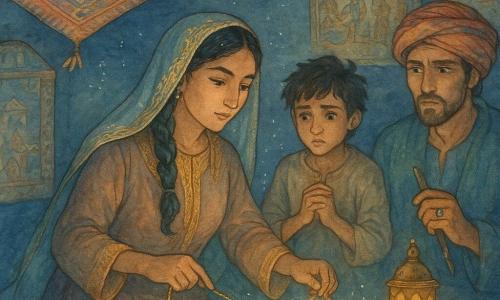
Chapter 1: The Night of Restless Sand
In the city of Qamar, where lanterns hung like captured fireflies and rooftops cooled under a quilt of stars, the sand-wind began to misbehave.
It did not arrive like a visitor with polite footsteps. It burst in like a thief—whistling through keyholes, tossing spices off market stalls, and scribbling gritty messages across windows.
“Again?” groaned the baker, coughing flour and sand at the same time. “If the wind wants bread, it could simply ask.”
At the edge of the bazaar stood Safiya, an adult woman with clever eyes and calm hands. She sold ink, paper, and stories—because in Qamar, words were valued like jewels. Safiya watched a ribbon of sand curl around a date cart as if the wind were tying a knot in the air.
The wind felt angry, but also… hungry. Not for food. For something else.
Safiya's neighbor, old Auntie Rima, slammed her shutters. “These are not ordinary gusts. They're sulking. Like a camel refused water.”
Safiya smiled gently. “Then perhaps we should offer water. Or listening.”
Auntie Rima snorted. “You can't pour listening into a bowl.”
“Maybe not,” Safiya said, tucking a vial of ink into her satchel, “but you can carry it in your heart.”
That night, as the wind rattled doors like a child demanding sweets, Safiya climbed to her roof. She laid a sheet of paper flat, placed a pebble on each corner, and dipped her reed pen.
“Sand-wind,” she whispered, not as a command, but as an invitation, “if you have a message, let it land.”
A gust swept past her cheek—cooler than expected—then a single grain fell onto her page. One grain, shining like a tiny amber bead.
Safiya leaned close. In that grain she imagined a whole desert, and in the desert, a reason.
She made a promise to the night: she would calm the sand-winds with wisdom, not force. Because in Qamar, even storms could be taught—if the teacher had patience.
Chapter 2: The Door That Wasn't There
In the morning, Safiya visited the Great Library, where the shelves rose like palm trunks and the air smelled of leather and time. The librarian, Master Harun, wore spectacles so thick they could probably read minds.
Safiya placed her page on his desk. “A sand grain fell onto this paper like a punctuation mark. I think the wind is trying to speak.”
Master Harun adjusted his spectacles. “Or perhaps you're trying to hear. Both are rare talents.” He peered at the grain, then at Safiya. “There are old tales of winds that become wild when something precious is locked away.”
“What kind of precious?” Safiya asked.
Harun's finger traced the spine of a book titled Doors of the Unseen. “Sometimes it is gold. Sometimes it is truth. And sometimes…” He lowered his voice, as if the shelves were eavesdropping. “It is a kindness that was promised and forgotten.”
Safiya borrowed the book. Outside, the bazaar was still messy with sand, and shopkeepers grumbled like thunder in teacups.
A boy balancing a basket of figs called out, “Lady Safiya! If you can talk to winds, tell them to stop stealing my customers!”
Safiya chuckled. “If the wind buys figs, I'll tell it to pay.”
She walked toward the city gate, where the desert began—an ocean with no water, only waves of gold. The wind followed her, circling like a curious cat.
Safiya spoke softly. “I'm not your enemy. I'm only a listener.”
The wind answered by pushing her book open. Pages fluttered like frightened birds. Then the book snapped shut on a chapter, as if an invisible hand had chosen it.
Safiya read the line aloud: “Where the moon's shadow touches the seventh dune, the door that isn't there will open for the generous heart.”
Safiya looked up. “A door that isn't there,” she repeated. “That's either poetry… or trouble.”
A voice behind her said, “In my experience, it's usually both.”
It was Captain Nadir of the city guard, famous for his grand mustache and his small patience. He squinted at the desert. “You're not planning to walk out there alone, are you?”
“I'm planning to walk out there with my good sense,” Safiya said. “It's quieter than a sword.”
Captain Nadir huffed. “Good sense doesn't stop sand in your teeth.”
Safiya held up a cloth scarf. “This does.”
The wind tugged the scarf playfully, as if to say: Come on, then.
Safiya stepped beyond the gate.
Chapter 3: A Teapot for a Storm
The desert greeted her with a wide, bright silence. Dunes rolled into the distance, each one a sleeping lion of sand. The sun climbed overhead, and the heat pressed down like a heavy hand—but Safiya walked as if she had all the time in the world.
At the third dune, she found a traveler collapsed beside a broken wheel. His donkey looked offended, as if it had been asked to carry the whole desert.
The traveler's lips were cracked. “Water,” he rasped.
Safiya knelt, poured from her flask, and shaded his face with her scarf. “Slowly,” she said. “Drink like a wise person, not like a thirsty goat.”
He managed a tiny laugh. “Are you always this bossy?”
“Only when someone is about to faint,” Safiya replied.
When he could sit up, he said his name was Yusef and that he had tried to cross the desert quickly to avoid the sand-winds. “But the winds found me anyway,” he muttered. “They're furious. Like they've been insulted.”
Safiya opened her satchel and took out a small brass teapot—dented, yes, but polished so it caught the sun. Yusef stared.
“Tea?” he said weakly. “Out here?”
Safiya nodded. “A storm is a guest too. And a guest should be greeted, even if it tracks sand onto your rug.”
Yusef blinked at her. “You're going to serve tea to the wind?”
“I'm going to offer it the idea of tea,” Safiya said. “Some things are symbols. They speak to the invisible parts of the world.”
She set the teapot on the sand. She did not light a fire. She simply placed beside it two cups and a few dates, and then she sat, hands resting on her knees, as calm as a pond.
The wind arrived in a sudden swirl, pushing grit against the cups, rattling the teapot lid.
Safiya did not shout. She did not swing a stick. She only said, “If you're angry, tell me why. If you're hungry, sit with us.”
The wind spun faster, and for a moment Yusef looked ready to run. Then the swirl slowed. Sand settled. The teapot lid stopped rattling.
In the quiet that followed, Safiya felt—not heard, felt—a thought brush her mind like a soft wing: Locked. Forgotten. Dry.
Safiya touched the brass teapot. “Something is locked away,” she murmured. “And the wind is thirsty—not for water, but for what was promised.”
Yusef stared at the unmoving air. “Did… did it just listen?”
Safiya smiled. “Everyone listens when they believe they are safe.”
The wind, as if pleased, nudged the teapot so it pointed toward the horizon.
Safiya rose. “Seventh dune,” she said. “Come, Yusef. Help me find a door that isn't there.”
Yusef hesitated. “I'm not a hero.”
“Good,” Safiya said. “Heroes are always getting into trouble. Be a helper instead.”
And together they walked, guided by a wind that was learning, grain by grain, how to be gentle.
Chapter 4: The Seventh Dune's Shadow
They reached the seventh dune at late afternoon, when the sun began to soften and the desert turned the color of warm honey. The dune was taller than the others and curved like the back of a giant sleeping whale.
Safiya opened the book and read again: “Where the moon's shadow touches the seventh dune…”
Yusef looked at the sky. “But the moon isn't up.”
Safiya nodded. “Then we wait.”
Waiting in the desert can feel like trying to catch a lizard with your eyes closed. Yet Safiya did not fidget. She told Yusef a story about a pearl that thought it was a stone until someone washed it. Yusef listened, and even the donkey seemed to lean in.
As dusk deepened, the first star appeared—sharp as a pinprick. Then the moon rose, pale and patient. Its light spilled across the dune, and a shadow formed where no object stood.
Safiya stepped toward the shadow. It looked like a doorway drawn with charcoal on the sand—an outline with no wall.
Yusef swallowed. “That's… not possible.”
Safiya replied, “Magic often looks like impossible wearing a neat coat.”
The wind circled them, not wild now, but watchful. Safiya approached the shadow and spoke to it as if speaking to a neighbor behind a curtain.
“If this door opens for a generous heart,” she said, “let it open for the sake of peace. Not for treasure.”
Nothing happened.
Yusef shifted. “Maybe your heart isn't generous enough?”
Safiya gave him a sideways look. “Careful. My heart has sharp elbows.”
Then she remembered the traveler, the donkey, the teapot, the cups. Generosity was not a speech. It was an action.
Safiya turned to Yusef. “Do you have anything you don't want to give away?”
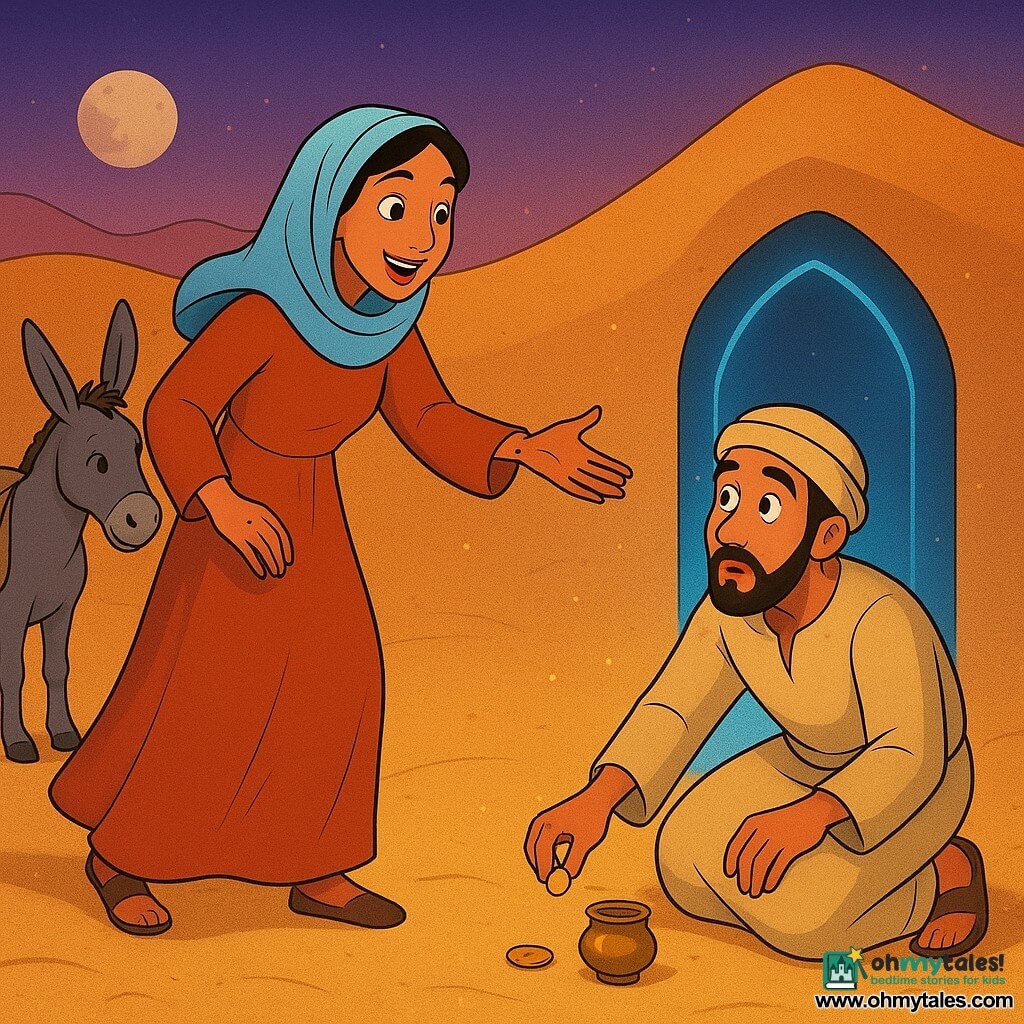
Yusef clutched his belt pouch. “My last silver coin.”
Safiya nodded. “Then offer it—not because I demand it, but because you choose it.”
Yusef groaned the way people do when the right thing is also the annoying thing. He pulled out the coin, kissed it like a dramatic actor, and placed it on the sand before the shadow.
“I hope the door has good manners,” he muttered. “That coin was my breakfast.”
Safiya added her own offering: her brass teapot, dented and beloved. She placed it beside the coin.
“For you,” she said to the unseen door, “and for the thirsty wind.”
The shadow shimmered, as if someone on the other side had smiled. The outline brightened. A cool breeze—fresh, not sandy—slipped through.
And then the door that wasn't there opened.
Chapter 5: The Bottle of Listening
Beyond the doorway lay a chamber carved into stone, lit by a bluish glow that seemed to come from the air itself. The walls were etched with swirling patterns—wind-maps, Safiya realized, like fingerprints of storms.
In the center stood a pedestal holding a glass bottle taller than Safiya's arm. Inside the bottle, a small cyclone spun, trapped and furious. It looked like anger given a body, like a tantrum folded into a jar.
Yusef whispered, “So that's why the desert is upset.”
Safiya approached carefully. Around the bottle's neck was a chain, and on the chain hung a tag of hammered copper. Safiya read the inscription:
“This wind was bound to protect the wells of Qamar. When the people forgot to share water with strangers, the wind was locked away in shame. Now the desert drinks your forgetfulness.”
Safiya's throat tightened. In the city, the wells had guards and rules. Strangers paid extra. Sometimes they were turned away. “We thought we were being careful,” she murmured. “But careful became cruel.”
The trapped cyclone slammed against the glass. The bottle rang like a bell struck by rage.
Yusef stepped back. “We should smash it open.”
Safiya shook her head. “No. Violence is a loud answer to a quiet mistake.”
“How else do we free it?” Yusef asked.
Safiya lifted her ink vial and reed pen. “With a new promise, written and spoken.”
She spread paper on the stone floor and wrote in steady strokes, as if stitching cloth:
We will share water. We will welcome the thirsty. We will not use fear as an excuse for hardness.
Then she signed her name, and after a moment, Yusef signed too—his letters crooked but earnest.
Safiya held the paper to the bottle. “Wind,” she said, voice warm as bread, “we were wrong. We locked you away because we didn't like what you showed us. But you were made to protect, not to punish. Will you help us again?”
The cyclone slowed, as if listening. The glass did not break, but the chain around the bottle loosened on its own, link by link, as though generosity were a key.
With a soft click, the stopper lifted.
The wind did not explode outward. It poured, smooth as silk, spiraling around Safiya and Yusef like a ribbon being unrolled. It smelled of rain that hadn't happened yet.
It paused at Safiya's face. She felt a wordless feeling: gratitude mixed with tiredness. Even winds get weary of shouting.
Safiya bowed. “Come home,” she whispered. “Not as a weapon. As a guardian.”
The wind rose through the doorway and into the night, leaving the chamber still and calm.
On the pedestal, where the bottle had been, lay something small: a seed, dark and shiny.
Yusef picked it up. “Treasure?”
Safiya smiled. “A different kind. Hope with a shell.”
Chapter 6: Wells, Lanterns, and Quiet Courage
When Safiya and Yusef returned to Qamar, the sand-wind arrived ahead of them—not raging, but sweeping. It cleared grit from doorsteps. It pushed open shutters to let sunlight in. It tugged children's kites into perfect loops.
People stepped outside, stunned.
The baker blinked as flour settled peacefully. “Is it… behaving?”
Captain Nadir marched up, mustache trembling. “Safiya! Did you—did you tame it?”
Safiya lifted a hand. “No one tames the wind. We only stopped insulting it.”
In the square by the main well, Safiya asked everyone to gather. The crowd murmured like a pot about to boil.
Safiya spoke clearly. “We forgot a kindness that keeps a city alive. Water is a gift, not a prize. From tonight, any traveler who is thirsty will drink.”
A merchant protested, “But what if we run out?”
Safiya answered, “Then we will drink less, together. Sharing is not losing; it is surviving with a clean conscience.”
Auntie Rima crossed her arms. “Easy words.”
Safiya nodded. “Then let's make them harder—by doing them.”
She took the seed from her pocket and planted it beside the well. “This seed came from the place where the wind was locked. It will grow if our promise is real.”
Yusef stepped forward, holding a new brass cup he'd bought with borrowed money. “I'll be the first to serve,” he announced, then muttered to Safiya, “If I faint, please boss me back to life.”
Safiya laughed softly. “Agreed.”
That night, a traveler arrived—dusty, nervous, alone. The crowd went quiet. The traveler stared at the guarded well, expecting rejection like a slap.
Safiya walked forward with the cup. “Drink,” she said.
The traveler hesitated. “What is the price?”
Safiya shook her head. “A story, if you have one. If not, a smile will do.”
The traveler drank. When he smiled, it looked as if someone had lit a lantern inside his chest.
The wind moved through the square, cool and gentle, and for the first time in many days, no sand stung anyone's eyes.
Morning brought a miracle that didn't shout. A green sprout rose beside the well—small, brave, and bright as a comma in a long sentence.
People gathered around it, whispering as if it might get shy.
Captain Nadir cleared his throat. “So,” he said grudgingly, “non-violence works.”
Safiya tilted her head. “It isn't magic by itself. It's paired with responsibility.”
Auntie Rima leaned in, pretending not to be impressed. “And what will you do if the wind gets angry again?”
Safiya looked up at the sky, where the wind traced invisible circles like a dancer practicing.
“I will listen sooner,” she said. “And I will remind my city that a hard heart is the driest desert of all.”
That evening, as children drifted to sleep and lanterns hummed softly, the sand-wind curled around Qamar like a protective shawl, no longer a thief but a guardian.
And Safiya, with ink-stained fingers and a steady smile, understood the simplest spell of all: when you meet trouble with kindness and sense, even invisible doors can open—quietly, safely, and wide enough for everyone to pass through.