Chapter 1: The Sealed Letters and the Stolen Gate
In the city of Saffron Steps, night arrived like a soft shawl laid over shoulders—warm, quiet, and stitched with stars. In a small room above a tea shop, an adult courier named Nadir warmed his hands around a cup that smelled of mint and honey.
Nadir carried sealed letters from city to city. Some were fat as pigeons, some thin as whispers. Each seal was a promise: red wax stamped with moons, lions, or tiny palm trees. People called him “the Invisible Man,” not because he vanished, but because he never asked to be praised. He delivered words the way a river delivers water—faithfully, without fuss.
That evening, the tea seller slid a letter across the counter. The wax seal was green, the color of fresh leaves after rain. Pressed into it was a small key.
“Not for a palace,” the tea seller murmured. “For a garden.”
“A garden?” Nadir echoed.
The tea seller leaned in as if secrets had ears. “There was a public garden here once, the Garden of Shared Shade. Children learned to whistle to sparrows there. Grandmothers traded recipes under pomegranate trees. But a wealthy man, Lord Badr, built a tall iron gate and claimed the garden for himself. Now the people walk past and swallow their longing like dry bread.”
Nadir turned the letter over. It was addressed to him, though no one signed it.
“Why me?” he asked.
The tea seller shrugged. “Some doors don't open for strong hands. They open for steady hearts.”
Outside, the wind rattled the lanterns like a row of small bells. Nadir tucked the green-sealed letter into his satchel. In the street, two boys chased each other, then stopped at the garden's iron fence. Their laughter shrank to silence, like a candle pinched out.
Nadir looked at the locked gate. Above it, vines tried to climb but were snagged and broken, like unfinished sentences.
He felt the city's sadness, not loud, but constant—like a drumbeat far away.
“All right,” he said to the night. “Let us see what your letter wants.”
Chapter 2: The Letter That Spoke in Fragrance
At dawn, Nadir went to his room and held the letter above a small brass bowl. He did not tear it open. Couriers respected seals the way sailors respect storms.
Instead, he warmed the wax with a candle until it softened. The green seal did not melt into a puddle. It lifted like a leaf from water, and the key mark on it shone.
A scent rose—jasmine mixed with something sharp and bright, like peeled lemons. The letter unfolded on its own, as if the paper had been waiting to stretch its limbs.
The ink did not sit still. It flowed like a thin river across the page, forming words one by one:
Nadir of the Quiet Footsteps,
The garden was never meant to be owned. It is a bowl of shade for all.
You will find three sealed letters on your road. Deliver them without breaking the seal.
Do this, and the stolen gate will remember it was once a doorway.
Nadir blinked. “A gate with a memory,” he muttered. “That is new.”
At the bottom of the letter, a small drawing appeared: a pigeon carrying a ribbon, a fountain shaped like a crescent, and a door with no wall around it.
Nadir laughed once, softly. “Even the ink likes riddles.”
He packed his satchel: bread, dates, a small waterskin, and a notebook where he scribbled addresses. Then he walked toward the market, where rumors fluttered from mouth to mouth like paper kites.
He asked a spice merchant, “Do you know of sealed letters that no one dares to carry?”
The merchant scratched his beard. “There is a letter in Copper Alley, sealed in blue wax. People say it hums at night. Who wants a humming letter? It might sing your eyebrows off.”
A potter overheard and snorted. “And there is one sealed in silver wax at the old caravanserai. It belongs to a man who disappeared after trying to open it. Vanished like a coin in sand.”
Nadir raised an eyebrow. “And the third?”
A girl arranging oranges spoke up. Her voice was clear as morning water. “A letter sealed in amber wax is kept by the storyteller in Lantern Square. He says it is too heavy with sorrow to travel.”
Nadir nodded and bought one orange. “Then I will travel with it. Sorrow likes company.”
As he walked away, the orange in his hand felt like a tiny sun—warm, round, and brave.
Chapter 3: The Blue Letter and the Humming Alley
Copper Alley was narrow, walled with old bricks the color of tea. Pots and pans hung from balconies, and cats watched from windows like judges.
At the far end of the alley stood a door painted blue. A woman named Auntie Rima opened it just enough to peer out. Her eyes were sharp, but not unkind.
“You're the courier,” she said. “The one who walks like he's apologizing to the ground.”
“I prefer not to step on the world too hard,” Nadir replied.
Auntie Rima huffed, but her mouth twitched. “Come in. The letter is on the shelf. Don't blame me if it starts reciting poetry.”
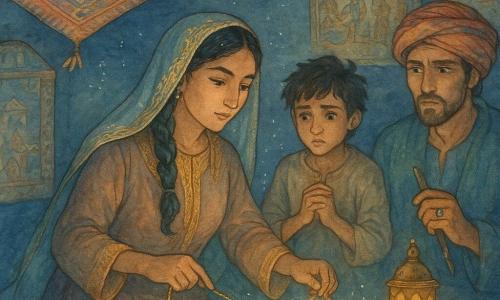
Inside, the room was crowded with copper kettles and bowls that gleamed like captured sunsets. On a shelf sat a small envelope sealed with deep blue wax. As Nadir approached, it truly did hum—a low sound, like a bee thinking.
He did not touch the seal. He bowed slightly, as if greeting a nervous guest, and slid the letter into his satchel.
The humming softened, as if pleased.
Auntie Rima crossed her arms. “Why would you carry a letter that refuses to be quiet?”
“Because sometimes quiet is not peace,” Nadir said. “Sometimes quiet is fear holding its breath.”
She studied him, then sighed. “If you get in trouble, I will deny ever seeing your face.”
“That will be easy,” Nadir said. “My face is very ordinary.”
He stepped back into the alley. The cats blinked slowly, as if granting permission.
As he walked, the satchel hummed. The sound was not annoying. It was like a reminder: some messages are alive.
At the corner, a guard from Lord Badr's estate stood watching passersby, his spear upright as a stiff question mark.
The guard pointed at Nadir's satchel. “What do you carry?”
“Words,” Nadir said honestly.
The guard frowned. “Words can be sharp.”
Nadir smiled. “Not the words I deliver. Mine are wrapped in wax. They cannot bite anyone—unless someone bites first.”
The guard, confused by this, waved him on. Nadir walked away with his heart steady, like a lantern that refused to flicker.
Chapter 4: The Silver Letter at the Caravanserai
By midday, Nadir reached the old caravanserai, a courtyard where travelers once traded stories as easily as they traded cloth. Now it was half empty. Dust lounged in the corners like sleepy camels.
An elderly caretaker sat near the well, playing a slow game of stones and lines scratched into the ground.
“I've come for a letter,” Nadir said.
The caretaker squinted. “If you mean the silver-sealed one, it brings bad luck.”
“Then let it bring it to me,” Nadir replied. “I have a strong umbrella.”
The caretaker chuckled despite himself and led Nadir to a small room. On a table lay an envelope sealed with silver wax, stamped with a crescent moon. It looked cold, as if it had been stored in winter.
Nadir did not open it. He simply picked up the envelope carefully, as one might pick up a sleeping bird, and placed it in his satchel beside the blue one.
The caretaker rubbed his palms. “A man tried to crack that seal. The wax jumped like a flea and burned his finger. He ran out shouting that the letter had looked back at him.”
“A letter with eyes,” Nadir murmured. “How rude.”
“Are you not afraid?” the caretaker asked.
Nadir considered. He thought of the children at the fence, their laughter folded away.
“I am afraid,” he admitted. “But fear is only a guard dog. It barks. It doesn't decide where I go.”
The caretaker nodded slowly, as if tasting that sentence. “Then go gently, courier. Some powerful men hate gentle people. They don't understand how softness can move mountains.”
Nadir tipped his head in thanks and left the caravanserai. The silver letter did not hum. It did not sing. But in his satchel, it felt heavy with silence—like a stone that had been listening for years.
Chapter 5: The Amber Letter and the Storyteller's Bargain
Lantern Square was bright with colored glass lamps, even in daylight. They hung in rows like captured rainbows. At the center sat a storyteller on a cushion, surrounded by children and a few adults who pretended they were only passing by.
The storyteller's name was Hakim, and his voice was a carpet—woven with jokes, flying with patterns. When he saw Nadir, he paused mid-tale.
“Ah!” Hakim cried. “The courier with the silent shoes! Come, come. Have you brought me news, or have you come to steal my best audience members?”
“I've come for the amber-sealed letter,” Nadir said.
A hush fell, like a scarf over the crowd. Hakim's smile stayed, but it grew smaller.
“It is a letter that makes even brave hearts sit down,” he said. “Why would you want it?”
“Because a garden is locked,” Nadir replied, “and the city is thirsty for shade.”
Hakim leaned closer. “Lord Badr does not unlock things. He collects them. First he took the garden, then he took the fountain inside it, then he took the idea of sharing. Next he will take laughter and sell it in jars.”
A boy in the crowd whispered, “Can he do that?”
Hakim winked. “Only if we let him.”
He reached beneath his cushion and pulled out an envelope sealed with amber wax, stamped with a tiny sunburst. The seal looked warm, like it had swallowed a piece of afternoon.
Hakim held it out but did not release it. “A bargain, courier.”
Nadir lifted an eyebrow. “I do not have much money.”
“I don't want money,” Hakim said. “I want a promise. Deliver these letters without violence. No swords, no fists, no clever accidents involving banana peels.”
A few children giggled.
Nadir smiled. “Agreed. I am a courier. My weapons are patience and good manners.”
Hakim finally placed the amber letter into Nadir's hands. It felt like holding a tiny hearth.
“Remember,” Hakim said softly, for Nadir alone, “some people think peace is weak. Show them peace is a key.”
Nadir bowed and walked away, his satchel now holding three sealed letters—blue, silver, and amber—like three stars hidden in cloth.
Chapter 6: The Doorway That Wasn't There
Night returned, glittering and calm. Nadir stood before the iron gate of the stolen garden. Two guards lounged nearby, bored as old stones. Beyond the bars, Nadir could see dark leaves and the pale glimmer of a fountain—like a moon trapped in a cage.
He remembered the first letter's instruction: Deliver them without breaking the seal.
But to whom?
He walked along the fence until he reached a section where the wall was covered in climbing vines. There, half-hidden, was an odd shape in the stone: a door outline, carved long ago and forgotten. A door with no handle. A door that led to a wall.
Nadir set down his satchel and took out the three sealed letters. He held them up to the carved outline.
The blue letter hummed louder, like a throat clearing.
The silver letter felt colder, like a breath held too long.
The amber letter warmed his palm, as if urging courage.
Nadir spoke to the empty doorway, feeling a little silly. “I have brought messages. I do not know your name, so I will call you… Door.”
The guards glanced over.
One muttered, “Is he talking to the wall?”
“Maybe the wall owes him money,” the other said, yawning.
Nadir ignored them. He placed the three letters, still sealed, against the stone outline—blue at the top, silver in the middle, amber at the bottom, like a strange, patient face.
For a moment, nothing happened. Then the carved outline shimmered, as if the stone remembered being soft once. The air thickened with scent: jasmine, lemon, and something like rain on hot dust.
A thin line of light appeared around the door shape. It widened, quietly, without cracking or crashing. The wall did not break. It simply… agreed to move aside.
Where there had been stone, there was now an open doorway, glowing with gentle light. Beyond it, Nadir saw the garden—alive, green, and listening.
He stepped through.
The fountain inside was shaped like a crescent moon, just like the drawing. Water flowed in a steady arc, singing softly. Trees held their leaves like generous hands. The air tasted of mint and possibility.
On a bench sat an old woman with eyes like deep wells. She wore no crown, yet the garden seemed to bow toward her. In her lap was a ledger book, and in her hand, a tiny key made of green glass.
“You delivered the letters,” she said, though her voice was not loud. It was the kind of voice that made you lean in and behave.
“I did,” Nadir replied. “Without opening them.”
“Good,” she said. “Because the letters are not meant to be read. They are meant to be carried.”
Nadir frowned. “Carried where?”
“Through fear,” she answered. “Through greed. Through the ugly idea that only the powerful deserve beauty.”
He swallowed. “Are you… a spirit?”
“I am what gardens remember,” she said, smiling. “Once, people promised this place would belong to everyone. That promise became a magic older than Lord Badr's lock.”
Nadir glanced toward the gate. “How does this help the city?”
The old woman tapped the ledger. “Lord Badr believes ownership is a spell. He is wrong. Sharing is a stronger spell, because it multiplies.”
She lifted the green glass key. “But spells require a witness. Tomorrow, bring the people here—not with force. With invitation.”
Nadir nodded slowly, understanding like sunrise—gradual, then sudden.
“And Lord Badr?” he asked.
The old woman's smile turned playful. “We will not fight him. We will offer him something harder to resist than fear.”
“What is that?”
“A chance to be remembered kindly,” she said.
Chapter 7: The Feast of Open Hands
At dawn, Nadir walked into the market and began delivering a new kind of message—spoken, not sealed.
To bakers he said, “Bring bread to the garden today.”
To musicians: “Bring your drums.”
To children: “Bring your loudest games.”
To grandmothers: “Bring your stories and your sharp opinions.”
People stared. “The garden is locked,” they said.
Nadir smiled. “Not to everyone. Meet me at the vine-covered wall at midday. Come peacefully. Come hungry for shade.”
By noon, a crowd gathered—curious, cautious, hopeful. Nadir led them to the hidden doorway. When they saw the wall open like a polite curtain, a gasp rippled through the people like wind through wheat.
Inside, the garden welcomed them. Children ran under the trees as if they had been waiting years to remember how. Adults sat by the fountain and let their shoulders drop, as if they had been carrying invisible sacks.
Nadir asked the bakers to lay bread on cloths. The orange girl brought a basket of fruit and grinned at him. Hakim arrived with his storyteller's voice and began spinning a tale about a proud lock that learned to laugh.
Music rose. Not a battle song—something bright and teasing. The garden, once stolen, became a shared bowl again, filled with simple treasures: water, shade, and company.
Then Lord Badr arrived.
He came in a robe the color of expensive midnight, flanked by guards who looked nervous. His eyebrows were two angry birds. He stopped at the doorway, eyes narrowing.
“What is this?” he demanded. “This is my garden.”
The crowd fell quiet, not from fear, but from attention—like an audience waiting for the next line.
Nadir stepped forward. He did not raise his voice. He did not clench his fists. He simply stood, calm as a lamp.
“My lord,” Nadir said, bowing, “we have not come to take anything. We have come to return what was always meant to be shared.”
Lord Badr snorted. “You cannot return what you never owned.”
Nadir gestured to the fountain. “Does water belong to the cup, or does the cup serve the water?”
Lord Badr stared as if he'd been asked to juggle clouds.
A child called out, bold as a sparrow, “The cup is useless if it's empty!”
A few people chuckled. Even one guard's mouth twitched.
Nadir continued gently, “You can keep the title, if that is what you love. Keep your name on the gate. But let the people in. Let the garden make you generous.”
Lord Badr's face reddened. “Why would I?”
Hakim spoke up, his voice silky and sharp. “Because the city already remembers you as the man who stole shade. But today you can be remembered as the man who gave it back.”
The orange girl lifted an orange. “Also, we brought snacks.”
A ripple of laughter rolled through the crowd—warm, not mocking. The garden seemed to brighten, as if amused.
Lord Badr looked around. He saw no weapons. No stones in hands. Only bread, fruit, music, and faces that were not begging—faces inviting him to step into a kinder story.
His anger wobbled, suddenly unsure of its footing.
Nadir took out the first green-sealed letter—the one that had begun it all. He did not open it. He simply held it out.
“This letter chose me,” Nadir said. “But perhaps it was meant for you.”
Lord Badr stared at the seal with the tiny key. For a moment, his expression softened, the way hard soil softens when rain finally arrives.
He did not take the letter. Not yet.
But he did something small, and small things can be enormous: he stepped into the garden.
The guards followed, lowering their spears without being told. The crowd did not cheer. They made room.
Lord Badr approached the fountain and watched the water arc and fall, again and again, never hoarding its own song.
Hakim offered him a piece of bread. “It tastes better when shared,” he said.
Lord Badr hesitated, then took it. He chewed slowly, as if tasting more than flour.
“I do not like being tricked,” he muttered.
Nadir replied, “Then do not call it a trick. Call it an invitation.”
Lord Badr looked at the children running and the elders smiling. “If I unlock the gate,” he said gruffly, “will they stop cursing my name?”
A grandmother called from her spot under a pomegranate tree, “We can upgrade to grumbling, if you behave.”
The crowd laughed again, and Lord Badr—astonishingly—let out a short sound that might have been a laugh trying on new clothes.
He exhaled. “Very well,” he said. “The gate will be opened. But I will keep it clean.”
Nadir bowed. “Clean gates for clean hearts.”
Chapter 8: The Garden Returns to the Map
That evening, the iron gate stood open. The lock remained, but only as a decoration—like a retired villain in a children's play. People came and went, respectful and joyful. The garden returned to the city's map, not as a treasure chest, but as a table.
Nadir visited the vine-covered wall one last time. The glowing doorway had faded back into stone, but the outline remained, faint and friendly.
In the quiet, he thought he heard a whisper—jasmine and lemon in the air.
The old woman's voice seemed to drift near the fountain: Sharing is a stronger spell, because it multiplies.
Nadir smiled and sat on a bench. He watched Lord Badr awkwardly hand a cup of water to a little boy, who accepted it with solemn dignity. Peace, Nadir thought, was not the absence of trouble. It was the presence of good choices, made again and again.
Hakim arrived and flopped down beside him. “Well,” he said, “you have done a dangerous thing.”
Nadir glanced at him. “What is dangerous about a picnic?”
Hakim tapped his forehead. “You made generosity look possible. Some people will catch that idea like a yawn.”
Nadir chuckled. “Let them catch it.”
Hakim leaned back. “And what will you do now, Invisible Man?”
Nadir touched his satchel, lighter now that the three sealed letters had served their purpose. “I will keep carrying messages,” he said. “Because words can build bridges without breaking bones.”
Hakim nodded, eyes shining. “That is a fine moral, courier.”
Nadir looked at the open gate, the shared shade, the fountain's calm moon-song.
He stood, ready for the next road. The night wrapped the city in its warm shawl again, but this time, the darkness did not feel like a closed door.
It felt like a corridor full of lanterns, waiting for kind hands to pass them along.