Chapter 1: The Missing Map
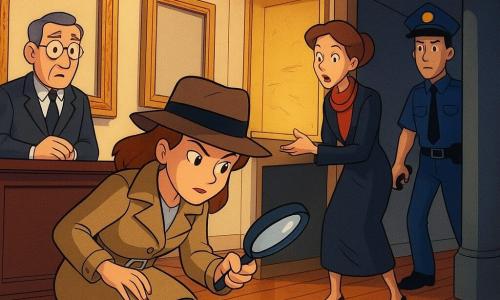
Detective Clara Grey kept her coat buttoned against the October wind and walked slowly down Lantern Lane. The street lamps were turning on, little moons along the cobblestones, and the bakery on the corner still smelled of cinnamon and warm bread. Clara liked to notice small things—the crooked sign above the hat shop, a dog's red ball under a bench, the way the paperboy always folded the same page twice. Observation was a sort of quiet habit with her, not grand or dramatic, just steady.
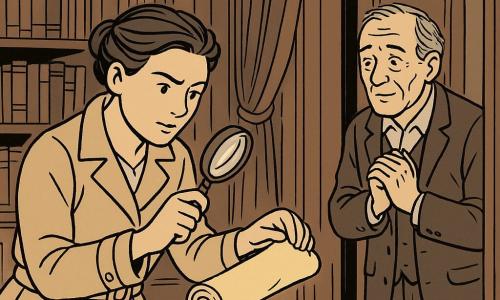
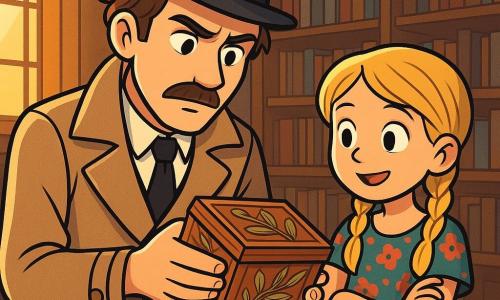
The case had started that morning when Mr. Finch, the mapmaker, had come into the station with a pale face and an empty wooden box. Inside the box had been a treasure map—old paper in a new frame, inked in careful lines, dotted with small Xs. The map had been a family heirloom and, Mr. Finch said, a reminder of his father's promise to hide something “for a rainy day.” That something was missing now, and Mr. Finch wanted it back. He was not rich, but he had pride; he was old-fashioned and honest and had no reason to invent a story.
Clara had listened with calm attention, tapping a pencil against a small notebook. She believed in following leads, not hunches. She asked Mr. Finch where he had kept the box. He said the attic, under an old chest. Who else had been in the house? The neighbor's cat, perhaps, and his niece, who visited each Wednesday. Clara looked at the map's edges, at the way the ink had browned. She noticed tiny smudges of soil along one corner, like muddy fingerprints, and a faint scent of sea salt if she held it close. That was the first clue: someone had handled the box outside, near water.
She closed the notebook as if closing a small door in her mind: start near the water. Lantern Lane topped a hill that sloped down toward the river that cut the town in two. Clara decided to check the riverside market where Mr. Finch often walked after breakfast. She liked routines; they helped her test possibilities.
At the market, stalls buzzed with the evening crowd. Fishermen traded gossip for coffee. A boy juggled rotten apples for spare change. The market manager, Sofia, recognized Clara and waved. “You look like you're looking for trouble,” she said with a smile.
“Only the kind that happens to have paperwork,” Clara answered. She asked Sofia if she'd seen anyone with a wooden box or unusual paper. Sofia remembered a man who'd been asking about maps two days ago, a tall fellow with a coat too big for him and a limp that made him lift one foot oddly. He had asked where to find old sea charts. “Maybe he wanted to go treasure-hunting,” Sofia mused.
Clara wrote “tall man, large coat, limp, sea charts” in her notebook. She felt the case settling into shape, edges and corners forming. She checked the river path where people often walked with parcels. There, on a bench, sat a scrap of blue fabric with mud stains like the map's corner. Clara folded it gently into a plastic bag and labeled it. Collecting evidence, she told herself, was like gathering pieces of a quick puzzle.
She left the market with one other thought: prudence. She would not rush to confront anyone until she had more than a guess. The town was small; false accusations could ripple like a pebble in a pond. Clara preferred to be careful and calm.
Chapter 2: The Lead at the Boathouse
The boathouse was a square of old wood and flaking red paint at the edge of the river. Inside, boats leaned like tired teeth. Its owner, Mr. Arno, was a man with hands that smelled of rope and varnish. He knew everything about tides and nets; if anyone near the water had handled a box and left a trail, Arno would know.
Clara introduced herself and mentioned Mr. Finch's missing box, keeping her voice level and steady. Arno frowned. “Maps? Lots of folks look for old charts. But a tall man with a limp—oh, that's Lyle Thornton. He's been around asking about old sea routes and gull calls. Odd sort, but harmless, mostly.”
“Did you see him carry a wooden box?” Clara asked.
Arno thought. He remembered a wooden box under a bench two days earlier, wet from the river spray, and a scrap of blue cloth caught on a nail. He could show her the spot. Clara followed through the boathouse, watching shafts of light cut dust into stripes. A gull tapped the window like a knuckle.
Outside, where the dock met the mud, Clara noticed footprints pressed into the damp earth. One set of prints was clear and large; the other showed a strange drag, as if one shoe had a tear. She photographed them in her mind, then on her phone. The prints led toward the old mill path, which wound into the marshes. Clara tucked the vial of blue cloth into her jacket. The visible clues were starting to connect: sea salt on the map, mud on the cloth, footprints toward the marsh. Someone had moved the box near the water.
She considered Lyle Thornton. Clara did not like to jump to conclusions about people who seemed odd. Lyle could be a harmless eccentric, or he could be a guest in a story who turned out to be something else. The best choice was to check his alibi, gently. She asked Arno if he knew where Lyle lived. Arno pointed to a cluster of cottages at the lane's end—small, close together, like a family of boxes.
Clara walked there, step slow and even. Investigation was a matter of following a path until it forked, then choosing the path that made sense and testing it. At one cottage she found a man who resembled Arno's description: tall, coat too big, and a limp that made him tilt his shoulder when he walked. He was painting a fence and humming under his breath.
“Mr. Thornton?” Clara asked.
“Lyle,” the man corrected, smiling. “You from the council? Need a hand with the paint?”
“Just asking a few questions,” Clara said. She showed him the map's photo from her notebook without pointing fingers. “Do you know this map?”
Lyle looked at it as if it were a song he had forgotten. “Ah, that old thing. Always been around. Mr. Finch traded me stories about it once. No, I don't have it. I only asked about sea routes here and there. I'm not one for stealing. My left shoe has a tear, yes, but I keep to my own affairs.”
Clara thanked him and noted the detail: a torn shoe matched the dragged print at the boathouse. That was a lead, not proof. She needed more. Prudence meant cross-checking. She asked around—neighbors, a baker, the postman—and learned that Lyle had been seen with a friend, Mara, the following afternoon near the old mill. Mara ran a small stall selling handmade soaps and knitted hats. Clara decided to speak with her next.
Chapter 3: The Ordinary Passerby
Mara's stall smelled of lavender and lemon. She greeted Clara with a bright, quick smile and a question about which hat would suit her. Clara asked calmly about the afternoon by the mill. Mara's face shifted while she remembered—small, immediate movements. She said she had seen Lyle arguing with another man, someone she didn't know, who had a satchel and walked fast, like he was late for something.
Clara's pen hovered. “Did the man say anything you remember?”
Mara's fingers tightened on a knitting needle. “Just one odd line. He kept saying, ‘Enough of hiding things away. Maps are for finding, not locking up.' That's all I recall. He seemed nervous, like the words were a key for him.”
A key. Clara wrote that down as a separate clue: the stranger's words, “maps are for finding.” It sounded like philosophy until one thought about motives—if someone believed maps should be found, they might take them from others who kept them. Words could turn a person from ordinary to dangerous.
She left the market and walked toward the mill path. Halfway there, she met a passerby: a woman in a green jacket carrying a grocery bag, whose face was pleasantly ordinary—no limp, no dramatic clothing, just a kind, tired look and a small mole by the chin. The woman paused when Clara slowed to look at the path's muddy prints.
“Oh! You looking for something?” the passerby asked. Her voice was plain, a friendly bell.
Clara hesitated. The passerby seemed like a background person in a painting, someone who belonged to the town, not a suspect. But in detective work, ordinary people sometimes had extraordinary information. Clara explained who she was and mentioned a wooden box and footprints. The passerby blinked, then said, “I saw a man yesterday, near the old mill. He was arguing with someone. He said, ‘Maps are for finding,' like you said Mrs. Mara heard. But what struck me was his purse—he had a small leather journal tucked into it. He dropped it when he ran off.”
Clara's breath narrowed for a beat. The passerby had provided a detail no one else had: the leather journal. She asked where the passerby had seen it, and the woman pointed to a path by a low stone wall near the mill. “I thought it might belong to a lover or a traveler,” she said. “I picked it up and meant to take it to the notice board, but I got home and forgot. This morning I thought of it and meant to come back—but that was when it all seemed too small and silly and then I had to cook for my father and—” She looked apologetic, as ordinary people often do when they had delayed something important.
Clara felt the case pivot. A phrase, a simple shape of words—“maps are for finding”—and the discovery of a dropped journal turned the investigation into a direction she could test. The passerby's ordinary nature was part of the value of her information. She hadn't been looking for mystery, but stepping into one with two feet, and her small action mattered.
“May I see the journal?” Clara asked gently.
The passerby thought about it and then, with a small laugh, said she had left it on her kitchen table. She offered to fetch it. While the woman walked away, Clara made a mental note: never dismiss ordinary people. Sometimes they were the only ones who noticed simple things like a dropped journal.
The woman returned with the leather-bound journal tied with a thin ribbon. Its pages were smudged with river mud, and inside were notes—drawings of the river's bends, a sketch of a boathouse, lists of tide times, and, tucked between two pages, a small pressed leaf. The journal seemed like a river's memory. On the last page, in hurried handwriting, there was a single sentence repeated twice: “It must be found. Maps are for finding.”
Clara folded the ribbon back and felt the shape of the journal in her hands. The ordinary passerby had given her what she needed to check the new lead: this stranger cared enough to carry notes about the river and tides and the map's likely hiding places. Now the task was to match the handwriting, the leaf, the soil to someone in town.
She thanked the woman and offered her card—simple, with the detective agency logo. “If you remember anything else, please call,” Clara said. The woman nodded and left. Clara tucked the journal into an evidence bag and stepped back toward the mill path. She felt the case sharpening into a form she could test with logic and patience.
Chapter 4: The Turn of Phrase
Back at the station, Clara spread her collected items on the table like a small landscape: the blue scrap, the map photograph, the leather journal, a photograph of Lyle Thornton, and the notes she had taken. She compared handwriting, soil smudges, and the leaf's serrated edge. The leaf matched a type of marsh grass that grew along the old causeway, near a place where fishermen sometimes hid things in barrels to keep them dry. That pointed back to the marsh rather than the river market.
She visited the old causeway at dawn, when fog turned the world soft and suspicious. The air smelled of fish and cold. Clara moved slowly along the path, checking barrels and hollow logs. She used logic like a ruler, measuring possibilities one after another. Her calmness was a tool; haste was a magnet for mistakes.
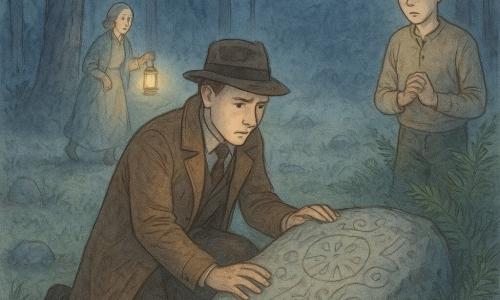
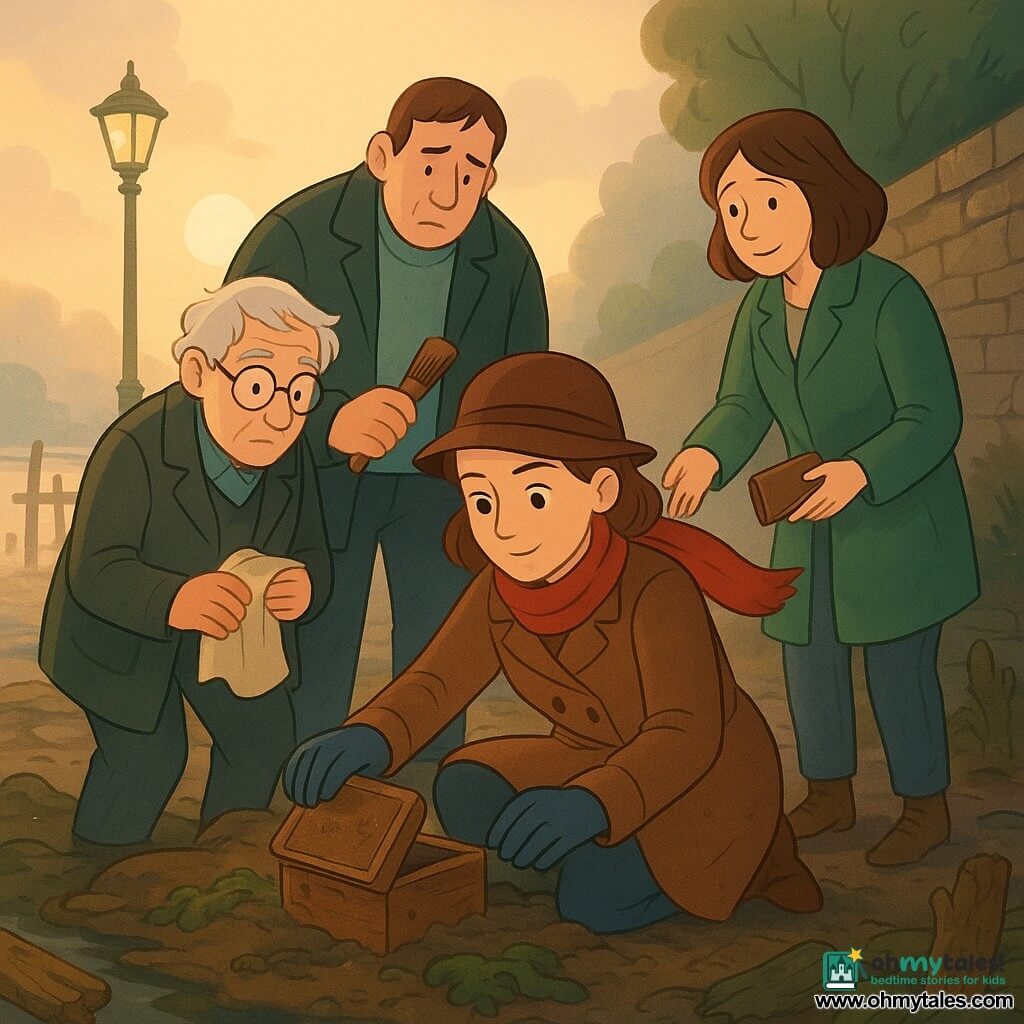
Near a pile of driftwood, she found a small hiding place where someone had tried to tuck a box away under stones. The earth was recently disturbed. Inside the hollow, wrapped in oilcloth, lay a wooden box not unlike the description Mr. Finch had given. It was damp but intact. Clara's heart gave a small, responsible flutter—evidence, found by following plain clues and patient steps. She photographed it with her phone and called for backup to lift the box properly.
As she waited, she sat on a rock and opened the lid with gloved hands. Inside were old papers, a small carved whistle, an envelope addressed to “For Finch's Rainy Days.” But the papers were not the treasure anyone had expected. They were lists of names—names of sailors, small drawings of coastlines, and, tucked behind, a single folded note in a different hand. Clara unfolded it carefully. The note read: “Maps should not be locked away. They belong to people who remember the sea. Share this with those who care.”
The tone was earnest, almost pleading. It matched the journal's repeated sentence. The handwriting seemed to belong to someone who thought of the river like family. Clara's mind turned to Mr. Finch's niece, who had easy access to the attic, and to Lyle, who loved sea stories. She did not leap to accusation, though; she wrote down possibilities and waited for lab tests to confirm what simple signs suggested.
Then, as she packed the box for transport, Clara's phone buzzed with a message from an unknown number: “Do not blame Lyle. He cannot hide what the river gives him.” It was a strange sentence, almost a warning, and below it a single word: “Listen.” The word landed like a small stone.
Clara thought of the passerby's words, the stranger's phrase, the journal's insistence. “Listen,” she said softly to herself, and then looked around at the marsh. In the distance, a gull cried, and far off, someone was singing under their breath while mending nets. Listening was not just hearing; it was paying attention to how people used words.
She replayed conversations in her head and compared the rhythm and shape of handwriting. The note's hand matched the leather journal. That suggested the person who had left the journal at the passerby's home had also left the plea inside the box. Whoever wrote “maps are for finding” saw the map as a communal thing, not a private secret.
Clara's investigation was becoming clearer: the thief—or the person who had taken the map—might not have intended harm. They might have wanted to share it, to let people remember. But sharing without permission was still wrong. The question was motive: did they take the box to give it away, or to hide it from someone else? Prudence meant preparing for both possibilities.
She arranged to speak with Mr. Finch's niece, three friends of Lyle, and the passerby again. She was building a web of conversations, each one another line of evidence. She kept her voice even, her questions precise. Persistence paid more than pressure.
Chapter 5: The Message Sent
Clara gathered the people in the small room behind the station: Mr. Finch, who seemed thinner than his stories; Lyle, who stood awkward and honest; the passerby, who had brought the journal; Mara, who knitted without looking; and the neighbor who had borrowed things from the attic. Clara placed the wooden box and the journal on the table and told the simple story of evidence: the mud, the leaf, the handwriting, the footprints, the note found inside the box. She spoke slowly, letting each fact land.
Everyone listened. Faces shifted like pages. Prudence showed itself in alliances forming—someone offered to help Mr. Finch check other family papers; Lyle promised to repair his torn shoe and help mend the fence by the mill. The passerby, who had been careful and awkward about her role, looked relieved to be part of the resolution.
Clara then spoke about motives. “Someone wrote these words, ‘Maps are for finding,'” she said. “They believed the map belonged to the town, to remember the river and the people who loved it. They took it because they wanted others to remember, not because they wanted to harm Mr. Finch.” She paused and looked at each person in turn, making sure her calm was shared. “But taking without asking has consequences. We must be careful when we act on something we think is right. Prudence calls for asking, for explaining, for listening first.”
Mr. Finch's face softened into a gratitude that was quiet and true. He had been afraid, proud, and angry in turns. He sat back and said, “I kept it because it was our family's memory. But I see now that secrets sometimes keep us from the very people we want to share with.” He suggested a simple idea: host a small gathering on the riverbank to show the map and tell the stories hidden in it. He would invite everyone who loved the river.
Clara watched the small room transform. Lyle, who had been suspected only because of a torn shoe and a love of old charts, held out his hand to Mr. Finch. “I'm sorry,” he said. “I should have said what I planned. I promised the sea folk I would share, but I forgot to ask you.” His voice was steady; his limp looked like a new thing to bear with honesty.
The passerby then explained why she had kept the journal so long. She had been unsure if someone else would need it or if she should knock on doors and interrupt people's evenings. Clara had a soft thought about how ordinary kindness sometimes requires a small courage—the courage to interrupt routine to speak up. The woman was given thanks and a promise that next time she would do the right thing sooner.
Finally, Clara tapped her pen and cleared her throat. “There's one more thing,” she said. She wrote a short message on her phone, careful and clear. The message was simple and meant to tie the town together rather than to punish: a note to the community group chat they all used for lost pets and bake sales. She typed:
“Found: Mr. Finch's family map safely returned. We will have a small gathering by the river this Sunday to share the map and stories. Please come if you love the river or remember the sea. Let's promise to ask before taking and to listen before acting. -Clara G.”
She looked up and saw nods, some quiet smiles, a few teary eyes. The message was not a dramatic end—no handcuffs, no long trial—but it was right for the place and the people. It promoted careful speaking, kind asking, and practical sharing. Clara pressed send.
The message slipped from her phone into the network like a small boat released on the river. It would go to people who might otherwise have stayed apart. Clara felt the satisfaction of a case resolved with logic, observation, and a simple dose of prudence. She did not celebrate loudly; she preferred to close a book and set it back on the shelf.
As they left the station, the town already felt a little rearranged. People said polite things, made small plans to come Sunday, and offered to bring hot drinks and biscuits. Mr. Finch walked slowly with Lyle beside him, trading a story about a storm that once swept a crate of maps into the water and how a boy had dived to save them.
Clara walked home with the sun low and warm on her face. She liked the quiet after a problem solved. She thought of the passerby's ordinary kindness and of the thief—if thief there had been—whose words had changed the story. She believed mistakes could teach, if people were willing to learn. Prudence meant more than being careful; it meant being wise about how to fix what had been broken.
That evening, Clara folded her notebook and wrote one last line beneath the day's notes: “Listen, ask, share.” She sent a private message to the passerby she had met at the mill: “Thank you. Your ordinary kindness helped everyone. See you at the river?”
The passerby replied with a small, happy emoji and the words: “I wouldn't miss it.”
Clara smiled and set her phone aside. Outside, the gulls still argued with the wind. Inside, the town's maps and memories were safe again, and the river hummed a steady song, like a secret shared between friends.