Chapter 1: The Quiet Agency and the Loud Problem
Milo Grant's detective agency was the smallest office on Maple Street and the busiest in Milo's head. A crooked sign in the window read: GRANT & GRANT—INVESTIGATIONS. There was no second Grant. Milo had painted the sign himself when he was fourteen, mostly because it looked official.
Rain tapped the glass like impatient fingers. Inside, Milo sat at his desk with a notebook open, sharpening a pencil until it could have performed surgery.
A bell jingled. Mrs. Dalloway hurried in, cheeks pink from the cold, clutching an empty velvet tray.
“My medallions,” she said. “All twelve. Gone. Right from my stall.”
Mrs. Dalloway sold handmade charms at the Saturday market—tiny brass moons, stars, and lucky keys. They were popular, shiny, and, apparently, stealable.
Milo listened, eyes steady, not interrupting. Then he asked, “When did you last see them?”
“This morning. I turned to help a customer choose ribbons. When I turned back…” She opened her hands like she expected the medallions to fall out. Nothing did.
Milo nodded. “Who was near your stall?”
Mrs. Dalloway bit her lip. “A tall man in a green raincoat. A girl with a yellow backpack. And—oh—Tommy Pike, the delivery boy. He was pushing a cart of boxes.”
Milo wrote three names, three details. Green coat. Yellow backpack. Boxes.
He pushed his chair back. “I'll go look. If you want to help solve it too, keep those details in mind. The answer will fit the clues, not the guesses.”
Outside, Maple Street smelled like wet leaves and warm bread from the bakery. The market was only a block away, under strings of bright flags that drooped in the rain.
Milo set his shoulders. Curiosity was his best tool, and today it felt sharp.
Chapter 2: The Scene That Tells Stories
The Saturday market was usually noisy, but rain made everyone hurry. Footsteps splashed. Umbrellas bumped. The flags above fluttered like tired birds.
Milo walked straight to Mrs. Dalloway's stall. The table was neat, almost too neat: ribbons in jars, small boxes stacked like bricks, and the empty velvet tray sitting in the center like a missing tooth.
He didn't touch anything at first. He watched.
A detective's eyes were not just for seeing. They were for noticing what other people stepped over.
Milo crouched and looked at the ground. Mud prints crisscrossed the stones, but one set stood out: a long, thin shoe pattern, pointed at the toe. Nearby was a little smear of glitter—gold glitter, the kind that stuck around for days like an annoying song.
Milo glanced up at the stall's wooden leg. A thread was caught there, bright yellow and fuzzy, like it came from a sweater or backpack strap.
Now it was your turn to think, if you were walking beside him:
- A tall man in a green raincoat might wear long shoes.
- A girl with a yellow backpack might leave yellow fuzz.
- A delivery boy with boxes might bump the table and snag a thread.
Milo followed the evidence instead of the list.
He traced the glitter smear. It led toward the bakery cart parked nearby, where cinnamon rolls sat under a clear cover like golden pillows. The baker, Mr. Sato, stood behind it, wiping his hands on his apron.
Milo kept his voice calm. “Did you notice anything strange near Mrs. Dalloway's stall?”
Mr. Sato's eyebrows lifted. “Only that people were in a hurry. A man in green asked me for change. A girl stopped to tie her shoe. And Tommy pushed past, nearly knocking my cart.”
Milo noted the order. Change. Shoe. Push.
“Did anyone leave anything behind?” Milo asked.
Mr. Sato tilted his head, thinking hard. “A button. I found it near my cart.” He held it out: a flat, dark-green button with a tiny crack.
Milo took it carefully. “Thank you.”
The rain eased to a drizzle. Milo's thoughts stayed heavy.
A green button. Gold glitter. Yellow fuzz.
The clues were beginning to talk, and Milo was listening.
Chapter 3: A Kind Stranger With Warm Tea
Milo stepped into the covered walkway beside the market to write without his notebook turning into soup. That's when he heard a small voice.
“Are you really a detective?”
A woman stood nearby under a striped umbrella, holding a thermos and two paper cups. She had gentle eyes and a knitted scarf with tiny stitched stars.
“I try,” Milo said.
She poured tea as if this was the most normal thing in the world to do for a stranger in the rain. “You look like you forgot to eat breakfast.”
Milo hesitated, then accepted the cup. It warmed his fingers right away. “Thanks.”
“I'm Nora Bell,” she said. “I run the little reading corner at the library.”
Milo knew it. The library had a beanbag chair shaped like a whale, which was impossible to ignore.
Nora's smile softened. “I saw the commotion earlier. Mrs. Dalloway looked upset. Did something happen?”
Milo didn't share everything—detectives didn't spill clues like marbles—but he also knew kindness could carry important information.
“The medallions are missing,” he said. “Did you see anyone near her stall?”
Nora's eyes narrowed, not meanly, but thoughtfully. “I saw a tall man in a green raincoat. He seemed nervous. He kept patting his pocket, like checking something. And I saw a girl with a yellow backpack. She wasn't nervous at all. She was… excited. She kept looking at the charms.”
Milo sipped his tea. “Did you see a delivery boy?”
Nora nodded. “Tommy Pike. He dropped a box. It made a loud thud.” She paused. “Then I heard a small metallic sound, like coins.”
Milo's pencil stopped. A thud. A metallic sound.
If you were helping, you might ask yourself:
- If a box hits the ground, what could happen on a table nearby?
- If something small and metal falls, where could it roll?
- Would a thief choose the exact moment of a loud noise?
Nora added quietly, “After the thud, the man in green moved fast. But not away. He moved closer to the stalls, like he was trying not to be noticed.”
Milo thanked her. He felt steadier, as if the warm tea had poured patience into him too.
Kind people didn't solve mysteries for you. They helped you see them more clearly.
Chapter 4: The Testimony Sharpens
Milo found Tommy Pike near the storage tent, struggling with a rope that kept slipping through his wet hands. Tommy was about Milo's age, but his face was younger somehow, like he still expected adults to fix things.
Milo waited until Tommy stopped tugging and looked up.
“I'm Milo Grant,” Milo said. “I'm investigating the missing medallions.”
Tommy's eyes widened. “I didn't take them.”
“I didn't say you did,” Milo replied. His voice stayed even. “Tell me about the box you dropped.”
Tommy groaned. “It slipped. The rain made everything slippery. I was carrying jars for the jam stall. When it fell, everyone stared at me like I'd dropped a puppy.”
Milo nodded. “Did you hear anything?”
Tommy frowned. “I heard a little clink. Like… metal tapping stone. I thought it was a jar lid, but the jars didn't break.”
Milo leaned slightly closer. “Where were you standing when it happened?”
Tommy pointed. “Right beside Mrs. Dalloway's table. I bumped it. I said sorry. She didn't even hear me.”
Milo's mind built a picture. A table jostled. A tray of small brass medallions. A loud thud covering a soft clink. Tiny objects rolling.
“Did you see anyone pick something up?” Milo asked.
Tommy looked away, then back. “Maybe. There was this man in a green raincoat. He bent down like he dropped a coin. I saw his hand scoop something—quick. I thought he was just helping.”
Milo took out the cracked green button. “Does this look familiar?”
Tommy's mouth opened. “That's from his coat! I noticed because it was kind of fancy. He brushed past me and I saw it hanging loose.”
Milo's notebook filled with one clear sentence: Not stolen from the tray—spilled and collected.
Now came the part that mattered most: logic.
If medallions spilled onto the ground, anyone could grab them. But which person had a cracked green button, moved fast at the exact moment, and was close enough to scoop them up?
The clues all pointed one way, like arrows drawn by the rain.
Milo stood. “Thank you, Tommy. You may have helped more than you think.”
Tommy looked worried. “Am I in trouble?”
Milo shook his head. “Accidents make messes. Curiosity cleans them up.”
Then Milo followed the muddy shoeprints he'd seen earlier—long, thin, pointed—leading away from the market toward Maple Street.
Chapter 5: The Button, the Bag, and the Turned Page
The shoeprints ended outside a small shop squeezed between a music store and a plant nursery. Its window was crowded with old costumes: feather hats, velvet capes, and a bright green raincoat on a mannequin that looked proud of itself.
A bell chimed as Milo stepped in. The shop smelled like fabric and time.
Behind the counter, a tall man looked up. He wore a different coat now—brown and dry—but his shoes were long and pointed, just like the prints.
Milo's eyes went to the man's pocket. A thread dangled there, dark green. Like a missing button had once lived.
Milo didn't rush. He observed the shelves, the floor, the man's hands. His fingers had faint gold glitter on them.
The man cleared his throat. “Can I help you?”
“I'm looking for twelve brass medallions,” Milo said. “Moon and star shapes. They belong to Mrs. Dalloway.”
The man's face tightened for a moment, like a knot pulled too hard. Then he forced a laugh that sounded lonely. “I don't know what you mean.”
Milo took out the cracked green button and set it on the counter, gently, like a chess move. “This was found near the market. It matches the kind on some raincoats.”
The man stared at it. His shoulders drooped. The fight left him as quickly as it had arrived.
“I didn't mean to steal,” he said, voice low. “When that box fell, I saw the charms roll. I… I picked them up. I told myself I'd return them. Then I thought—just for a moment—that I could sell them and pay my rent. Just for a moment.”
Milo kept his tone firm but not cruel. “A moment can still hurt someone.”
The man swallowed. “You're right.”
He reached under the counter and pulled out a paper bag. Inside, the medallions clinked softly, all twelve, duller now without their velvet stage.
Milo exhaled slowly. The mystery's shape finally fit the clues: the thud, the clink, the quick hand, the cracked button, the glitter.
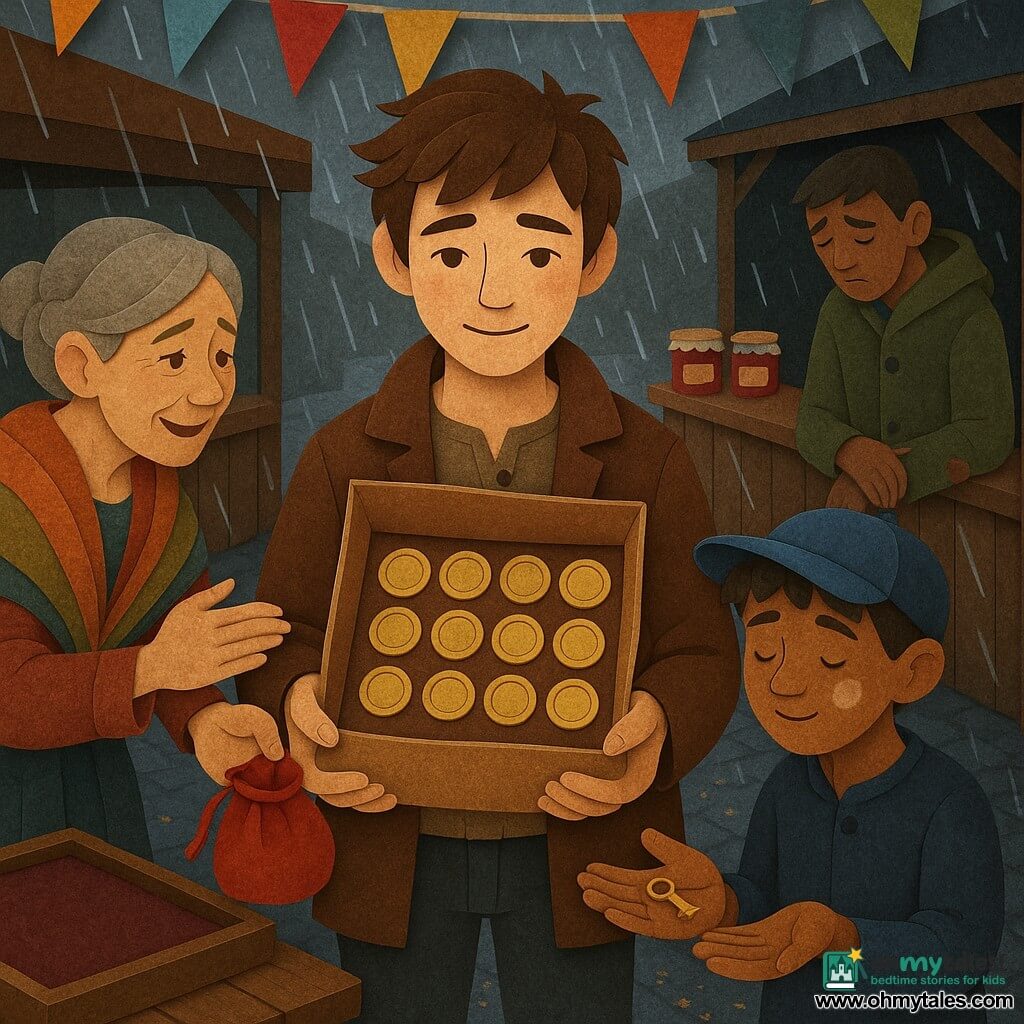
Back at the market, Mrs. Dalloway's eyes filled when Milo returned the bag. She counted each medallion with careful fingers, as if numbers could protect them.
Tommy stood nearby too, twisting his cap.
Milo spoke to both of them. “The box falling was an accident. The missing medallions were a choice someone made after the accident. Next time, if something spills, call out. Help gather it openly.”
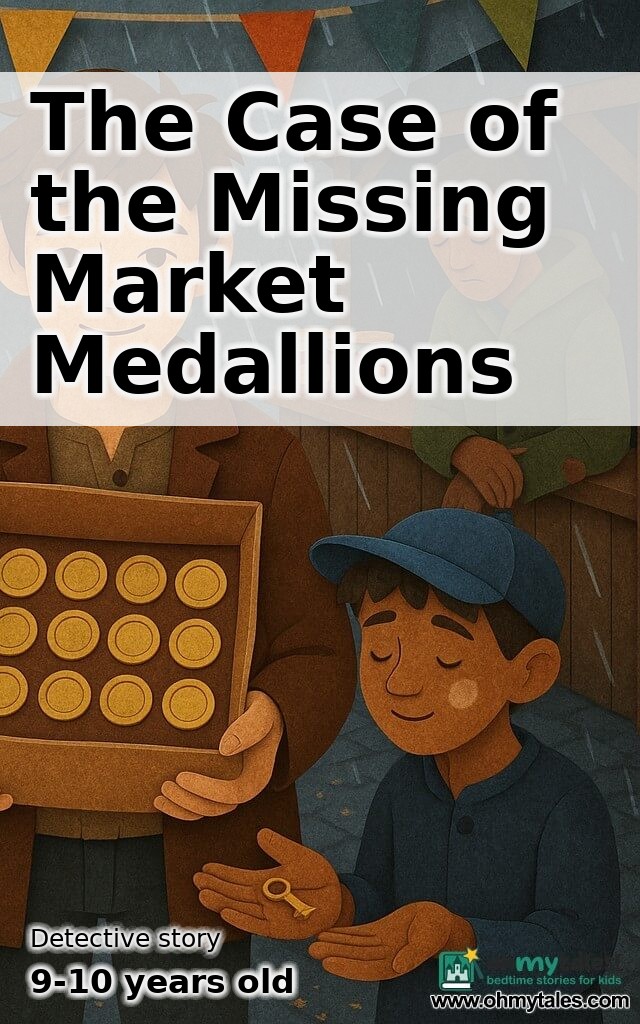
Mrs. Dalloway nodded, then surprised everyone by pressing a small charm into Tommy's palm—a tiny brass key. “For being honest,” she said. “And for learning.”
Tommy's face brightened like a lamp.
As for the man in green, he returned the medallions and promised to work with the market organizer to make things right. The rain had washed the street clean, but it had not washed away the lesson.
Later, back in his tiny agency, Milo opened his notebook to a fresh page. He wrote the case name, then drew a neat line underneath it.
Outside, the clouds were breaking apart, letting light spill through in careful strips.
Milo closed the notebook. The mystery was solved, and a new page—quiet, blank, and full of possibilities—was ready to be turned.