Chapter 1: The Missing Medal
Detective Mara Pike liked to notice things other people missed. She had a small notebook, a quiet voice, and shoes that made almost no sound. On a rainy Thursday, she stood at the edge of Elm Park where the town's old trophies were kept in a glass case. Someone had taken the school's history medal—the one with the tiny laurel leaves—and the school principal was worried.
“Did you see anyone?” Principal Rios asked, hands wrapped around a paper cup of coffee.
Mara squinted. Drops of rain made tiny rivers on the glass. “Not yet,” she said. “But I will watch. Tell me about the medal.”
“It was awarded to Riverbridge School for community service. It meant a lot to everyone,” Principal Rios replied. “It was inside here last night.”
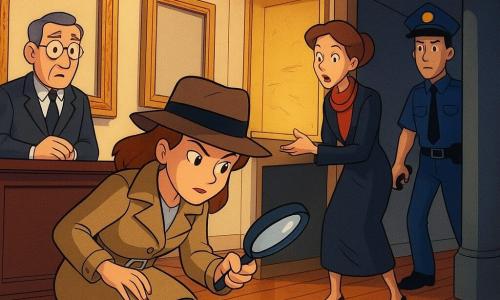
Mara walked around the case, listening to the soft plink of rain. She tapped the glass, looked for fingerprints, and studied the hinges. “Someone opened it from the side,” she murmured. She drew a tiny sketch in her notebook: a hinge, a smudge, a wet footprint leading away.
“Look,” said a teacher, pointing to muddy marks on the path. The footprints were small—like a child's shoes—and they curved toward the playground. Mara crouched and listened carefully to the park. The swing creaked, a dog barked in the distance, and a pigeon shuffled nearby. Listening was like turning a dial: each sound brought new clues.
“Who has motive?” Mara asked aloud.
“Some kids wanted the medal for show-and-tell,” Principal Rios answered. “But no one said they would take it.”
Mara nodded. She decided to watch the playground. She would wait and observe. Patience, she knew, often made people show themselves.
Chapter 2: The Quiet Watch
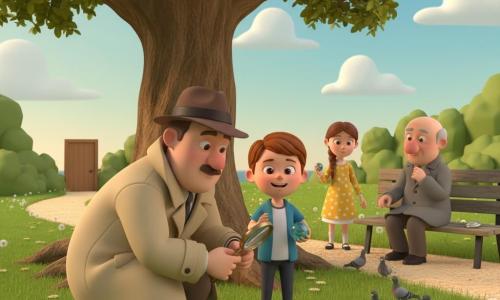
Mara sat on a bench under a large oak and opened her notebook. She drew the playground carefully: slides, monkey bars, two benches. Then she pressed her ear to the wood of the bench to hear the faint echo of the park. A pair of sparrows hopped close and chirped like tiny conversation.
An hour passed. Children came to play after school and then left. Shadows grew longer. Mara spotted a silhouette near the sandbox—a girl about nine, tying her shoe. The girl hummed and looked around, but she didn't try to hide.
Mara kept watching. “Hello,” she called gently when the girl stood up.
The girl blinked. “Hi. I'm Nina.”
“What are you doing here?” Mara asked.
Nina shrugged. “I come every day. I like to see what people leave behind.”
Mara smiled. “Do you remember the medal?”
Nina's face tightened. “I saw someone by the trophy case during lunch. They looked like Mr. Clarke.” She lowered her voice. “But Mr. Clarke is the crossing guard. He's nice. He helps the kids across the street.”
Mara held her pen still. Mr. Clarke was a trusted person in town—a kind man who always waved. Seeing a trusted person was important. Could he be involved? Maybe he had a reason. Maybe someone used his uniform. Mara listened to the rhythm of Nina's breathing; a steady breath often meant truth.
“Can you show me where you were?” Mara asked.
Nina pointed. “I was on the swing. I saw a man in a blue jacket at the case. He had gloves. He was quick.”
Gloves meant no fingerprints. Mara's mind clicked: someone who wanted to hide their prints. She scribbled down: blue jacket, gloves, quick. The park's lights blinked on as evening settled.
“Do you remember anything else?” Mara asked.
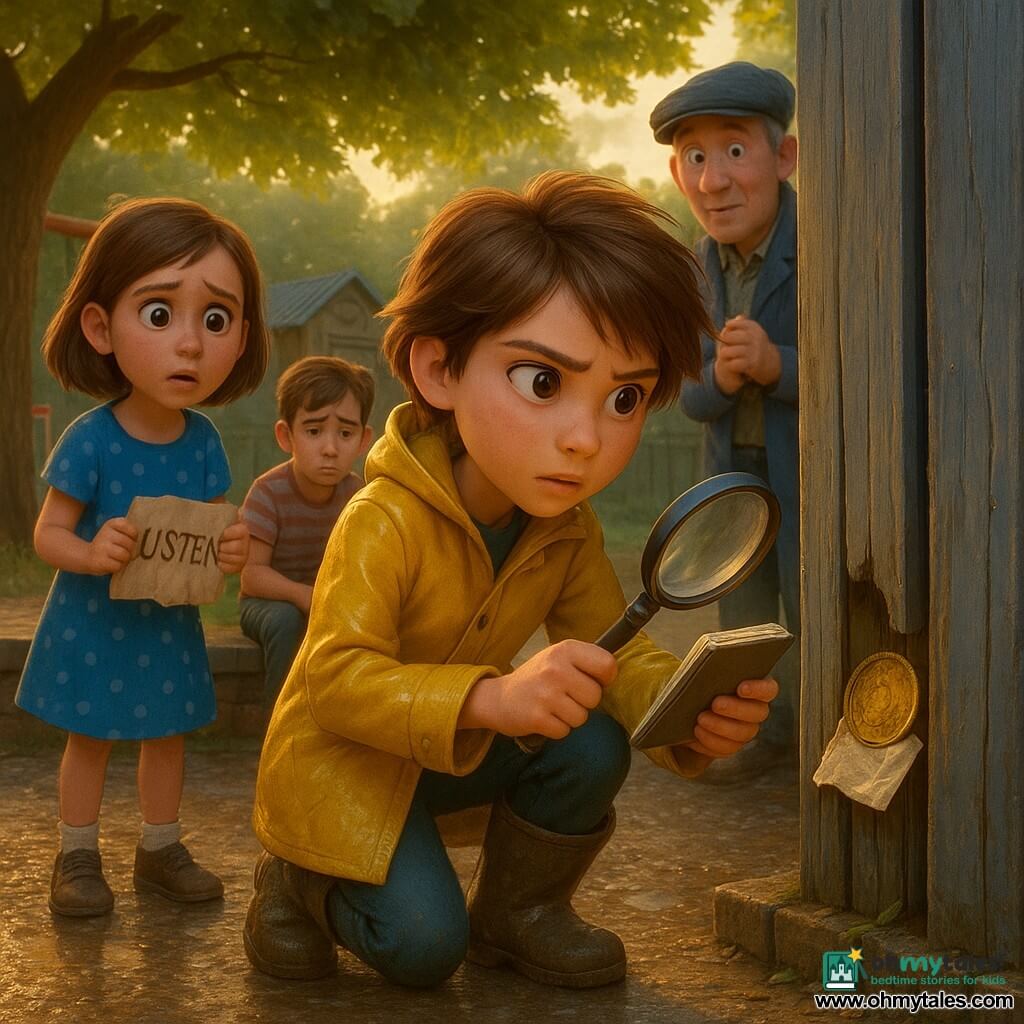
Nina dug in her pocket and pulled out a small crumpled scrap of paper. “I found this by the bench,” she said.
On the paper was a single word, written in a hurried hand: LISTEN.
Mara read it twice. The word was simple and puzzling. She felt her detective muscles stretch. A note, a trusted face mentioned, and a hurried thief. It was time to think, not leap.
“Thank you, Nina. You did well,” Mara said. “I'm going to follow the footprints and ask Mr. Clarke a question or two.”
Chapter 3: The Person You Trust
Mr. Clarke lived in a small house with a blue door and a wind chime that sang like tiny bells. Mara knocked. He opened the door with a surprised smile, wiping his hands on his jacket.
“Mara! What brings you here? Did you find the medal?” he asked.
“I'm asking questions,” Mara replied. She explained what Nina had said and showed the scrap with LISTEN written on it.
Mr. Clarke's smile faltered. “I saw someone near the case during my break, but I left my jacket at the bench because it was hot. Some kids tried to put a leaf in my jacket as a joke. I didn't mean to leave it. I always come back, but—”
He looked worried. “I stopped for soup at Mrs. Hara's. When I came back, the medal was gone. I came straight to check.”
Mara asked about the jacket and checked for mud. She found a faint smear of paint on the cuff—blue-gray, like the paint used on the fence near the art room. It was small, almost invisible. She noted it.
“You're a trusted person,” Mara said softly. “People remember you. Did anyone offer to take your jacket?”
Mr. Clarke thought and then hung his head. “A tall boy asked about the case. He was nervous. He had a sketchbook with maps and used the word ‘listen' like it was a code. He said, ‘We need to hear the park tonight.'”
Mara's heart sped. Someone was using a code. Someone had planned this.
“Where was he?” Mara asked.
“At the bench, by the sandbox,” Mr. Clarke said. “He left when I went to the shop.”
Mara thanked him and looked out at the park through Mr. Clarke's window. The bench by the sandbox—she had been watching that spot for hours. Now she had names of places, a word, and people who cared. Listening had led them here.
She walked back to the bench. The town was quieter now. The park smelled of wet earth and leaf tea. Mara sat and thought. LISTEN. Who used that word, and why? Maybe the thief wanted a distraction—music, noise—so no one would notice. Or perhaps LISTEN meant to pay attention to sounds, like a hidden clue someone left.
She closed her eyes and listened. Footsteps, wind, the distant clatter of a bus. Then she heard faint tapping—rhythmic, like someone tapping Morse code on the metal of the playground slide.
Mara opened her eyes. “Nina!” she called. The girl came running, breathless.
“You heard it?” Nina asked, eyes wide.
Mara nodded. “Who's clever enough to tap code?”
Nina bit her lip. “My brother. He likes secret codes. He used to tap to tell me the time in class.”
Mara smiled. “Then we need to listen like detectives.”
Chapter 4: The Note and the Riddle
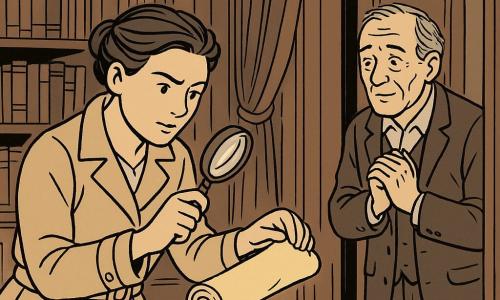
They followed the tapping to the slide. Underneath, someone had left a small tin box. Inside was a folded page with a map and a short riddle:
“To hide what mattered, we made a plan.
Listen to footsteps, not to the band.
Find the place where paint meets wood,
Count the planks, the thirteenth is good.”
Mara read it aloud. The map drew a path from the bench to the art room fence. Paint meets wood—like the fence by the art room had blue-gray paint on its lower boards. Mara counted the planks carefully: one, two, three—until thirteen. Behind the thirteenth plank, the wood sounded hollow.
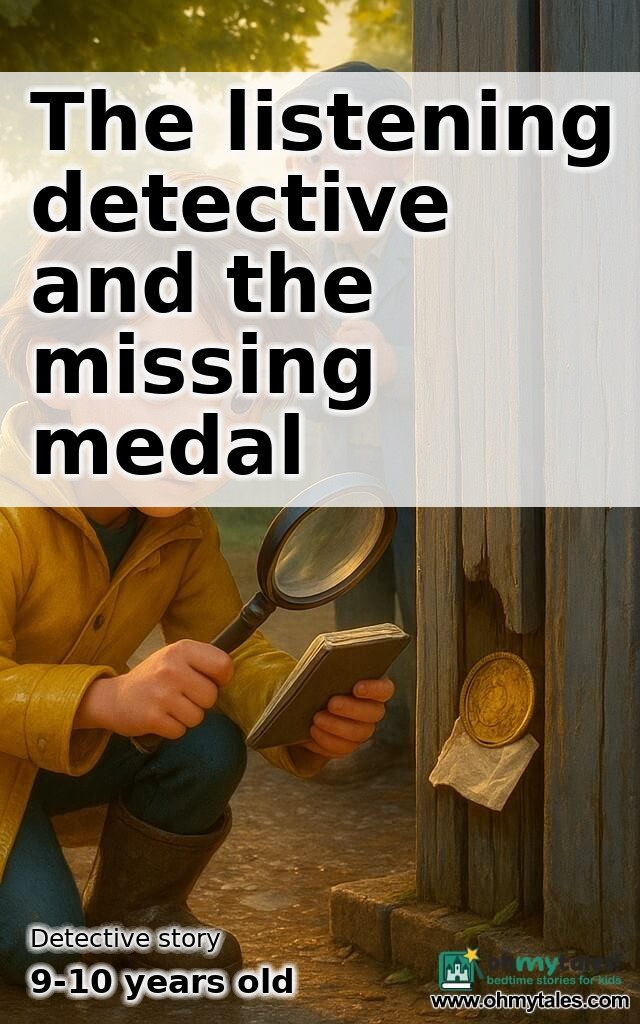
Mara knelt and ran her fingers along the slat. There, tucked into a hollow, was the medal wrapped in tissue and a small note: "Not for show. For giving. —J."
“Who's J?” Nina whispered.
Mara thought of the people she had seen: Mr. Clarke, Principal Rios, teachers, the tall boy with a sketchbook, Nina's brother. A list formed in her notebook. She looked at the medal—still shiny, still important.
“You did well listening,” Mara told Nina. “The clue led us here.”
Just then, Mrs. Hara, the soup-shop owner, arrived, wiping her hands. “I heard Mrs. Donnelly playing her violin—such lovely music that someone noticed the case at the same time. I thought it odd.”
Mara put pieces together: the thief needed a moment when attention was elsewhere; music would draw eyes away. The note said not to listen to the band. Someone created a plan using sound as a cover.
Mara turned to Nina. “Does your brother have a friend named Jonah? He's J.”
Nina's eyes widened. “Jonah sketched the map for their history project. He's on the school council but wanted the medal for his family.”
They found Jonah sitting on a low wall, sketchbook open, hands fidgeting. When Mara showed him the medal, his face went pale. He stammered, “I— I wanted to move it to the library for safe keeping. My grandma told me to keep things where people can see them, so they won't be forgotten. I only meant to borrow it.”
Mara listened to Jonah's voice. He seemed honest but nervous. The gloves, the note, the tapping—was it clumsy planning or a real theft? Jonah admitted making the plan, tapping the slide so Nina would find the tin, and using the word LISTEN as a code for his friend to distract people with music.
“He thought if people were listening to music, no one would watch the case,” Jonah mumbled. “I'm sorry. I panicked and hid it.”
Principal Rios took a long breath. “Jonah, we must be honest about actions. You scared your school.”
Jonah apologized, eyes wet. He handed the medal back. “I wanted to help, but I did it wrong.”
Mara looked at the gathered faces: trusted Mr. Clarke, worried Principal Rios, kind Mrs. Hara, clever Nina, and Jonah with his sketchbook. She felt glad the medal was safe and that people were talking. Listening had solved the puzzle.
“Let's make this right,” Mara said. “You return the medal, explain to the school, and help set up a display so everyone understands why it matters.”
They all agreed. Jonah helped clean the case and wrote a public note about responsibility and community service. The school forgave him after he helped repair the fence and explained his plan to the student council.
That evening, the town gathered by the trophy case. Jonah read a short speech. “I thought I could protect the medal, but I learned that hiding things only hides the reason we celebrate them. I will listen more and act with care.”
Mara closed her notebook. She had watched, listened, asked questions, and used small logic steps to find the truth. The puzzle had been solved by paying attention, trusting people, and admitting mistakes.
Nina hugged her brother. “You should have asked for help,” she said.
Jonah nodded. “I know. Next time I'll listen to others.”
Mara smiled. “Listening helped today. It helps solve most puzzles.”
They all looked at the medal shining in its case, the laurel leaves bright in the soft light. Outside, the wind chime at Mr. Clarke's house sang like tiny bells, and the town felt a little wiser.