Morning Maps
Detective Lucas Rivera folded his favorite city map like a secret letter and smiled at the morning light. He was a police officer who loved maps more than anyone in the station. Streets, parks, and tiny dotted alleys were like friends he could visit whenever he wanted. Today, Lucas had a calm plan: a community event called the Mini Sign Hunt. The town council had said yes, the parents had said yes, and the school had agreed to let the children join. Everything felt gentle and possible.
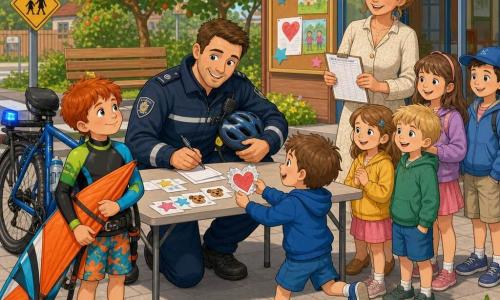
He pinned a bright poster on the notice board: “Mini Sign Hunt — Learn the Signs, Keep Each Other Safe.” Then he set up a small table in the square with printed maps, pencils, and stickers. Lucas wore his uniform, but his smile was the most visible thing. A little boy named Mateo tugged his sleeve as he arrived.
“Are we going to race?” Mateo asked, bouncing.
“No racing,” Lucas answered, kneeling to be level. “We're discovering. We'll talk to people, ask questions, and help each other. Ready?”
Mateo puffed his chest like a superhero. “Ready.”
Lucas handed out tiny maps with simple symbols: a stop sign, a pedestrian crossing, a playground sign. He explained each one simply. “Signs are like friendly reminders. They tell drivers and walkers how to share the road so everyone gets home safe.”
A teacher named Ms. Patel arrived with a group of giggling children. She nodded at Lucas. “Thank you for doing this with them. It helps when they see a friendly officer.”
Lucas tapped his map. “We'll walk together and practice asking questions. If we see something unclear, we'll talk with the shopkeepers or the crossing guards. The hunt is about learning, not just spotting.”
The Gentle Hunt
The group moved through the neighborhood in a slow, cheerful line. Lucas carried a bigger map folded into his pocket and glanced at it often, pointing out how streets connected like the veins of a leaf. Whenever the children spotted a sign, they raised their hands and Lucas came close.
“There's a yield sign!” called out Maria, pointing to a bright triangle.
“Good eye,” Lucas said. He explained softly why drivers yield, and how patience makes the street kinder. At a corner with a crooked lamppost, a small discussion started. A driver had parked partly on the pavement, making it tight for strollers. Lucas listened to the children's worries, to the driver's explanation that he'd been late for work, and to a passerby who worried about the squeezed sidewalk.
Lucas smiled and used his calm voice. “Thank you for telling us. Let's ask how we can help each other. Could you move a bit so the stroller can pass? And if you're ever late, the crossing guard will help everyone get through safely.” The driver nodded and moved the car. The stroller passed. The children learned that talking can fix things, and that police officers sometimes help people find friendly ways to solve problems.
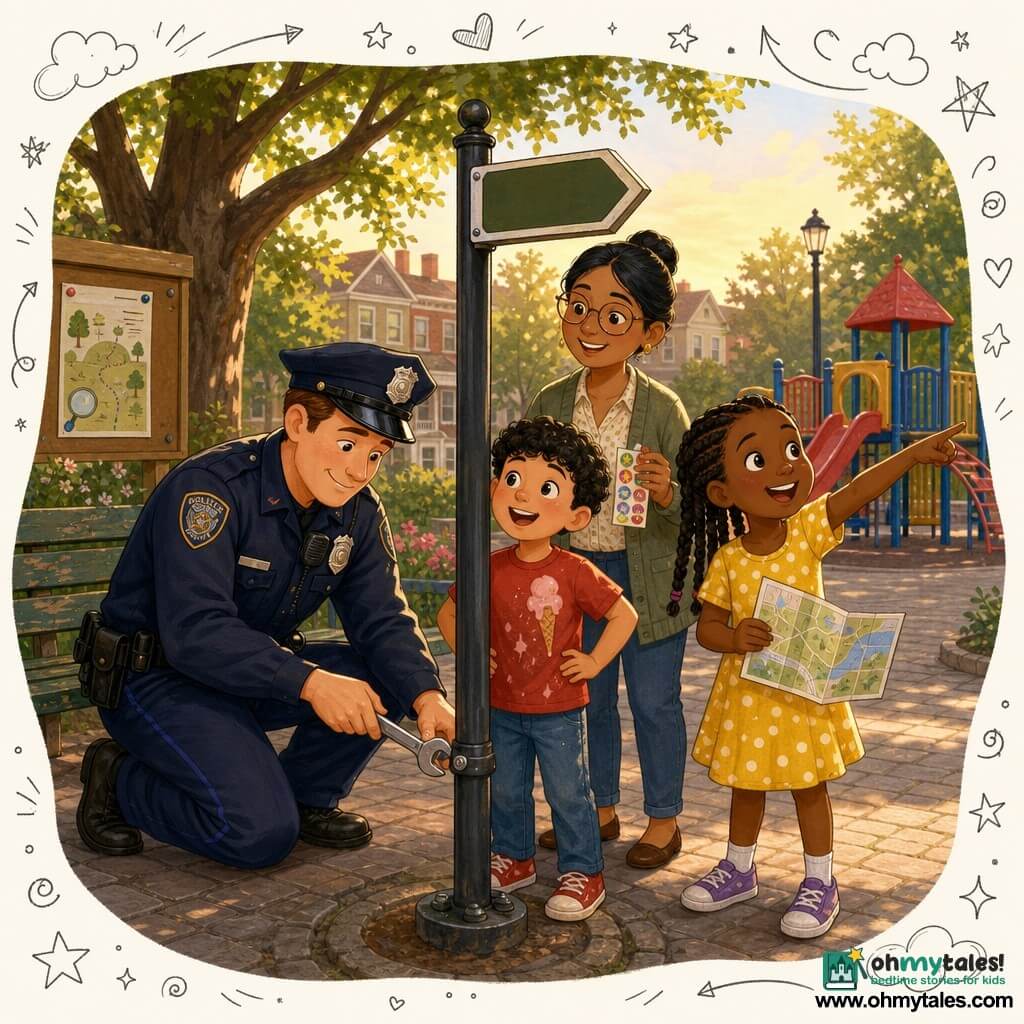
At the park entrance, a new sign had a missing bolt. The bench nearby was wobbly. Lucas found his little toolbox and tightened the bolt while the children watched, their fingers sticky with ice cream. He explained why keeping signs in good shape matters: “If a sign falls down, people might not know where to stop. We fix what we can and tell the town when we need help with bigger jobs.”
A grandmother named Mrs. O'Neil came by and thanked Lucas quietly. “You remind us all to be kinder, Detective. You make the street feel like a neighborhood.”
Lucas blushed and said, “We all make it kinder. People talking to each other does most of the work.”
Maps, Questions, and Answers
After the stroll, they gathered under a big oak tree. Lucas unfolded his large city map and spread it on a low bench. He traced paths with his finger, showing how shortcuts should be safe, not dangerous. The children leaned in, eyes wide. He asked them questions, and they asked him back.
“Why do you carry maps, Mr. Rivera?” asked Mateo.
Lucas laughed softly. “Because maps tell stories. They show where people live, where stores are, and where we need to be careful. They help me plan where to put help when people ask for it.”
“Do police only stop bad things?” Maria wondered.
“Not at all,” Lucas replied. “We help people talk, keep places tidy, and answer questions. We listen to worries, like when sidewalks are narrow, or when traffic is fast. We also teach—like today—so everyone knows how to stay safe.”
He had prepared small booklets that matched the symbols on the hunt maps. The pages were simple: pictures of a crossing, a shopkeeper using a smile to calm a problem, a policeman helping fix a sign. Lucas turned each page and explained one idea—prevention, listening, making rules together.
“You see this page?” he said, opening to a drawing of two children and a crossing guard. “Talking to the crossing guard helps everyone cross together. That's prevention. Planning keeps us safe before problems start.”
The children took turns holding the map and pointing to places they wanted to protect: the playground, the bakery, the old bakery window where Mrs. O'Neil dropped crumbs. With each choice, Lucas talked about who they might tell and how to ask politely. The town felt like something they could shape with small, gentle acts.
Evening Pages
As the sun dropped, parents arrived to collect their children. Lucas handed each child a small sticker that matched a sign they had found. They smiled proud, tired, and full of tiny knowledge.
Before everyone left, Lucas opened a thin book on his bench. It was a log he kept—just a few pages—filled with quick notes: where a sign needed a bolt, the name of a kind shopkeeper, and a drawing of the corner with the crooked lamppost. He asked the children to add a few marks, and some scribbled little stars beside the places they liked most.
“Can you read us one page?” Mateo asked, leaning close.
Lucas read softly, like a lullaby of the day: “We walked, we talked, we found a fallen bolt, and a neighbor moved a car so the stroller could pass. We learned that maps help us find places, and words help us fix things. Listen first. Ask kindly. Help where you can.”
He showed them the last pages—blank except for a few lines. “These are for you,” he said. “Write what you think needs help near your house. Ask a grown-up to bring it to a town meeting, or tell me at the station. Small notes can lead to big changes.”
The children pressed their stickers into their maps, hugged their parents, and waved goodbye. Mrs. O'Neil patted Lucas's shoulder. “You make being safe seem like a neighborhood story.”
Lucas closed the book gently, his fingers tracing the few pages they had filled. He felt grateful for the day—the maps, the conversations, the tiny fixes. He folded his big map and pocketed it, knowing he would come back tomorrow to check on the sign with the new bolt and to listen to more stories.
As the square emptied, the small book lay open on the bench, its last pages catching the fading light. The few notes on those pages looked like promises: a list of little actions and the names of people ready to talk. Lucas turned out the lamp on his table and walked home, his steps slow and content. Tonight, the town slept a little safer, because people had shared their questions and listened to each other. Tomorrow, the maps would wait—and so would the gentle work of helping, one conversation at a time.