Chapter 1: Evening Patrol
Officer Ben Carter drove his patrol car along Maple Lane where the streetlights hummed like quiet night insects. He knew every bend of this town the way a baker knows the smell of fresh bread: familiar, steady, full of small surprises. Tonight the air tasted of baked apples and distant rain, and the radio murmured routine details—parking reminders, a broken streetlight on Oak, a lost dog found near the riverbank. Ben hummed along with the radio like a neighbor greeting another neighbor.
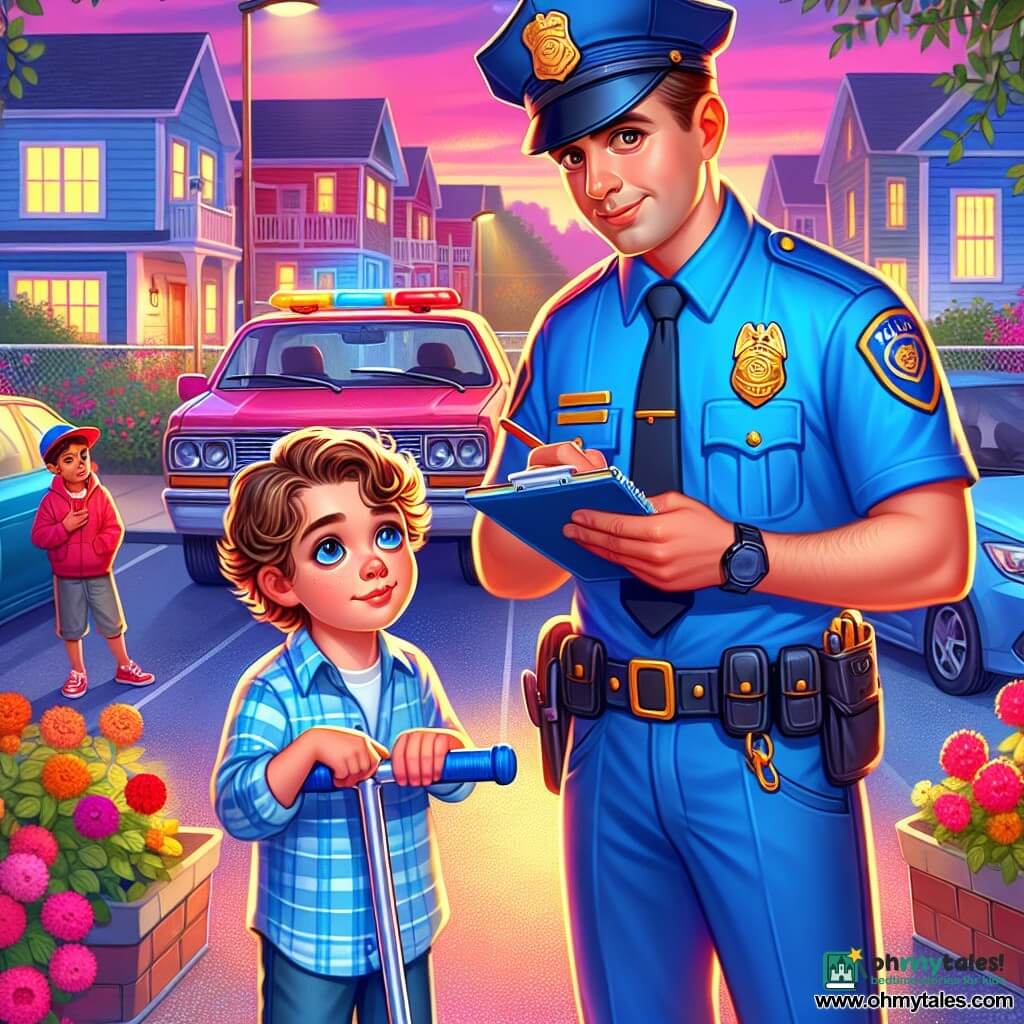
He was on his way to the community center because a woman named Mrs. Alvarez had called in with a problem. Her son Mateo's bright blue scooter, the one with a star sticker and a slightly bent bell, had been left in the front parking lot after a guitar lesson. It was gone. To many people this would have been a small thing, but to Mateo it was a treasure. Ben had once been a child whose own treasures disappeared and felt the pinch of small unfairness. He believed that fairness mattered—whether it was a missing scooter or a more serious harm. Justice, for him, meant making things right and teaching people how to keep one another safe.
He parked near the lamps that spilled honey-colored light onto the pavement and walked to the entrance. The parking lot smelled of rubber and rain, the open space dotted with painted lines like a grid of sleeping birds. A few neighbors lingered, their faces expectant but calm. Ben smiled, the kind of smile that makes people feel seen. He listened as Mrs. Alvarez described the scooter and how Mateo had been careful, always locking its little wheel with a cable. Yet the lock had been cut.
Ben knelt to look at the place where the scooter had stood. It was small detective work at first—bent grass, a faint scuff on the asphalt where bike tires sometimes dragged, a little scrap of blue plastic stuck to a nearby gutter. He took out a notebook and jotted words in neat, patient letters. Observation, he taught himself, was like breathing slowly: steady, meant to keep panic from rising.
“You think it'll be found?” asked a neighbor, voice soft, as if worried that answering might affect the outcome.
Ben straightened. “We'll look carefully. Sometimes things turn up in the most surprising places.” His voice was steady, warm as a blanket. Inside him he planned a gentle investigation—checking the parking, asking people, and reminding children about safety without scaring them.
While he worked, he thought of prevention. Locks, lights, and community notice—small actions stacked together—kept many problems from happening. He would speak about those things, but first he needed to find out what happened to Mateo's scooter.
Chapter 2: The Parking Lot Puzzle
The parking lot held its own stories. Cars parked like shells on a beach, a delivery van with a sleepy driver, an old bicycle chained to a lamppost. Ben moved among them like someone reading a map. He looked for footprints, tire marks, and anything that did not belong. The blue plastic scrap he had found went into an evidence bag—not because the case needed heavy policing, but because treating small problems with care showed respect to the people who felt hurt.
As he examined the lines painted on the asphalt, Ben noticed something else: a set of shoe prints leading toward the shopping row, then circling back. The prints were small, as if made by a child, and beside them were faint drag marks—the kind that matched a scooter being pulled quickly. Ben knelt again and ran a gloved finger along the drag, as if reading the curve of a river. He took pictures with his phone, careful and methodical. He made notes about the time Mrs. Alvarez had called, the angle of the lights, and the smell of oil that lingered near a particular drain.
He spoke with the delivery driver, a man named Tom, who had noticed someone moving quickly through the lot earlier. Tom described a figure with a hood, carrying a bag, who paused near the row of bins and then walked away. “I thought they were just going to the store,” Tom said, shrugging. “Maybe they were cold.”
Ben listened and asked gentle questions. He asked the neighborhood kids if they had seen anything. Children's memories can be like treasure chests—sometimes full of sparkling facts, sometimes muddled by imagination. Mateo, who was small and serious, described the scooter's bell as “a little stargate that rang like marbles.” His words made Ben smile inwardly and reminded him of why this mattered: it was not about the scooter alone, but about trust. No one should feel that their belongings or their safety could vanish without care.
Ben also checked the parking lot lights. One lamp near the far corner flickered. He made a note to call the town maintenance crew in the morning. A well-lit area is often the best prevention. He explained that to a couple of kids who were watching from the steps: “Lights help you be seen. Locks help you hold on. And sometimes, neighbors watching out for each other help put pieces back together.”
As the evening grew cooler, the police presence felt calm rather than scary. Ben taped off the center of the parking lot with a bright yellow cordon, not to make a fortress but to make a gentle boundary. It was meant to keep the spot safe while he asked questions and collected small signs. The tape fluttered like a low, patient flag, reminding passersby that someone was caring for the place.
Chapter 3: The Choir and the Kind Clues
The rehearsal at the community center had been scheduled for seven. Ben liked music; the rhythm of voices could soothe a town as much as a kettle song could soothe a kettle. He was still at the parking lot when a group of children, cheeks rosy from the breeze, came outside carrying sheet music and warm smiles. It was the children's choir, practicing for the seasonal concert. They had been rehearsing “Street Lamps and Starlight” and now spilled into the parking lot like confetti.
Their choir leader, Ms. Harper, noticed the tape and the little gathering. “Officer Ben!” she said, stepping forward with a small, confident wave. The children peered from behind her, curious and bright.
They were not there to spy—rather, they offered to sing a few notes to help calm the nerves of neighbors. Singing in public can make people feel safer; melody stitches a place together. Ben listened as their voices rose and fell like a soft wind. Some neighbors dropped their bags and smiled, some clapped hands like small umbrellas opening.
One child, a boy named Amir, hesitated and then spoke up. “We heard a rattle,” he said. “When we were walking through, someone made a noise near the bin. We thought it was just the wind, but it sounded like... like metal hitting metal.”
Ben's eyes brightened at the usefulness of that clue. The choir continued a short, bright verse and then sat on the curb, their presence both peaceful and practical. Music had brought them closer, but kindness had made them participants in the investigation.
Ben followed the hint to the bins at the edge of the parking lot. There, beneath a drop-lid, he found a tangle of metal—an old bike lock and the hook of a scooter bell. The lock was not the one taken from Mateo's scooter, but it could have been used to fix the scooter into a bag for carrying. There were tiny smudges of blue paint on the rim of the bin. It was a clue, not a conclusion.
He explained to the choir in simple words how small hints could add up. “Like notes in a song,” he said. “One note doesn't make the whole tune, but when you listen to many, you can know the melody.” The children nodded, pleased with the comparison. Ben taught them a little about looking without touching, about asking an adult, and about telling someone when they saw something odd. Prevention, he said quietly, is about looking out for one another and taking small safe actions.
Ms. Harper offered to have the choir learn a short verse about caring for belongings and people. “We'll sing it at the concert,” she said, and the children cheered. Ben felt the good warmth that comes when a town decides to be kinder because it knows how to be safer.
Chapter 4: Re-Tying the Line
The investigation grew smoother as neighbors cooperated. A security camera from the grocery store across the street provided grainy footage showing a figure passing quickly through the lot just after five. The image was shaky, but there was enough—an outline, a hood, a small glint on the ground that could have been a wheel catching light. Ben worked calmly, making sure every step respected everyone's rights. To him, fairness meant probing gently, listening longer, and never assuming guilt.
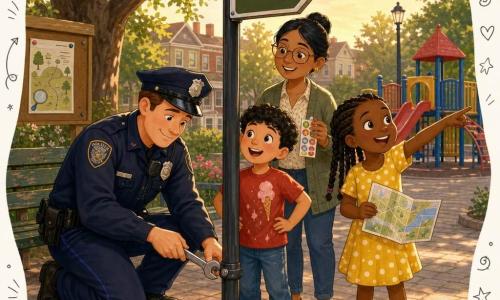
At one point, the parking lot felt like a small stage where a quiet drama had played. Ben needed to keep the spot orderly while the last witnesses said what they knew. He took the roll of yellow cordon and, with careful hands, re-tied the tape around the area that had been disturbed. He fixed it tight and neat, not as a barrier to frighten but as a frame to help the neighborhood breathe. The act of putting the cordon back in place had an almost meditative rhythm—over, under, knot—and each knot felt like a promise to protect what was left.
A family who lived in the flats nearby came down to talk. Their son, Joe, had been caught on another camera riding quickly with a bag that, up close, belonged to someone else. The boy looked small and frightened, but not guilty in the way of a villain—more like someone caught in a tangle that could be loosened with kindness.
Ben sat on the bumper of his car and spoke softly. “Joe,” he said, “can you tell me how you came by that bag?”
Joe's voice was thin but honest. “I found it near the river,” he said. “There were lots of bags there. I was going to take it to the lost and found, but then I thought... I could trade it for my brother's snack. I didn't mean to hurt Mateo. I thought it would be okay.”
Ben listened. He believed in justice that taught rather than punished when possible. He asked questions about why Joe had made that choice, about where he had been, and about whether his family needed help. It turned out Joe's family had been going through a hard stretch. There was no malice in Joe's actions, only confusion and a bad decision born of need.
Ben explained the importance of returning found items to lost and found, of telling an adult, and of asking for help when life feels difficult. He spoke about consequences, but also about chances to make amends. “You can fix this,” he told Joe gently. “You can help make it right.”
Joe agreed to come with Ben to speak with Mateo and his family, face honest and cautious but ready. The parents arranged to replace some of the scooter's missing parts, and Joe promised to help with chores and to learn about civic responsibility—about how people in a neighborhood depend on each other. The yellow cordon, once tightened and then later loosened, had served as a calming frame for truth to emerge.
Chapter 5: A Little Party of Rightness
By the weekend, the town gathered in the community center courtyard. The scooter had been returned by Joe, who had left it on the center's steps with a note and an apology. He had learned how his choice had affected Mateo, and the apology was sincere. Ben had helped arrange for the shop to mend the scooter bell and straighten the handle, and neighbors had pitched in to buy a new lock. Joe had agreed to do community service—helping at the center and learning about how to be a good neighbor.
The children's choir opened the small party with a song about street lamps and starlight, their voices bright as glass marbles. The music was a gentle ribbon that tied the courtyard together, and when they sang the little verse about looking out for one another, the audience clapped like rain on tin roofs—happy, light, and steady.
Ben watched from the edge, arms folded like a relaxed gate. He felt the soft hush of contentment that comes from mending things. Mateo's grin as he rode his scooter in wide loops was like a sun emerging. Joe stood nearby, planting flowers in a small patch of soil where a community garden would grow—an act that showed he would put something back into the world instead of taking from it.
Neighbors chatted about prevention measures they would take: better lighting for the parking area, a community board for lost-and-found items, and a rota for watching the lot on busy evenings. Ben had shown them that keeping a town safe is not just the job of one person in a blue jacket; it is a shared practice, a mixture of small actions and kindness.
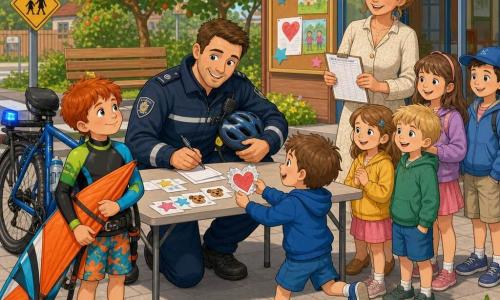
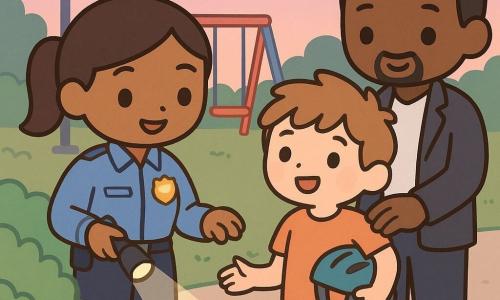
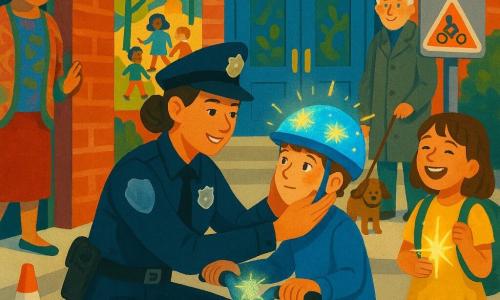
There were short speeches—thank-yous, a hand-shake or two, the exchange of freshly baked cookies. Ben reminded the children to wear helmets and to keep their belongings secured. He spoke about mediation, telling people that when someone made a mistake, the path to fairness was often through conversation and repair. His language was gentle, rooted in the idea that justice is about restoring balance and learning, not merely punishing.
When the evening wound down, lanterns glowed like shy stars, and people lingered as if unwilling to cut a good story short. The party ended with a promise: a picnic next month, a watchful but warm approach to the parking lot, and a neighborhood board where lost things could be posted and found. Ben felt proud in the human sense—pleased that ordinary people had come together to heal something small that mattered.
He walked home under the same humming streetlights, thinking about how his job was part detective, part teacher, and part neighbor. He liked knowing that he could help bring fairness and calm—sometimes by putting up a tape, sometimes by listening, and sometimes by arranging for a boy to plant flowers. The town would go to sleep feeling a bit safer, a bit kinder. That night, Officer Ben opened his window and heard, faint and cheerful, the echoes of the choir practicing once more, their voices carrying the lesson of the week: together we keep each other safe.