Chapter 1: Morning on Foot
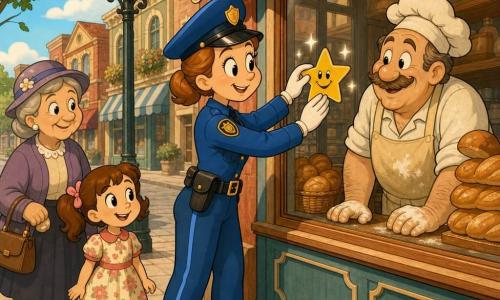
Officer Maya Rivera clipped her radio to her vest and stepped out of the small neighborhood station. She was a foot patrol officer, which meant her job happened at walking speed. She waved to the bakery owner, nodded to the bus driver, and listened to the town waking up—doors chiming, bikes rolling, dogs sniffing every post like it was a newspaper.
Walking patrol wasn't about chasing bad guys in movies. It was about being available. People could see her, talk to her, and ask questions. “Good morning, Officer Maya!” called Mr. Lee from his flower shop.
“Good morning! Your sunflowers look like they're smiling,” Maya said.
Mr. Lee laughed. “They learned from you.”
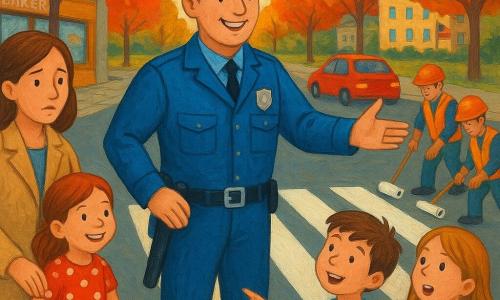
Maya kept going, her boots tapping a friendly rhythm. She checked the crosswalk by the school, where bright paint made safe stripes across the road. She reminded herself of her three most important tools: her eyes, her ears, and her calm voice.
On the corner, two kids were debating the rules of a brand-new scooter.
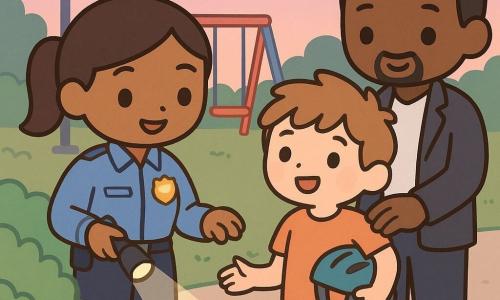
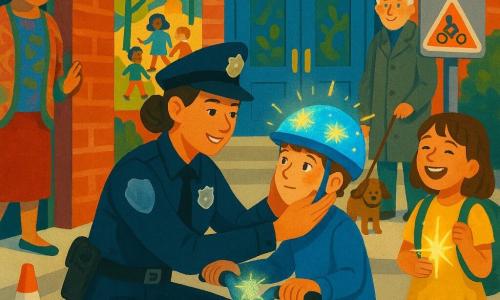
“Helmet first,” Maya said gently, stopping beside them. “Scooters are fun, but your head is not replaceable.”
One kid patted his helmet proudly. “Mine has a dinosaur!”
“Perfect,” Maya said. “Dinosaurs know survival.”
The kids giggled, and Maya felt that quiet, warm feeling she got when safety sounded like something exciting, not scary.
Chapter 2: The Missing Pen Mystery
Later that morning, Maya visited the community center. The building smelled like crayons, clean floors, and old books. Inside, Ms. Patel, who ran the after-school club, looked around with her hands on her hips.
“I can't find the sign-in pen,” Ms. Patel said. “It's always right here!”
Maya glanced at the welcome desk. A clipboard waited patiently, but the pen holder stood empty, like a tiny nest with no bird.
“A missing pen,” Maya said, lowering her voice as if the pen might be shy. “Let's solve it the peaceful way.”
Ms. Patel sighed. “It's not a big problem, but the kids will arrive soon, and I need them to sign in.”
Maya nodded. “Small problems matter too. They can make our day bumpy. My job is to help smooth things out.”
She didn't accuse anyone. Instead, she asked gentle questions—who used the desk last, whether someone had moved things while cleaning, if a pen had rolled away.
A little boy named Noah raised his hand as if he were in class. “I borrowed a pen yesterday,” he admitted. “But I brought it back! I think.”
Maya crouched so she was at his eye level. “Thank you for telling the truth. That's brave. Let's look together.”
They searched calmly: under the clipboard, beside the flyers, behind the donation jar. Maya explained, “Police officers often take notes. A pen helps us remember details, like names and places, so we can help people correctly.”
Noah peeked under the desk and gasped. “There!”
A blue pen lay on the floor, hiding near a table leg, like it had gone on a tiny adventure and gotten tired.
Maya picked it up and placed it back in the pen cup. “A pen belongs where people can find it,” she said. “Returning things is a kind of respect.”
Ms. Patel smiled with relief. “Thank you, Officer Maya.”
Noah added, “Sorry, pen. Sorry, Ms. Patel.”
Maya's voice stayed warm. “Mistakes happen. What matters is we fix them.”
Chapter 3: A Talk, Not a Trouble
Outside, Maya continued her patrol. On Willow Street, she heard raised voices—not angry, but tangled, like two people pulling on the same shoelace.
Two neighbors stood near a fence. Mrs. Alvarez pointed at a row of bikes. Mr. Grant held up his hands.
“The bikes block the sidewalk,” Mrs. Alvarez said. “My little niece uses a stroller!”
“I didn't mean to,” Mr. Grant said. “There's no room in the yard.”
Maya stepped closer, not rushing, just arriving—like a lamp being turned on.
“Hi,” she said. “I'm Officer Maya. Sounds like we need a sidewalk that works for everyone.”
They both looked at her, a bit embarrassed, as if they'd been caught arguing with the wind.
Maya explained, “Part of my job is mediation. That means helping people talk and find a fair solution. No one has to ‘win.' We just need a plan.”
She asked each person to speak one at a time. She listened and repeated what she heard so they knew she understood.
“So, Mrs. Alvarez, you want the path clear for strollers and wheelchairs,” Maya said. “And Mr. Grant, you need a safe place for the bikes.”
They nodded.
Maya pointed to a small patch of gravel beside the fence. “Could the bikes park here, lined up? If they're neat, the sidewalk stays open.”
Mr. Grant rubbed his chin. “I could add a hook rack on the fence too.”
Mrs. Alvarez's shoulders relaxed. “That would help. Thank you.”
They moved the bikes together. It took less than five minutes and saved many grumpy minutes later.
Before leaving, Maya added, “If something bothers you, it's okay to ask kindly first. And it's okay to say ‘I didn't realize.' That's how neighbors stay neighbors.”
Mrs. Alvarez said, “Thank you for helping us talk.”
Mr. Grant nodded. “And for not making it a big scary thing.”
Maya smiled. “My goal is for you to feel safe and heard.”
Chapter 4: The Thank-You Parade
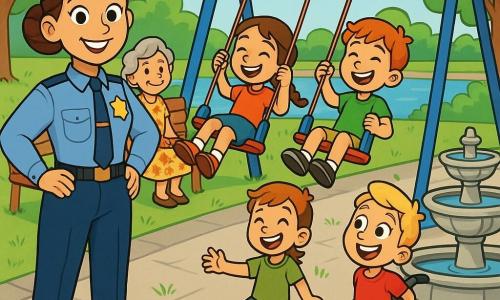
In the afternoon, the school bell rang, and the sidewalk filled with backpacks and bouncing conversations. Maya stood near the crosswalk, holding up her hand to stop cars while children crossed.
A girl with braids asked, “Do you always walk? Don't you get a police car?”
“Sometimes officers drive,” Maya said. “But walking helps me notice things: a broken streetlight, a lost dog, a worried face. When I'm on foot, I'm part of the neighborhood.”
A boy squinted at her radio. “Is it heavy?”
“A little,” Maya admitted. “But it means I can call for help fast. Police work is teamwork. Even when I'm walking alone, I'm connected to others.”
The kids seemed to like that—being connected.
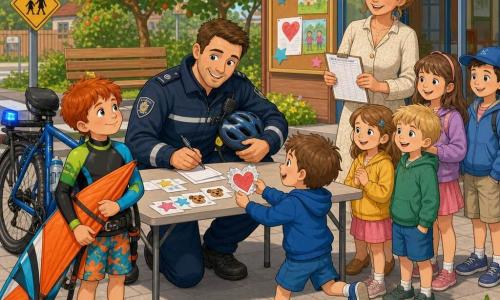
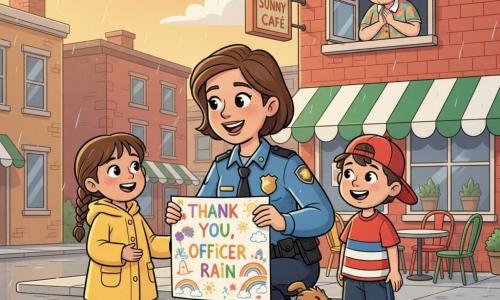
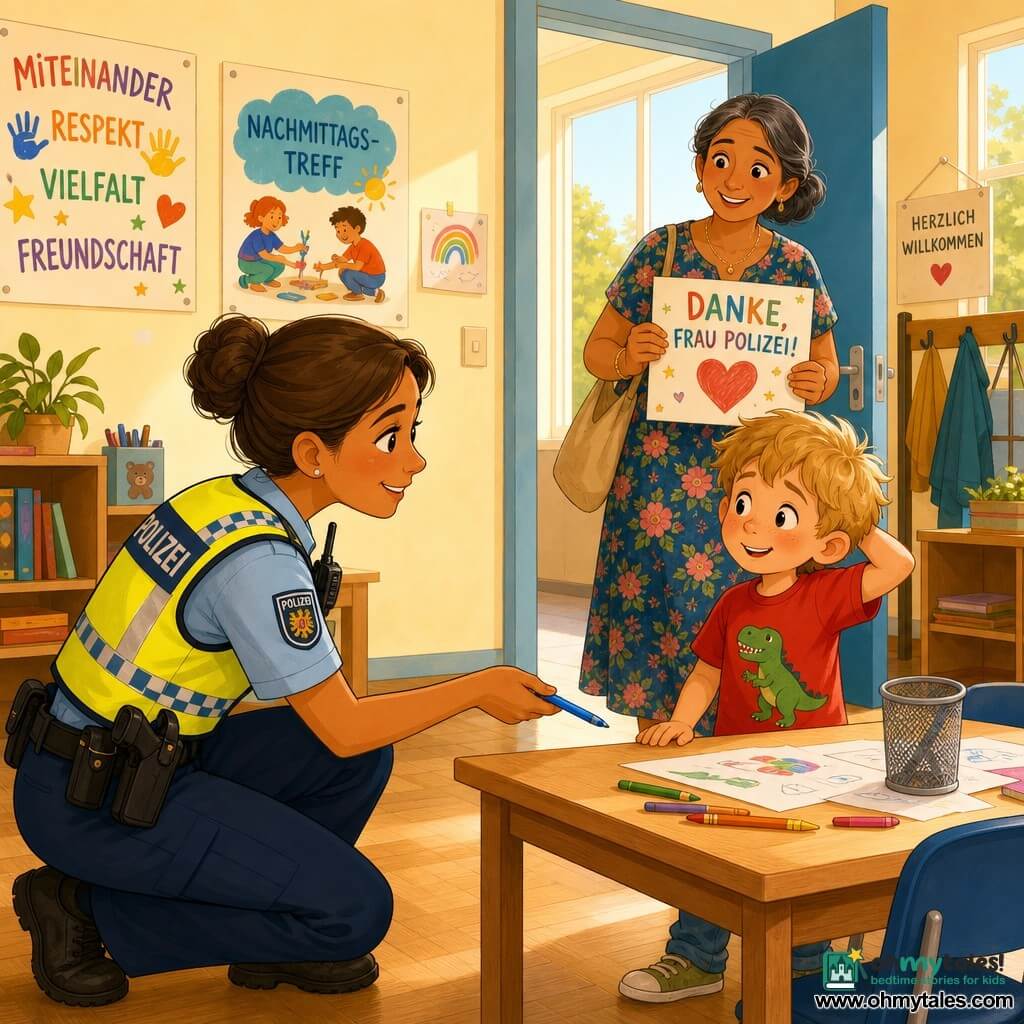
At the community center, Ms. Patel came outside with a small paper bag. “Officer Maya,” she said, “I know you can't accept gifts that are too big, but I made you a thank-you card with the club.”
She handed Maya a card covered in stick-figure drawings: Maya with a giant smile, a tiny pen wearing a cape, and a scooter with a dinosaur helmet.
Maya laughed softly. “This is perfect.”
Inside the card, it said: THANK YOU FOR HELPING US FIND THE PEN AND STAY CALM.
Maya felt her chest warm again. Gratitude was like sunlight—it made ordinary things shine.
She tucked the card safely into her pocket. “Thank you for saying thank you,” she told Ms. Patel. “It reminds me why I do this job.”
Chapter 5: The Marker Finds Its Home
Evening arrived with peach-colored clouds and the smell of dinner drifting through open windows. Maya made one last stop at the community center to check that everything was locked and ready for tomorrow.
Inside, the after-school room was quiet now. Chairs were stacked. Crafts lay in neat piles. On the art table, a cup held markers—red, green, purple—standing like colorful soldiers.
But one black marker lay alone on the table, its cap on, looking left behind.
Maya picked it up carefully. “You must be tired,” she whispered, as if the marker could hear. She remembered the missing pen and how easy it was for small things to wander.
She walked over to the marker cup and placed the black marker inside, snug among its friends. The cup looked complete again.
Ms. Patel, carrying a box of paper, noticed. “Oh! Thank you. We're always hunting for markers.”
Maya nodded. “Helping people isn't only about big emergencies. It's also about returning little things to their places so tomorrow feels easier.”
Ms. Patel smiled. “I'm grateful you're in our neighborhood.”
Maya looked around the calm room—the tidy table, the waiting crayons, the marker now resting in its pot. Outside, streetlights blinked on like gentle stars.
“I'm grateful too,” Maya said. “For kind neighbors, honest kids, and problems we can solve with patience.”
She stepped back into the evening, her footsteps steady and unhurried, ready to be available again—one calm conversation, one safe crosswalk, and one returned item at a time.