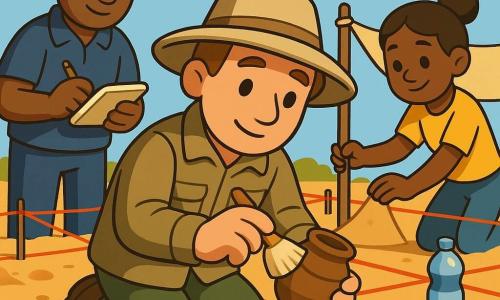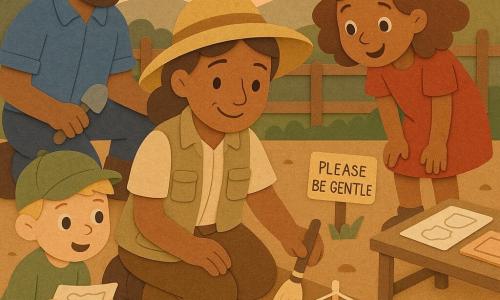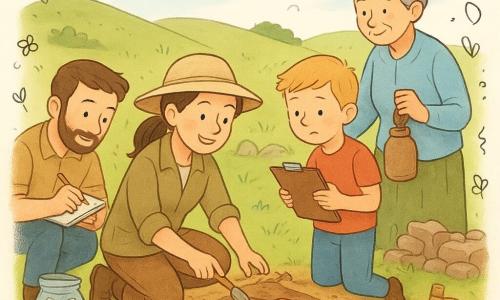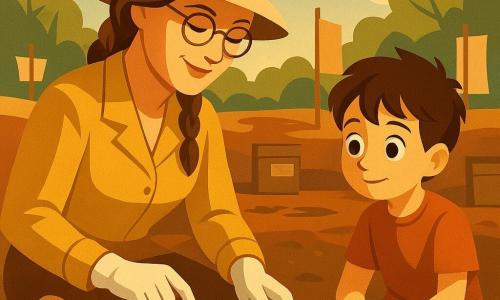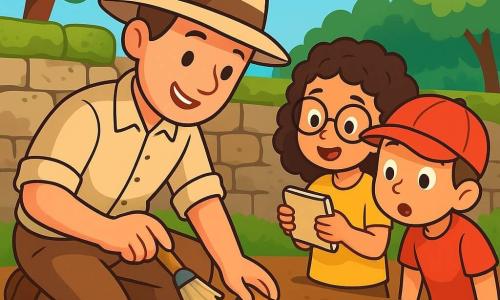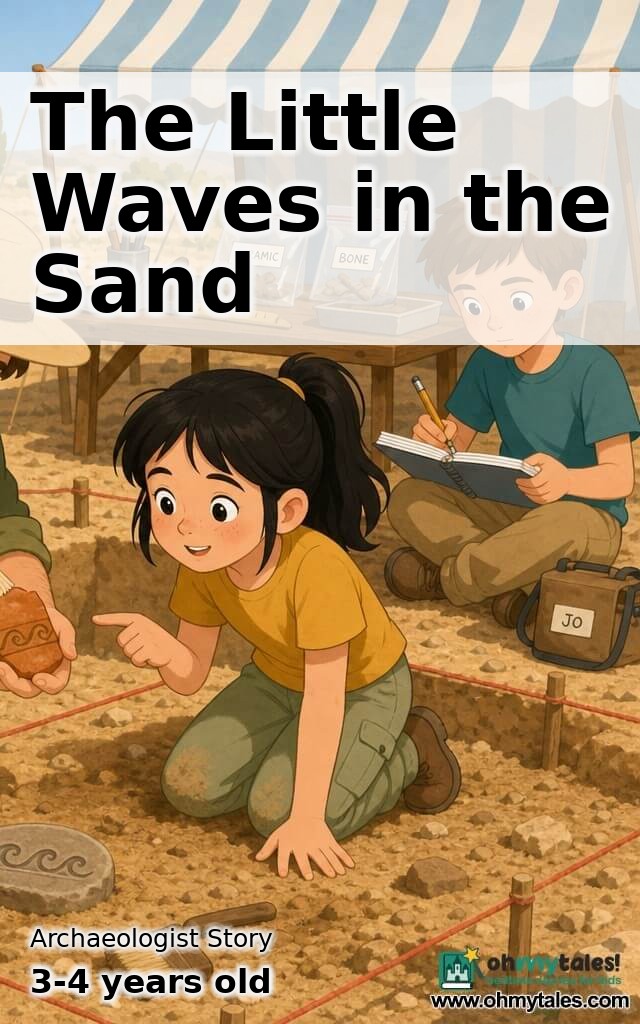
Mr. Rowan wore a wide hat and soft boots. His boots made quiet steps on the sandy ground. He was an archaeologist. That meant he helped old stories come back, in a careful way.
This morning, the sun was warm but gentle. Birds sang in the trees. The dig site was calm, like a big outdoor classroom.
“Good morning, team,” Mr. Rowan said. His voice was kind and steady.
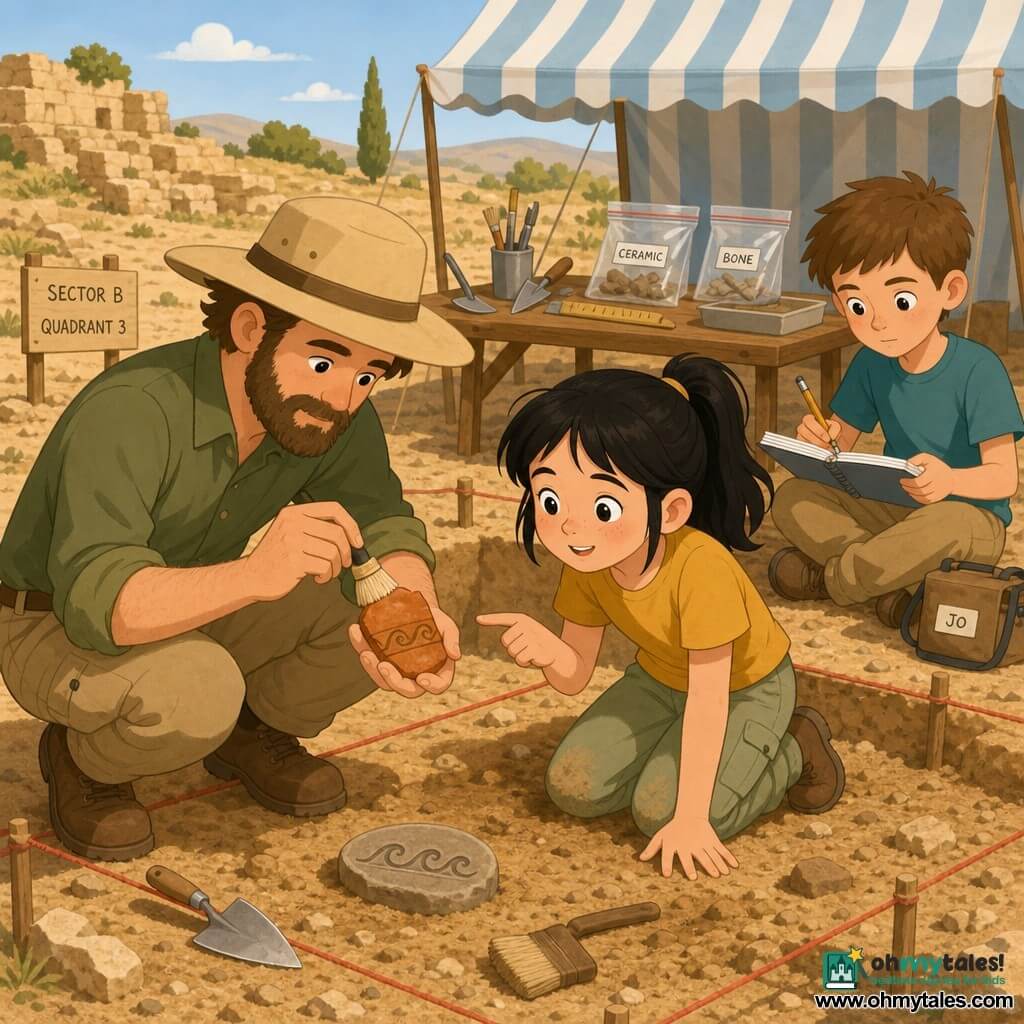
Mina and Jo waved. They were his helpers. They had water bottles, notebooks, and little brushes.
On a table there were tools. A small trowel. A soft brush. A tiny scoop. A ruler. Little bags with labels.
Mr. Rowan smiled. “We do not rush here,” he said. “We look, we listen, we write it down.”
Mina nodded. “Like reading the ground?”
“Yes,” said Mr. Rowan. “The ground can keep memories.”
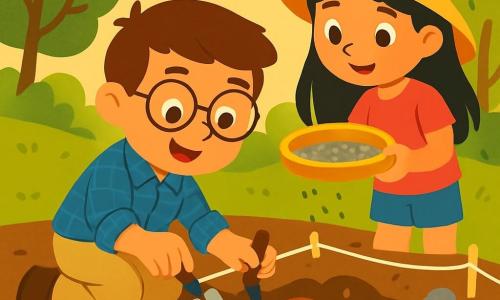
They walked to a square marked with string. The string made neat lines, like a big window on the earth.
Mr. Rowan pointed. “We dig in squares so we know where things are. Where we find something matters.”
Jo held the notebook. “I can write,” Jo said.
“Good,” said Mr. Rowan. “Writing helps the future.”
Mr. Rowan kneeled. He used the trowel like a gentle spoon. Scrape, scrape. Then he stopped. He used the brush. Brush, brush. The sand moved away like a soft blanket.
Mina leaned close. “I see something!”
Mr. Rowan did not grab it. He did not pull. He breathed slowly.
“First we look,” he said. “Then we clean around it.”
They brushed together. Brush, brush. A small piece of clay showed. It was curved and orange-brown.
“A pot!” Jo whispered.
“A pot piece,” Mr. Rowan said. “A shard. Long ago, someone held a bowl or a cup. Maybe they ate soup. Maybe they shared water.”
Mina's eyes grew wide. “Was it a king?”
Mr. Rowan chuckled softly. “Maybe just a family. Most old things come from regular people. That is why it matters.”
He picked up a ruler. He measured where the shard was. Jo wrote the number on a label. Mina drew a simple picture in the notebook.
“We keep it safe,” Mr. Rowan said. “We put it in a bag. We write where it came from. That is how we protect the story.”
They kept working. Scrape, scrape. Brush, brush. Measure. Write. Bag. Again and again.
Soon Mina found something shiny. It was not gold. It was smooth green glass, like a tiny leaf.
“A treasure!” Mina said.
Mr. Rowan smiled. “It is a find,” he said. “Treasures are fun in stories. But in real digs, the treasure is learning.”
He held the glass up to the light. “This could be from a bottle. People might have traded it. Or they might have reused it. People long ago were smart with what they had.”
Jo asked, “Why do we go so slow?”
“Because the ground is like a puzzle,” Mr. Rowan said. “If we pull pieces out too fast, we lose where they fit. Patience helps us be fair to the past.”
They moved to another square where the soil was darker. Mr. Rowan's face stayed calm. He spoke softly.
“Sometimes,” he said, “we find very old human remains. That means we might find signs that a person was laid to rest here long ago.”
Mina held her brush still. “Is it… scary?”
“No,” Mr. Rowan said gently. “It is not scary. It is quiet. It is sad and also peaceful. We treat that place with respect.”
Jo asked, “What do we do?”
“We stop,” Mr. Rowan said. “We speak in kind voices. We cover the area to keep it safe. We tell the right helpers, like special scientists and the people who care for this land. We do not show it like a show. We remember it was a person.”
Mina nodded slowly. “Like saying, ‘We see you, and we will be gentle.'”
“Yes,” Mr. Rowan said. “That is a good way to say it.”
They did not find any remains today, and Mr. Rowan seemed glad. “But it is important to know,” he said. “An archaeologist protects people's stories, even when the stories are very old.”
After lunch, they sat under a small shade tent. Mr. Rowan poured water into cups.
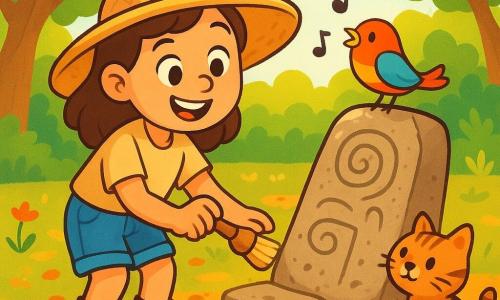
On the table were the finds: the pot shard, the green glass, and a small flat stone with tiny lines.
Jo pointed. “What is that stone?”
Mr. Rowan's eyes brightened. “That might be a stamp,” he said. “Or a piece of a pattern. We will not guess too fast. We will check.”
He took out a picture book of old patterns from the area. The pictures showed zigzags and dots and little wave lines.
Mina tapped the stone. “It has waves!”
Mr. Rowan nodded. “Yes. Waves like water.”
Then he lifted the pot shard. Along its edge, there were faint marks too. Not easy to see. He held it in the light. He brushed it once more, very gently.
There it was. A tiny wave line, the same kind of wave.
Mr. Rowan looked from shard to stone. His mouth made a small “oh,” like a soft surprise.
Jo leaned in. “They match?”
“They might,” Mr. Rowan said. “Two clues. The same pattern.”
Mina bounced a little, but kept her voice quiet. “So the pot and the stone were friends!”
Mr. Rowan laughed in a warm, quiet way. “Maybe the stone made the pattern on the pot,” he said. “Like a stamp. That tells us how people decorated their dishes.”
He picked up the notebook. “We will share this,” he said. “Not to brag. To teach. So everyone can learn about the people who lived here.”
As the afternoon turned golden, they packed the tools. Mr. Rowan checked each bag and label. Mina put the brushes away. Jo closed the notebook with care.
The dig site looked peaceful. The string squares lay on the ground like gentle lines in a drawing.
Before they left, Mr. Rowan stood still for a moment. He looked at the earth and the sky.
“Thank you,” he whispered, not loud at all. “We will keep listening.”
In the car ride home, Mina yawned. Jo watched the trees go by. Mr. Rowan held the notebook on his lap.
He looked again at the sketch of the wave pattern on the shard, and the sketch of the wave pattern on the stone. Two small waves. Two small hints. One big story, slowly waking up.
Mr. Rowan made a quiet, pleased smile. Not a huge grin. Just a gentle one.
And the day felt complete, calm, and kind—like a bedtime story the ground had shared with them.