Part 1
Maya put on her sun hat and smiled at the quiet hill. The morning was soft. Birds sang. The grass waved like green hair.
Maya was an archaeologist. That means she studied people from long ago. Not like a pirate. Not like a treasure hunter. She did careful work, slow work, kind work.
On her table she had old photos in a folder. The photos were black and white. In one photo, there was a stone wall. In another, there was a round shape in the ground, like a gentle ring.
Maya held up a photo and looked at the hill. “Photo… hill… photo… hill,” she said, comparing them.
Her friend Ben held a clipboard. “Do you see the wall?”
Maya pointed. “Yes. The photo shows it right there. But now it is under grass. We have to be gentle.”
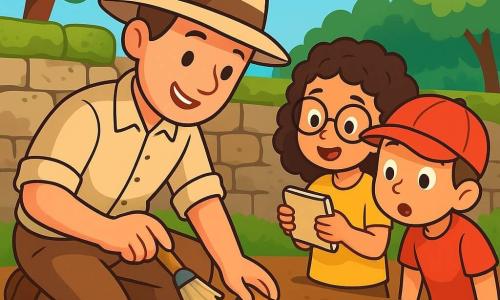
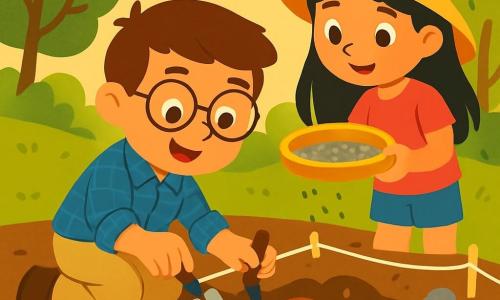
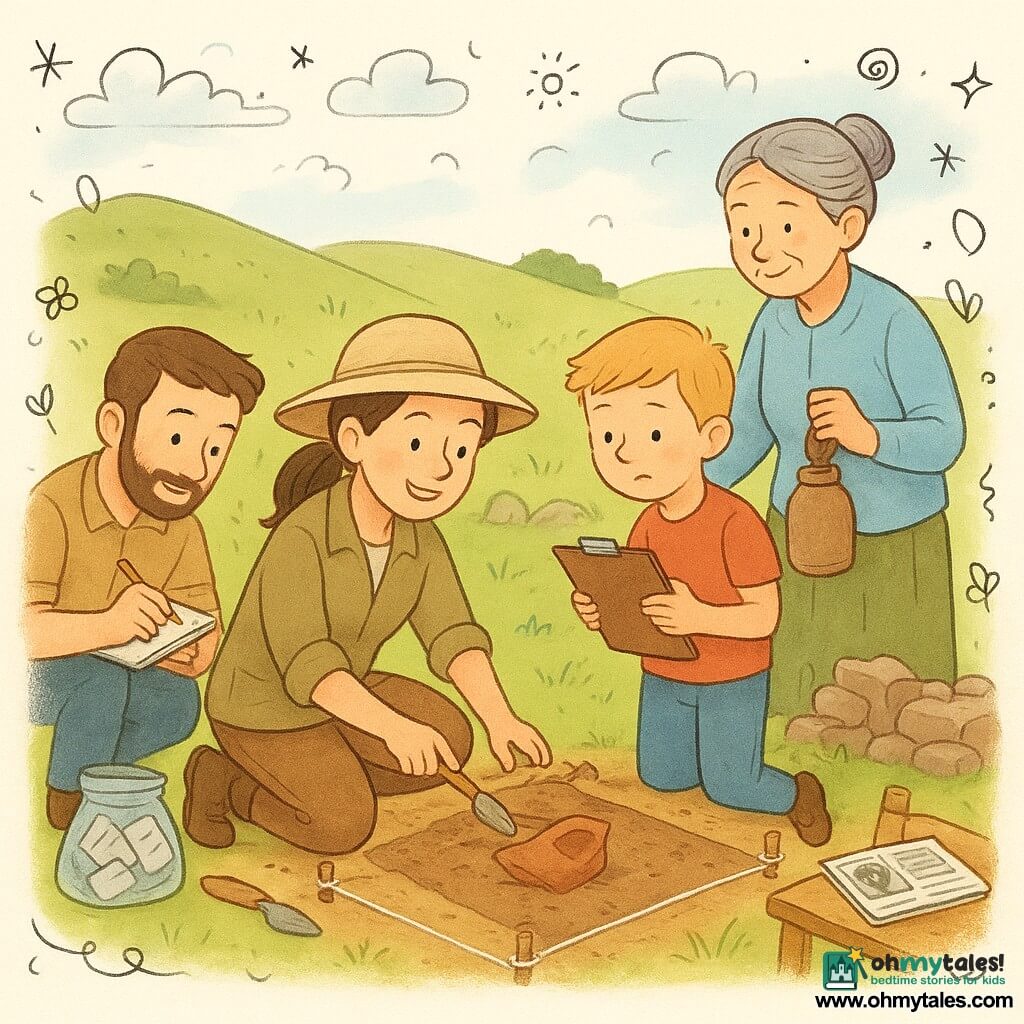
They walked to a little square made with string. This was the dig area. Maya knelt down. She used a small trowel, like a tiny shovel. She scraped the soil like she was brushing crumbs from a table.
“Slow and steady,” Maya whispered. “We keep the past safe.”
Part 2
Soon, more helpers arrived. There was Grandma Lina with water bottles. There was Jo with a measuring tape. There was Sam with labels and bags.
Maya showed them the old photo again. “Look,” she said. “This line here matches the edge of the hill today. The land changes, but it also remembers.”
Ben asked, “Why do we measure so much?”
Maya smiled. “Because we want the story to be true. We write down where things are. We draw maps. We take photos. That way, other people can learn too.”
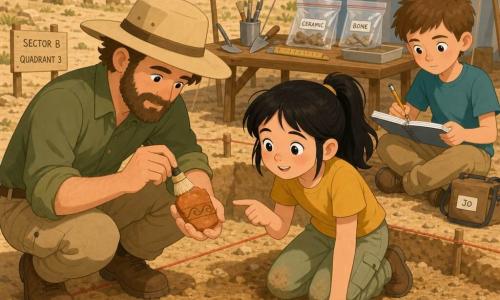
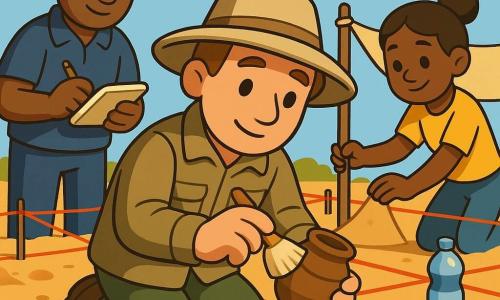
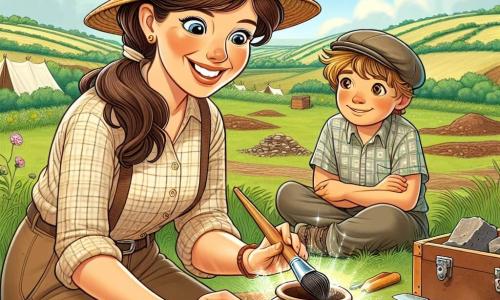
Maya found something small and dull in the soil. She did not grab it. She used a brush with soft bristles.
“Hello, little thing,” she said.
Ben leaned close. “Is it treasure?”
Maya shook her head. “It is not treasure. It is a clue.”
She lifted it carefully. It was a broken piece of clay, the size of a cookie. “This is pottery,” Maya said. “A bowl or a cup, from long ago.”
Jo measured the spot. Sam wrote a label: “Pottery piece, Square A2.” Maya took a photo with a scale, a tiny ruler next to it.
Grandma Lina said, “People ate from bowls like that?”
“Yes,” Maya said. “They cooked, they shared food, they laughed. They were humans like us.”
Then Maya found dark specks in the soil. “These might be old seeds,” she said. “We will send them to a lab. The lab can tell what plants grew here.”
Ben's eyes got wide. “So you can learn what they ate!”
“Exactly,” said Maya. “Archaeology helps us understand daily life.”
Before lunch, Maya checked the old photo again. She noticed a shadow near the stone wall.
“See this?” she told Ben. “This shadow could be a doorway.”
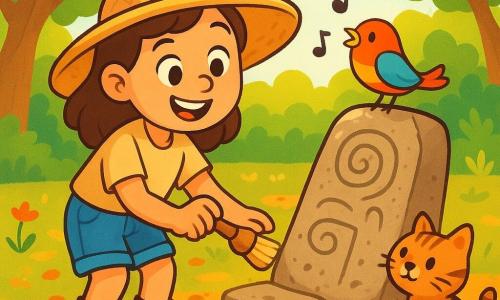
They brushed and brushed. And there it was: two stones standing like calm teeth, with a gap between them.
“No pulling,” Maya reminded everyone. “No rushing. We protect the heritage. This place belongs to everyone.”
Part 3
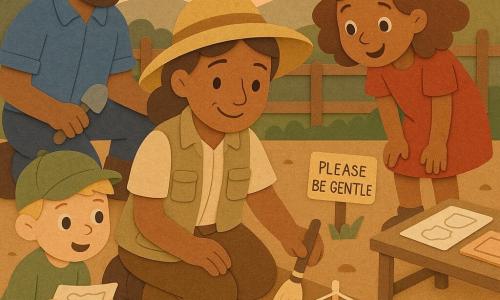
In the afternoon, Maya set up a small table with pictures and drawings. A few children from the village came with their grown-ups. They watched quietly.
Maya held up the old photo and then pointed to the doorway. “The photo helped us,” she said. “We compare old pictures to what we see today. It is like matching two puzzles.”
A child asked, “Can I dig?”
“You can help in safe ways,” Maya said warmly. She handed the child a brush and a tray of clean sand with shells. “Practice brushing gently.”
Ben showed the map. Jo showed the measuring tape. Sam showed the labels. Everyone had a job. Everyone mattered.
Maya spoke softly. “We do not take things for fun. We learn, and we share. We keep careful notes, so the past is not lost.”
When the sun began to sink, Maya covered the dig with cloth and sandbags. “Sleep well, little stones,” she said.
Ben yawned. “What will you tell people tomorrow?”
Maya packed the old photos back into the folder. “I will tell them what we found and what it might mean,” she said. “And I will use clear words. I will use kind words. Words that include everyone.”
She looked at the hill one last time. The grass moved again, slow and peaceful.
“Tomorrow,” Maya whispered, “we listen to the past, together.”